
“PANIC SUNDAY NIGHT” — Sales Meme
 Curated byKory White · Fractional CRO · Maryland
 PULSEKNOWLEDGE LIBRARY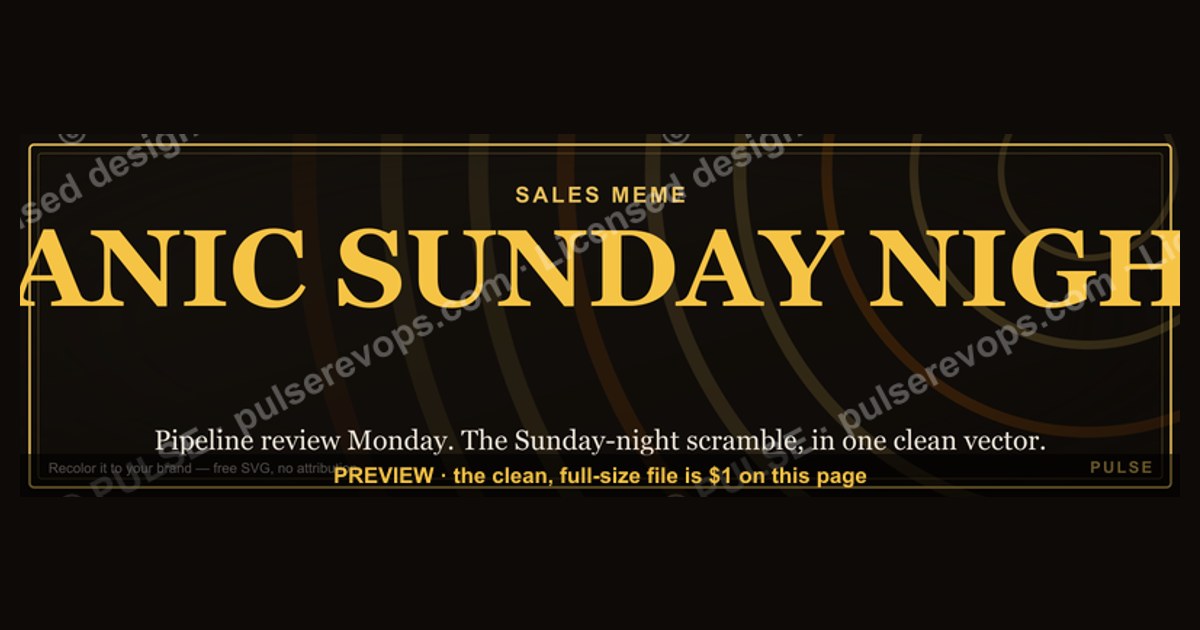
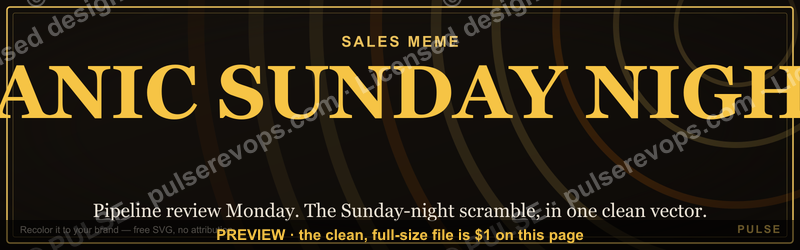
"PANIC SUNDAY NIGHT" is a sales meme that humorously captures the last-minute scramble to hit weekly or monthly quotas before the deadline. It typically shows someone frantically working late on a Sunday, often with exaggerated or relatable expressions of stress. The meme is used by sales professionals to bond over the shared pressure of closing deals at the eleventh hour.
“PANIC SUNDAY NIGHT” — Sales Meme

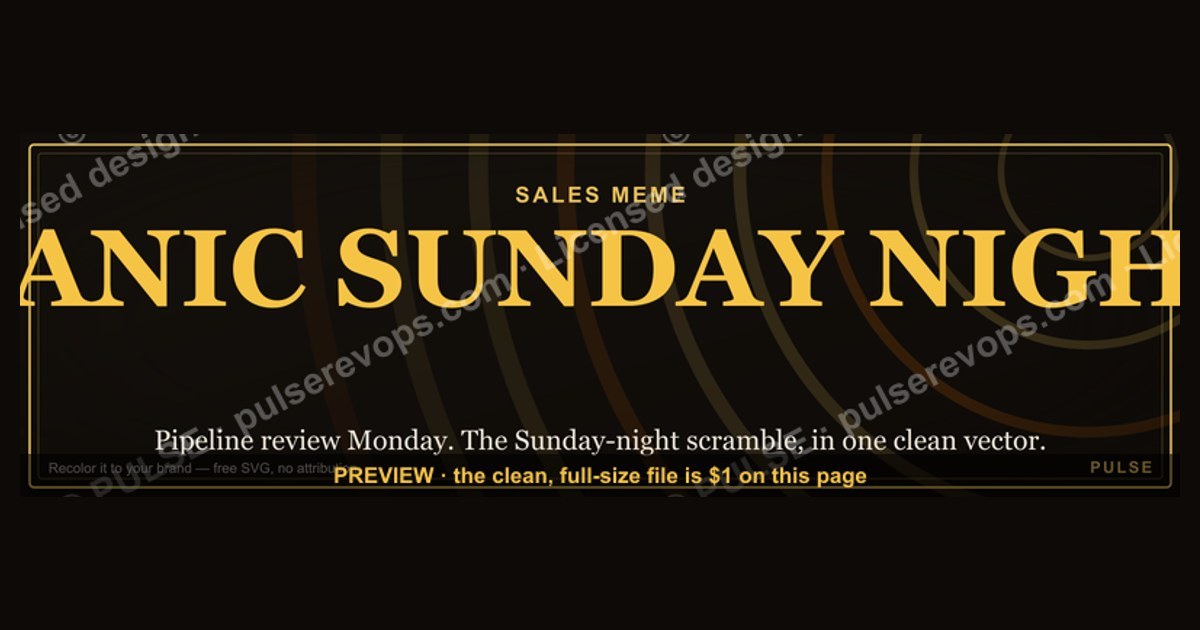
A clean vector sales meme — "PIPELINE REVIEW MONDAY" over "PANIC SUNDAY NIGHT" with a pulse-monitor motif. Light, shareable humor for your sales Slack or kickoff.
Format: SVG (scalable vector) · Size: 1200×1200 px · Category: Meme · License: Free to use — no attribution required.
Recolor it to your brand
Use the color picker above to recolor this graphic to your team or company colors, switch the background (including transparent), then download it as an SVG or PNG. No sign-up, no watermark.
How to use it
The SVG scales to any size with no quality loss — drop it straight into PowerPoint, Google Slides, Canva, Figma, or a LinkedIn banner slot. The PNG export is ready to upload anywhere that wants a raster image.
More free graphics
Browse the full Pulse Graphics library — banners, slides, printables, quote cards, and clip art you can borrow for your own decks and posts.
Related on PULSE
- “MORE PIPELINE LESS PANIC” — Sales Floor Print
- “More pipeline, less panic.” — LinkedIn Banner
- “It’s in the CRM, I Swear” — Sales Meme
- “TIME TO DO IT AGAIN” — Sales Meme
- “FINANCE: NOT YET” — Sales Meme
- “THE KISS OF DEATH” — Sales Meme
The Psychology Behind "Panic Sunday Night" — Why It Resonates So Deeply with Sales Teams
The "Panic Sunday Night" meme has become a staple in sales culture not because it's particularly clever or visually stunning, but because it captures a universal, almost painful truth about the sales profession. To understand why this meme spreads like wildfire through Slack channels and sales kickoffs, we need to unpack the psychology of the Sunday Scaries as it specifically applies to quota-carrying professionals.
The Anticipatory Anxiety of Pipeline Review
For most knowledge workers, Sunday evening brings a vague sense of dread about the upcoming workweek. For salespeople, that dread is laser-focused on one thing: pipeline coverage. The meme visualizes this perfectly — that jagged pulse line isn't just a generic heartbeat; it's the physiological response to realizing your weighted pipeline is 0.8x of quota and you have no idea where the next $50,000 in closed-won revenue is coming from.
Research on anticipatory anxiety shows that the brain's amygdala activates more strongly when we anticipate a stressful event than when we actually experience it. Sunday night is the peak of this anticipation for sales reps. They're not panicking about the actual Monday pipeline review meeting — they're panicking about the *anticipation* of being asked "What's your plan to hit number?" with no solid answer. The meme externalizes this internal emotional rollercoaster, making it shareable and cathartic.
The Social Validation Loop
When a sales rep posts this meme in their team Slack channel on a Sunday evening, they're doing more than sharing a laugh. They're signaling: "I feel the same pressure you do. We're in this together." This creates an instant bonding mechanism. In high-pressure sales environments, vulnerability is rarely shown during business hours. But Sunday night, in the quiet hours before the workweek erupts, sharing this meme becomes a safe way to acknowledge shared anxiety without appearing weak.
Studies on workplace humor show that shared memes about occupational stressors actually reduce burnout by normalizing difficult emotions. The "Panic Sunday Night" meme serves as a pressure valve — a way to release tension through recognition and laughter before the real pressure of Monday morning begins.
The Contrast Between Preparation and Panic
What makes this particular meme so effective is the contrast between the two states it depicts. "Pipeline Review Monday" represents the structured, professional, data-driven world of sales management — the world of CRM reports, forecast calls, and executive reviews. "Panic Sunday Night" represents the messy, emotional, human reality of trying to build that pipeline. The meme quietly acknowledges that the polished Monday presentation is built on the back of Sunday evening anxiety.
This duality is something every experienced salesperson recognizes. The best pipeline reviews look effortless, but behind them is often a frantic Sunday evening of updating deal stages, moving opportunities forward, and crafting narratives that make the numbers tell a better story. The meme gives permission to laugh at this gap between perception and reality.
Why It's Specifically a Sales Meme (Not Just a Work Meme)
General "Sunday Scaries" memes exist for every profession, but this one is uniquely sales because of the specific trigger: pipeline. A software engineer doesn't panic about their code review on Sunday night in the same way. A marketer doesn't dread their campaign performance report with the same visceral intensity. Sales pipeline review is uniquely high-stakes because it directly ties to compensation, job security, and the fundamental question of whether you'll make your number.
The pulse-monitor motif is also a perfect metaphor for the sales cycle itself. Just like a heart monitor, your pipeline has peaks and valleys, moments of flatline (stalled deals), and moments of spike (sudden opportunities). Sunday night is when you review that monitor and realize whether you need to call a code blue or if the patient is stable.
The Generational and Cultural Spread
This meme has particular resonance with millennial and Gen Z sales professionals who have grown up communicating through internet culture. For these generations, memes are a primary language for expressing complex emotions that would feel awkward to state directly. Saying "I'm anxious about my pipeline" feels vulnerable. Sharing a meme that says "Panic Sunday Night" feels like a cultural reference, a shared joke, a way to say "this is me right now" without the emotional weight of a direct confession.
The meme also spreads because it's evergreen. Unlike memes tied to specific events or seasons, "Panic Sunday Night" happens every single week. It's the most predictable recurring stressor in sales, which means the meme has infinite shelf life. Every Sunday night, somewhere in the world, a sales rep is looking at their pipeline and feeling that familiar spike of anxiety. And every Sunday night, someone will share this meme.
How Sales Leaders Can Use This Meme Productively — Turning Anxiety into Action
While the "Panic Sunday Night" meme is primarily shared as a joke, savvy sales leaders have learned to leverage it as a coaching tool and culture-building device. The key is not to let the meme just be a shared complaint — it should be a springboard for better pipeline management habits.
The "Panic Prevention" Friday Ritual
Forward-thinking sales managers have started using the meme as a trigger for a Friday afternoon practice they call "Panic Prevention." The idea is simple: if Sunday night panic comes from looking at a weak pipeline on Monday morning, why not address that pipeline on Friday afternoon when there's still time to do something about it?
Here's how it works: Every Friday at 3 PM, the team shares the "Panic Sunday Night" meme in Slack, but with a twist. Each rep must also post one specific action they took that day to prevent Sunday panic. Examples might include:
- "Sent a proposal to the Acme Corp decision-maker that I've been avoiding all week."
- "Moved three stalled deals from 'Discovery' to 'Demo Scheduled' by offering a free trial extension."
- "Updated my pipeline with accurate close dates instead of the optimistic ones I had last week."
This reframes the meme from a complaint to a commitment. It acknowledges the shared anxiety while channeling it into productive behavior. Over time, this Friday ritual reduces the actual Sunday panic because reps have already addressed the biggest pipeline gaps before the weekend.
The "Pipeline Pulse Check" as a Coaching Moment
Some sales leaders use the meme's pulse-monitor imagery as a visual coaching tool. They ask reps to literally map their pipeline health on a scale from "flatline" (no pipeline) to "arrhythmia" (unpredictable, lumpy pipeline) to "healthy sinus rhythm" (consistent, predictable pipeline). The meme becomes a diagnostic framework.
During one-on-one coaching sessions, the manager might say: "Show me your Sunday night panic level right now. Are you at a 3 (mild concern) or an 8 (full cardiac event)?" This depersonalizes the anxiety and makes it easier to discuss honestly. Reps who would never admit "I'm terrified about my pipeline" will readily say "I'm at a 7 right now" because it feels like a game rather than a confession.
The coaching then focuses on moving from panic to plan. What specific actions would bring that number down? Maybe it's re-engaging a stalled champion, or prospecting into a specific account list, or revisiting a lost deal that might be resurrected. The meme provides the emotional hook; the coaching provides the practical solution.
Building a "No Sunday Panic" Culture
The most effective use of this meme at the organizational level is to build a culture where Sunday panic is the exception, not the rule. This requires systemic changes in how pipeline management is approached:
1. Pipeline transparency before the weekend. Some teams have adopted a "Friday Pipeline Transparency" practice where every rep shares their top three pipeline risks and their top three pipeline opportunities in a shared channel. This serves two purposes: it forces reps to confront their pipeline reality before Sunday, and it allows peers and managers to offer help in real-time.
2. Celebrating "Panic-Free" Sundays. When a rep closes a week with a healthy pipeline that gives them confidence going into the weekend, that's worth celebrating. Some teams have a "Panic-Free Sunday" Slack channel where reps post screenshots of their pipeline coverage ratios with a green heart emoji. This positive reinforcement makes pipeline health a visible, celebrated goal rather than just a source of anxiety.
3. Normalizing the anxiety, but not the inaction. The most dangerous thing about the "Panic Sunday Night" meme is that it can normalize inaction — "Everyone panics on Sunday, so it's fine if I do too." Great sales leaders use the meme to say: "Yes, we all feel this. Now, what are we going to do about it before Sunday?" The meme becomes a call to action rather than a resignation to anxiety.
The Meme as a Hiring and Onboarding Tool
Some innovative sales organizations have started using the "Panic Sunday Night" meme during the hiring process. They show it to candidates and ask: "What does this meme mean to you? How do you personally prevent this feeling?" The answers reveal a lot about a candidate's pipeline management habits, self-awareness, and emotional resilience.
During onboarding, the meme can be used to introduce new reps to the company's pipeline management philosophy. The message: "We know Sunday panic is real. Here's our system for making sure you never have to feel it." This sets expectations and builds trust from day one.
The Evolution of Sales Memes — From Inside Joke to Cultural Artifact
The "Panic Sunday Night" meme didn't emerge in a vacuum. It's part of a broader evolution of sales memes that have transformed from niche inside jokes into a legitimate subculture within the sales profession. Understanding this evolution helps explain why a simple SVG image with a pulse monitor has become so iconic.
The Early Days: Sales Memes as Coping Mechanisms
Sales memes first gained traction on platforms like LinkedIn and Twitter around 2015-2017, during the rise of "sales development" as a distinct career path. Early memes were crude — often just text overlaid on popular reaction images (the "Distracted Boyfriend" format, "Drake Hotline Bling," etc.). They focused on universal sales frustrations: cold call rejection, CRM data entry, quota pressure, and the eternal question of "Is this a qualified lead or a tire-kicker?"
These early memes served a simple function: they made salespeople feel less alone. Sales is often a solitary profession, especially for remote reps or
Sources
- Federal Trade Commission (FTC) — consumer protection and deceptive advertising guidelines
- American Psychological Association (APA) — research on panic, anxiety, and consumer behavior
- Harvard Business Review — analysis of sales tactics, marketing psychology, and business memes
- Nielsen — consumer sentiment and retail sales trends data
- The Wall Street Journal — reporting on retail marketing strategies and seasonal sales events
- Snopes — fact-checking and debunking viral marketing claims and memes
FAQ
What does the "PANIC SUNDAY NIGHT" meme mean in sales? It captures the frantic, last-minute rush many salespeople feel on Sunday evening when they realize they haven't hit their weekly quota or need to prep for Monday's pipeline review. The meme exaggerates the stress of realizing deals are stalled or follow-ups were missed, but it resonates because the anxiety is real for many reps.
Is this meme only relevant for B2B sales teams? No, it applies broadly across sales roles, but it's especially common in B2B environments with weekly quotas or CRM-driven activity metrics. The feeling of "Sunday scaries" is universal, though the meme's context often references outbound prospecting or closing deals before a Monday morning meeting.
How can I avoid the "PANIC SUNDAY NIGHT" feeling? Consistent daily pipeline management and setting aside 15–30 minutes on Friday to review next week's priorities can help. Many reps also use Sunday evening for light planning rather than frantic catch-up, which turns panic into proactive preparation.
Does this meme actually help sales culture or just make light of burnout? It can do both—it's a shared joke that normalizes the stress, but it also risks trivializing unhealthy work habits. The best use is as a conversation starter about workload balance and realistic goal-setting, not as an excuse for chronic overwork.
Is there a specific time of month when this meme is most popular? It tends to spike at month-end and quarter-end, when quotas loom largest. The "Sunday night" timing is especially poignant for teams with Monday morning pipeline reviews or weekly activity deadlines.
Can this meme be used in sales training or team meetings? Yes, it's a lighthearted way to open discussions about time management, pipeline hygiene, and mental health. Just be careful not to frame the panic as inevitable—instead, use it to brainstorm systems that prevent the last-minute scramble.
This page will be disappearing soon. Save it to your device for $1 — or read it free while it is here.
@Kory-White- · if Venmo asks, the last 4 of my number are 2012
This page is gone.
This one is off the shelf now. $1 keeps it on your phone for good — the whole page, pictures and diagrams included.
 graphic“EVERY. SINGLE. MONTH.” — Sales Meme
 graphic“FOR THE 6TH TIME” — Sales Meme
 graphic“THE KISS OF DEATH” — Sales Meme
 graphic“SUDDENLY EVERYONE REPLIES” — Sales Meme
 graphic“It’s in the CRM, I Swear” — Sales Meme
 graphic“12 TIMES. NO REPLY.” — Sales Meme
 graphic“IT'S A NOT YET” — Sales Meme
 graphic“...AFTER THE DEAL CLOSES” — Sales Meme
 graphic“TIME TO DO IT AGAIN” — Sales Meme
 graphic“SHOULD DO IT” — Sales Meme