


What's the right SDR-to-AE ratio in 2027?
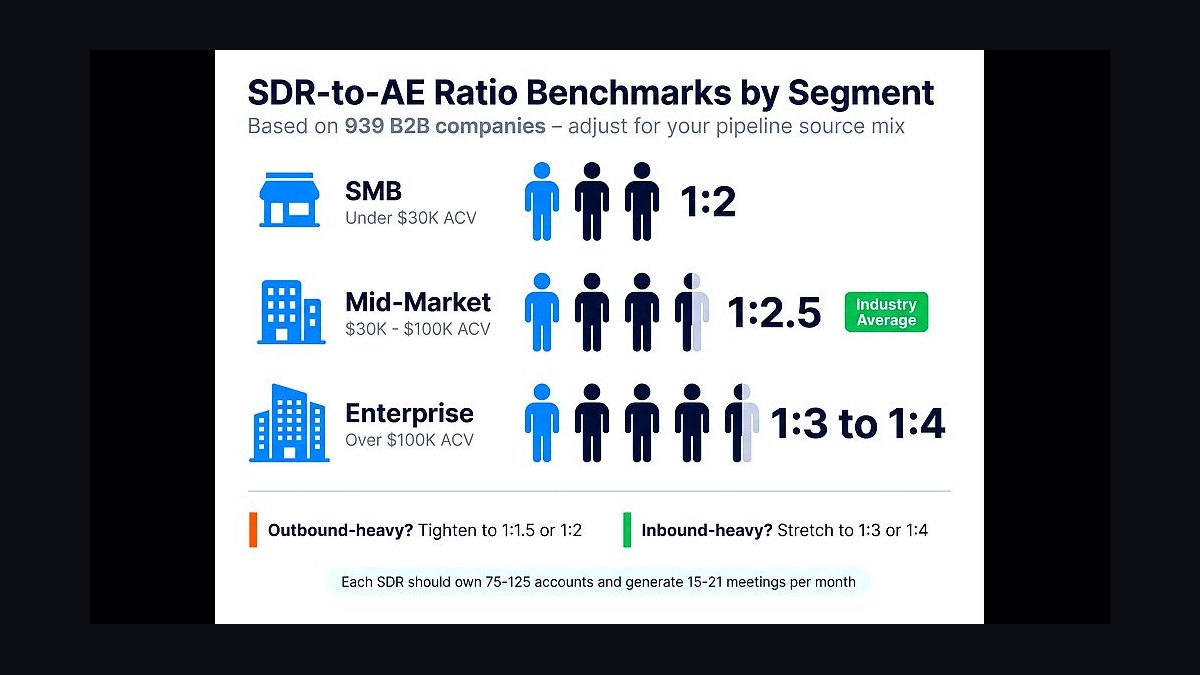
There is no universal SDR-to-AE ratio in 2027 — the right number depends entirely on GTM motion and average contract value. Pure outbound enterprise teams run 1:1 (sometimes 1.5:1) because cold-prospecting six-figure deals is full-time work no AE can absorb. Mid-market hybrid teams run roughly 0.5:1 (one SDR per two AEs). SMB high-velocity inbound runs 0.25-0.33:1. PLG with sales-assist often runs zero dedicated SDRs and routes PQLs directly to AEs. Bridge Group's 2024 data shows the median dropped from 0.71 in 2022 to 0.52 in 2024.
TL;DR
- The "right" ratio is a function of ACV, territory size, and inbound mix — not a single industry benchmark.
- Bridge Group 2024 median sits at 0.52 SDRs per AE, down from 0.71 in 2022, driven by PLG, AI prospecting (Clay + Apollo + ChatGPT), and AE-direct outbound productivity gains.
- Enterprise outbound demands 1:1 (or 1.5:1) because a 500-account AE can't cold-prospect and still run six-figure cycles.
- SMB inbound-led teams ratio down to 0.25-0.33:1 — inbound MQLs already do the prospecting work.
- The economic test: an SDR is only justified if they generate >$300K in attributed pipeline that converts at AE win rates.
The Ratio by GTM Motion + ACV
The cleanest way to think about SDR-to-AE ratio is to start with the motion and ACV, then adjust for territory and inbound volume. Here is the 2027 reference table built from Bridge Group's 2024 SDR Metrics Report and Pavilion's 2024 GTM benchmarks:

| GTM Motion | ACV Range | Typical Ratio | Why |
|---|---|---|---|
| Pure outbound enterprise | $100K+ | 1:1, sometimes 1.5:1 | A 500-account AE cannot cold-prospect and run six-figure cycles. SDR is a full-time research-and-outreach role. |
| Mid-market hybrid (inbound + outbound) | $25K-$100K | 0.5:1 (1 SDR / 2 AEs) | Inbound covers ~40-50% of pipeline; SDRs supplement with targeted outbound to named accounts. |
| SMB high-velocity inbound | <$25K | 0.25-0.33:1 (1 SDR / 3-4 AEs) | Marketing-sourced MQLs do most of the top-funnel work. SDRs qualify and route; AEs run short cycles. |
| PLG with sales-assist | Variable | 0:1 or near-zero | Self-serve activation creates PQLs; AEs handle expansion calls directly. SDRs add latency without lift. |
Territory size flips this in both directions. A Series B SaaS company with a 5,000-account SMB territory per AE doesn't need a dedicated SDR — the AE works the inbound queue and lets marketing nurture the long tail. But a Series D enterprise rep with 50-100 named accounts and a $250K ACV mandate absolutely needs an SDR (or two) running deep account research, multi-threaded outbound, and event follow-up.

The ACV cutoff matters too. Below roughly $25K ACV, the AE's hourly value is too low to justify a $130K-fully-loaded SDR feeding them. Above $100K ACV, the AE's hourly value is too high to waste on cold prospecting — they should be running discovery, demos, and negotiation, not LinkedIn-searching for VPs of Engineering.
The 2024-2025 Shift (Why Ratios Are Dropping)
Bridge Group's 2024 SDR Metrics Report flagged a structural change: median SDR-to-AE ratio fell from 0.71 in 2022 to 0.52 in 2024. That is a 27% drop in two years, and it is not a recession story — it is a productivity story.

Three forces pushed ratios down. First, PLG-led companies (Figma, Notion, Linear, dbt Labs, Vercel) demonstrated that you can run nine-figure revenue businesses with vanishingly small SDR teams because product usage itself is the qualification signal. By 2024-2025, every Series B+ founder with a usage-based pricing model started questioning whether they needed SDRs at all.
Second, AI prospecting stacks (Clay for enrichment, Apollo for data, ChatGPT and Claude for first-draft outreach, Lavender for personalization) made AE-direct prospecting two to three times more productive than it was in 2022. An AE in 2027 can spend 30 minutes a day on outbound and generate the same self-sourced pipeline that used to take two hours. That collapsed the marginal value of a dedicated SDR for mid-market reps.

Third, buyer behavior shifted. Cold-call connect rates dropped below 2% in most B2B segments per Sara McNamara's 2024 cold-call benchmark work, and email reply rates compressed to 1-3% for unpersonalized sequences. The result: the same SDR who used to book 8-10 meetings per month now books 4-6. CFOs noticed, and ratios re-baselined down.
The companies that nailed the transition didn't just cut SDRs — they restructured. They moved high-performing SDRs into AE roles, kept a smaller elite SDR pod for strategic enterprise accounts, and invested the savings in AI tooling and marketing.
The 3 Ratio-Design Failure Modes

Failure mode 1: Over-hiring SDRs to "feed the AEs" without product-market-fit. This is the classic Series A trap. The founder reads that "great companies hire SDRs early," hires four of them before the product converts inbound demos at >20%, and creates expensive activity with no pipeline. The SDRs hit their dial counts, the dashboard looks busy, and zero of those meetings turn into closed-won. Rule: don't hire your first SDR until inbound demos convert and your AEs are already prospecting successfully on their own. If the AE can't sell, the SDR can't either.

Failure mode 2: Under-staffing SDRs in enterprise where the AE shouldn't be cold prospecting. The mirror image. A Series C enterprise company with 25 AEs carrying 80-account territories and $300K quotas tries to run a 0.3:1 ratio because "that's what the benchmark says." The AEs burn 40% of their week on cold outreach, miss quota, and churn. Enterprise math is unforgiving: if your AE costs $300K fully loaded and you're spending 15 hours a week on prospecting they can't do well, you're lighting $60K/year per AE on fire.
Failure mode 3: Ratio not adjusted by territory size. A 500-account enterprise AE needs a dedicated SDR. A 5,000-account SMB AE does not. Yet most RevOps teams set one company-wide ratio and apply it uniformly, which over-resources the SMB segment and starves the enterprise segment simultaneously. The fix is territory-based ratio design: enterprise reps get 1:1, mid-market reps get 0.5:1, SMB reps share a single SDR across the pod or get none.

A real example sharpens this. A Series C cybersecurity company with 25 AEs and 20 SDRs (0.8:1) audited attribution in Q3 2024 and found 60% of SDR-sourced pipeline was duplicative of AE outbound — the same accounts, the same buyers, just two reps emailing them in parallel. They cut SDRs from 20 to 12 (dropping to 0.48:1), kept attainment flat the following two quarters, and saved $1.4M annually in fully-loaded comp. The lesson: ratio is downstream of attribution. If you can't tell whether your SDRs are sourcing net-new pipeline or duplicating AE work, your ratio is probably wrong.
Related on PULSE
- What's the right SDR-to-AE ratio at a $5M ARR seed-stage company?
- How do you build a SDR-to-AE pass-off process in 2027?
- What's the optimal SDR-to-AE handoff process in 2027 B2B sales?
- How do you structure SDR-to-AE handoff to prevent dropped leads?
- What is the right sales engineering to AE ratio in 2027?
- What's the right ratio of SDRs to AEs in a 2027 outbound sales team?
Why the Ratio Keeps Falling (and What It Means for You)
The downward trend in SDR-to-AE ratios isn't random — it reflects three structural shifts in B2B sales. First, buyer self-education has accelerated: by 2027, roughly 70-80% of B2B buyers complete their research before ever speaking to a sales rep, reducing the need for SDR-led cold outreach. Second, AI-powered prospecting tools now handle sequence personalization, lead scoring, and meeting scheduling at scale, letting a single SDR manage 2-3x the pipeline they could in 2022. Third, product-led growth (PLG) has matured — companies with strong product adoption often see 40-60% of qualified meetings come from in-product triggers rather than outbound calls. If your team hasn't adjusted ratios in 18+ months, you're likely over-invested in SDR headcount relative to actual pipeline generation.
How to Calculate Your Team's Optimal SDR-to-AE Ratio
Instead of copying someone else's benchmark, derive your ratio from three inputs: target pipeline per AE per month, average SDR output, and deal velocity. Start with your AE's quota: if each AE needs $50k in closed-won revenue monthly and your average deal is $10k, that's 5 deals per month. At a 20% win rate on qualified opportunities, each AE needs 25 SQLs monthly. If your SDRs generate 12 SQLs per person per month, you need roughly 2 SDRs per AE (a 2:1 ratio). But if your AEs self-source 40% of their pipeline, that drops to 15 SQLs needed from SDRs — a 1.25:1 ratio. Run this math quarterly, adjusting for ramp time (new SDRs produce 30-50% less in months 1-3) and seasonality. The right ratio is the one that keeps your AEs at 80-100% pipe coverage without SDRs sitting idle.
The Hidden Cost of Getting the Ratio Wrong
Misaligned ratios create measurable damage beyond missed quota. Too many SDRs (e.g., 2:1 in an inbound-heavy motion) leads to territory overlap, squabbling over leads, and SDRs cold-calling accounts already in the AE's pipeline — wasting 15-25% of prospecting effort. Too few SDRs forces AEs into prospecting, which typically drops their closing capacity by 30-50% because they're splitting focus. The real financial hit: companies with a 0.8:1 ratio in a motion that needs 0.4:1 often burn an extra $60-120k per SDR per year in salary, tools, and management overhead, with no incremental pipeline to show for it. Conversely, under-investing by 0.3 ratio points in a high-ACV outbound motion can cost $300-500k in missed revenue annually per AE. Review your ratio every quarter against actual pipeline contribution — not industry averages — and adjust ruthlessly.
FAQ
What’s the biggest mistake companies make when setting their SDR-to-AE ratio? The most common mistake is copying a benchmark without considering deal complexity or pipeline source. A ratio that works for a high-velocity SMB team will break an enterprise outbound motion. Teams should start with their average contract value and inbound-to-outbound mix, then adjust based on actual pipeline generation data.
How often should I re-evaluate my SDR-to-AE ratio? Most high-growth teams review the ratio quarterly, but leading indicators like lead response time and SDR activity volume can signal misalignment sooner. If AEs are spending more than 20% of their week prospecting, the ratio is likely too low. Conversely, if SDRs have idle capacity, it may be too high.
Does the ratio change when you have a mix of inbound and outbound SDRs? Yes, and it’s common to split the ratio by motion. Inbound SDRs can often support 2-3 AEs (0.33-0.5:1) because leads are warmer. Outbound SDRs typically max out at a 1:1 ratio for enterprise or 0.5:1 for mid-market. Blending them without separate tracking can hide inefficiencies.
What’s a realistic ramp-up time for a new SDR before expecting a full quota? Most teams see 3-4 months for an SDR to reach full productivity, though 5-6 months is common in complex enterprise sales. Ramp includes training, territory familiarity, and building a pipeline that converts. Expect 60-70% of target in month three and 90%+ by month five.
How does AI or automation in 2027 affect the ideal SDR-to-AE ratio? AI tools can reduce the need for pure volume SDRs, especially for initial outreach and qualification. Teams using advanced automation often see a 20-30% reduction in SDR headcount while maintaining pipeline, shifting the ratio lower. However, human SDRs remain critical for high-touch, complex deal qualification.
What’s the impact of a bad SDR-to-AE ratio on revenue? A ratio too low leads to AEs prospecting instead of closing, which typically drops close rates by 15-25% and extends sales cycles. A ratio too high wastes SDR capacity and increases cost per lead. The sweet spot usually maximizes pipeline velocity while keeping AE selling time above 70%.
Sources
- Bridge Group, *2024 SDR Metrics Report* — median ratio benchmarks and the 2022-2024 drop from 0.71 to 0.52.
- Pavilion, *2024 SDR and GTM Benchmark Survey* — ratio-by-motion data across 1,400+ B2B teams.
- Tomasz Tunguz, *"The Changing Economics of SDR Teams"* (2024) — ROI math and the PLG impact on outbound team sizing.
- Sara McNamara, *Modern Sales Pros 2024 Cold-Call Benchmarks* — connect rates and reply rates by segment.
- OpenView Partners, *2024 SaaS Benchmarks Report* — fully-loaded SDR and AE cost ranges.
- ICONIQ Growth, *2024 Operating Metrics Report* — sales productivity and headcount ratios at scale.
- Gong, *2024 Revenue Intelligence Benchmarks* — attribution and pipeline duplication patterns in hybrid SDR-AE teams.
- Lavender, *2024 Outbound Email Benchmarks Report* — AI-assisted prospecting productivity gains for AE-direct outbound.
This page will be disappearing soon. Save it to your device for $1 — or read it free while it is here.
@Kory-White- · if Venmo asks, the last 4 of my number are 2012
This page is gone.
This one is off the shelf now. $1 keeps it on your phone for good — the whole page, pictures and diagrams included.
 revopsHow do you actually use AI in B2B SaaS sales — and what's hype vs real in 2027?
 revopsHow do you do usage-data triggered outbound for PLG accounts in 2027?
 revopsHow should a 2027 sales org structure deal review templates?
 revopsHow should a 2027 CS team attribute expansion vs save revenue?
 revopsHow do you design a sales kickoff that changes behavior in 2027?
 revopsWhat are North Carolina Tar Heels men's basketball's 2027 NIL needs and strategy?
 revopsWhat capacity-planning models do SaaS sales teams use in 2027?
 revopsHow should a 2027 startup design compensation for the first AE?
 revopsWhat are the 2027 best churn-save playbooks?
 revopsWhat's a healthy AE ramp time — and how do you actually design ramp in 2027?