 Pulse Reviews and Analysis
What Pipeline Coverage Ratio Should I Target in 2027?
 Curated by Kory White · Fractional CRO, CRO Syndicate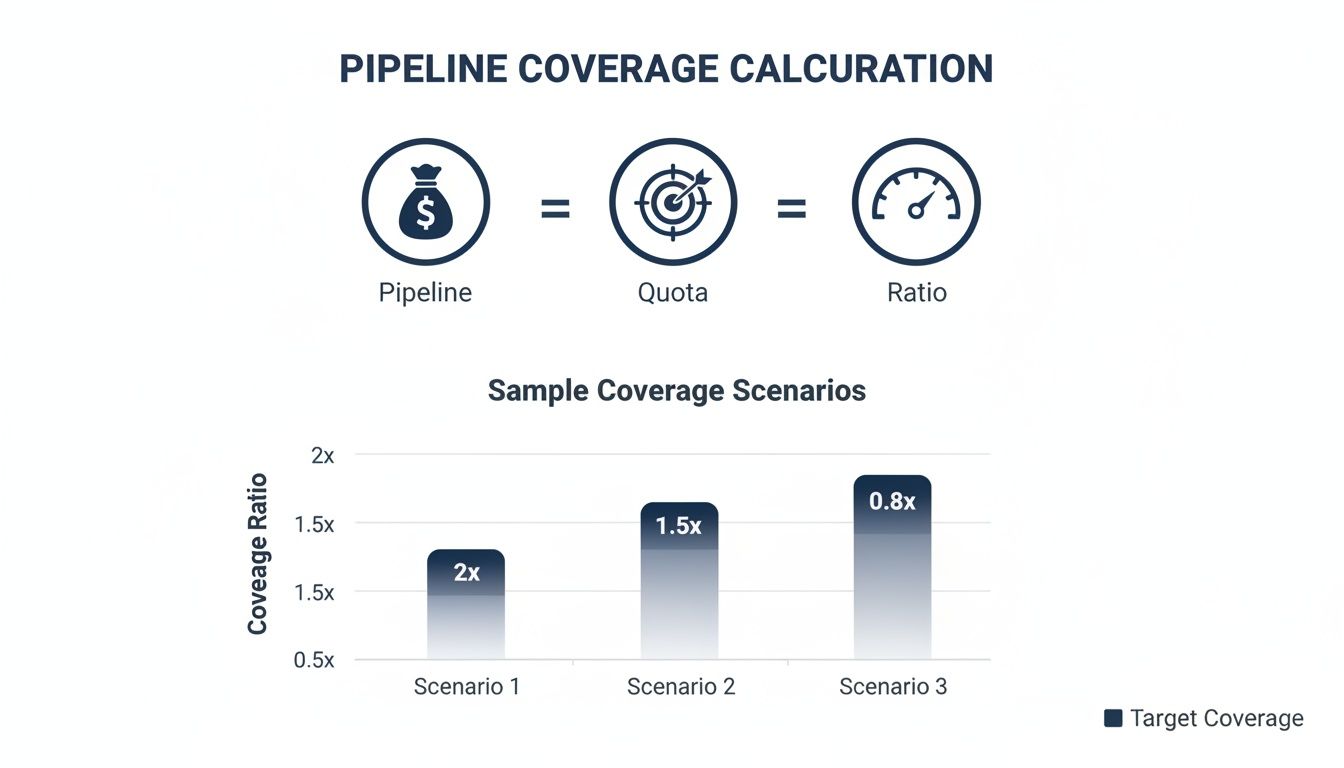
Direct Answer
The right pipeline coverage ratio for 2027 is not the old "3x and you're fine" rule of thumb — it is a number you derive from your own conversion math, then adjust upward for cycle length and economic uncertainty. The defensible formula is: required coverage = 1 ÷ (stage-weighted win rate), applied to open pipeline that can realistically close inside the quarter.
A team that converts 25% of qualified pipeline needs roughly 4x coverage; a team converting 33% needs about 3x; a team converting 20% needs 5x. In 2027, with longer cycles and noisier early-stage pipeline, most B2B teams target 3x–4x for next quarter and watch a *forward* coverage curve (this-quarter, next-quarter, two-quarters-out) rather than a single blended number.
Coverage is a diagnostic, not a goal: a team that hits quota at 2.5x has a conversion problem worth more than any amount of extra top-of-funnel.
Why the "3x Rule" Is Misleading in 2027
The 3x heuristic assumes a 33% win rate, a relatively short cycle, and pipeline that is honestly qualified. None of those assumptions are safe defaults anymore. With buying committees that Gartner has characterized as routinely exceeding ten stakeholders and cycles frequently running two or three quarters, a deal sitting in "Stage 2" may be 9 months from a decision — counting it the same as a deal in legal review badly distorts coverage.
Worse, AI-assisted prospecting in tools like Outreach, Salesloft, and Clay has made it trivial to manufacture top-of-funnel volume, which inflates raw coverage without improving the odds of hitting the number. The result: many teams report healthy 4x coverage and still miss, because most of that pipeline is unqualified or out-of-quarter.
Coverage only means something when it is *qualified, stage-weighted, and time-bound*.
How to Calculate Your Real Coverage Target
Work the math from outcomes backward, not from a rule of thumb forward.
- Measure your true win rate by stage, not blended. Pull the last 4–8 quarters of closed deals and compute conversion at each stage transition. A deal in "Proposal" might convert at 55%; a deal in "Discovery" at 18%. These are different and should be weighted differently.
- Define what counts as pipeline. Only opportunities past a hard qualification gate (a confirmed economic buyer, an identified compelling event, a budget signal) should count toward coverage. Everything earlier is "early pipeline" and belongs in a separate forward bucket.
- Set the in-quarter target. Required coverage = 1 ÷ weighted win rate. Multiply your quarterly quota by that number to get the target qualified pipeline.
- Adjust for cycle length. If your average cycle exceeds your quarter, in-quarter coverage matters less than *aging* coverage. Track how much pipeline has been in-stage long enough to plausibly close this quarter.
- Add an uncertainty buffer. In a tightening economy, no-decision and "do nothing" outcomes rise; budgeting an extra 0.5x–1x of coverage absorbs that drag.

👉 Quick Call with Kory White, Fractional CRO · See Kory on LinkedIn · CRO Syndicate
Forward Coverage Beats a Single Number
The single most useful upgrade is to stop reporting one coverage ratio and start reporting a coverage curve across multiple future quarters. A team at 4x for this quarter but 1.2x for next quarter is in a worse position than a team at 3x this quarter and 3x next quarter, because the first team is about to fall off a cliff.
RevOps should publish a standing view that shows, for each of the next three quarters, the qualified pipeline already created against the quota for that quarter. This turns coverage from a lagging scoreboard into a leading early-warning system that gives marketing and SDR teams two quarters of runway to fix a gap.
Where Coverage Goes Wrong
- Counting unqualified pipeline. If "pipeline" includes every open opportunity regardless of qualification, your ratio is fiction. Gate it.
- Using a blended win rate. Blending early- and late-stage conversion overstates the value of early pipeline.
- Treating coverage as a quota for SDRs. When you reward people for *creating* coverage, they create junk. Reward qualified, stage-progressing pipeline instead.
- Ignoring time. Coverage with no time dimension can't tell you whether pipeline will close this quarter or next year.
- Chasing more coverage when the real problem is conversion. If you miss at 5x coverage, adding a sixth turn won't help; fix discovery, qualification, and velocity.
Tooling
By 2027 most teams maintain coverage views in Salesforce or HubSpot dashboards, often layered with a dedicated revenue-intelligence platform such as Clari or Gong Forecast that can show forward coverage by segment and flag pipeline that has stalled in-stage. Whatever the tool, the discipline is the same: define qualification rigorously, weight by stage, and look forward across quarters rather than at a single blended figure.
FAQ
Is 3x coverage still a safe target? Only if your true win rate is around 33%. Derive your target from your own stage-weighted conversion; teams with 20–25% win rates need 4x–5x, and teams above 40% can run leaner.
Should early-stage pipeline count toward coverage? Not toward *in-quarter* coverage. Keep it in a separate forward bucket so it doesn't inflate your near-term picture, but track it as your future-quarter coverage signal.
What does it mean if I have high coverage but still miss quota? It almost always means a conversion or qualification problem, not a volume problem. Audit your stage-weighted win rates and discovery quality before generating more pipeline.
How often should RevOps recalculate the coverage target? Recompute win rates and the resulting coverage target at least quarterly, and immediately after any major change to pricing, ICP, or sales process, since each of those moves conversion.
Sources
- Gartner, B2B Buying Journey research on buying-group size and complexity (gartner.com).
- Salesforce, State of Sales reports on pipeline and win-rate benchmarks (salesforce.com).
- HubSpot Sales Benchmarks and pipeline reporting guidance (hubspot.com).
- Clari, resources on pipeline coverage and forecasting discipline (clari.com).
- Gong Labs, published analyses of deal conversion and win-rate drivers (gong.io).
Related on PULSE
- How do you measure and improve sales velocity by stage in 2027?
- How do you design a lead scoring model that marketing and sales both trust in 2027?
- How do you build a forecast-accuracy scorecard for sales managers in 2027?
- How Do I Get My Reps to Forecast Accurately?
- See pipeline and quota calculators in Pulse Tools.