
Is ServiceNow's pricing model broken at the bottom in 2027?
 Curated byKory White · Fractional CRO · Maryland
 PULSEKNOWLEDGE LIBRARY
Quality
Certified

Yes — ServiceNow's pricing is structurally broken below roughly 1,000 employees, but deliberately so. Per-employee minimums land in the low-to-mid six figures, list prices are unpublished, and the AI tier adds a further uplift. Competitors with published per-user pricing win that segment, and ServiceNow's cost-to-serve makes defending it uneconomical.
The outcome you should expect when you evaluate ServiceNow under 1,000 employees
Run the exercise and the pattern repeats with unnerving consistency. A 400-person company with a six-person IT team decides the ticketing system is embarrassing, builds a shortlist — ServiceNow, Jira Service Management, Freshservice, maybe a Microsoft Power Platform build — and discovers within two weeks that only one of those four requires a discovery call before you can see a number. That asymmetry alone reshapes the evaluation. Three vendors publish per-agent or per-user pricing on a page you can read in ninety seconds; one asks for a calendar invite, an org chart, and a conversation about "workflow strategy."
What you should expect, concretely: a quoted annual contract value that sits far above what the buying committee had penciled in, a proposal structured around per-employee rather than per-agent licensing, and a sales cycle measured in months rather than the days it took to trial the alternatives. Mid-market buyers routinely report effective ACV minimums in the $300–500K range before discount — not because the software costs that much to run for 400 people, but because below that number the deal does not clear the internal bar for a quota-carrying enterprise seller's time. The floor is a go-to-market artifact, not a cost-of-goods artifact.
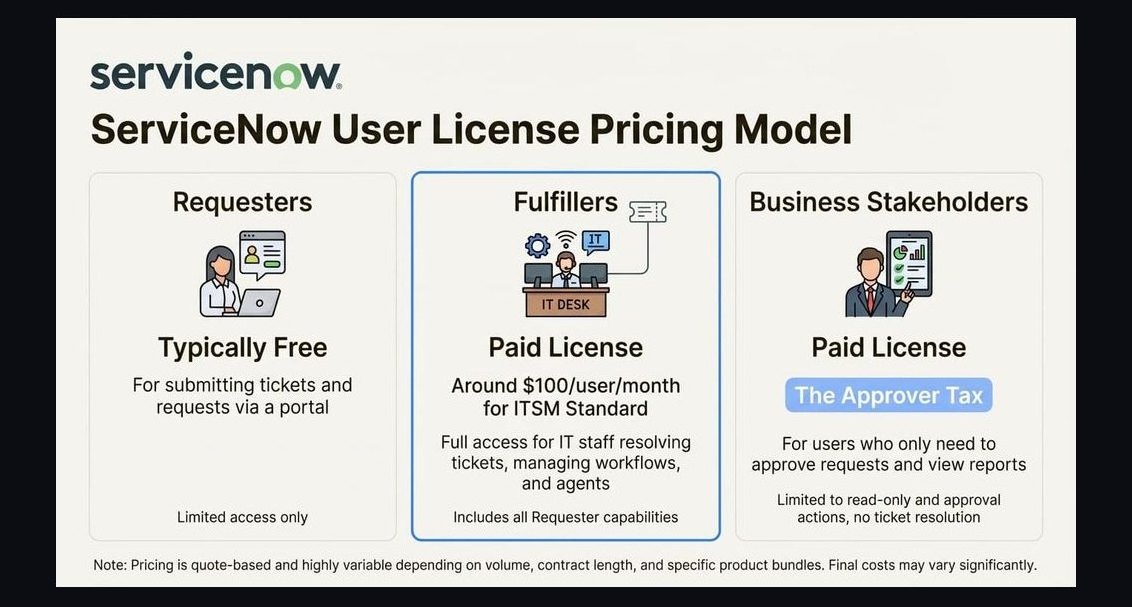
The second thing to expect is a licensing model mismatch. ITSM tools priced per *agent* charge you for the six people answering tickets. ServiceNow's per-employee fulfiller-and-requester structure ties a meaningful share of cost to headcount that never logs into the platform except to submit a request. For a 400-person company with six agents, that's a roughly 66x difference in the denominator. Even at a much lower per-unit rate, the per-employee model produces a larger number — and the buyer experiences it as the vendor charging for people who aren't using the product. Whether that's fair is arguable (ServiceNow's pitch is that the whole company consumes the service catalog), but it's not the pricing shape a 400-person IT org is mentally prepared for.

Third: expect the implementation quote to arrive after you've anchored on the license quote, and to be roughly the same size. Partner-led ITSM deployments with a handful of integrations are typically quoted in the low hundreds of thousands. A buyer who negotiated the license down feels the win, then discovers the total first-year commitment landed back where it started. For a RevOps or IT leader who has to defend a number to a CFO, the license figure is the least reliable part of the estimate.
Fourth, and least discussed: expect ServiceNow to be perfectly happy with this outcome. Nothing about the experience is accidental. The gating, the minimums, the enterprise-quoted structure, the absence of a self-serve trial — these are the deliberate outputs of a company that has decided which customers it wants and priced accordingly. The model isn't failing at the bottom. It's declining to compete there, and the discomfort you feel in the evaluation is the mechanism working as intended.
What drives that outcome
The forces here are structural, and understanding them tells you whether to expect a fix (mostly, no).

Cost-to-serve sets the floor. A ServiceNow account carries a named account executive, a solution consultant, a customer success manager, legal and security review cycles, and a partner ecosystem the vendor invests in supporting. Fully loaded, that's a six-figure annual cost per active logo before a line of software runs. A vendor with that cost structure cannot profitably serve a $60K account — not at any margin, and not for years. This is the single most important thing to understand: the pricing floor is downstream of the go-to-market cost structure, and you cannot change the floor without dismantling the motion that produces enterprise wins.
The per-employee denominator amplifies everything. Any per-seat model produces a number that scales with company size. A per-employee model scales with total headcount, which for a service-desk use case is dramatically larger than the population actually operating the tool. That's defensible when the platform genuinely spans HR service delivery, IT asset management, and employee experience — a large enterprise really does have most of its workforce touching the portal. In a 400-person company running incident and request management only, the denominator is measuring something the buyer isn't buying.
Unpublished pricing creates a discovery tax. Gating price behind a sales conversation is standard enterprise practice, and it preserves negotiation flexibility that genuinely benefits large buyers. Below the enterprise threshold it functions as a filter — most small evaluators simply never enter the funnel. They compare the three vendors whose pricing they can read and pick one. ServiceNow loses those deals without ever knowing they existed, which is precisely why the segment's competitive loss data is invisible internally.

The AI tier compounds the arithmetic. The premium AI-inclusive tier carries a meaningful uplift over the standard professional tier. In an eight-figure enterprise agreement, that uplift is absorbed into a rounding discussion. At a $200K deal size, it's a separate CFO conversation requiring a business case for productivity gains nobody has measured yet. Meanwhile competitors are folding AI capability into existing tiers or into a Microsoft agreement the company already pays for — so the mid-market buyer's mental comparison is "pay a premium for AI" versus "AI is included."
Competitive structure is stable and rational. Atlassian's Jira Service Management wins engineering-led organizations on price and Jira adjacency. Freshservice wins the transparent-pricing, fast-provisioning case. Microsoft wins wherever a Power Platform build is good enough and the tenancy is already paid for. Salesforce set the market expectation for what published SMB SaaS pricing looks like. None of these vendors carries ServiceNow's cost-to-serve, and ServiceNow cannot match their prices without rebuilding its GTM from scratch.
The AI-agent variable is the one thing that could shift this. If autonomous agents genuinely absorb a large share of L1 service-desk work, the value story changes from "seats" to "deflected headcount" — and deflected headcount is a number a 600-person company can put in a business case. That's the scenario in which the segment becomes reachable. It requires a delivery motion that doesn't cost six figures per logo, which means partner-led everything.

Benchmarks and realistic ranges you can plan against
Treat every number below as a planning range, not a quote. Software pricing moves, discounting is deep and situational, and the only figure that matters is the one on your paper.
Published competitor pricing is the useful anchor, because it's verifiable. Jira Service Management, Freshservice, and the Power Platform SKUs all publish per-agent or per-user rates on their pricing pages, generally in the tens of dollars per user per month depending on tier. Salesforce publishes SMB tiers the same way. You can build a defensible three-year TCO for any of them in an afternoon without talking to a salesperson. That is the comparison baseline a ServiceNow proposal is landing against, and it's why the gap feels so stark — you're comparing a known number to an unknown one.
ServiceNow's own figures come from buyer reports and analyst coverage, not a price list. The recurring pattern in practitioner accounts: per-employee professional-tier pricing in the low hundreds of dollars per employee per year, effective deal minimums in the low-to-mid six figures, and an AI tier uplift that adds a substantial percentage on top. Discounting off list is real and can be significant, particularly on multi-year terms — buyers who commit to two or three years and forgo the AI tier report materially better per-unit economics. But discount depth is unpredictable precisely because there's no published anchor to discount from.

Build the model three ways before you take any meeting. First, per-agent: how many people actually resolve tickets? For most sub-1,000-employee organizations that's between four and fifteen. Second, per-employee: total headcount, plus a growth assumption, because your bill grows with hiring whether or not IT ticket volume does. Third, total first-year: license plus implementation plus internal time. That third number is the one your CFO will remember, and it is routinely two to three times the license line alone.
Price the internal cost of the evaluation itself. A gated enterprise sale consumes real hours: discovery calls, technical deep-dives, security review, legal redlines, procurement. Several people, several weeks. At mid-market loaded labor rates, that's a five-figure soft cost before you've signed anything — and you pay it whether or not you buy. Against a competitor you can trial in an afternoon with a credit card, that soft cost is a legitimate line item in the comparison, and RevOps leaders who've run both motions will tell you it's the most underweighted number in the whole exercise.
Segment the decision by headcount band. Above roughly 5,000 employees, the per-employee model tracks the value delivered reasonably well and the platform breadth justifies the price — this is the segment ServiceNow was built for. Between 1,000 and 5,000, the base tier is generally defensible and the AI tier is where the argument happens; buying professional and deferring AI until deflection is measured is the common play. Between roughly 250 and 1,000, the model is genuinely broken for most buyers and the alternatives win the bake-off on transparency alone. Below 250, it isn't a serious evaluation. Regulated and federal buyers are the exception at every band — where compliance certification narrows the field to a handful of options, price elasticity largely disappears.
One benchmark worth watching over time: the rising floor of "good enough." Every release cycle, the bundled workflow and automation capability inside suites companies already own gets a little better. The threshold at which a build-versus-buy conversation tips toward "we already pay for this" keeps moving up. That's a slow variable, but it's the one that determines whether the bottom of the market stays conceded or starts compressing the middle.

Risks, edge cases, and failure modes
The cheap-alternative trap. The most common failure isn't overpaying for ServiceNow — it's underbuying and rebuying eighteen months later. A lightweight tool at a fraction of the price is genuinely the right call for incident and request management at 400 people. It becomes the wrong call the moment the requirement list grows a CMDB, discovery, asset lifecycle management, HR case management, and audit-grade change control. Organizations that grow into that requirement set often end up migrating anyway, having paid twice and absorbed a painful data migration. The honest question isn't "what do we need now" but "what will we need at 1,500 people, and how much does switching cost then?"
The over-scoped platform trap. The inverse failure is just as expensive. A mid-market buyer signs a multi-module platform agreement on the strength of a compelling vision, deploys incident management, and never stands up the other modules because there's no one to own them. Shelfware at enterprise pricing is the worst outcome on this list, and it happens most often when the buying decision was made by an executive who saw the demo rather than the team who'd operate it. Before committing to platform breadth, name the person who owns each module and the quarter they'll stand it up. If you can't, don't buy it.
The negotiated-floor trap. Buyers who push hard on price sometimes win a discount that puts them below the vendor's viable cost-to-serve. That deal doesn't fail at signature — it fails at renewal, when account coverage has thinned, response times have stretched, and the renewal quote arrives with a correction built in. A price below the vendor's floor is not a win; it's a deferred problem. If you get a number that seems too good, ask directly what account coverage looks like at that price, and get the answer in writing.

The implementation-partner mismatch. The partner ecosystem spans firms that do enterprise transformation work and firms that do focused mid-market deployments. Engaging a partner sized for a Fortune 500 program on a 600-person deployment produces a scope document, a governance structure, and a bill that all belong to a different project. Match the partner to the deployment size, ask specifically for references at your headcount band, and be skeptical of any statement of work that reads like it was templated from a much larger engagement.
The AI-uplift-without-baseline trap. Buying the AI tier before you've measured current deflection rate, average handle time, and ticket mix means you have no way to prove ROI at renewal. Instrument first — three to six months of clean baseline data — then buy the uplift against a specific target. This applies well beyond ServiceNow; it's the same discipline RevOps teams should apply to any AI add-on across the stack, where per-seat AI premiums have become the standard upsell motion and the standard place where value goes unmeasured.
The headcount-growth surprise. Per-employee licensing means your bill grows when you hire, independent of ticket volume or IT usage. A company planning to double headcount over a contract term needs to model that growth into the TCO and negotiate the growth rate up front. Discovering the true-up at renewal, after a hiring spree, is a genuinely bad meeting.

The edge case where none of this applies: regulated environments. Where compliance certification is a hard gate, the field of viable vendors collapses, and pricing debates become largely academic. A small agency with a certification requirement will pay enterprise-shaped pricing because the alternative isn't a cheaper vendor — it's no vendor. The same dynamic shows up in adjacent regulated categories across the stack, and it's the clearest illustration that "broken pricing" is always relative to available substitutes rather than absolute.
A practical rollout plan for buyers in the broken zone
If you're between roughly 250 and 1,500 employees, here's a sequence that produces a defensible decision either way.
Weeks 1–2: instrument before you shop. Pull ticket volume by category, average handle time, current deflection rate, agent headcount, and the list of systems the service desk touches. Most organizations at this size have never measured these cleanly, and every subsequent decision — tool selection, AI business case, renewal negotiation — depends on them. This step is free and it's the highest-leverage thing on the list.

Weeks 2–3: write requirements in two tiers. Tier one is what you need in twelve months. Tier two is what you'd need at roughly double your current headcount. Keep them visibly separate. Tier one drives the near-term decision; tier two tells you whether you're buying a tool you'll outgrow, and how expensive outgrowing it would be.
Weeks 3–5: trial the published-price options first, in parallel. Stand up real trials of the transparent vendors with real tickets and real agents. This costs you almost nothing and produces two assets: a working fallback if the enterprise evaluation goes nowhere, and a concrete performance baseline that makes any subsequent enterprise demo much easier to evaluate honestly.
Weeks 4–8: run the gated evaluation in parallel, not sequentially. If you're going to talk to a gated vendor, do it while the trials run. Ask for the number in the first call — not a range, an actual proposal structure — and say plainly what band you're in. Good enterprise sellers will tell you early if you're below their floor, which saves everyone weeks. Ask specifically about partner-led delivery options, per-agent versus per-employee structures, multi-year terms, and what the price looks like without the AI tier.

Weeks 8–10: build the three-year TCO for every finalist. License, implementation, internal administration time, integration maintenance, and a headcount-growth assumption. Include the cost of the evaluation itself. Include a switching-cost estimate for the cheaper options, weighted by the probability you'll outgrow them. Present ranges rather than point estimates — the ranges are the honest part.
Weeks 10–12: decide, and write down what would change the decision. Whatever you pick, document the specific conditions that would make you revisit: a headcount threshold, a module requirement, a compliance change, a competitor's pricing move. Put a calendar reminder eighteen months out. The most expensive mistakes in this category come from decisions nobody revisited until the renewal forced it.
Ongoing: treat this as a RevOps discipline, not an IT purchase. The same evaluation logic — instrument first, model per-unit economics three ways, price the evaluation cost, separate current from future requirements, document revisit triggers — applies to every platform decision in the stack. Service management just happens to be the category where the gap between published and gated pricing is widest, which makes it the clearest teaching case.
Related questions
Does ServiceNow ever discount below its stated minimums?
Discounting is real and can be deep on multi-year commitments, but the effective floor reflects cost-to-serve rather than list price. Deals struck far below that floor tend to correct at renewal or come with thinner account coverage. Ask what support looks like at the discounted price.
Is per-employee licensing inherently worse than per-agent?
No — it's a different value theory. Per-employee makes sense when the whole workforce genuinely uses the service portal across IT, HR, and facilities. It's a poor fit when only a small team touches the tool, which describes most sub-1,000-employee IT-only deployments.
Would a lower-priced tier actually help ServiceNow?
Only with a delivery motion that doesn't carry enterprise cost-to-serve — meaning published pricing, self-serve trial, and partner-led implementation. A cheaper SKU sold through the existing direct motion is just a discount, and it risks undercutting the premium tier's perceived value.
Should a growing company buy ahead of its needs?
Rarely. Buy for the next twelve to eighteen months, but document the switching cost of your choice and set an explicit revisit trigger tied to headcount or module requirements. Migration pain is real, but so is paying enterprise rates for capability you won't deploy.
How much does the implementation cost relative to the license?
Frequently comparable to or larger than the first-year license for a platform deployment with several integrations. Any TCO model that stops at the license line is understating the commitment by a wide margin — model implementation, training, and internal administration time explicitly.
FAQ
Is ServiceNow's pricing model actually broken at the bottom of the market?
For buyers under roughly 1,000 employees, functionally yes — the minimums, the unpublished list price, and the per-employee denominator combine to produce a number and a process that don't fit the segment. But "broken" implies unintended. It isn't. The model is optimized for large enterprise accounts and performs well there, and the discomfort smaller buyers experience is the filter working as designed.
Why doesn't ServiceNow just publish its pricing?
Unpublished pricing preserves negotiation flexibility in large, complex, multi-module agreements where the right price genuinely depends on scope, term, and configuration. That flexibility has real value at the top of the market. The cost is that smaller buyers self-select out before ever contacting sales — which, from ServiceNow's perspective, is a feature rather than a bug.
What should a 500-person company buy instead?
Start with the published-price service management tools and trial two of them with real tickets. If your organization is engineering-led and already on Jira, the adjacency argument is strong. If you're heavily invested in a Microsoft tenancy, evaluate what you already own before buying anything new. Reserve the enterprise platform conversation for when you have CMDB, discovery, or multi-department workflow requirements you can actually name.
Does the AI tier change the calculation for mid-market buyers?
It can, but only against measured baselines. If autonomous agents demonstrably deflect a meaningful share of L1 volume, the value story shifts from seats to avoided headcount, which is a number a CFO will engage with. Without a clean pre-AI baseline of deflection rate and handle time, you have no way to prove the uplift paid for itself at renewal.
How do I keep an enterprise evaluation from consuming a quarter?
Ask for pricing structure in the first call and state your headcount band plainly. Run trials of transparent alternatives in parallel rather than sequentially. Set an internal decision date before the first vendor meeting. And treat the hours your team spends in the evaluation as a real cost line — it typically runs well into five figures at mid-market labor rates.
Will this change over the next few years?
Possibly, driven by two forces: AI agents lowering the cost of delivering and supporting the platform, and bundled workflow capability in suites companies already own raising the floor of "good enough." If both continue, a partner-led lower tier becomes strategically defensible. Neither force moves quickly, so plan for the current structure and treat a change as upside.
Sources
- https://www.servicenow.com/products/itsm.html
- https://www.atlassian.com/software/jira/service-management/pricing
- https://www.freshworks.com/freshservice/pricing/
- https://www.microsoft.com/en-us/power-platform/products/power-automate/pricing
- https://www.gartner.com/reviews/market/it-service-management-platforms
- https://www.salesforce.com/editions-pricing/
- https://investors.servicenow.com/
- https://www.forrester.com/research/
Related on PULSE
- Is Datadog pricing model broken at the bottom?
- Is Salesloft pricing model broken at the bottom?
- Is Outreach pricing model broken at the bottom?
- How do you build a build-versus-buy case for a RevOps platform?
- What belongs in a three-year TCO model for a GTM platform?
- How do you negotiate a multi-year SaaS renewal without losing coverage?
This page will be disappearing soon. Save it to your device for $1 — or read it free while it is here.
@Kory-White- · if Venmo asks, the last 4 of my number are 2012
This page is gone.
This one is off the shelf now. $1 keeps it on your phone for good — the whole page, pictures and diagrams included.
 servicenowHow should ServiceNow price Now Assist against Microsoft Copilot in 2027?
 servicenowWhat should ServiceNow do about ITSM stagnation in 2027?
 servicenowHow does ServiceNow upmarket without losing mid-market in 2027?
 servicenowWhat does ServiceNow's churn math look like under AI pressure in 2027?
 servicenowShould ServiceNow kill its Pro+ pricing tier in 2027?
 servicenowShould ServiceNow launch a vertical-SaaS sub-brand in 2027?
 servicenowShould I work for ServiceNow in 2027?
 servicenowHow does ServiceNow defend against Microsoft Power Platform in 2027?
 servicenowHow should ServiceNow rethink its workflow thesis for AI buyers in 2027?
 outreachIs Outreach pricing model broken at the bottom in 2027?