
How should ServiceNow price Now Assist against Microsoft Copilot in 2027?
 Curated byKory White · Fractional CRO · Maryland
 PULSEKNOWLEDGE LIBRARY
Quality
Certified

ServiceNow should never ship a standalone per-user Now Assist SKU against Microsoft Copilot. Keep Now Assist bundled inside the Pro Plus tier uplift, layer AI Agent Studio on consumption metering, and lead with workflow-outcome SKUs priced per resolved ticket or completed onboarding — where Copilot has no comparable, because it does not own the record.
The renewal room where this pricing decision actually gets made
Picture a 12,000-employee manufacturer three months from an enterprise agreement renewal. They already run ServiceNow ITSM Pro and CSM Pro. They already pay for Microsoft 365 E3 across every knowledge worker. Their Microsoft account team walks in first, because Microsoft always walks in first — the EA renewal date is a fixed calendar event and the ServiceNow renewal floats around it. The Microsoft pitch is not "buy Copilot." The Microsoft pitch is "add Copilot at a discounted rate as part of this three-year commit, and we'll credit the first year against your E5 step-up." The CFO hears one number: an incremental line item on a contract they were signing anyway, with no new vendor, no new security review, no new procurement cycle, and no new SOC 2 questionnaire.
Then the ServiceNow account team arrives. If they arrive holding a per-user-per-month Now Assist SKU, they have already lost the room — not because the product is worse, but because the comparison is now framed as seat versus seat, and seat-versus-seat is the only fight Microsoft cannot lose. The procurement analyst opens a spreadsheet, puts Copilot 365 in column A at roughly $30 per user per month, puts Now Assist in column B at whatever number ServiceNow named, and asks the only question that matters in that format: which one is cheaper per head. Nothing about CMDB reconciliation, incident deflection, or onboarding cycle time survives that spreadsheet. The format kills the argument before the argument is made.
The scenario matters because it repeats hundreds of times a quarter, and because the outcome is determined almost entirely by the unit of measure ServiceNow chooses — not by feature parity, not by benchmark scores, not by demo quality. If the unit is a seat, Microsoft's installed base decides. If the unit is a resolved incident, a completed onboarding, or a reconciled configuration item, the comparison has no column B for Microsoft at all, and the conversation moves to a buyer who owns the workflow rather than the headcount budget. Every pricing recommendation that follows is downstream of that single framing choice. The same dynamic plays out for any workflow-of-record vendor facing a productivity-suite incumbent: observability platforms facing Copilot-adjacent assistants, HR suites facing Viva, security platforms facing Security Copilot. The lesson generalizes, but ServiceNow is where it is sharpest, because ServiceNow's entire value proposition is that it holds the system of record for work.

There is a second character in that room worth naming: the RevOps or IT-operations leader who will actually be held accountable for the outcome. That person does not care about per-seat parity. They care whether ticket volume drops, whether the onboarding backlog clears, and whether they can defend the spend in a QBR six months out. Pricing that speaks to that person — pricing denominated in the same units their dashboard already reports — converts far more reliably than pricing that speaks to the procurement spreadsheet. The pricing model is a targeting decision disguised as a finance decision.
How the bundling asymmetry actually works
The reason ServiceNow cannot win a per-seat contest is structural, not tactical, and it has four distinct components that compound.
First, distribution cost. Microsoft sells Copilot into an installed base measured in the hundreds of millions of paid Microsoft 365 seats. Adding a Copilot line to an existing EA involves no new contract vehicle, no new legal review, and no new vendor onboarding. The marginal *distribution* cost of one more Copilot seat rounds to zero. ServiceNow's Now Assist reaches customers through a platform-tier upgrade that requires its own commercial conversation, its own business case, and frequently its own budget line.

Second, inference economics. Microsoft runs Copilot inference on Azure capacity it owns and depreciates on its own balance sheet. ServiceNow rents compute — from partners, from cloud providers, from GPU capacity it does not own end to end. Every Now Assist execution carries a real, recurring cost of goods sold that shows up in gross margin. Microsoft can absorb an inference cost line inside a business already carrying a hyperscaler's margin structure; ServiceNow cannot match that on a per-seat basis without diluting the software margin its valuation depends on.
Third, discount absorption. When a competitor names a per-user price, Microsoft's enterprise agreement machinery can respond within a single quarter using discounting mechanics that are effectively invisible in a bundled contract — a Copilot concession disappears inside a nine-figure EA renewal. ServiceNow has no equivalent hiding place. A discount on a named Now Assist SKU is a visible, auditable, precedent-setting concession that the next customer's procurement team will find and demand.
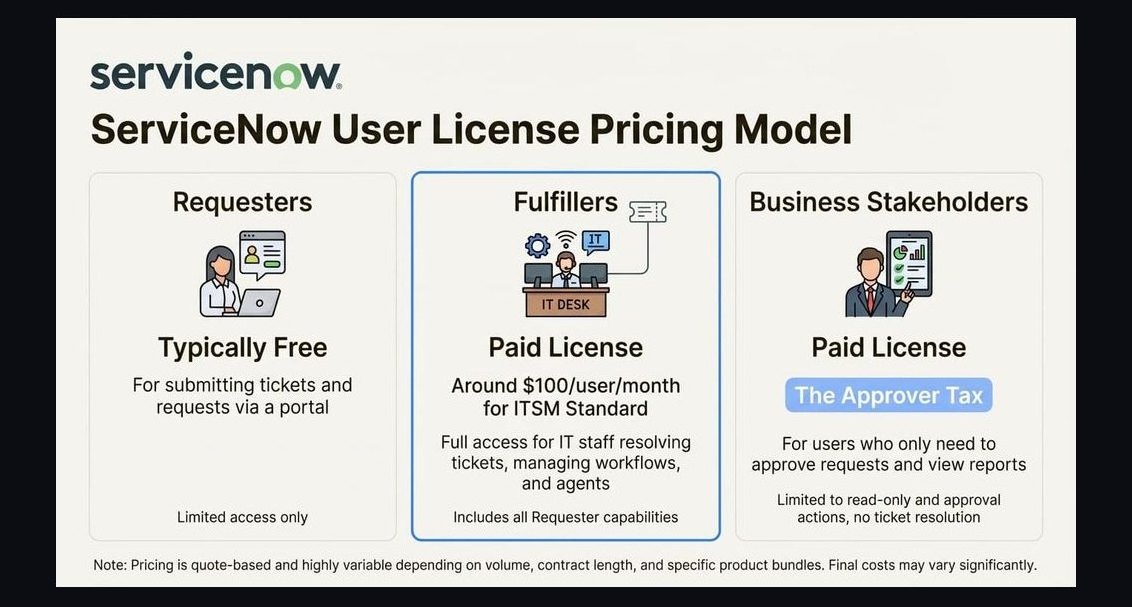
Fourth, and most damaging, the per-employee versus per-named-user mismatch. ServiceNow's enterprise pricing frequently normalizes against total employee population rather than a smaller pool of licensed agents. Racing Copilot to a $30-per-user number in that context does not lower ServiceNow's price — it multiplies it. Twelve thousand employees times $30 a month is $4.3M a year, against a Pro Plus uplift structure that lands materially lower for the same population. The "competitive" price is arithmetically worse for both parties.

The asymmetry has one important exception worth conceding openly in a sales cycle rather than pretending away: for pure knowledge-worker productivity — inbox triage, meeting summarization, document search across SharePoint, first-draft generation — Copilot genuinely is the better buy for most organizations, and arguing otherwise destroys credibility. The system of engagement belongs to Microsoft. The correct posture is to cede that ground explicitly and immediately, then move the conversation to the system of record, which Microsoft's assistant can read about but cannot operate. A rep who says "yes, buy Copilot for that, here's what it can't do" wins more deals than a rep who claims parity on email summarization.
Real numbers, ranges, and the arithmetic buyers will actually run
Concrete figures matter here because pricing arguments collapse into hand-waving without them. The public-facing list landscape as of 2026 sets the anchors.
Microsoft Copilot for Microsoft 365 lists in the neighborhood of $30 per user per month, but it is not a standalone purchase in practice — it sits on top of a Microsoft 365 subscription typically in the $36 to $57 per user per month range depending on tier. The all-in stack for a Copilot-enabled knowledge worker therefore lands somewhere around $66 to $87 per user per month. That total is the number ServiceNow reps should be putting on the whiteboard, not the $30 headline, because the $30 headline is the number Microsoft's own materials lead with and it understates the real commitment. Role-specific Copilot variants for sales and service scenarios list around $50 per user per month standalone, with lower step-up pricing when a customer already holds the corresponding Dynamics premium license. Copilot Studio, the agent-building surface, uses a tenant-level entry price plus consumption message packs — a structurally different model, and the one that reveals where Microsoft actually believes agent pricing is going.

Against that, the Now Assist commercial structure lives inside the Pro Plus tier uplift, commonly discussed in the range of a 30% premium over the corresponding Pro tier. Normalized against a per-employee population, that maps to a materially lower effective per-user-equivalent figure than Copilot's — a range roughly in the high single digits to high teens per user per month depending on employee count, tier mix, and negotiated discount. That normalization is the single most useful slide in the deck, because it converts a tier uplift the CFO cannot benchmark into a number the CFO can benchmark, on terms favorable to ServiceNow, without ever creating an actual per-seat SKU.
Now the outcome layer, where the numbers get interesting. Reasonable, defensible ranges for outcome pricing in this category:
Per-resolved-ticket, ITSM and CSM. A range of roughly $1 to $3 per autonomously resolved ticket, with a committed floor. Compare that against a fully-loaded internal cost per Tier 1 ticket, which most service organizations put somewhere between $15 and $40 once agent salary, tooling, and management overhead are loaded in. A price of $2 against an avoided cost of $22 is a defensible ten-to-one story that survives a CFO's scrutiny. At 40,000 tickets a month with a 35% deflection rate, that is 14,000 resolutions, roughly $28,000 a month, against roughly $308,000 of avoided handling cost. The buyer does that arithmetic themselves and reaches the right answer without a salesperson in the room.

Per-completed-onboarding, HR service delivery. Somewhere between $50 and $150 per employee onboarded end to end — laptop provisioned, accounts created across identity and application systems, training assigned, manager notified, day-one checklist closed. The manual version of that workflow consumes six to twelve hours of coordinator time spread across IT, HR, and facilities. At a loaded hourly rate, the avoided cost sits in the several-hundred-dollar range per hire. For an organization hiring 2,000 people a year, an outcome SKU at $100 is $200,000 — trivially defensible against the coordinator headcount it displaces, and completely uncomparable to any Copilot line item.
Per-incident-resolved, security and major incident workflows. These are lower volume and dramatically higher value. When the event being handled carries a business impact measured in thousands of dollars per hour of downtime, per-event pricing well above the ITSM range is defensible, and the buyer is a security or resilience leader who does not benchmark against productivity software at all.

Per-agent-execution, AI Agent Studio. Fractions of a cent to a few cents per execution, with a meaningful free tier per instance — something on the order of a thousand executions a month — to eliminate the adoption friction that kills developer platforms. Price the *run*, not the message. A single agent run that opens an incident, joins context across the CMDB, an HR record, and a finance approval, then resolves and closes the loop, is not economically equivalent to one chat message, and pricing it as one message leaves most of the value uncaptured. A high-value orchestrated run can reasonably carry a price measured in tens of cents to a couple of dollars.
The category precedent supports all of this. Intercom's Fin priced at a sub-dollar per-resolution figure and scaled rapidly on exactly this logic — the pricing made ROI legible without a spreadsheet. Salesforce moved Agentforce to per-conversation pricing after the standalone Einstein per-seat approach underperformed. Zendesk shipped per-automated-resolution pricing on the same reasoning. Outcome pricing in workflow AI is not a bold experiment in 2027; it is the emerging default, and the risk to ServiceNow is arriving late rather than arriving wrong.
Trade-offs across the four viable models
There is no single correct model, and pretending otherwise is where most pricing strategies fail. Each of the four viable structures optimizes for something different, and the right answer is a portfolio in which each model is aimed at a distinct buyer.

The tier uplift — Now Assist bundled into Pro Plus at roughly a 30% premium — optimizes for margin protection and for keeping the conversation with the platform owner. Its weakness is that it forces an all-or-nothing upgrade decision on a customer who may only want to test AI on a single workflow, and it creates shelfware risk when adoption lags the license. The mitigation is a consumption safety valve: let a customer meter a single workflow before committing the whole population to the higher tier, then convert them on renewal when usage data makes the tier upgrade obvious rather than speculative.
Consumption metering on AI Agent Studio optimizes for developer adoption and for capturing value from high-volume automation that per-seat pricing structurally cannot reach. Password resets, access requests, and routine compliance checks are individually low-value and collectively enormous; a per-seat model earns nothing incremental from automating ten thousand of them. Its weakness is revenue predictability — consumption revenue is harder to forecast, and enterprise procurement teams dislike uncapped meters. The mitigation is committed-spend contracts with rollover and a hard spend ceiling the customer sets themselves.
Outcome pricing optimizes for value alignment and for making the Copilot comparison structurally impossible. Its weakness is operational, not commercial: it requires instrumentation both parties trust. What counts as "resolved"? Who adjudicates a reopened ticket? Does a ticket resolved by an agent but reopened within 48 hours still bill? These questions must be answered in the contract before the first invoice, or the model generates disputes that cost more than the revenue. The mitigation is a published, auditable definition of a billable outcome, a reopen window that voids the charge, and a customer-visible dashboard that reconciles to the invoice line by line.

Per-tenant flat entry pricing for a developer or sandbox tier optimizes for pipeline generation rather than revenue. Its weakness is that it earns almost nothing directly. Its purpose is to get builders inside the platform, and it should be evaluated on downstream conversion rather than on its own P&L.
The portfolio logic is what makes this durable. A single model can be attacked on a single axis. Four models aimed at four buyers means Microsoft's bundling advantage only touches one of them — and it is the one ServiceNow should not be competing in anyway.
Pitfalls that turn a good pricing strategy into a lost quarter
Shipping the standalone per-user SKU. This is the highest-risk move available and it should be treated as closed. It invites the exact spreadsheet comparison Microsoft wins, it cannibalizes the Pro Plus uplift that platform ARPU expansion depends on, and it hands every procurement team a number to benchmark forever. The Salesforce precedent is instructive: a standalone per-seat AI license underperformed on attach, and the strategy pivoted toward per-conversation pricing. The pattern is not a ServiceNow-specific risk; it is what happens to any workflow vendor that lets a productivity incumbent set the unit of measure.

Defining the billable outcome loosely. Outcome pricing dies on definitional disputes. "Resolved" must be specified before contract signature: what state transition triggers billing, what reopen window voids it, how partial automation is treated when an agent handles 80% of a ticket and a human closes it, and who arbitrates a disagreement. Build the reconciliation dashboard before the first invoice, not after the first dispute.
Pricing the message instead of the run. Copilot Studio's message-pack model is a productivity-assistant construct. Applying it to orchestrated workflow agents systematically undercharges for the highest-value work, because a run that touches five systems and closes a business process bills identically to a chat turn that answers a question. Meter the run and its complexity, not the token.
Letting the CFO chair the conversation. The buyer who benchmarks per-seat costs is the wrong buyer for this product, and time spent with them is time spent losing. Route the conversation to the service owner, the HR operations lead, or the RevOps leader who owns the ticket-volume and cycle-time metrics — the person whose dashboard the outcome SKU is denominated in. The CFO still signs, but they sign a business case built by someone who wanted it.

Discounting the outcome SKU to close a quarter. Every concession on a published outcome price becomes the new list price, because outcome pricing is transparent by construction and buyers compare notes. Hold the per-outcome number and concede on commitment volume or term instead.
Claiming parity on productivity. Any attempt to argue Now Assist is a better inbox summarizer than Copilot loses the technical evaluator immediately and poisons the credibility needed for the workflow argument. Cede the productivity ground in the first meeting, deliberately and out loud.
Ignoring the co-existence path. Most enterprises will run both. The strongest commercial position is not displacement but adjacency: Copilot surfaces the summary in Teams, Now Assist executes the workflow behind it, and the integration between them is a reason to buy both rather than a battleground. A pricing model that assumes displacement will consistently underperform one that assumes co-existence, because co-existence is what procurement is actually going to approve.
Related questions
Should ServiceNow discount Now Assist to match a Copilot bundle offer?
No. Match on commitment term or volume tiers instead of on the per-outcome or per-tier rate. Rate concessions on a published outcome price propagate to every subsequent negotiation, while term and volume concessions stay contained to a single contract.
What is the strongest single proof point against Copilot?
Execution ownership. Copilot can summarize an outage email; Now Assist opens the incident, pages on-call, pulls CMDB topology, and posts the war-room link. Demonstrate the end-to-end run live rather than describing it — the gap is obvious in thirty seconds of demo.
How does outcome pricing affect the sales compensation plan?
It requires rework. Quota credit denominated in seats does not translate to consumption or outcome revenue, and reps will default to whatever the comp plan pays. Credit committed outcome spend at signature, with a true-up on realized volume, or the field will keep selling tiers.
Does this apply to observability and security vendors too?
Yes, broadly. Any vendor whose moat is owning a system of record faces the same asymmetry against a bundled productivity assistant, and the same answer applies: price the outcome your record enables, not the seat the assistant occupies.
When should a customer be steered to the consumption tier instead of Pro Plus?
When they want to validate one workflow before committing the full employee population. Meter that workflow, gather six months of usage data, then convert on renewal with adoption evidence rather than projections.
FAQ
What is the single biggest pricing risk for Now Assist in 2027?
Competing head-on with Microsoft on per-user-per-month pricing. Microsoft can attach Copilot to an existing enterprise agreement at near-zero marginal distribution cost and absorb discounts inside a bundled renewal, while ServiceNow carries real inference cost per execution and has no comparable place to hide a concession. A standalone per-seat SKU makes that unwinnable comparison the default frame.
Should ServiceNow ever unbundle Now Assist as a standalone license?
No. Unbundling creates a benchmarkable per-seat number, cannibalizes the Pro Plus tier uplift that platform expansion depends on, and invites a direct comparison against a product the customer may already own. The comparable industry precedent — a standalone per-seat AI license that underperformed on attach and was replaced by per-conversation pricing — is well documented and should be treated as settled evidence.
How should AI Agent Studio be priced?
Consumption, metered on agent executions rather than messages, with a free monthly tier per instance to remove adoption friction and committed-spend contracts with customer-set ceilings to make the meter procurement-safe. Price complexity: a multi-system orchestrated run is worth an order of magnitude more than a single chat turn and should bill accordingly.
What makes outcome pricing hard to operate in practice?
Definition and trust. Both parties must agree in writing on what constitutes a billable outcome, what reopen window voids a charge, how partially automated work is treated, and how disputes are arbitrated — and the customer needs a dashboard that reconciles line by line to the invoice. Solve the instrumentation before the first billing cycle or the model generates disputes that exceed the revenue.
How should a RevOps team evaluate these models internally?
Model each unit against your own volumes: total tickets, deflection rate, hires per year, loaded cost per manual resolution. Then compare the resulting annual figure to the tier uplift for your employee population. Whichever model produces the lower total cost at your actual volumes is the one to negotiate toward — and having that math ready changes the negotiation dynamic considerably.
Will Microsoft eventually copy outcome pricing?
Possibly, but the constraint is structural rather than commercial. Outcome pricing requires owning the record that defines the outcome. A productivity assistant that reads systems it does not operate cannot credibly bill per resolved ticket, which is precisely why the moat is durable for as long as the system of record stays separate from the system of engagement.
Sources
- https://www.microsoft.com/en-us/microsoft-365/copilot
- https://www.microsoft.com/en-us/microsoft-365/enterprise/microsoft365-plans-and-pricing
- https://www.microsoft.com/en-us/microsoft-copilot/microsoft-copilot-studio
- https://www.servicenow.com/products/now-assist.html
- https://investors.servicenow.com/
- https://www.intercom.com/fin
- https://www.salesforce.com/agentforce/
- https://www.zendesk.com/service/ai/
- https://www.gartner.com/en/information-technology
- https://hbr.org/topic/subject/pricing
Related on PULSE
- [How does ServiceNow price Now Assist without cannibalizing core?](/knowledge/q1631)
- [How should Datadog price Bits AI against Microsoft Copilot in 2027?](/knowledge/q1724)
- [What is Microsoft Copilot for Sales and what does it mean for RevOps in 2027?](/knowledge/q12967)
- [How does Microsoft Sales Copilot compare to Salesforce Einstein in 2027?](/knowledge/q12003)
- [What is the difference between ChatGPT Enterprise and Microsoft Copilot for business?](/knowledge/q14493)
- [Why did ServiceNow's stock drop after Now Assist launch?](/knowledge/q1630)
This page will be disappearing soon. Save it to your device for $1 — or read it free while it is here.
@Kory-White- · if Venmo asks, the last 4 of my number are 2012
This page is gone.
This one is off the shelf now. $1 keeps it on your phone for good — the whole page, pictures and diagrams included.
 servicenowIs ServiceNow's pricing model broken at the bottom?
 servicenowWhat does ServiceNow's churn math look like under AI pressure?
 servicenowShould ServiceNow kill its Pro+ pricing tier?
 servicenowHow does ServiceNow ARPU change post-AI agent rollout?
 datadogHow should Datadog price Bits AI against Microsoft Copilot in 2027?
 snowflake-pricingHow should Snowflake price AI assistant against Snowflake equivalent?
 servicenowShould ServiceNow launch its own AI agent marketplace?
 servicenowWhat is the bull case for ServiceNow 2027?
 servicenowShould ServiceNow pivot from platform-led to agent-led?
 servicenowWhat is ServiceNow's playbook for the next $5B in revenue?