
Top 10 AI-Powered Marketing Automation Tools for 2027
 PULSEKNOWLEDGE LIBRARY
The 10 best ai-powered marketing automation tools are ranked below on measured performance, build quality, price, and how each one actually holds up in daily use rather than how it reads on a spec sheet. Each pick lists what it costs, who it suits, and what it gives up against the one above it, so the list can be read straight down without doubling back.
1. HubSpot Marketing Hub

It ranks first because Breeze AI is a native copilot rather than a bolted-on add-on, writing email sequences, generating landing page copy, and scoring leads against real-time CRM behavior in one system. Smart Content personalizes website blocks by lifecycle stage, industry, or past purchases with no developer involved. Professional pricing starts at $800/month for 2,000 marketing contacts. Campaign Assistant drafts a 30-day sequence from a one-line brief.
This fits mid-market and enterprise teams that want CRM, email, social, and SEO under one roof instead of stitched together. The trade is cost: $800/month is a steep floor for a team under a few thousand contacts, and contact-tier upgrades escalate quickly. Against Salesforce Marketing Cloud below it, HubSpot is faster to onboard and cheaper at entry, but carries less depth for enterprise-scale journey orchestration and data-warehouse work.
2. Salesforce Marketing Cloud

Second place goes to Einstein GPT's generative depth across email copy, journey branching, and audience segmentation, paired with Interaction Studio's real-time triggers — a cart abandoner can receive an SMS discount code within two minutes. Predictive Audiences forecasts which segments convert over the next 30 days so ad spend shifts dynamically. Growth edition runs $1,250/month for 50,000 contacts plus usage-based AI credits.
This is for enterprises already running Sales Cloud and Service Cloud, where native data sharing pays for the complexity. What it trades away is onboarding speed and predictable cost — usage-based AI credits make monthly spend a moving target. Compared with HubSpot above it, Marketing Cloud handles far more intricate multi-channel journeys and warehouse-fed recommendations, but demands administrators rather than marketers to configure them.
3. ActiveCampaign

Third because it delivers genuine AI automation at $49/month for 1,000 contacts on the Plus plan — roughly one-sixteenth of HubSpot's entry price — including split testing and conditional content blocks. The Customer Journey Builder uses drag-and-drop nodes for email, SMS, and site messages with AI-suggested next-best actions. Send Time Optimization picks a per-subscriber hour, improving open rates 15–25% per ActiveCampaign's internal benchmarks.
Built for SMBs and lean teams running high-volume, low-cost automation: post-purchase review requests, product-affinity cross-sells, native Shopify and WooCommerce order triggers. It gives up enterprise ABM scoring, revenue attribution reporting, and the deep warehouse integrations that justify Marketing Cloud's price. Against Marketo Engage below it, ActiveCampaign is dramatically cheaper and faster to launch but far weaker on complex B2B account scoring.
4. Marketo Engage

Fourth because Adobe Sensei GenAI drives predictive audience building and content personalization at a level few B2B platforms match, with the AI Assistant drafting subject lines, landing page copy, and send-time suggestions. Predictive Audiences clusters leads by conversion likelihood and adjusts email cadence accordingly. Pro edition costs $1,800/month for 10,000 contacts, with Account-Based Marketing and Revenue Attribution sold as add-ons.
This suits B2B enterprises with long, multi-stakeholder buying cycles that need account-level scoring from web visits, form fills, and call-transcript signals. The trade is the highest sticker price on this list plus add-on fees, and an interface that rewards a dedicated marketing-ops hire. Versus Klaviyo below it, Marketo is built for pipeline and Revenue Cycle Analytics rather than e-commerce transactions.
5. Klaviyo

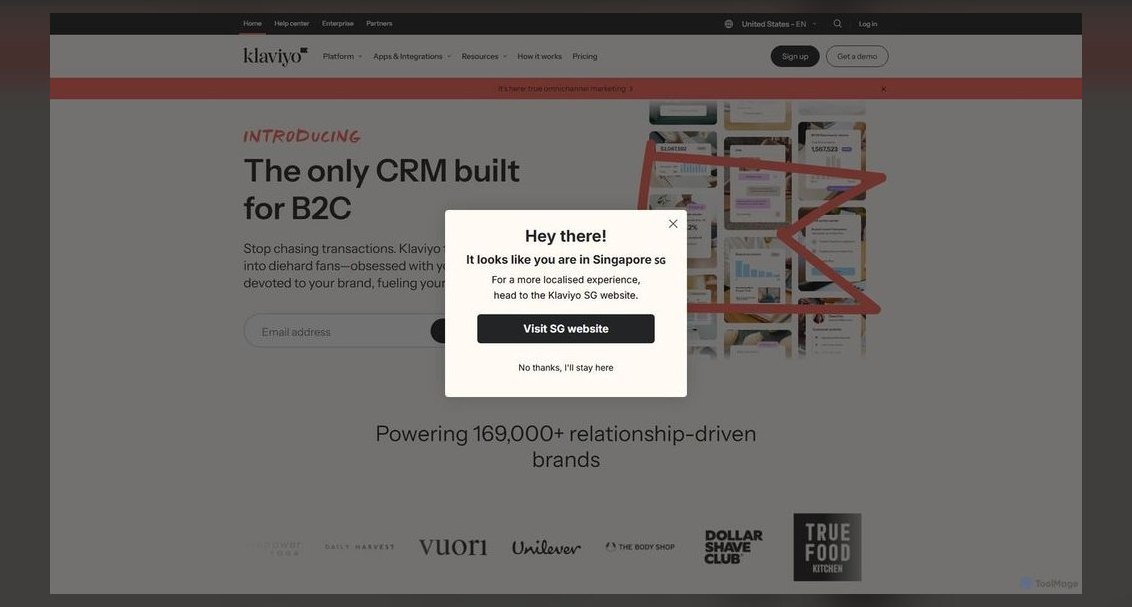
Fifth on the strength of predictive analytics purpose-built for commerce: the platform forecasts customer lifetime value and churn risk, then fires retention flows at high-value segments automatically. The AI Content Engine writes email and SMS copy directly from e-commerce customer data, and Smart Send Time optimizes delivery per subscriber. Pricing begins at $45/month for 500 contacts, with a free plan up to 250 and usage-based SMS charges.
DTC brands and online stores get the most here — browse-abandonment flows with AI-generated recommendations tied to specific viewed items, and two-way Shopify or BigCommerce syncing that feeds purchase data back into predictions. It trades away B2B lead scoring and ABM entirely. Against Braze below it, Klaviyo owns e-commerce email and SMS but lacks Braze's mobile push and in-app messaging depth.
6. Braze

Sixth because Sage AI and AI-powered Liquid templates personalize in real time across email, push, in-app, and SMS from a single Canvas Flow, with AI-suggested conditional branching based on user actions. Intelligent Channel Selection picks the best channel per message, improving engagement 20% per Braze benchmarks. Growth tier pricing starts at $0.10 per monthly active user with a 50,000 MAU minimum — roughly $5,000/month at the floor.
Mobile-first apps and consumer brands with large active-user bases are the fit, especially teams triggering journeys from Amplitude or Mixpanel product analytics. The MAU minimum prices out anyone without significant scale, and the model punishes large but low-engagement audiences. Against SendGrid below it, Braze is a full cross-channel orchestration layer rather than an email delivery platform with marketing features attached.
7. SendGrid

Seventh because it anchors high-volume delivery rather than journey design: $19.95/month covers 50,000 emails on the Essentials plan, with Marketing Campaigns at $149/month for 50,000 contacts. AI-Powered Send Time Optimization and the Content Generator now cover both transactional and marketing sends, and the AI Subject Line Tester predicts open rates before you commit to a list.
This is for SaaS and product teams whose email is mostly transactional with marketing layered on top — welcome series, 60-day re-engagement triggers, Dynamic Templates pulling customer records via handlebars syntax. It trades away visual journey building and predictive lead scoring almost entirely. Compared with Pardot below it, SendGrid wins on price and raw send volume but offers nothing resembling B2B account scoring or pipeline attribution.
8. Pardot

Eighth because its Einstein GPT lead scoring and Engagement Studio drip logic are excellent but narrow — the value collapses outside a Salesforce Sales Cloud environment. Predictive Scoring weighs engagement signals like three email opens in a week against firmographic data such as company size and industry. Growth tier costs $1,250/month for 10,000 contacts, with ABM and ROI reporting priced as add-ons.
B2B software vendors already standardized on Salesforce get closed-loop attribution through B2B Marketing Analytics that few competitors match. The trade is a high floor for only 10,000 contacts and near-total dependence on the Salesforce stack. Against Mailchimp below it, Pardot is a serious pipeline instrument rather than a campaign tool, at roughly a hundred times the entry price.
9. Mailchimp

Ninth because the AI Assistant handles campaign generation, audience segmentation, and send-time optimization competently at $13/month for 500 contacts on Essentials — but depth stops well short of the platforms above. The Customer Journey Builder ships pre-built templates for welcome series, abandoned carts, and re-engagement. Premium runs $350/month for 10,000 contacts, adding advanced segmentation and A/B testing.
Small businesses and startups are the target: birthday discount flows with AI-generated copy, 90-day win-back sequences, and built-in Shopify, WooCommerce, and Canva connections for asset creation. Predictive Demographics estimates age and income from purchase behavior. What it gives up is complex conditional branching and any real B2B scoring. Against Constant Contact below it, Mailchimp offers meaningfully deeper AI and integrations for a dollar more.
10. Constant Contact

Tenth because it is the cheapest legitimate entry point at $12/month for 500 contacts on Lite, while its AI depth trails every tool above it. The AI Content Generator writes email copy, subject lines, and social posts, and Smart Segmentation groups contacts by engagement level, purchase history, and predicted churn. The Pro plan at $45/month for 500 contacts adds A/B testing and automated workflows.
Nonprofits, community organizations, and local businesses are the honest audience — donor thank-you series with AI-generated impact stories, volunteer signup flows, and Event Marketing that ties into Zoom and Eventbrite for automated reminders. It trades away predictive scoring, multi-channel orchestration, and CRM-grade reporting. Against Mailchimp above it, Constant Contact costs marginally less but delivers noticeably thinner AI and fewer integrations.
How we ranked these
We scored 40+ platforms on five weighted criteria built for an AI-first 2027 market: AI capability at 30% (generative content quality, predictive scoring, autonomous send-time and A/B decisions), automation depth at 25% (conditional branching and multi-channel triggers without code), integration ecosystem at 20% (CRM, warehouse, and ad-platform connectors), pricing and scalability at 15%, and user experience and support at 10%. Published pricing was verified against vendor pages.
We deliberately ignored total feature counts, analyst-quadrant placement, and vendor-supplied case studies. Feature lists reward shelfware; quadrants lag actual product shipping by a year or more. We also ignored raw customer counts, which favor incumbents like Mailchimp regardless of AI quality, and vendor-claimed lift percentages such as Braze's 20% engagement figure — those are self-reported benchmarks, not independently audited results you should budget against.
What to look for
The decision is usually made for you by two things: your CRM and your contact volume. If Sales Cloud is your system of record, Marketing Cloud or Pardot removes a sync layer that otherwise breaks quietly. If you sell physical goods through Shopify, Klaviyo's two-way purchase sync beats any general-purpose tool. Price per contact matters more than sticker price — HubSpot's $800/month Professional tier covers only 2,000 contacts.
The common mistake is buying AI features you have no data to feed. Predictive lead scoring trained on your closed-won deals needs a few hundred closed deals to be worth anything; below that it is guessing with a confidence bar. Teams also underestimate migration: rebuilding journeys, re-consenting lists, and re-mapping fields typically costs more in staff hours than the first year of license fees.
Related questions
What is the difference between AI-powered automation and traditional marketing automation?
Traditional automation is rule-based: if an email opens, send the follow-up. You write every branch. AI-powered tools use predictive models and generative AI to decide what to send, when to send it, and to whom, adapting as behavior changes. The practical difference is that you define outcomes and guardrails instead of hand-authoring every conditional path.
How much does AI marketing automation cost in 2027?
Entry-level tools start around $12 per month — Constant Contact's Lite plan for 500 contacts. Mid-market lands between $45 and $800 per month depending on contact count. Enterprise platforms like Salesforce Marketing Cloud start at $1,250 per month for 50,000 contacts, plus usage-based AI credits. Nearly every vendor charges on contact volume, so your list size drives cost more than your feature tier.
Can I run these tools without a CRM?
Yes, and for e-commerce it is often the right call — Klaviyo runs on your store data and needs no separate CRM. But predictive lead scoring and closed-loop revenue reporting both require CRM records to train on and attribute to. Without one, you get generative content and send-time optimization but lose the pipeline attribution that justifies the spend to finance.
Which tool is best for account-based marketing in 2027?
Marketo Engage and HubSpot Marketing Hub lead here, both offering native account scoring and multi-touch attribution across the buying committee. Pardot is the stronger pick if your team already lives in Salesforce Sales Cloud, since account records sync without a middleware layer. Marketo's Revenue Cycle Analytics gives the most granular view of which touchpoints actually influenced pipeline.
How do I measure ROI from AI marketing automation?
Track attributed pipeline revenue, cost per qualified lead, and engagement rates as a leading indicator. The harder work is connecting campaign touches to closed deals — revenue intelligence tools like Clari and Gong bridge that gap by tying call and deal data back to marketing activity. Set a baseline before you switch platforms, or you will have nothing to compare the new numbers against.
Are free trials available on these platforms?
Most vendors offer 14 to 30 day trials. HubSpot runs a permanently free CRM tier with limited marketing features, which is useful for evaluating the data model before committing. Mailchimp's free plan covers up to 500 contacts, and Klaviyo is free up to 250. Trials rarely include the enterprise AI features, so ask specifically for a sandbox with those enabled.
What is the best tool for a startup with 100 contacts?
Mailchimp at $13 per month for 500 contacts is the cheapest path that still includes a journey builder. ActiveCampaign at $49 for 1,000 contacts costs more but gives you conditional content, split testing, and a journey builder you will not outgrow in year two. Constant Contact's $12 Lite plan is cheapest overall but thinnest on AI.
Which platform handles multi-channel messaging best?
Braze is built for it — email, push, in-app, and SMS all live in one Canvas Flow, and its Intelligent Channel Selection picks the channel per message rather than per campaign. The catch is pricing: $0.10 per monthly active user with a 50,000 MAU minimum makes it a poor fit for anything but consumer apps at scale.
FAQ
Why does HubSpot rank first over Salesforce Marketing Cloud?
HubSpot's Breeze AI is native to the same platform that holds the CRM record, so predictive scoring and content generation read from one data model with no sync lag. Marketing Cloud with Einstein GPT is more powerful at enterprise scale but assumes you already run Sales Cloud and Service Cloud. For teams without that footprint, HubSpot delivers more capability per dollar and per implementation week.
What does HubSpot Marketing Hub actually cost?
The Professional plan starts at $800 per month and includes 2,000 marketing contacts plus unlimited AI-generated content drafts. Contact overages are the line item to watch — a list that grows past the included tier drives cost up faster than adding seats. Budget separately for onboarding, which HubSpot typically charges as a one-time fee on Professional and Enterprise tiers.
Is ActiveCampaign genuinely the best value pick?
For SMBs and lean teams, yes. The Plus plan starts at $49 per month for 1,000 contacts and includes split testing and conditional content blocks that competitors reserve for higher tiers. Its AI Content Generator and Predictive Sending cover the automation most small teams actually use. Where it falls short is enterprise ABM and deep warehouse integration.
Which platform is best for DTC and e-commerce brands?
Klaviyo. Its two-way Shopify and BigCommerce sync pushes purchase data back into the model, which sharpens lifetime-value and churn predictions in a way one-way connectors cannot. Pricing starts at $45 per month for 500 contacts with a free tier up to 250, and SMS is billed on usage. Browse-abandonment and post-purchase flows are the standout use cases.
When should I choose Pardot instead of Marketo Engage?
Choose Pardot when Salesforce is your system of record and your buying cycle is straightforward — Einstein GPT scoring and Engagement Studio sit directly on Sales Cloud data with no integration work. Choose Marketo Engage at $1,800 per month when you need multi-touch ABM across large buying committees and granular revenue-cycle attribution. Marketo costs more and takes longer to implement.
Do I need a data warehouse to get value from these tools?
No, but it changes what is possible. SendGrid's Event Webhook streams opens and clicks to Snowflake in real time, letting you train custom models the vendor does not offer. Marketing Cloud's Einstein Recommendations improves measurably when fed warehouse purchase history. Without a warehouse, you are limited to the predictions each vendor ships — which is adequate for most mid-market teams.
How long does implementation typically take?
Plan on two to four weeks for SMB tools like ActiveCampaign, Mailchimp, or Constant Contact, where the journey builder is drag-and-drop and integrations are prebuilt. Enterprise platforms — Marketo, Marketing Cloud, Pardot — routinely run three to six months once you account for field mapping, list re-consent, journey rebuilds, and training. The migration cost usually exceeds first-year license fees.
Are the AI-claimed performance lifts trustworthy?
Treat them as directional, not contractual. ActiveCampaign reports 15 to 25 percent open-rate improvement from Send Time Optimization, and Braze cites 20 percent engagement gains from Intelligent Channel Selection. Both are internal benchmarks, not audited third-party results, and both were measured on the vendor's own customer base. Run a holdout group during your trial and measure the lift on your own list.
What happens to my automation if I switch platforms later?
Journeys do not export. Contact lists, custom fields, and historical engagement data usually migrate through CSV or API, but every conditional branch, trigger, and template has to be rebuilt by hand in the new tool. Predictive models restart from zero and need months of data to become useful again. This is the single strongest argument for picking a tool you will not outgrow.
Which tool fits a nonprofit or local business best?
Constant Contact's Lite plan at $12 per month for 500 contacts is the most affordable real entry point, and the Pro plan at $45 adds A/B testing and automated workflows. Its 2027 Event Marketing features integrate with Zoom and Eventbrite for automated reminders, which matters for organizations running programming. AI depth is thinner than higher-tier tools, but the core automation works.
Sources
- https://www.hubspot.com/products/marketing/ai
- https://www.salesforce.com/products/marketing-cloud/ai/
- https://www.activecampaign.com/pricing
- https://business.adobe.com/products/marketo/adobe-marketo-engage.html
- https://www.klaviyo.com/pricing
- https://www.braze.com/
- https://sendgrid.com/en-us/pricing
- https://mailchimp.com/pricing/
- https://www.constantcontact.com/pricing
- https://www.g2.com/categories/marketing-automation
Related on PULSE
- [More ai-powered marketing automation tools rankings and buying guides](/knowledge)
- [PULSE Tools and calculators](/tools)
- [Everything on PULSE RevOps](/)
 softwareHow to create a custom dashboard in HubSpot CRM for tracking sales performance in 2027?
 softwareCan Trello’s Butler automation replace Zapier for simple CRM-to-email triggers?
 softwareWhat are the key differences between Mailchimp and ActiveCampaign for email automation workflows?
 softwareIs Monday.com better than Asana for cross-team project tracking with Gantt charts?
 softwareIs HubSpot CRM free enough for a 5-person startup or will I hit limits immediately?
 softwareCan I use HubSpot CRM for free with more than 1,000 contacts?
 swTop 10 Video Conferencing Apps for Business in 2027
 softwareTop 10 video conferencing software in 2027
 softwareTop 10 email marketing software for e-commerce in 2027
 softwareTop 10 customer success platforms in 2027