
How do I hire a fractional VP of Sales for a legaltech company in 2027?
 Curated byKory White · Fractional CRO · Maryland
 PULSEKNOWLEDGE LIBRARY
Quality
Certified

Hire a fractional VP of Sales for legaltech by defining scope first — pipeline, closing, or team building — then screening hard for law firm and in-house legal buying fluency. Expect a 3–6 month retainer at 2–5 days per week, written deliverables, a 30–60 day out clause, and references from comparable-stage legaltech companies.
The end-to-end process from decision to first pipeline review
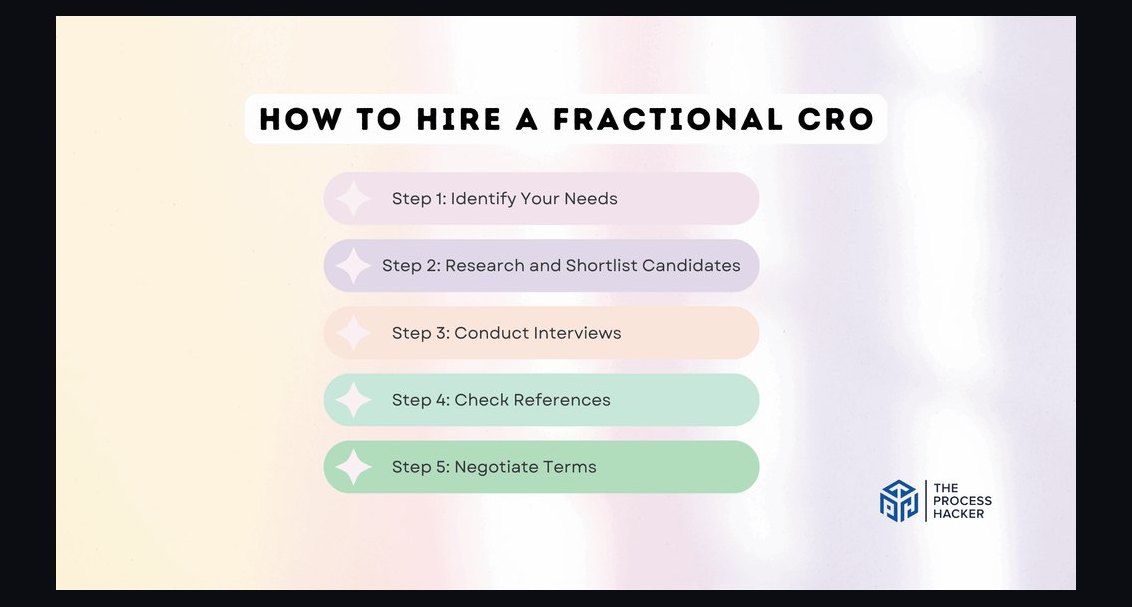
The hiring motion for a fractional revenue leader looks nothing like a full-time executive search, and treating it like one is the most common way legaltech founders waste a quarter. A retained search for a full-time VP of Sales runs eight to sixteen weeks before a start date, plus another two to three months of ramp. A fractional engagement can be scoped, screened, referenced, and signed in two to four weeks, with the person inside your CRM in week one. That compression is the entire point — but it only works if you do the sequencing correctly instead of improvising.
Start with a scope document. It does not need to be long; a single page is enough. Write down what you actually want changed in ninety days. "Build pipeline" is not a scope. "Generate forty qualified opportunities from mid-market law firms, rebuild the discovery call script for a compliance-heavy buyer, and hire one AE" is a scope. Founders who skip this step end up hiring someone who spends the first six weeks doing discovery on their own role, which you are paying retainer rates for.
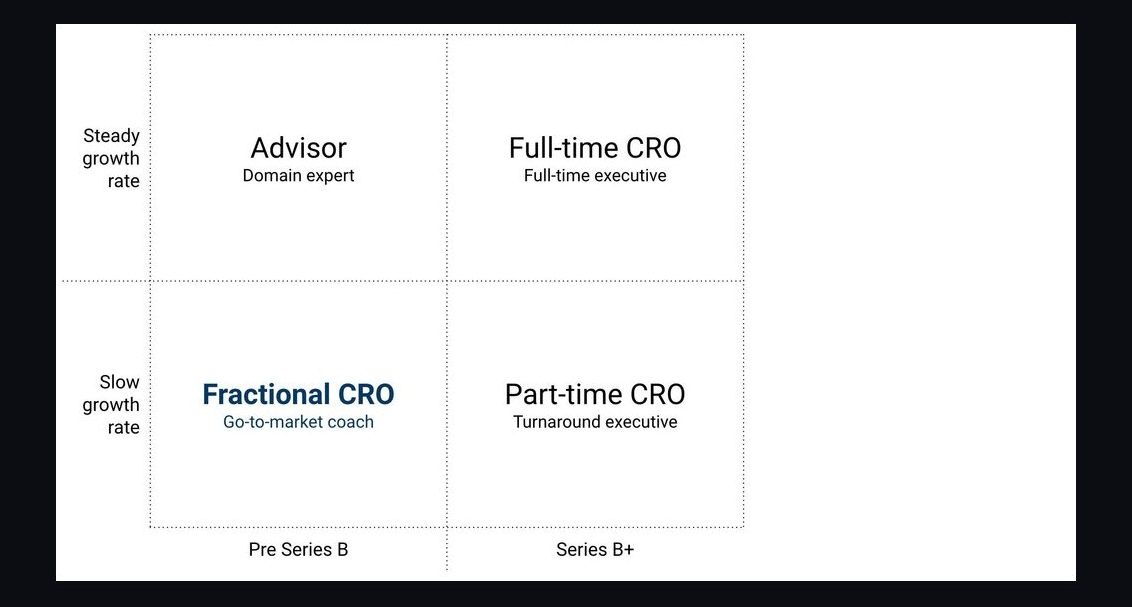
Next, decide the shape of the gap. There are three distinct fractional profiles, and they are not interchangeable. The builder creates a repeatable motion where none exists: messaging, ICP definition, outbound sequences, a first playbook. The closer parachutes into a company that has leads but cannot convert them, and personally works the top ten deals while teaching the team by demonstration. The manager inherits an existing team of three to eight reps that is underperforming and fixes forecasting, territory design, comp, and accountability. A pre-product-market-fit legaltech company almost always needs a builder. A company at $3M ARR with five reps and a 12% win rate needs a manager. Ask candidates which of the three they are, and be suspicious of anyone who says "all of them" without evidence.
Sourcing comes third. The strongest fractional operators in this space are not on job boards — they are booked through referral chains. Work the network in this order: your investors' portfolio founders (they have hired fractional leaders and will tell you honestly who delivered), legaltech-specific communities and conference alumni, revenue leader communities like Pavilion, and only then LinkedIn search. When you search LinkedIn, filter for profiles that name specific legaltech employers rather than generic "fractional CRO" headlines, and read the recommendations rather than the summary.

Screening is where legaltech diverges hardest from generic SaaS hiring. Your first-round question should be about buying committees, not about quota attainment. Ask a candidate to walk you through the last legal-sector deal they closed: who signed, who blocked, what the security review required, how long procurement held it, and what the pricing model was. A generalist will describe a champion and an economic buyer. Someone who has actually sold into law firms will mention the practice group leader whose billable hours were at risk, the IT director who demanded SOC 2 Type II and a penetration test summary, the firm's general counsel or risk committee, and possibly an outside client whose data governance terms flowed through the contract.
Reference checks are non-negotiable and should be structured, not casual. Ask for three former clients at roughly your stage and revenue. Call all three. Use the same four questions with each: What did they actually build that outlived them? Did the pipeline they created convert after they left? How did they handle the month where nothing closed? Would you hire them again at a higher rate? The last question is the sharpest — people will say "yes, I'd hire them again" reflexively, but adding a price increase forces an honest answer.
Contracting should be boring. A monthly retainer, a defined day count, a start date, a written deliverable list, a 30–60 day termination clause for either party, standard IP assignment, and a confidentiality clause that accounts for the fact that your candidate probably serves two or three other clients. Ask explicitly about conflicts: are any of their other clients competitive with you, and what happens if one becomes competitive mid-engagement? A professional operator will have a clean answer ready.
Onboarding in week one should be aggressive. Give CRM access on day one, not day ten. Hand over the last twelve months of closed-won and closed-lost records, the current pricing sheet, any security questionnaire responses you have already completed, and access to your two best customers for reference calls. A strong fractional leader will produce a diagnostic memo within ten business days identifying where your funnel actually breaks. If week three arrives and you have received nothing written, that is a real signal, not a scheduling problem.

Where legaltech engagements create revenue and where they quietly leak it
The revenue math on a fractional VP of Sales is not primarily about cost savings, even though the cost comparison is what founders fixate on. The real value is time-to-competence. A full-time VP hired from adjacent SaaS spends four to six months learning that law firm partners think about software purchases as a threat to billable hours, that legal IT teams have veto power disproportionate to their headcount, and that a firm's fiscal calendar often keys to partner distributions rather than a standard fiscal year. A fractional operator who already knows those things starts contributing in week two. Six months of executive salary burn is the actual number you are avoiding, not the delta in day rate.
Value creation shows up in four specific places. First, cycle compression through better qualification. Legaltech deals often run six to eighteen months not because the buyer is slow but because the seller failed to identify who could actually kill the deal. A leader who front-loads the security review — sending your SOC 2 report, penetration test summary, and data residency documentation before the buyer asks — routinely removes four to eight weeks from the back half of a cycle. Second, pricing discipline. Many early legaltech companies price per-seat when their buyer thinks in matters, documents, or practice groups. Repackaging to match how the firm budgets can lift average deal size meaningfully without changing the product. Third, pipeline hygiene. A stalled legaltech deal looks identical to a live one in most CRMs, because both are quiet for weeks. Someone who imposes a real exit criteria per stage will typically remove twenty to forty percent of the reported pipeline in the first month, which feels like a loss and is actually the beginning of a usable forecast. Fourth, hiring leverage — a fractional leader who recruits and onboards two competent AEs leaves behind capacity that persists long after the retainer ends.
The leaks are just as concrete. The largest is scope creep into non-sales problems. Founders under revenue pressure hand the fractional VP customer success escalations, partner negotiations, pricing pages, and board deck production. Every hour spent there is an hour not spent on pipeline, and because they are fractional, there are far fewer hours to redirect. Write down explicitly what is out of scope.

A second leak is the two-day-per-week trap. Two days is enough to advise, review, and coach. It is not enough to build a motion from nothing. If you are pre-product-market fit and you buy two days a week, you will get thoughtful diagnosis and very little execution, then conclude that fractional does not work. It worked; you underbought.
Third, knowledge that leaves with the person. A fractional engagement ends. If everything the operator learned lives in their head and their personal notes, you have rented insight rather than bought an asset. Require that the playbook, the objection handling library, the ICP definition, the security questionnaire response bank, and the forecast methodology all live in your systems in your account. Make it a contractual deliverable rather than a hopeful assumption.
Fourth, misaligned incentives on equity. Founders offer equity to reduce cash outlay, which is reasonable, but often attach it to tenure rather than outcomes. A fractional leader who vests on a calendar has a mild incentive to extend the engagement. One who vests on a milestone — a specific ARR threshold, a completed hire, a documented and adopted playbook — has an incentive to finish. Milestone-based vesting is harder to draft and materially better aligned.
Downstream of the engagement, there is a decision most companies handle badly: what happens at month six. The three real options are convert the fractional leader to full-time, extend at a reduced day count as an advisor while you hire a full-time VP underneath the motion they built, or end cleanly and promote internally. The worst outcome is drift — quietly rolling month to month for eighteen months with no decision, which costs more than a full-time hire and produces a leader with divided attention. Put the month-six decision on the calendar at signing.

Concrete numbers, benchmarks, and how to sanity-check a proposal
Be careful with published rate ranges, because the fractional market is genuinely wide and varies by geography, stage, and whether equity is in the mix. What follows is how to reason about the numbers rather than a price list you should treat as gospel.
Fractional pricing is almost always structured one of three ways. A monthly retainer for a fixed number of days is the most common and the easiest to manage — you agree on, say, three days a week, and you pay the same amount regardless of whether a given week is light. A project or milestone fee works for narrowly-scoped builds like "produce a playbook and hire two AEs in ninety days" and reduces ambiguity, but it fits poorly with legaltech's long cycles because the outcomes you care about land after the project ends. An hourly arrangement is generally the worst fit for a leadership role; it incentivizes logged hours over judgment and makes the operator hesitant to think about your business between sessions.
For benchmarking, anchor on the full-time equivalent. Look up current VP of Sales compensation for your metro and stage using public compensation datasets and job postings — many jurisdictions now require salary ranges in listings, which makes this easier than it used to be. Take that fully loaded number (base plus variable plus benefits plus payroll taxes plus recruiting fee, which for a retained search is typically a meaningful percentage of first-year cash comp), divide by five to get a per-day equivalent, and expect a fractional day rate to sit above that per-day figure. It should be higher — you are paying a premium for zero ramp, no severance exposure, and no recruiting cost. If a proposal comes in dramatically below the full-time per-day equivalent, ask why, because either the person is early in their fractional career, is stretched across too many clients to serve you well, or does not have the domain depth you are screening for.
On equity: a common structure for fractional executives is a smaller grant than a full-time hire would receive, on a standard four-year schedule with a one-year cliff, sometimes accelerated or shortened to match the engagement length. Trading cash for equity typically reduces the monthly outlay somewhat, but do the math honestly — for a pre-seed company, equity is the most expensive currency you have, and using it to shave a modest amount off a six-month retainer is often a bad trade. Reserve equity for engagements you expect to convert or extend past a year.

Legaltech-specific benchmarks worth tracking from day one, regardless of who you hire:
Sales cycle length by segment. Solo and small-firm deals can close in weeks. Mid-market firms typically run months. Am Law 100 firms and large corporate legal departments commonly run six to eighteen months with a formal security review and procurement negotiation. Track these separately — a blended average cycle across those segments is a meaningless number that will wreck your forecast.
Security review pass rate and duration. Instrument this explicitly. What percentage of deals that reach security review clear it, and how many calendar days does it take? This is often the single largest source of unexplained slippage in legaltech, and most companies do not measure it because it does not exist as a CRM stage. Add the stage.
Pipeline coverage ratio. Standard SaaS guidance of roughly three to four times quota needs adjustment upward in legaltech, because long cycles mean more deals go dormant rather than lost, and dormant deals inflate coverage while contributing nothing. Insist on a "no activity in sixty days" auto-flag.

Win rate against the incumbent versus against no decision. In legal software, your most common competitor is the status quo — a shared drive, an email folder, a decades-old on-premise system, or a paralegal doing it manually. Segment your losses. Losing to a named competitor is a product or positioning problem. Losing to no decision is a business case problem, and the fix is entirely different.
Ramp time for new AEs. Legaltech AE ramp typically runs longer than generic B2B SaaS because the vocabulary alone takes a quarter. Budget accordingly when your fractional leader proposes hiring.
Finally, benchmark the engagement itself. By day thirty you should have a written diagnostic and a rebuilt qualification framework. By day sixty you should see measurable change in pipeline hygiene — stage definitions enforced, stale deals cleared, forecast categories that mean something. By day ninety you should see leading indicators moving: more qualified first meetings, faster progression through early stages, security reviews initiating earlier. Do not expect closed revenue at ninety days in a market with a six-to-eighteen-month cycle; demanding it will push your operator toward discounting and small deals that distort your ICP.
Pitfalls that sink legaltech fractional engagements
Hiring a generalist and expecting fast domain absorption. This is the most expensive mistake and the most common. Legaltech has its own vocabulary — matters, engagement letters, conflicts checks, trust accounting, e-discovery review workflows, retention schedules, privilege logs. A leader who has to learn that vocabulary will spend the first two months translating rather than selling, and by then you are already deciding whether to renew. Adjacent domains do transfer reasonably well: regulated fintech, healthcare compliance software, and enterprise governance-risk-compliance tools all share the security-review-heavy, committee-driven buying pattern. Generic mid-market SaaS transfers poorly.

Buying too few days for the job. Covered above, but worth repeating because founders under cash pressure make this trade constantly. A two-day-per-week engagement is an advisory relationship. If your ask includes personally working deals, running weekly pipeline reviews, interviewing candidates, and writing a playbook, you need four to five days, at least for the first sixty days. A reasonable compromise is a front-loaded structure: heavier days for the first two months, stepping down once the motion exists.
No written success definition. If you and your fractional VP have different definitions of a good ninety days, you will discover it in month four during an awkward conversation. Write down three to five outcomes, with numbers, before the start date. Revisit them at day forty-five and adjust openly if the diagnosis changed what matters — that is legitimate — but never leave them unwritten.
Letting them operate without the founder in the room. Early-stage legaltech deals close partly on founder credibility, especially when the buyer is a managing partner evaluating whether your company will exist in three years. A fractional VP cannot replace that. The right pattern is the operator running the process and the founder appearing at the moments that require them. Founders who fully delegate and disappear see win rates drop.
Ignoring the security and compliance surface. If you do not have SOC 2 Type II, a documented data retention policy, a penetration test from the last twelve months, and clear answers on data residency and subprocessors, no sales leader — fractional, full-time, or otherwise — will get you through enterprise legal procurement. This is a company problem, not a sales problem, and it is worth diagnosing before you spend on a revenue hire. A good fractional VP will tell you this in week two; a mediocre one will keep selling into a wall.

Treating RevOps as optional. Hiring a sales leader into a broken data foundation is like hiring a driver for a car with no dashboard. If your CRM stages are undefined, your closed-lost reasons are free text, and nobody can produce a reliable conversion rate by segment, your fractional VP will spend a third of the engagement doing RevOps work at leadership rates. Either fix the data layer first with an ops contractor at a lower cost, or explicitly scope and budget that cleanup as part of the engagement rather than pretending it will not happen.
Conflicts of interest across a portfolio. Fractional operators serve multiple clients simultaneously, which is fine and normal. It becomes a problem when two clients converge on the same buyer set. Ask up front, get a written commitment to disclose new engagements, and include a clean exit path if a conflict emerges.
Confusing a fractional VP of Sales with a fractional CRO. The VP of Sales role owns pipeline, the sales team, and closing. A CRO owns the whole revenue function — marketing, sales, customer success, partnerships, and the RevOps layer underneath. If your problem is that marketing generates leads sales considers junk, hiring a VP of Sales will not fix it, because the fracture is at the boundary neither side owns. Diagnose whether your problem lives inside sales or between functions before you write the job scope.

Letting the engagement drift past its decision point. Set the month-six review at signing. Decide to convert, extend with reduced scope, or end. Ambiguity here is the quiet default and it is the most expensive outcome available.
A selection checklist you can actually run
Turn the screening into a scored process rather than a series of pleasant conversations. Five dimensions, weighted for legaltech.
Domain fluency (heaviest weight). Can they name specific legaltech or adjacent regulated-software companies they have sold for or into? Can they describe a legal buying committee without prompting? Do they know what a conflicts check is, what a matter number does, why a firm's IT team cares about data residency? Test this with a scenario: "A managing partner loves us, IT is neutral, and the firm's risk committee has not seen us. What do you do next?" A strong answer involves getting the risk committee's requirements in writing early and arming the champion with the documentation to survive a review they will not attend.
Operational rigor. Give them read access to a sanitized slice of your pipeline before the final conversation and ask what they see. Someone with rigor will come back with specific observations: stages that do not gate on anything, deals with no next step, a conversion cliff between demo and security review. Someone without will return generalities about "focusing on qualification."

Evidence of durable output. Ask what artifact they left behind at their last three clients and whether it is still in use. Playbooks, objection libraries, territory models, forecast processes. The answer distinguishes an operator from a very experienced advisor.
Availability honesty. Ask how many clients they currently serve and what the day commitments are. Add them up. If the total exceeds five days a week, ask directly how yours will not be the one that slips. There are legitimate answers — some engagements are winding down — but you want the arithmetic on the table.
Founder chemistry. Legaltech founders are frequently former practicing attorneys or legal operations leaders. That population tends to value precision and to react badly to unsupported claims. Watch how a candidate handles being challenged on a number. Defensiveness in an interview becomes defensiveness in a board meeting.
Run this as three touches, not five. First, a sixty-minute screen focused entirely on domain and buying committees. Second, a working session where they analyze real pipeline data and present findings — pay them for this if it takes more than ninety minutes, both because it is fair and because paid work reveals how they actually operate. Third, structured reference calls you make yourself rather than delegate. Then decide within a week. Strong fractional operators are usually deciding among several engagements, and a slow process loses the ones you most want.
Related questions
Should a legaltech company hire a fractional VP of Sales or a fractional CRO?
If the breakdown is inside the sales team — pipeline, conversion, rep performance — hire a VP of Sales. If it sits between marketing, sales, and customer success, or if RevOps is unowned, you need a CRO-level scope. Diagnose where the fracture actually is before writing the job description.
How long should a fractional sales engagement in legaltech last?
Plan a three-to-six month initial term with a defined month-six decision point: convert, extend at reduced days, or end. Long legal sales cycles mean revenue outcomes may land after the term, so evaluate on leading indicators — qualified meetings, cycle progression, security review timing — not closed ARR.
Can a fractional VP of Sales work fully remote for a legaltech company?
Yes, and most do. Reserve travel budget for board meetings, major firm visits, and industry conferences where legal buyers actually gather. What matters more than location is timezone overlap with your team and a written commitment to specific weekly hours rather than vague availability.
What should a fractional VP of Sales deliver in the first thirty days?
A written diagnostic of where the funnel breaks, rebuilt stage definitions with real exit criteria, a cleaned pipeline with dormant deals flagged, a segmented view of win rates including losses to no decision, and a prioritized ninety-day plan with named owners and dates.
Does hiring fractional signal weakness to legaltech investors?
Generally no — investors see fractional leadership as capital-efficient sequencing, particularly pre-Series A. What concerns them is drift: an engagement running eighteen months with no conversion decision, or a fractional leader whose name appears on three portfolio companies simultaneously without disclosure.
FAQ
What is the difference between a fractional VP of Sales and a sales consultant?
A fractional VP of Sales holds operational ownership — they run the forecast, manage reps, sit in your leadership meetings, and are accountable for pipeline outcomes. A consultant diagnoses and recommends. The distinction shows up in whether they carry a number and whether your reps report to them. If you need someone to make decisions rather than produce a deck, you want the fractional leader.
How do I verify legaltech domain experience without industry contacts of my own?
Use the scenario interview. Present a realistic deal — a mid-market firm, an enthusiastic practice group leader, an unresponsive IT director, a procurement team asking about data residency — and ask what happens next. Someone with real experience will move immediately to the security documentation, the internal business case, and the risk committee. Then verify against references you source yourself from LinkedIn rather than the list they hand you.
What happens to my pipeline when the engagement ends?
That depends entirely on what you contracted for. Require that all pipeline, notes, playbooks, objection handling, and forecast methodology live in your CRM and your document systems under your accounts, not in personal files. Build a two-week overlap into the exit for handoff to whoever inherits the motion. Companies that skip this discover after departure that half the deal context existed only in one person's head.
Is a fractional VP of Sales worth it before product-market fit?
Sometimes, but the scope is different. Pre-PMF you are not scaling a motion — you are discovering whether one exists. A fractional leader who is genuinely good at customer discovery and can feed structured buyer feedback into product is valuable. One who wants to hire reps and build a comp plan is premature and will burn cash. Be explicit that the mandate is learning, not scaling.
How do I structure equity for a fractional executive?
Prefer milestone vesting over calendar vesting. Tie tranches to outcomes you actually care about — a documented and adopted playbook, a specific ARR threshold, two AEs hired and ramped. Use standard paperwork and have counsel review it, since fractional executives are typically contractors rather than employees, which affects tax treatment for both sides. Keep the grant modest and reserve larger equity for a conversion to full-time.
Do I need RevOps in place before hiring a fractional sales leader?
You need enough data hygiene that pipeline reports mean something — defined stages, structured closed-lost reasons, clean account records. You do not need a full RevOps function. If your CRM is genuinely a mess, scope the cleanup separately with an operations contractor first; paying a sales leader's rate for data remediation is an expensive way to get a tidy CRM.
Sources
- Pavilion — community and job board for revenue leaders, including fractional roles
- SaaStr — sales leadership hiring, ramp, and compensation guidance for SaaS companies
- First Round Review — long-form startup guides on early sales hiring and go-to-market sequencing
- Harvard Business Review — research on sales management, executive hiring, and organizational design
- AICPA SOC 2 overview — the trust services criteria enterprise legal buyers evaluate
- Legaltech News (ALM) — coverage of legal technology buying, vendors, and firm adoption
- Bureau of Labor Statistics — Sales Managers — occupational wage and employment data for benchmarking
- Stanford Law School CodeX — legal informatics research and the legaltech company landscape
- NIST Cybersecurity Framework — the security baseline referenced in many enterprise legal vendor reviews
- LinkedIn — sourcing and verifying fractional executive backgrounds and recommendations
Related on PULSE
- [How to build a sales playbook for a long enterprise sales cycle](/knowledge.html)
- [What pipeline coverage ratio should a B2B SaaS company target](/knowledge.html)
- [How to structure compensation for a first sales hire](/knowledge.html)
- [When should a startup hire a full-time VP of Sales instead of fractional](/knowledge.html)
- [How RevOps fixes forecast accuracy in a committee-driven sale](/knowledge.html)
- [How to pass an enterprise security review as an early-stage vendor](/knowledge.html)
This page will be disappearing soon. Save it to your device for $1 — or read it free while it is here.
@Kory-White- · if Venmo asks, the last 4 of my number are 2012
 pulse-toolsHow do I find a fractional CRO in Oakton in 2027?
 pulse-toolsIs there a fractional CRO available near me in the Gulf Coast in 2027?
 pulse-toolsHow do I evaluate a fractional CRO in San Diego in 2027?
 pulse-toolsHow do I find a fractional CRO in Austin in 2027?
 pulse-toolsHow do I hire a fractional VP of Sales in Charleston in 2027?
 pulse-toolsHow do I hire a fractional VP of Sales in Raleigh in 2027?
 pulse-toolsHow do I find a fractional CRO in Christiana in 2027?
 pulse-toolsWhere do I find a fractional VP of Sales in Berkeley in 2027?
 pulse-toolsShould I Hire a Fractional CRO If I Have No Sales Enablement Function in 2027?
 pulse-toolsHow do I find a fractional CRO in Minneapolis in 2027?