
What is the best quiet canister filter for a 40-gallon breeder tank in a bedroom?
 Curated byKory White · Fractional CRO · Maryland
 PULSEKNOWLEDGE LIBRARY
Quality
Certified
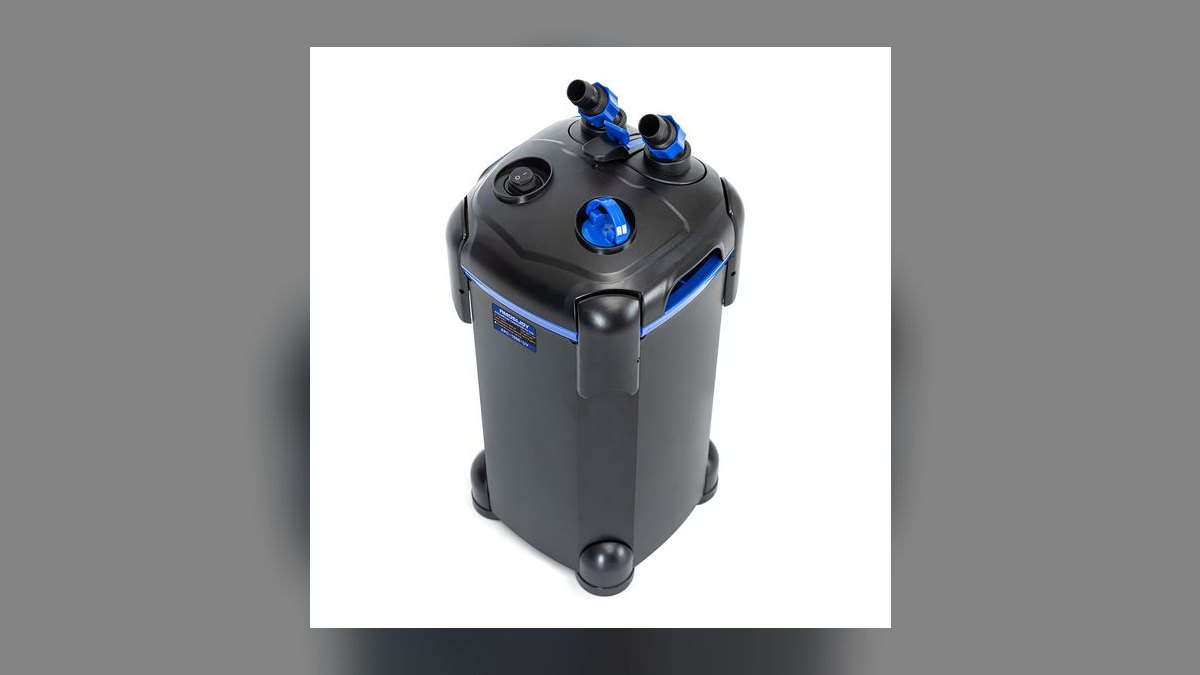
For a 40-gallon breeder in a bedroom, choose a mid-size canister filter rated roughly 250–400 GPH, mount it inside a closed stand on a foam pad, and run the return through a submerged spray bar. Fluval's 07-series, Eheim's Professionel line, and OASE BioMaster are the standard quiet picks; installation quality matters more than brand.
The bedroom tank that woke someone up at 2 a.m.
Picture the setup that generates this question. A 36" × 18" × 16" breeder sits on a wooden stand along the wall opposite the bed, maybe seven feet from the pillow. Daytime, the tank is invisible acoustically — HVAC, traffic, a laptop fan, all of it sits somewhere around 40–45 dBA and swallows everything. Then the house goes quiet at midnight, ambient drops to the mid-20s dBA, and a hum that was never audible becomes the loudest thing in the room. That's the actual failure mode: not a loud filter, but a quiet room.
What makes a breeder specifically prone to this is geometry. A 40 breeder is wide and shallow — 36 inches of surface, only 16 inches of water column. Almost every canister filter ships with a return nozzle designed for a standard 20-inch-plus tank, where the outflow sits well below the surface and the falling water noise is contained. On a breeder, that same nozzle sits three or four inches under, and the moment the water level drops an inch from evaporation, you get surface break, splash, and a faint but relentless trickling sound. Most people diagnose this as "my filter is loud." It isn't. The pump is fine; the return geometry is wrong for the tank.
The second half of the scenario is the stand. Wooden aquarium stands are hollow boxes made of thin panels — structurally a drum. A canister sitting directly on the base panel couples motor vibration into that panel, which radiates it into the room far more efficiently than the motor housing alone ever could. The same filter that measures as a whisper on a concrete garage floor measures noticeably higher inside a hollow cabinet. This is why two people with the same model report wildly different experiences, and why online noise arguments never resolve.
Third factor: air. A canister that has not fully purged its air will gurgle, and a canister with a slow air leak at an O-ring or a loose hose fitting will re-accumulate air in the canister head over days. That produces the classic "it was silent for a week and now it's clicking" complaint. Air noise is intermittent, sharper than motor hum, and much more likely to wake a sleeper than steady broadband noise, because human sleep architecture responds to changes in sound, not absolute level.
So the practical brief for a bedroom breeder is narrower than "buy the quietest filter." It's: pick a pump sized so it isn't straining, decouple it from the stand, get the return below the surface and spread out, and eliminate air. Do those four things and any decent modern canister is bedroom-viable. Skip them and the most expensive filter on the shelf will still annoy you at 2 a.m.
How a canister filter actually makes noise
There are four distinct noise sources inside a canister, and they have different fixes. Confusing them is the reason people replace a perfectly good filter and end up with the same problem.
Motor and impeller. Modern canisters use a synchronous or magnetically driven motor turning an impeller on a ceramic or stainless shaft, riding in rubber or silicone bushings. The motor produces a steady electrical hum, typically in the 100–120 Hz range plus harmonics. The impeller adds a higher-frequency whir. A new, clean, properly seated impeller is the quietest state this assembly will ever be in; from there it degrades as the shaft wears, as calcium builds on the bushings, and as debris lodges in the impeller well. A chipped impeller blade throws the rotor slightly out of balance and turns a hum into a wobble you can feel through the canister lid.
Cavitation and air. If the intake is partially blocked, the water level is low, or a hose fitting draws air, the pump momentarily moves air instead of water. That produces clicking, gurgling, or a rattling that comes and goes. Cavitation is also the only noise source on this list that indicates real mechanical harm — running dry chews up bushings.
Structure-borne transmission. Vibration leaves the canister feet, enters the stand, and the stand panel acts as a soundboard. This is usually the single largest contributor in a bedroom, and it's the cheapest to fix.
Water-surface noise. Outflow breaking the surface, spray bar spraying above the waterline, or a poorly aimed nozzle churning the top inch. On a shallow breeder this is disproportionately common.
The diagnostic order matters. Always test structure-borne transmission first, because it takes ten seconds — press down firmly on the canister lid with the flat of your hand while it runs. If the room gets noticeably quieter, the problem is coupling, not the pump, and a $12 anti-vibration pad solves what a $200 replacement filter would not.
Flow rate interacts with all of this. A canister rated well above the tank's needs runs its pump harder against more head pressure and pushes more water through the return, which increases both motor noise and surface noise. Undersizing is worse for water quality but often quieter. The sweet spot for a 40 breeder is a pump that delivers real turnover — after head loss and media resistance — somewhere in the 4–6× tank volume per hour range, which for 40 gallons means roughly 160–240 GPH actually delivered. Since manufacturer GPH ratings are measured with no media, no hose, and zero head, a filter rated 250–400 GPH typically lands in that delivered range once it's installed and loaded. That's why the rating band in the direct answer looks generous relative to the turnover target.
Real numbers: decibels, turnover, head loss, and what they cost
Decibel numbers in aquarium marketing are close to meaningless without stated conditions, so it helps to anchor to references you can verify yourself with a sound level meter app.
Reference levels. A quiet suburban bedroom at night sits around 25–30 dBA. A refrigerator compressor measured a meter away is roughly 40–45 dBA. Normal conversation at a meter is about 60 dBA. WHO's night noise guidance for Europe recommends keeping outdoor night noise low enough that indoor bedroom levels stay under roughly 30 dBA for undisturbed sleep, with 40 dBA indoors flagged as the level where measurable effects begin. That last number is the one worth internalizing: a filter that measures 44 dBA at your pillow is genuinely too loud for a bedroom, no matter what the box says. A filter that measures 44 dBA at one meter from the canister inside an open cabinet may be perfectly fine at the pillow seven feet away, because sound pressure drops roughly 6 dB per doubling of distance in free field, and a closed cabinet door adds several dB of attenuation on top.
Do the arithmetic. A source at 44 dBA at 1 m falls to about 38 dBA at 2 m, about 32 dBA at 4 m, and around 29 dBA at 7 feet-plus once you account for a closed cabinet panel. That lands under the reference ambient of a quiet bedroom — which is the actual criterion. Manufacturer dB claims are measured at the canister; your ears are not at the canister.
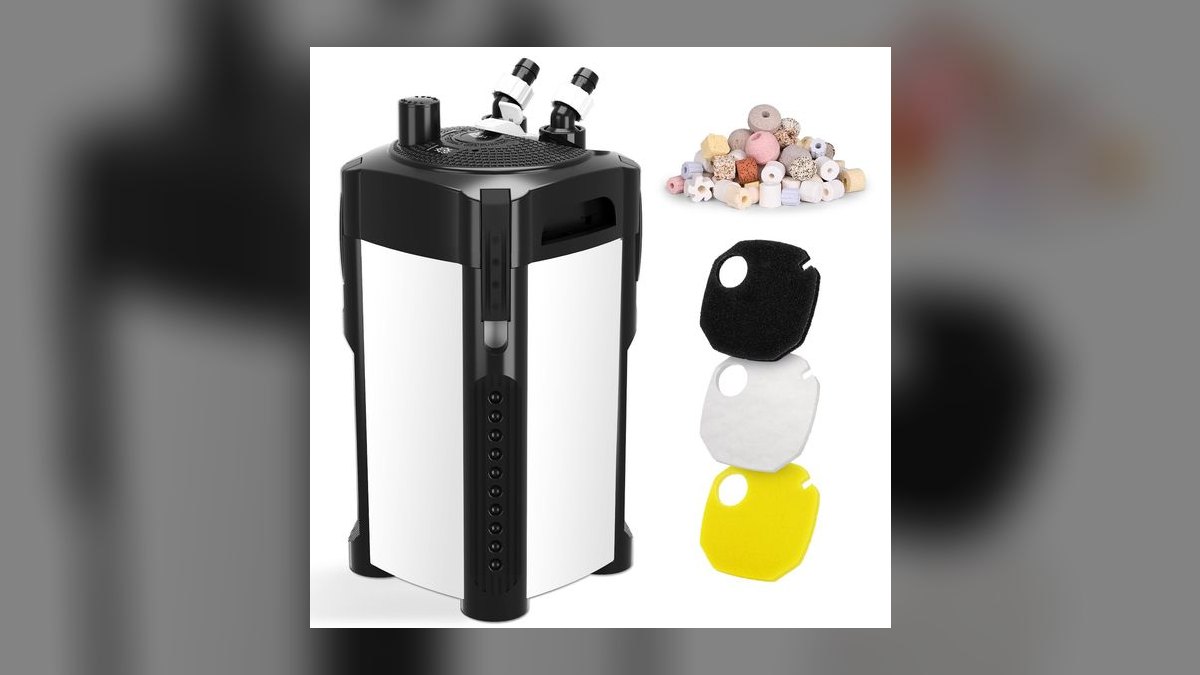
Turnover math for a 40 breeder. Nominal 40 gallons, but with substrate, hardscape, and a water line an inch below the rim, real water volume is closer to 33–35 gallons. At 5× turnover you want ~170 GPH delivered. Canister ratings are free-flow; expect 30–45% loss from hose length, elbows, static head from the canister sitting on the floor up to the tank rim (about 2.5–3 feet on a typical stand), and media resistance. A 300 GPH rated unit therefore delivers roughly 170–210 GPH loaded — right in band. A 400 GPH unit delivers maybe 230–280 GPH, which is more than needed and pushes you toward throttling at the output valve.
Throttling is legitimate and often the quiet move. Restricting a canister's *output* (never the intake) reduces flow, reduces motor load, and on most designs reduces noise. Closing an output valve to roughly 60–70% is standard practice and does not damage the pump the way intake restriction does, because the pump stays flooded.
Media and its cost in flow. A typical mid-size canister holds 3–4 liters of media across three or four baskets. A fully packed fine-pad-plus-sintered-glass stack costs more head loss than a coarse-foam-plus-ceramic-ring stack. If you're chasing quiet, run coarser mechanical media in the first basket and clean it more often rather than packing fine floss and letting it clog. Clogged media raises pump strain and noise measurably within weeks.
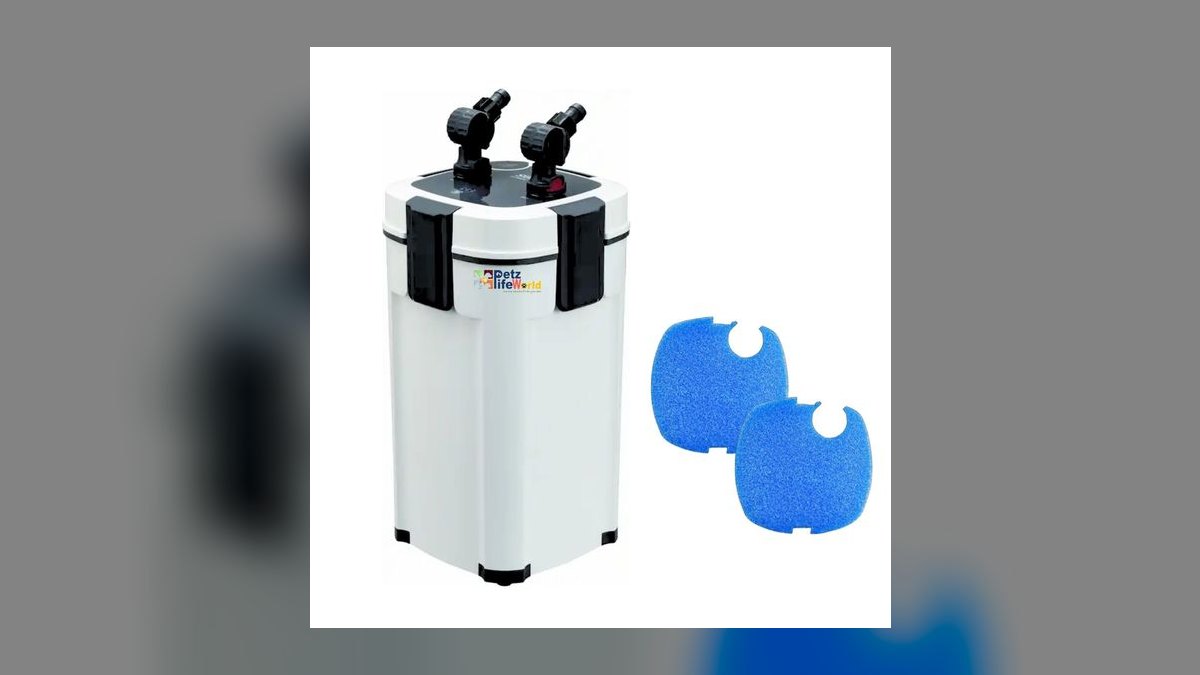
Realistic budget ranges. Mid-size canisters from the mainstream brands generally sit in a $130–$250 band new, with in-line-heater variants and larger models running higher. Consumables — foam pads, floss, carbon, ceramic rings — typically run $10–$30 per replacement cycle. The quieting accessories are cheap by comparison: a dense anti-vibration or washer pad runs about $10–$25, a spray bar kit $10–$20 if not included, silicone O-ring lubricant under $10, and a replacement impeller assembly usually $15–$40. Prices move, so treat these as orders of magnitude rather than quotes.
Maintenance intervals that keep the noise floor flat. Rinse or replace the coarse mechanical stage every 3–4 weeks on a moderately stocked tank. Full canister service — open, rinse baskets, wipe the head — every 2–4 months. Pull and clean the impeller and its well every 4–6 months. Lubricate the main lid O-ring with silicone grease at every full service; a dry O-ring is the most common cause of slow air ingress. Replace the impeller and shaft when noise creeps up and cleaning doesn't restore it, usually somewhere in the 2–4 year range depending on water hardness.
Bioload context. A 40 breeder stocked with a modest community — say a dozen small tetras, a half-dozen corydoras, a centerpiece fish — is a light-to-moderate bioload where 5× turnover is comfortable. The same tank as a cichlid grow-out or a goldfish pair is heavy, and you'd want the upper end of the flow band plus more frequent mechanical cleaning. The bedroom constraint doesn't change biology; it changes how you *achieve* the flow, favoring more surface-spread output over a single high-velocity jet.
Trade-offs: canister versus everything else in a room where you sleep
The question presumes a canister, and for a bedroom that presumption is usually right — the pump lives in a sealed housing inside a closed cabinet, which is structurally the best possible arrangement for hiding noise. But it's worth being honest about where canisters lose.
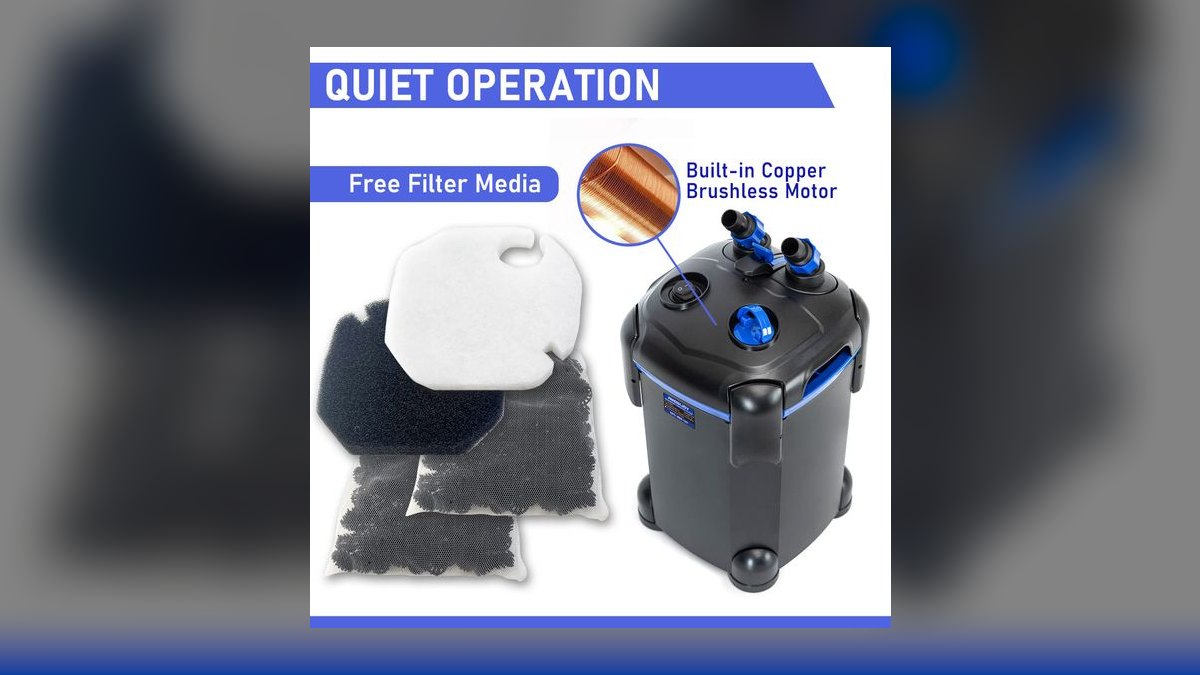
Canister. Quietest ceiling of any powered option when installed well, because the motor is enclosed and remote from the water surface. Large media capacity. Downsides: priming hassle, more failure points for leaks, air accumulation over time, and a full service is a 20–30 minute floor-level job with buckets — not something you'll enjoy doing in a bedroom at 9 p.m.
Hang-on-back. Cheaper, dead simple to service, but the motor is clamped to the tank rim, so it couples vibration directly into the glass, and the return is a literal waterfall. HOBs can be quieted — raise the water level so the outflow is nearly submerged, add foam between the housing and the rim — but their floor is higher than a canister's in a quiet room.
Sponge filter with air pump. The sponge itself is silent; the air pump is not. Air pumps are the single most common source of bedroom aquarium complaints, because diaphragm pumps produce a buzzing that couples into whatever surface they sit on and because the bubble burst at the water surface is a broadband hiss. A sponge can be made bedroom-quiet by suspending the pump on a bungee, running the airline through a check valve, and using a coarse air stone or none at all — but it's more fiddling than a canister needs.
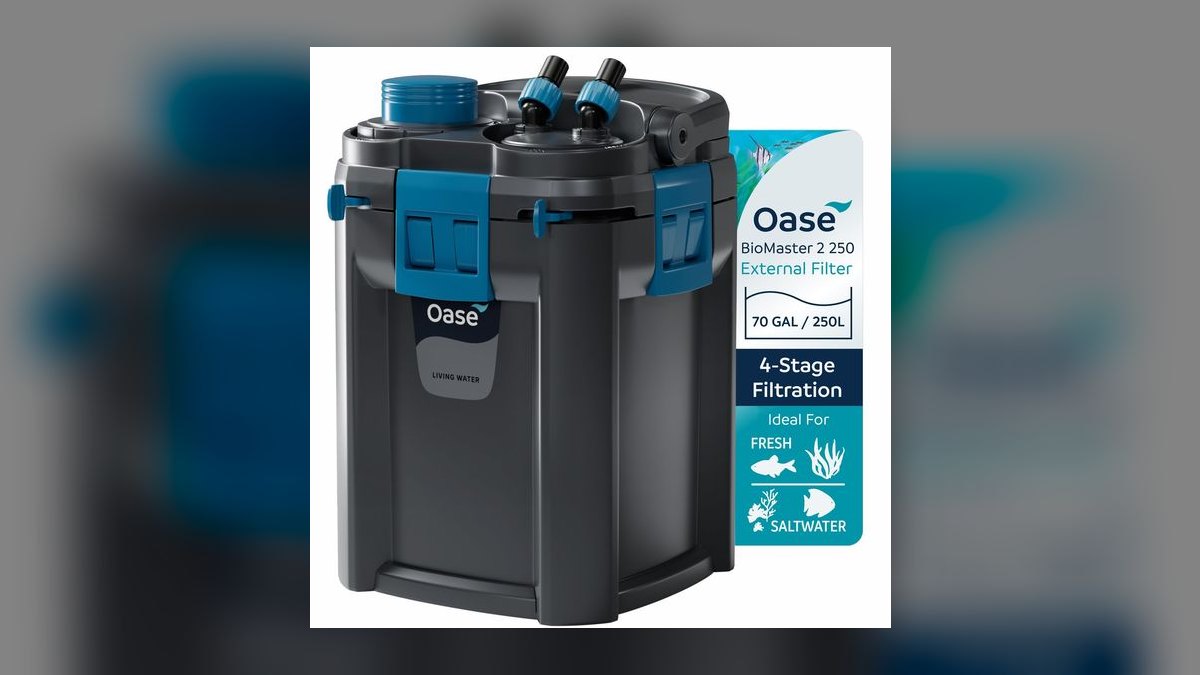
Sump. Best biological capacity and the return pump can be fully submerged, which is inherently quiet, but the overflow is a waterfall by design. Herbie and Bean Animal drain configurations exist specifically to solve overflow noise and can be genuinely silent — but plumbing a sump into a 40 breeder with a hollow bedroom stand is a project, not a purchase.
Internal / powerhead-driven. Compact and cheap, but the motor is submerged in the tank and the glass panels transmit sound outward. Surprisingly audible in a quiet room.
There's also the adjacent question of what else in the setup makes noise, because solving the filter and leaving the rest is a common miss. Heaters click when their bimetallic thermostat cycles — an audible tick every few minutes, which is exactly the kind of intermittent sound that disturbs sleep more than steady hum. Electronic-thermostat heaters and in-line canister heaters avoid the click. LED lights with cheap drivers can produce a faint coil whine. Air-driven ornaments are pure liability in a bedroom. And a CO2 solenoid on a planted tank clicks audibly when it opens and closes — worth putting on a timer that fires while you're awake.
Pitfalls that turn a quiet filter into a loud one
Buying by dB spec. Manufacturer decibel claims come from different test distances, different loading, and sometimes marketing rather than measurement. Two filters with identical published numbers can perform very differently in your cabinet. Use published specs to filter obviously-loud options out, then trust your own measurement at the pillow.

Setting the canister directly on the stand base. The most common and most consequential mistake. Put a dense closed-cell foam pad, a rubber anti-vibration mat, or even a folded towel under the canister. Better: put it on a paving stone or thick cutting board that itself sits on foam, so the mass damps vibration before it reaches the panel.
Letting the canister touch the cabinet wall. A hose, a corner of the housing, or a power cord resting against a panel creates a direct transmission path that defeats the pad underneath. Leave a finger's width of air around the entire canister.
Coiling excess hose. Long hose runs cost head pressure and make the pump work harder. Cut hoses to length. A tight coil also creates a spot where air bubbles collect and periodically release as a burp.
Ignoring evaporation. A breeder loses a noticeable fraction of an inch a week. On a shallow tank that's the difference between a submerged spray bar and a splashing one. Top off weekly, or set the spray bar deeper than you think you need to.
Aiming the spray bar at the surface. Angle it slightly downward along the back wall, or straight along the back wall horizontally. You still get surface exchange from the ripple it induces; you don't get the splash. If you need more gas exchange for livestock, aim it up during the day and reposition at night — or accept a small angle and use an air stone on a timer that runs only while you're out of the room.
Running fine floss as the first stage. It clogs fast, the pump strains, and noise climbs over three or four weeks in a way you'll blame on the motor. Coarse foam first, fine media last.
Never opening the impeller well. Calcium and biofilm build on the shaft and bushings. This is the single most effective noise-restoring maintenance action on an older canister, and most owners have never done it.
Skipping O-ring lubricant. A dry main O-ring lets air in slowly. Silicone grease, applied thin, at every service. Never petroleum jelly — it degrades the rubber.
Placing the tank against a shared wall or on a suspended floor. A floor joist bay under a hollow stand behaves like a resonator. If you have latitude, put the tank on the wall away from the bed and, on upper floors, over a joist rather than mid-span.
Assuming silence is the goal. It usually isn't achievable and often isn't necessary. A steady, low, broadband hum at or below your room's ambient is functionally inaudible and can even help sleep the way a fan does. What actually wakes people is *change* — clicks, gurgles, intermittent rattles. Prioritize eliminating intermittent noise over shaving the last two decibels off a steady one.
Neglecting the fallback. A white noise machine or a quiet fan set to the mid-30s dBA masks a compliant filter completely and costs less than any filter upgrade. It's not a cop-out; it's how most people with bedroom tanks actually live with them.
Related questions
Does a bigger canister run quieter than a smaller one at the same flow?
Often yes. A larger canister throttled down runs its pump further from maximum load and moves water through a bigger media cross-section, so both motor strain and velocity noise drop. The trade is cost, footprint, and a longer service job.
Will a UV sterilizer or in-line heater add noise?
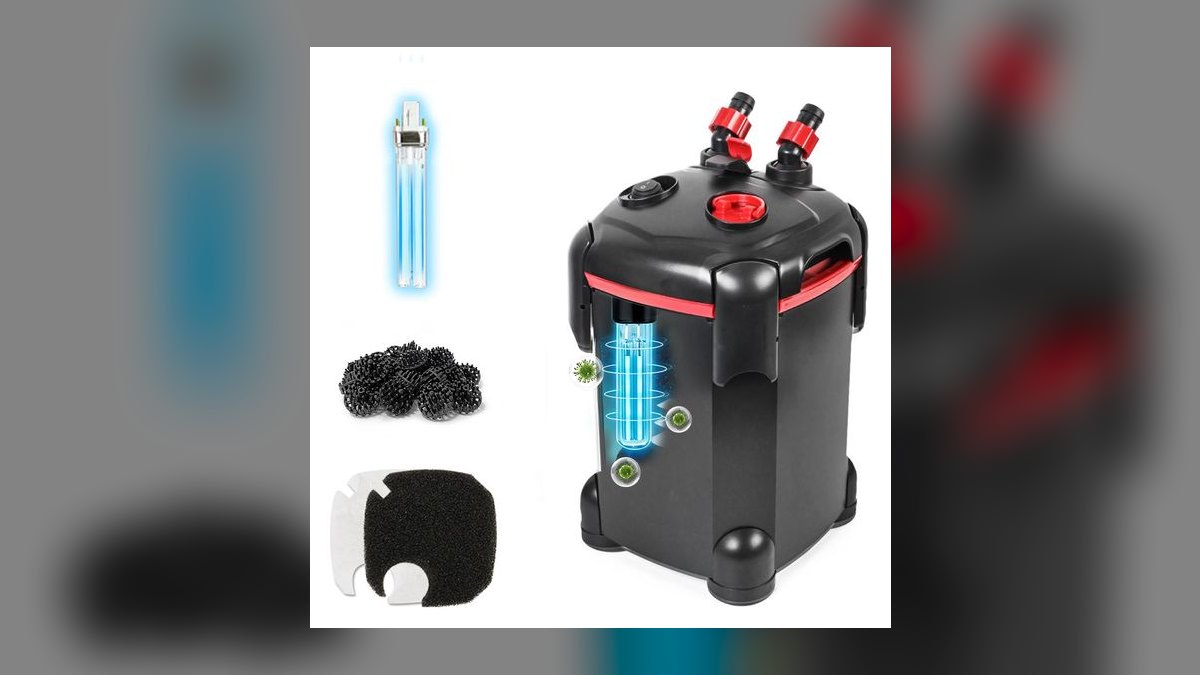
An in-line heater adds negligible noise and removes the in-tank heater's click, which is a net win for a bedroom. An in-line UV adds a small ballast hum but sits in the cabinet. Both add head loss, so expect a modest flow reduction.
Can I just turn the filter off at night?
No. Biological media depends on continuous oxygenated flow; even a few hours off can start killing nitrifying bacteria, and restarting pushes accumulated anoxic gunk into the tank. Fix the noise instead of interrupting the filter.
How loud is too loud for a bedroom tank?
If you can identify the filter as a distinct sound from your pillow with the room otherwise quiet, it's too loud. Measured, aim for the filter contributing at or below your room's night ambient — typically under about 30 dBA at the pillow.
Does a planted tank change the filter choice?
Somewhat. Planted setups want gentle, well-distributed flow and minimal surface agitation to preserve dissolved CO2 — which happens to be exactly the configuration that's quietest. A spray bar along the back wall serves both goals simultaneously.
FAQ
How do I measure my filter's actual noise level?
Use a sound level meter app on a phone, set to A-weighting and slow response. Take one reading at your pillow with the filter unplugged to establish room ambient, wait for the water to settle, then plug it back in and read again from the same spot. The difference between those two numbers is what the filter actually contributes. Do it at night, when ambient is lowest — a daytime measurement will tell you nothing useful. Phone meters aren't lab-accurate in absolute terms, but they're reliable for the *difference*, which is the number you care about.
Is a spray bar always quieter than the standard nozzle?
Almost always on a shallow tank, provided it's fully submerged. A spray bar splits the same volume of water across many small openings, so exit velocity per hole drops sharply and the water enters the tank without punching a hole in the surface. If the bar is at or above the waterline, though, it's louder than a submerged nozzle — you've just built a small waterfall with many streams. Position it one to two inches under, angled along the back glass.
My canister was silent for months and now it hums. What changed?
Three usual suspects, in order of likelihood. Clogged mechanical media raising pump strain — pull the first basket and rinse it. Debris or mineral deposit in the impeller well — open it, clean the shaft and bushings with a soft brush, check for a chipped blade. Slow air ingress from a dried O-ring or a loosened hose fitting — lubricate the O-ring and re-seat every connection. If cleaning restores quiet, you had maintenance debt. If it doesn't, the impeller assembly is worn and a replacement part is far cheaper than a new filter.
Can I put the canister in a closet in the next room?
Yes, and it's the single most effective quieting move available if the geometry allows. The constraint is head pressure and hose run: every foot of hose and every elbow costs flow, and the canister must sit below the tank's water line for siphon-driven intake to work. Keep total hose length under about ten feet per side, avoid tight bends, and expect to size up a model to compensate for the added resistance. Also plan for a leak: whatever floor that closet has should tolerate water.
Does a sponge prefilter on the intake help or hurt noise?
It helps indirectly. A prefilter sponge catches debris before it reaches the impeller, which keeps the impeller well clean and prevents the gradual noise creep that comes from buildup. It also stops the intake strainer from partially clogging, which is a cavitation trigger. The cost is a small flow reduction and one more thing to rinse every couple of weeks — but rinsing a prefilter under a tap is a two-minute job versus opening the whole canister.
What's the realistic quietest achievable setup for a 40 breeder bedroom tank?
A correctly sized canister on a mass-plus-foam isolation base, inside a closed stand with the door shut, throttled to about 70% at the output valve, feeding a fully submerged spray bar along the back wall, with an electronic-thermostat or in-line heater instead of a clicking bimetallic one, air fully purged, and mechanical media on a strict cleaning schedule. That combination reliably lands at or below quiet-bedroom ambient at pillow distance. Add a low-level white noise source and it disappears entirely.
Sources
- WHO Night Noise Guidelines for Europe
- CDC — What Noises Cause Hearing Loss (decibel reference levels)
- NIOSH Sound Level Meter App
- EPA — Aquatic Life Criteria for Ammonia
- Engineering ToolBox — Sound Pressure and Distance (inverse square law)
- Fluval — Canister Filters
- EHEIM — External Filters
- OASE — Aquarium Filters
- Aquarium Co-Op — Aquarium Filtration articles
- Sleep Foundation — Noise and Sleep
Related on PULSE
- [Top 10 40-Gallon Aquariums 2027](/knowledge/pt0184)
- [Top 10 Air Stones & Diffusers for Silent Operation in Bedroom Tanks (2027)](/knowledge/pt0054)
- [How often should I replace the filter media in a sponge filter for a fry tank?](/knowledge/pt0083)
- [Can I use a sand substrate with an undergravel filter in a freshwater planted tank?](/knowledge/pt0070)
- [Top 10 filter media types 2027](/knowledge/pt0321)
- [Top 10 Breeder Box Options 2027](/knowledge/pt0401)
This page will be disappearing soon. Save it to your device for $1 — or read it free while it is here.
@Kory-White- · if Venmo asks, the last 4 of my number are 2012
 petsTop 10 gallons per hour for aquarium water pumps in 2027
 pulse-petsTop 10 Betta Fish Tail Types 2027
 pulse-petsTop 10 best aquarium snail varieties 2027
 pulse-petsTop 10 20-Gallon Aquariums 2027
 pulse-petsTop 10 Ryukin Goldfish Round Body Types 2027
 pulse-petsTop 10 Aquarium LED Lights 2027
 pulse-petsTop 10 Floating Aquarium Plants 2027
 pulse-petsTop 10 Aquarium Tweezers and Scissors 2027
 petsTop 10 Water Change Frequency Recommendations for Planted Tanks in 2027
 petsHow much does pet insurance typically cost for an adult mixed-breed dog?