


How to Apply Strategic Selling — Step-by-Step Playbook in 2027
Quality
Certified

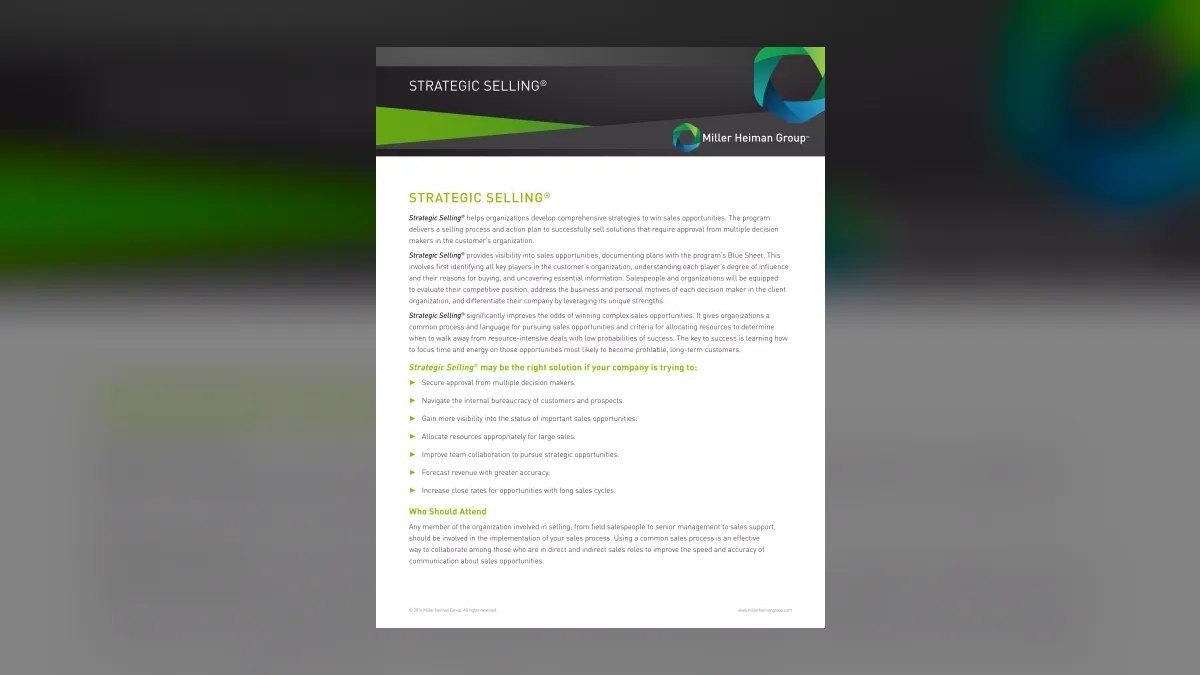
Strategic Selling is a buyer-map methodology: identify every buying influence (Economic, User, Technical, Coach), assess each one's rating and mode, then run a step-by-step playbook of position, plan, act, and verify. In 2027, apply it by rebuilding the map after every meeting and treating unverified assumptions as red flags.
The outcome you should expect
Teams that genuinely apply Strategic Selling — not just paste a blue sheet into the CRM once a quarter — see a narrow, repeatable set of outcomes. Understand these before you start, because the wrong expectation is how the methodology gets abandoned in month four.
The first outcome is shrinkage, not growth, in the reported pipeline. When reps map every buying influence and mark unverified ones honestly, a chunk of "commit" deals turn out to have no identified Economic Buyer, no access to one, and no Coach. Those deals do not disappear from reality; they disappear from the forecast, which is the point. It is common for the first honest pass across a mid-market team to reclassify somewhere in the range of a fifth to a third of late-stage pipeline as early-stage. Leaders who interpret this as the methodology "hurting the number" kill the program right when it starts working. Frame it in advance: quarter one is a measurement correction, quarter two is when win rate on the surviving pipeline moves.
The second outcome is fewer, larger, slower-but-more-certain deals. Strategic Selling is built for complex sales — multiple approvers, a formal or informal committee, a real risk of no-decision. It is not built for transactional, single-signer, sub-five-figure velocity motions, and forcing it there produces resented paperwork. When it fits, reps stop chasing the friendly User Buyer who loves the demo and start engineering access to the person who signs. That access work takes calendar time. Cycle length often stays flat or extends slightly; slippage and no-decision losses drop.
The third outcome is a legible, transferable deal state. The real product of the methodology is not the sale — it is the artifact. Any manager, any exec, any teammate covering a territory can open the map and know within two minutes who matters, what each person wants, who is on board, who is hostile, and what is unverified. That legibility is what makes deal reviews stop being storytelling. In practice, the meaningful metric is not "did the rep fill out the sheet" but "can someone else run the deal from the sheet."
Fourth, expect surfaced conflict. A properly run map makes it visible that the champion promising a Q1 close has never spoken to the CFO, or that the Technical Buyer who can veto has already been burned by a similar tool. Those facts existed before; the map only stops them from being pleasant surprises in week eleven. Some reps experience this as the methodology creating problems. It is finding them.
Fifth, and most often missed: expect better loss quality. Losing in week three to a documented "no budget cycle until FY28, Economic Buyer confirmed" is a good outcome. It returns selling capacity. A team that is applying the strategy well will show more early disqualifications and a shorter average age of losses, which is worth as much as a win-rate bump on a capacity-constrained team.
What you should not expect: a forecasting model, a pricing strategy, or a substitute for territory and account planning. Strategic Selling operates at the single-opportunity level. Its natural companions are an account-planning motion for whitespace and a separate qualification frame — many teams run MEDDPICC or a simple budget/authority/need/timing check alongside it rather than instead of it, because Strategic Selling is deliberately thin on quantified business impact and strong on political mapping.
What drives that outcome
The engine underneath the results is a small number of mechanics. Each one is a lever you can tune, and each one fails in a specific way when neglected.

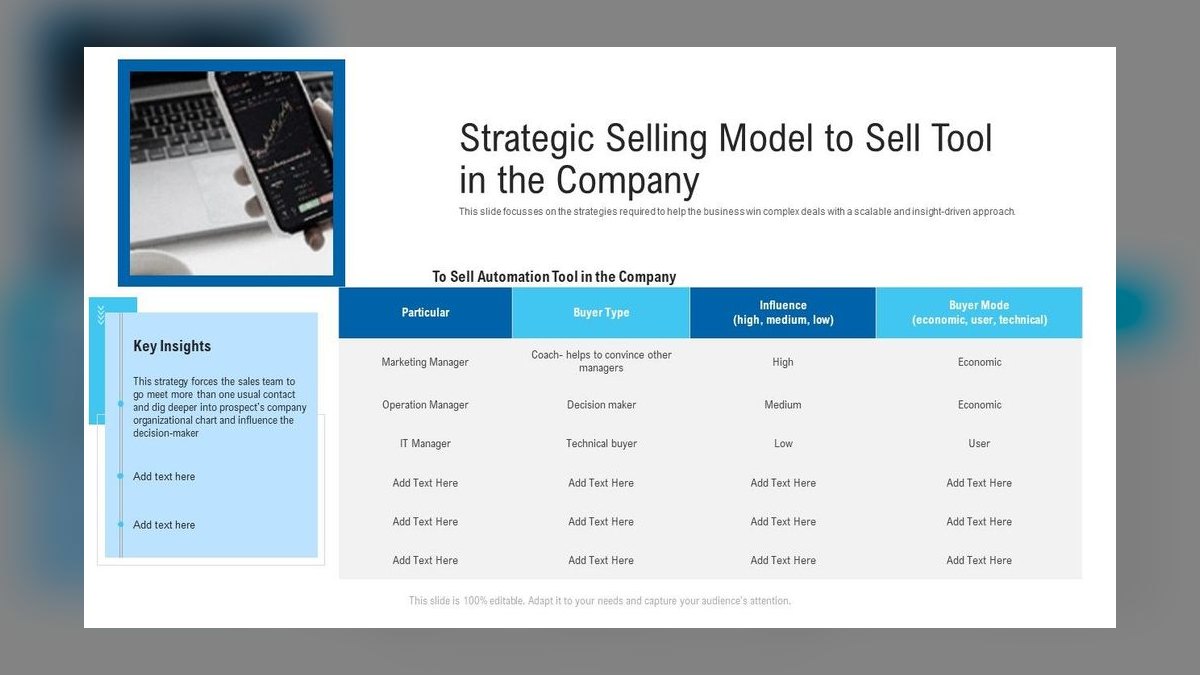
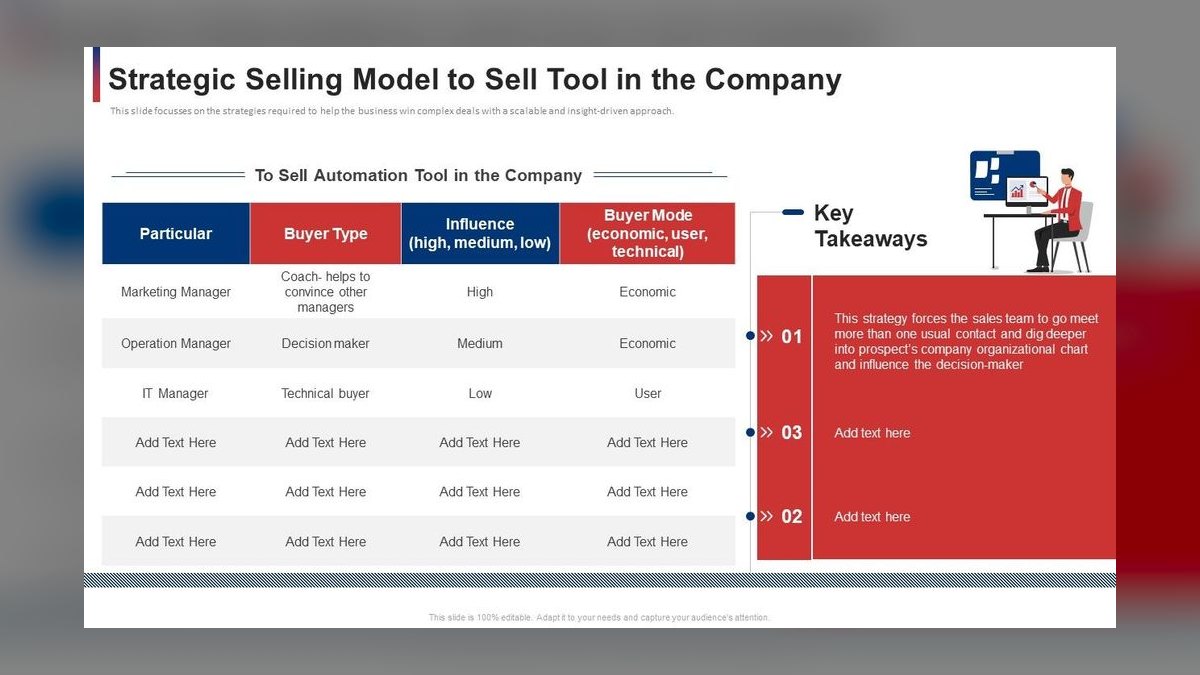
Buying influences. Every complex deal has four roles, and roles are not titles. The Economic Buyer gives final approval to release money and can veto anyone else; there is exactly one per opportunity, though it may be a committee acting as one. User Buyers judge the impact on their own daily work — there are usually several, and their yes is soft but their no is loud. Technical Buyers screen out: procurement, security review, IT architecture, legal, sometimes finance ops. They cannot say yes but they can absolutely say no, and in 2027 the security-review Technical Buyer is frequently the longest pole in the tent for anything touching customer data or AI features. Coaches are developed, not found: someone credible inside the account who wants you to win and will tell you the truth about the other three. One human can hold two roles — a VP of Sales who both uses the product and controls the budget is both User and Economic Buyer, and you sell to both hats separately.
Ratings and modes. For each influence you record two things. Rating is their disposition toward you, on a simple scale from strong advocate through neutral to strong opponent. Mode is their disposition toward change itself, and it is the more predictive of the two. Growth mode means they see a gap between results and goals and want more. Trouble mode means something is broken and urgent. Even Keel means results match expectations, so they see no reason to move — this is the mode that produces no-decision losses, and it is the mode most reps misread as "interested." Overconfident mode means they believe results already exceed the goal, often on bad data; they are the hardest to move and the most likely to become a late-stage blocker. The practical rule: you can rarely sell into Even Keel or Overconfident directly. You either find a Growth or Trouble influence with enough weight to reframe the account, or you introduce data that changes the mode.
Red flags and strengths. Anything unknown, unverified, or negative is a red flag: no Economic Buyer identified, no contact with an influence, a new player joining the committee, a reorganization, a strong opponent with real veto power, or a "yes" you heard secondhand. Strengths are verified positives — direct contact, confirmed budget, a Coach who has proven reliable. The discipline is that a red flag is not a mood. It is a specific, writable sentence with an owner and a date.
Win-results. Every influence has a business Result they need — measurable, organizational, impersonal — and a personal Win they need — subjective, individual, often unspoken. The CFO's Result might be a specific reduction in cost per transaction; her Win might be walking into the board meeting with a number she trusts. Deals stall when you serve Results and ignore Wins. Deals collapse when you serve one person's Win at the cost of another's.
The last mechanic is cadence, and it is the one that separates teams who apply the playbook from teams who own the binder. The map is a living document with a half-life of roughly one meeting. Any material contact — a new name on a calendar invite, a reorg announcement, a procurement handoff — invalidates part of it. Teams that re-map weekly on active deals and immediately after any executive contact get the compounding benefit; teams that update before QBRs get theater.
Benchmarks and realistic ranges
Hard numbers in methodology-land are mostly vendor marketing, so treat these as planning ranges from practitioner experience rather than published findings, and instrument your own baseline before you claim a lift.
Fit thresholds. The methodology earns its overhead when a deal has three or more distinct buying influences, a cycle of roughly 60 days or longer, and enough contract value that an hour of mapping per week is cheap relative to the outcome. Below that — single signer, two-week close, small ACV — the completion rate collapses and reps are right to resist. Many teams draw the line at a deal-size threshold and apply the full map only above it, running a lightweight three-field version below.

Time cost. Budget 45 to 90 minutes for the first full map on a live enterprise deal, then 10 to 20 minutes per update. A rep carrying 12 to 20 active complex opportunities should expect two to four hours a week total, concentrated on the top third. If your process demands full maps on 60 open deals, you have designed a system that will be abandoned, and the abandonment will look like a culture problem when it is a math problem.
Coverage targets. Reasonable early goals: Economic Buyer identified by name on 100% of deals past initial qualification, direct multi-threaded contact (not via champion) with the Economic Buyer on the majority of late-stage deals, and at least one verified Coach on every deal above your threshold. The gap between "identified" and "met" is usually the single largest predictor of slippage in a pipeline review.
Enablement ramp. Expect four to eight weeks before the language is natural. Week one is training, weeks two through four are managers running maps live in one-on-ones, and the behavior sticks somewhere in month two — but only if deal reviews change format. If a manager still opens with "what's the number look like," the methodology is a side quest. The reliable forcing function is a deal review that opens with the map on screen and asks only three questions: who is the Economic Buyer, what is your biggest red flag, and what did you verify since we last spoke.
Tooling. In 2027 most teams run this inside the CRM rather than in a spreadsheet, either through a vendor's native module or a set of custom objects — one record per buying influence, linked to the opportunity, with fields for role, rating, mode, last-contact date, and win-result. That structure matters more than the tool: influence-as-a-record is what lets you report on coverage. AI note-takers have made one part of this dramatically cheaper — call transcripts now reliably surface new names, titles, and stated concerns, and a well-built automation can propose new influence records and stale-contact flags for a rep to confirm. Let the machine draft; do not let it assert. A mode inferred from a transcript is a hypothesis until a human tests it.
Adjacent measurement. Track four things: percentage of qualified deals with a named and contacted Economic Buyer, average red flags open per late-stage deal, no-decision rate, and average age at loss. Win rate is the headline metric but it is slow and noisy; those four move first and tell you whether the behavior is real.
Risks, edge cases, and failure modes
The compliance trap. The dominant failure is not rejection — it is hollow adoption. Reps fill the sheet the night before the review, mark everyone a mild advocate, list zero red flags, and the artifact becomes a lie that leadership then forecasts against. This is worse than no methodology, because it launders guesswork as rigor. The countermeasure is cultural and specific: a map with no red flags is treated as an incomplete map, not a healthy deal. Managers should be suspicious of clean sheets on six-figure deals and should reward the rep who surfaces "I have never spoken to the EB" over the one who quietly writes "supportive."
Confusing the Coach with the champion. A champion advocates for you internally. A Coach gives you accurate information about the political landscape, including bad news. Sometimes they are the same person; often the best Coach is someone with nothing to gain who simply likes you and knows the building. Reps who treat their loudest fan as their Coach get a map built entirely from one biased viewpoint. Test a Coach the way you would test a source: ask something you already know the answer to, and ask something unflattering about their own organization.
Committee-as-Economic-Buyer. Increasingly the money decision belongs to a body — a steering committee, an AI governance board, a procurement council — with no single individual able to say yes alone. The methodology still works but the mechanics shift: you map the committee as one influence with a named chair, then map the members who sway it as separate influences with their own modes. The failure here is picking the friendliest committee member and calling them the Economic Buyer.
Selling to Even Keel. If every influence is in Even Keel mode, there is no deal today no matter how good the product is. Reps burn quarters here because the meetings are pleasant. Either find or create a mode shift — new regulation, a competitor's move, a metric they had not seen, a new executive with a mandate — or park the account on a documented nurture cadence and spend the capacity elsewhere.
Late-arriving Technical Buyers. Security review, procurement, legal, and data-privacy functions often appear at signature time with veto power and no relationship. In 2027 this is sharpest around AI functionality and data residency. The fix is upstream: identify the screen-out functions during discovery, ask your Coach who reviews contracts of this size, and start the security questionnaire while the deal is still in the middle innings.
Over-mapping. The mirror-image failure. A team that requires exhaustive maps on every opportunity produces a beautiful, unused database and resentful reps. Set a threshold and enforce it downward as hard as upward.
Methodology collision. Layering Strategic Selling, MEDDPICC, Challenger, and a homegrown stage gate simultaneously produces a stage-exit checklist nobody reads. Pick one as the primary lens — Strategic Selling is the political map — and let others contribute individual fields rather than parallel frameworks. If you already run MEDDPICC, the honest integration is: MEDDPICC owns metrics, decision criteria, and paper process; Strategic Selling owns the influence map, modes, and win-results.
Single-threaded champion risk. The most expensive edge case is the deal where one enthusiastic contact owns every relationship. When they change jobs — and in a mobile market a meaningful share of them will mid-cycle — the deal resets to zero. The map makes this visible as a red flag long before it becomes a loss, which is only useful if someone acts on it.

Data hygiene and privacy. Recording that a named individual is a "strong opponent" with personal motivations creates a record about a real person that may be subject to access requests and will certainly be read out of context someday. Keep entries factual and behavioral — "stated in the 3/12 call that the prior rollout failed" — rather than characterological. It is better practice and better data.
A practical rollout plan
Here is the step-by-step playbook to apply, in order, whether you are one rep or rolling out to eighty.
Step 1 — Pick the scope. Choose one segment or one team and a deal-size threshold. Do not roll out globally in week one. You want a pilot small enough that a single manager can inspect every map personally.
Step 2 — Build the artifact before the training. Create the influence object in the CRM with the fields you will actually report on: role, name, rating, mode, last contacted, win, result, is-verified. If the artifact does not exist on day one, reps will build private spreadsheets and you will never get coverage data.
Step 3 — Baseline honestly. Before any training, pull current pipeline and record: how many qualified deals have a named Economic Buyer, how many have documented contact with them, current no-decision rate, current average deal age. You cannot claim a lift later without this, and the baseline itself usually makes the business case.
Step 4 — Train on live deals only. Skip the case study. Each rep maps two of their real opportunities in the room, out loud, with peers challenging the ratings. The learning happens when someone asks "how do you know she's an advocate?" and the answer is "she seemed positive on the demo."

Step 5 — Change the deal review format. This is the step that determines success. New standing agenda: map on screen; who is the Economic Buyer and when did you last speak with them directly; what is your largest open red flag; what did you verify since the last review; what is the single next action, its owner, and its date. Nothing else. Managers must resist the pull back to pipeline arithmetic.
Step 6 — Run the red-flag loop weekly. Every active deal above threshold gets a five-minute pass: new names, changed modes, flags closed, flags opened. Re-map immediately after any executive meeting or organizational change rather than waiting for the weekly.
Step 7 — Wire in the automation, carefully. Once the habit exists, let transcript tooling propose new influences and stale-contact alerts. Keep human confirmation mandatory. An auto-populated map that nobody has thought about is the compliance trap with better formatting.
Step 8 — Inspect and publish. At 30, 60, and 90 days, report the four coverage metrics — not win rate, which is too slow. Publish them by team. Visible coverage data is what turns the strategy from an initiative into an operating norm.
Step 9 — Prune. At 90 days, remove any field nobody used and any deal tier where compliance stayed under half. Shrinking the process is how you keep it.
The adjacent workflows matter too. Downstream, the map should feed handoff to customer success — the User Buyers you identified are the adoption risk list on day one of implementation, and the Economic Buyer is the renewal conversation. Upstream, marketing can use aggregated mode data: if most of your losses are Even Keel accounts, the gap is demand creation, not sales execution. And in adjacent motions — partner-led deals, public-sector procurement, healthcare committee purchases — the same four roles hold with different names, which is why the framework has survived four decades of tooling churn.
Related questions
Does Strategic Selling still work in a product-led motion?

Partially. In PLG, usage data replaces early discovery and the User Buyers self-identify. The map becomes relevant at the expansion threshold, when a security review and a budget owner appear. Apply it at the enterprise conversion moment, not at signup.
How is this different from MEDDPICC?
MEDDPICC is a qualification checklist emphasizing metrics, decision process, and paper process. Strategic Selling is a political map emphasizing roles, modes, and personal wins. They coexist well: MEDDPICC tests whether a deal is real, Strategic Selling tells you who has to move.
Who owns the map, the rep or the manager?
The rep owns it; the manager inspects it. If managers edit maps, reps stop maintaining them. The manager's job is asking how each rating was verified.
What if the Economic Buyer refuses to meet?
Treat it as a standing red flag, not a personality quirk. Work through the Coach to understand what the Economic Buyer needs to see, and get a proxy meeting with someone who reports directly to them. Persistent inaccessibility on a large deal is a forecast problem.
Can AI tools maintain the map automatically?
They can draft it. Transcript tools reliably extract names, titles, and stated concerns. They cannot verify a mode or confirm a personal win, both of which require a human judgment call, so keep confirmation in the loop.
FAQ

How many buying influences should a typical enterprise deal have?
It varies with deal size and industry, but a complex six-figure B2B purchase commonly involves one Economic Buyer, two to five User Buyers, and two to four Technical Buyers across security, procurement, IT, and legal. If your map has two names on a large deal, the map is incomplete rather than the deal being simple.
Should reps show the map to the customer?
Not the raw artifact — it contains internal assessments of individuals. But a sanitized version is a powerful Coach conversation: "here's my understanding of who needs to weigh in, what am I missing?" Coaches routinely correct it, and the correction is worth more than the meeting.
What do you do when the mode and rating disagree?
Mode wins for forecasting. An enthusiastic advocate in Even Keel mode will not fight for budget. A neutral contact in Trouble mode will move mountains. Rating tells you how they feel about you; mode tells you whether they will act.
Is this methodology too slow for a fast-moving market?
The mapping itself takes minutes per week. What feels slow is the discovery it forces — getting to the Economic Buyer, opening the security review early. That work happens either way; the methodology just moves it earlier, which usually shortens the elapsed cycle rather than extending it.
How do you apply it to a renewal or expansion?
Re-map from scratch rather than reusing the original. Roles change, people leave, and the Economic Buyer for a renewal is often a different person than for the initial purchase. An expansion into a new department is a new opportunity with a new map, even inside a happy account.
What is the minimum viable version for a small team?
Four fields per deal: who signs, who blocks, who coaches, what is unverified. That covers most of the value. Add ratings, modes, and win-results once the four-field habit is stable — expanding a working process beats abandoning an elaborate one.
Sources
- https://hbr.org/2012/07/the-end-of-solution-sales
- https://hbr.org/2017/03/the-new-sales-imperative
- https://www.mhiglobal.com/
- https://www.gartner.com/en/sales/insights/b2b-buying-journey
- https://www.salesforce.com/resources/articles/sales-methodology/
- https://www.forrester.com/blogs/category/b2b-sales/
- https://corporatevisions.com/blog/
- https://www.hubspot.com/sales-methodology
Related on PULSE
- MEDDPICC vs Strategic Selling: choosing a primary sales methodology
- How to identify the Economic Buyer when the decision is made by committee
- Building a champion-development program that survives contact turnover
- Deal review agendas that surface risk instead of rehearsing the forecast
- Multi-threading playbook: getting past the single-champion trap
- No-decision losses: diagnosing Even Keel accounts before you invest a quarter
This page will be disappearing soon. Save it to your device for $1 — or read it free while it is here.
@Kory-White- · if Venmo asks, the last 4 of my number are 2012
This page is gone.
This one is off the shelf now. $1 keeps it on your phone for good — the whole page, pictures and diagrams included.
 book-summaryNew Sales. Simplified. by Mike Weinberg — Cliff Notes Summary for AEs
 book-summaryHow do you build a sales pipeline when your buyers do all their research before ever contacting you in 2027?
 book-summarySelling to VITO by Anthony Parinello — Cliff Notes Summary
 pulse-recentContagious by Jonah Berger — Top 10 Key Takeaways for Sales Leaders in 2027
 pulse-recentThe New Solution Selling by Keith Eades — Top 10 Key Takeaways for Sales Leaders in 2027
 pulse-booksThe Tipping Point by Malcolm Gladwell — Cliff Notes Summary for Sellers
 book-summaryTo Sell Is Human by Daniel Pink — Cliff Notes Summary
 book-summarySmart Calling by Art Sobczak — Cliff Notes Summary
 book-summaryZone to Win by Geoffrey Moore — Cliff Notes Summary
 book-summaryBargaining for Advantage by G. Richard Shell — Cliff Notes Summary