


Bargaining for Advantage by G. Richard Shell — Cliff Notes Summary
Quality
Certified

*Bargaining for Advantage* by G. Richard Shell is a Wharton negotiation textbook built on six foundations — bargaining style, goals, authoritative standards, relationships, the other party's interests, and leverage — executed across a four-stage process: preparation, information exchange, bargaining, and commitment. Its core claim: negotiation is a learnable system, not a personality trait.
The renewal call that goes sideways at minute nine
Picture a mid-market SaaS account manager walking into a $180,000 annual renewal. The customer has been on the platform three years, usage is up, the champion is friendly, and the AE has a mandate from finance to push a 7% uplift. Nine minutes into the call, procurement joins — someone the AE has never spoken to — and opens with "we've benchmarked this and we're seeing comparable tooling at 30% less." The AE, who is naturally accommodating and has never taken a conflict-style assessment in their life, responds by immediately offering to "see what I can do on the number." The renewal closes at flat, two weeks late, with an added out-clause.
That collapse is the exact failure mode Shell's book is engineered against, and it is worth naming precisely what went wrong because none of it was about being insufficiently tough. The AE had no articulated goal — "get the uplift" is a wish, not a target with a defensible justification behind it. The AE had no authoritative standard to counter the procurement benchmark, so the only number on the table with a source attached was the buyer's. The AE had never estimated either side's walk-away alternative, so when leverage got tested, there was nothing underneath. And the AE's default cooperative style, unexamined, ran the meeting on autopilot the moment pressure arrived.
Shell's argument is that all four of those are preparation failures, not courage failures. The book's structural insight — and the reason it survives as assigned reading in the Wharton Executive Negotiation Workshop nearly three decades after the 1999 Penguin first edition, with a second edition following in 2006 — is that it refuses to hand you a tactic before it hands you a diagnostic. Shell, a professor of legal studies and business ethics at Wharton, opens not with anchoring scripts but with the Thomas-Kilmann Conflict Mode Instrument, sorting negotiators into five modes: avoiding, competing, compromising, accommodating, and collaborating. The premise is that a competitive negotiator faking collaboration reads as incongruent, and a natural collaborator faking aggression burns the relationship they are actually good at building. Know the default first. Then decide when it serves you and when to bring someone else into the room.

This scenario generalizes well past software renewals. The same nine-minute collapse happens in a contractor bidding a commercial remodel, a candidate negotiating a compensation package, a hospital system negotiating payer reimbursement rates, and a founder taking a term sheet. In every one of those rooms, the party who prepared a goal with three justifications, a standards file, and a realistic estimate of both walk-aways is operating with instrumentation while the other side is operating on nerve.
How the six foundations feed the four stages
The book's two frameworks are not parallel lists — they are input and process. The six foundations are what you assemble before anyone speaks; the four stages are the sequence the conversation moves through whether or not you are steering it. Shell's own framing on that point is blunt: the stages happen regardless, so you may as well control them.
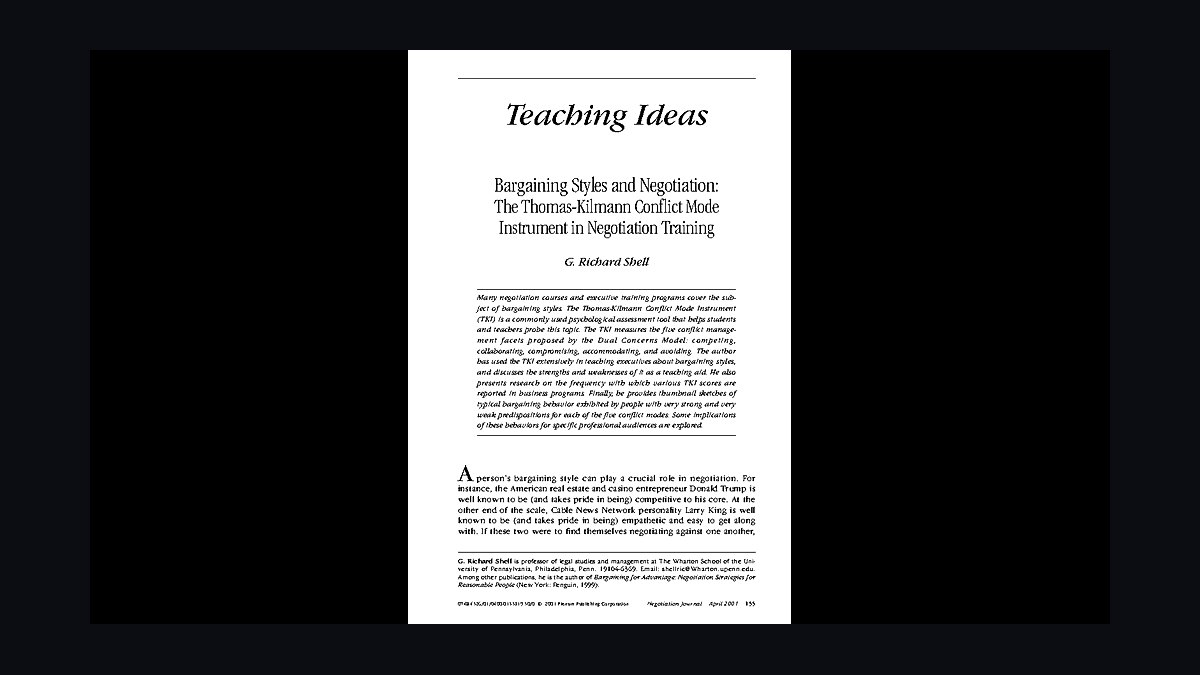
Foundation one, bargaining style. The TKI is a self-report instrument that has been used in management education since the 1970s. It plots you on assertiveness and cooperativeness. Shell's operational use of it is not to assign you a label but to predict your failure mode under stress. Accommodators concede early to relieve tension. Competitors win the point and lose the multi-year account. Avoiders let a solvable dispute calcify. Compromisers split reflexively and leave joint value unclaimed. Collaborators over-invest time in deals that were always going to be transactional.
Foundation two, goals and expectations. Shell separates the target you aim at from what you privately expect to get, and argues that the target drives the outcome more than the expectation does. He draws on mid-century bargaining experiments in the Siegel and Fouraker tradition showing that negotiators with specific, optimistic, and *justifiable* targets systematically outperform those with vague or modest ones. The justification clause is the operative part: a number you cannot defend with a reason collapses the first time it is pushed. The prescription is mechanical — write the goal in one sentence, write three reasons that justify it, rehearse both out loud before the meeting.
Foundation three, authoritative standards and norms. People resist violating standards they themselves consider legitimate. So a number sourced to an external authority — published comparables, an industry salary survey, a public rate card, a court-tested precedent — lands with force that an asserted number never does. Shell connects this to Cialdini's authority principle in *Influence*. The rule that falls out of it: never name a number without naming the standard behind it.
Foundation four, relationships. Shell divides the world into transactional one-shots and repeat games and insists tactics do not port between them. A hard anchor that wins a single used-car purchase poisons a five-year supplier partnership. Reciprocity is the currency, but reciprocity only accrues when the other side believes the relationship continues.
Foundation five, the other party's interests. This is the position-versus-interest distinction Shell inherits from Fisher and Ury's *Getting to Yes* — the stated demand versus the underlying need. The canonical illustration is two people fighting over one orange who discover, only after disclosure, that one wants the peel and the other wants the juice, converting a 50/50 split into a full win for both. Shell's addition is procedural: a worksheet that forces you to write down the other party's stated position, their probable economic interest, their probable personal interest, and the political constraints they face inside their own organization. That fourth column is the one most sellers skip and the one that most often explains otherwise irrational buyer behavior.

Foundation six, leverage. Shell's most-cited chapter. Leverage comes from your ability to walk away, not your willingness to argue. He splits it three ways: positive leverage (you hold something they want), negative leverage (no-deal hurts them), and normative leverage (their own publicly stated standards bind them to your position). Underneath all three sits BATNA — best alternative to a negotiated agreement, Fisher and Ury's term, which Shell turns into a preparation exercise you run for *both* sides.
The four stages then run in order. Preparation absorbs the majority of total effort and produces the widest variance in results — Shell treats a negotiation entered unprepared as already partly lost. Information exchange is where amateurs skip straight to a number; Shell prescribes disciplined two-way disclosure, open-ended questions, mirroring back the other party's last few words to invite expansion, and summarizing their interests before you respond. Those three moves are the direct ancestors of the tactical-empathy toolkit Chris Voss later popularized in *Never Split the Difference*. Bargaining is concession architecture, covered below. Commitment is the stage nearly everyone truncates: Shell's position is that verbal agreement is not closure, and that written, specific, immediate terms — who does what by when, with what consequence for missing — are what convert a handshake into a deal.
Numbers, ranges, and what the frameworks look like in practice
The book is not a statistics text, and the honest thing to say is that Shell's quantitative claims are directional rather than precisely benchmarked. But several concrete parameters travel out of it into working practice, and they are worth stating as ranges you can actually operate against.

Preparation-to-table ratio. The working heuristic that comes out of Shell's first stage is that preparation should dominate. For a routine transactional negotiation — a single-year renewal, a small purchase — thirty to sixty minutes of structured prep against a one-hour call is proportionate. For an enterprise deal with multiple stakeholders and a multi-year term, teams that run this framework well typically spend several hours across the deal team building the interest map, the standards file, and the two BATNA estimates. The asymmetry is deliberate: table time is expensive and irreversible, prep time is cheap and repeatable.
Concession architecture. This is where Shell gets specific and where the arithmetic is easy to verify against your own deal history. The rules: make the first concession the largest you will make, make each subsequent one smaller, never concede without asking for something in return, and signal scarcity explicitly. The cardinal sin is the equal-step pattern — conceding $5,000, then $5,000, then $5,000 — because a constant step size mathematically advertises that the next step is also $5,000, and a rational counterparty will simply keep pushing. A decaying pattern — $5,000, then $2,500, then $1,000, then $250 — communicates a limit without you having to claim one. Sellers who track this find the shape of the curve matters more than the total: the same aggregate discount delivered in a decaying sequence closes faster than the same amount delivered in flat steps, because the flat sequence never signals a floor.
Anchoring. Shell synthesizes the anchoring-and-adjustment work from Kahneman and Tversky's judgment-under-uncertainty research: the first number on the table exerts gravity on the final outcome well beyond its informational content. The decision rule he draws is conditional, not universal. If you have credible information about the bargaining range, open first and open ambitiously. If you genuinely do not know the range — a new market, an unfamiliar buyer, a product with no comparable — let the other side anchor and counter with a justified number rather than a reactive one. The systematic error is opening modestly against an aggressive opening and then splitting the difference, which transfers value to whoever was bolder. That mistake is precisely what Voss's title is a callback to.

Commitment leakage. Shell's warning about verbal-agreement-is-not-closure maps to something every sales operations team can measure directly from its own CRM: the gap between "verbal commit" and countersigned contract. Whatever your organization's number is — and it is rarely zero — the failure cause is almost always ambiguous terms, an unnamed signatory, or an unowned next step, not a change of heart. The countermeasure is procedural: name the specific deliverable, the specific date, the specific person, and send the written summary the same day while the shared understanding is still fresh.
Style distribution. The TKI is available commercially from its publisher for a modest per-assessment fee, and a practical way to use it on a sales team is to have every rep take it once, share results openly, and staff negotiations by complementary pairing — put a natural collaborator on the multi-year partnership and a comfortable competitor on the one-shot procurement fight. The value is not the label; it is knowing in advance who in the room will fold first when the temperature rises.
Interest-map coverage. A usable target for the fifth foundation is four documented interests per counterparty stakeholder: one economic, one personal, one political, one risk-related. Fewer than that and you are guessing. In a complex enterprise pursuit with a champion, an economic buyer, a security reviewer, and procurement, that is sixteen entries — an hour of work that routinely surfaces the constraint nobody said out loud.
Where the framework trades off against its alternatives
Shell is not the only operating system on the shelf, and pretending otherwise makes for a worse recommendation. The honest positioning is that *Bargaining for Advantage* sits between two neighbors and borrows from both.

*Getting to Yes* (Fisher and Ury, 1981) is upstream. It supplies principled negotiation — separate the people from the problem, focus on interests not positions, invent options for mutual gain, insist on objective criteria — and it supplies BATNA. Its weakness is that it is a philosophy more than a procedure; readers finish it agreeing with everything and still not knowing what to do on Tuesday. *Never Split the Difference* (Voss, 2016) is downstream and is the mirror image: enormously actionable at the sentence level — labeling, mirroring, calibrated questions, the accusation audit — and comparatively thin on the structural preparation that determines whether those sentences have anything to land on. Voss's tactics deployed without leverage analysis are theater.
Shell's trade-off is deliberate: he sacrifices punchiness for completeness. The book runs a few hundred pages, reads like a textbook because it is one, and expects you to take an assessment, fill in worksheets, and apply the framework to a live negotiation while reading. If you want a tactic for tomorrow morning's call, this is the wrong book. If you want a repeatable system that tells you *which* tactic and *when*, it is the right one. Deepak Malhotra and Max Bazerman's *Negotiation Genius* (2007) is the closest Harvard-side analogue and builds on the same preparation discipline; Howard Raiffa's *The Art and Science of Negotiation* (1982) is the more formal academic ancestor Shell draws on for concession dynamics; Jeb Blount's *Inked* (2020) is the sales-specific application layer.
There is also a real cost to the framework itself. Full six-foundation preparation is expensive, and applying it uniformly is a mistake Shell would not endorse. A $4,000 transactional renewal does not justify a sixteen-entry interest map. The sensible pattern is tiering: run the full discipline on deals above whatever threshold matters to your business, run an abbreviated version — goal, standard, BATNA, and nothing else — below it.
The ethics chapter deserves its own note because it is where the book is most useful and most dated at once. Shell frames three schools: the idealist, for whom deception is wrong regardless of consequence; the pragmatist, who accepts tactical misdirection in service of a legitimate end; and the poker school, which treats deception as acceptable within the accepted rules of the game. His observation is that most commercial environments — sales, procurement, real estate, litigation — implicitly run on poker rules, where misstating your reservation price is expected but misstating product specifications is fraud. Knowing which school your counterparty plays from is itself a foundation. What has aged is the regulatory backdrop: in healthcare, financial services, and public procurement, disclosure obligations have hardened to the point where the poker school is not merely distasteful but legally indefensible.
The pitfalls that eat the framework in practice

Taking the style assessment and then ignoring it. The most common failure is treating the TKI as a personality quiz rather than a stress predictor. The output is only useful if it changes staffing and behavior — if the accommodating rep gets a competitive partner on the procurement call, and if that rep has a pre-committed line to say instead of "let me see what I can do."
Setting a goal without justifications. A target with no reasons behind it is an opening bid you will abandon. The fix is trivial and almost nobody does it: three written reasons, rehearsed aloud.
Confusing your BATNA with your hope. Estimating your own walk-away honestly is uncomfortable, and estimating theirs is harder still. Most sellers overestimate their own alternatives and dramatically underestimate the buyer's switching costs, which cuts both ways — it produces both unwarranted rigidity and unwarranted panic. The countermeasure is writing both estimates down before the meeting, with the evidence for each, so the number can be challenged by a colleague rather than by the counterparty in real time.
Skipping information exchange. Jumping straight to price is the amateur signature. It forecloses the interest discovery that makes trades possible and guarantees a purely distributive fight over one variable. The discipline is to spend the opening block asking what success looks like, what the internal timeline actually is, and who else has to approve — and to summarize their answers back before responding.

Conceding to relieve your own discomfort. Silence after a buyer's aggressive number is uncomfortable, and the untrained response is to fill it with a concession. Shell's framework makes this visible by requiring every concession to be traded. If you cannot name what you got in return, you did not negotiate, you flinched.
Equal-step concessions. Covered above and worth repeating because it is the single most mechanically correctable error in the book.
Letting the relationship type get misread. Treating a repeat-game partner transactionally destroys reciprocity you will need next year. Treating a genuine one-shot as a relationship wastes hours and gives away margin for goodwill that will never be repaid.
Stopping at the handshake. The commitment stage is where deals leak. Verbal alignment feels like completion and is not. Named owner, named date, named consequence, written summary sent same-day.
The adjacent shift worth flagging: procurement has automated. Buyer-side platforms can now solicit competitive quotes at machine speed and run comparative benchmarking that collapses the information asymmetry sellers once enjoyed, and autonomous negotiation tools handle long-tail supplier agreements without a human in the seat. That does not invalidate the six foundations — it means the seller's normative-leverage and interest-mapping work matters more, because the leverage that came from the buyer not knowing the market has largely evaporated. Meanwhile product-led-growth motions remove the negotiation entirely at the low end while concentrating it at the enterprise-expansion layer, where the collaborative style and the relationship foundation carry the most weight.
Related questions
How does Shell differ from Getting to Yes?
Fisher and Ury supply the principles — interests over positions, objective criteria, BATNA. Shell supplies the procedure that operationalizes them: a self-diagnostic, a preparation checklist, and a staged process. Shell is the implementation layer on top of Fisher and Ury's philosophy.
Which negotiation style should I aim for?

None universally. Competitive fits one-shot deals with strong leverage; collaborative fits long-term partnerships; avoiding is genuinely correct when no-deal beats any available deal. Shell's argument is that honest self-diagnosis and situational matching beat style mimicry every time.
What is normative leverage?
Leverage created when the other party's own publicly stated standards, policies, or prior commitments bind them to your position. Citing their published procurement policy or their stated strategic priority is stronger than arguing, because disagreeing means contradicting themselves.
Is the book still relevant with AI in procurement?
Yes, with a shift in emphasis. Automation compresses preparation and erodes information asymmetry, which raises the relative value of interest mapping, normative leverage, and relationship quality — the parts a benchmarking tool cannot manufacture.
Do I need to take the TKI to use the book?
No, but it helps. The assessment is available commercially from its publisher. Absent it, an honest self-review of your last five negotiations — where you conceded, and why — surfaces most of the same information.
FAQ
Is Bargaining for Advantage worth reading if I've already read Getting to Yes and Never Split the Difference?
Yes, and it is arguably best read between them. Fisher and Ury give you the principles, Voss gives you the sentence-level tactics, and Shell gives you the operating system that decides which principle and which tactic apply to the situation in front of you. Readers who have only the other two often report knowing what to say without knowing what to prepare.

What is the single biggest mistake the book identifies?
Reflexively splitting the difference. The equal-step concession pattern systematically transfers value to whichever side opened more aggressively, and it feels fair while doing it. Shell's decaying-concession discipline is the direct countermeasure, and Voss's book title is essentially a callback to this warning.
How does Shell handle BATNA differently from other authors?
He turns it into a two-sided preparation exercise. Most treatments have you assess your own alternative; Shell insists you estimate the counterparty's as well, in writing, with evidence. Without both numbers, the leverage foundation is incomplete and you are guessing at who actually controls the deal.
Is this a quick read?
No. It is a textbook of a few hundred pages that expects participation — take the assessment, complete the preparation worksheets, and apply the framework to a live negotiation while you read. Treating it as a skim produces very little. Treating it as a workbook across two or three real deals produces a durable change in how you prepare.
Does the framework work outside sales?
It was not written for sellers specifically. Shell teaches law and business ethics, and the book is used in hiring negotiations, compensation discussions, procurement, real estate, litigation settlement, and internal cross-functional resource fights. The six foundations are domain-neutral; only the standards file and the interest map change content.
How should a sales team roll this out?
Start with the style assessment across the team, then require a one-page preparation sheet — goal plus three justifications, top authoritative standard, both BATNAs, four interests per stakeholder — on every deal above a defined threshold. Review the sheet in deal inspection, not the forecast number. The discipline shows up in cycle time before it shows up in win rate.
Sources
- https://www.penguinrandomhouse.com/books/291376/bargaining-for-advantage-by-g-richard-shell/
- https://www.law.upenn.edu/faculty/gshell
- https://executiveeducation.wharton.upenn.edu/for-individuals/all-programs/executive-negotiation-workshop-bargaining-for-advantage/
- https://kilmanndiagnostics.com/overview-thomas-kilmann-conflict-mode-instrument-tki/
- https://www.pon.harvard.edu/tag/batna/
- https://www.nobelprize.org/prices/economic-sciences/2002/kahneman/facts/
- https://www.hup.harvard.edu/books/9780674048133
- https://www.harpercollins.com/products/never-split-the-difference-chris-vosstahl-raz
- https://www.pon.harvard.edu/
Related on PULSE
- The Advantage by Patrick Lencioni — Cliff Notes Summary for Sales Leaders
- Misbehaving by Richard Thaler — Cliff Notes Summary for Sellers
- Never Split the Difference by Chris Voss — Cliff Notes Summary
- Getting to Yes by Fisher and Ury — Cliff Notes Summary
- How should a sales team structure discount approval thresholds?
This page will be disappearing soon. Save it to your device for $1 — or read it free while it is here.
@Kory-White- · if Venmo asks, the last 4 of my number are 2012
This page is gone.
This one is off the shelf now. $1 keeps it on your phone for good — the whole page, pictures and diagrams included.
 pulse-recentStrategic Selling by Robert Miller and Stephen Heiman — Top 10 Key Takeaways for Sales Leaders in 2027
 pulse-recentWhat is the most actionable step in The Sandler Rules for Sales Leaders by David Mattson to improve discovery in 2027?
 book-summaryMajor Account Sales Strategy by Neil Rackham: Summary, Key Lessons, and RevOps Takeaways
 pulse-recentWhat is the step-by-step process for Strategic Selling by Miller Heiman in 2027?
 pulse-recentHow does *The New Strategic Selling* define the first step in qualifying an opportunity in 2027?
 pulse-recentThe Transparency Sale by Todd Caponi — Top 10 Key Takeaways for Sales Leaders in 2027
 pulse-recentThe Greatest Salesman in the World by Og Mandino — Top 10 Key Takeaways for Sales Leaders in 2027
 pulse-recentThe Sandler Rules by David Sandler — Top 10 Key Takeaways for Sales Leaders in 2027
 pulse-recentHow do you implement the Sandler Rules by David Mattson in your first 30 days as a new sales manager in 2027?
 pulse-recentWhat is the first concrete step in The Sandler Rules by David Mattson for a sales leader to implement the system in 2027?