
Sales Storytelling Workshop: Crafting Case Studies into Narratives
 Curated byKory White · Fractional CRO · Maryland
 PULSEKNOWLEDGE LIBRARY
Quality
Certified

A sales storytelling workshop turns dormant case studies into repeatable narratives by teaching one structure — situation, complication, resolution, quantified result — then rehearsing it out loud. Budget 90 minutes, cap each story at 90 seconds, and require every rep to leave with one drafted, recorded story tied to a specific customer metric.
The Tuesday morning that exposes the gap
Picture a Monday pipeline review where seven reps each claim a strong quarter. The VP asks a simple question: "Tell me the customer story you used on your biggest call last week." Four reps describe a feature. Two describe an integration. One says the customer "wanted to modernize." Nobody names a customer, a before number, or an after number. Meanwhile the marketing team has fourteen published case studies sitting in a PDF folder that has been opened, according to the file share, roughly twice since it was created.
That gap is the entire justification for the workshop. It is not a communication-skills problem. It is an asset-activation problem. The company already paid for the raw material — the interviews, the design, the approval cycles with the customer's legal team — and then shipped it into a format nobody uses in conversation. A twelve-page PDF is a leave-behind. A ninety-second spoken narrative is a selling tool. They are built from the same facts and almost nothing else is shared between them.
Frame the workshop opening around this, concretely. Before you teach anything, run a two-minute pair exercise: one rep tells a partner about a recent win with no notes, sixty seconds; the partner's only job is to listen for a single specific number. Then ask the room how many partners heard one. In most teams it is a minority. That reveal does more to earn buy-in than any slide about the neuroscience of narrative, because reps discover the deficiency in their own mouths rather than being told about it.
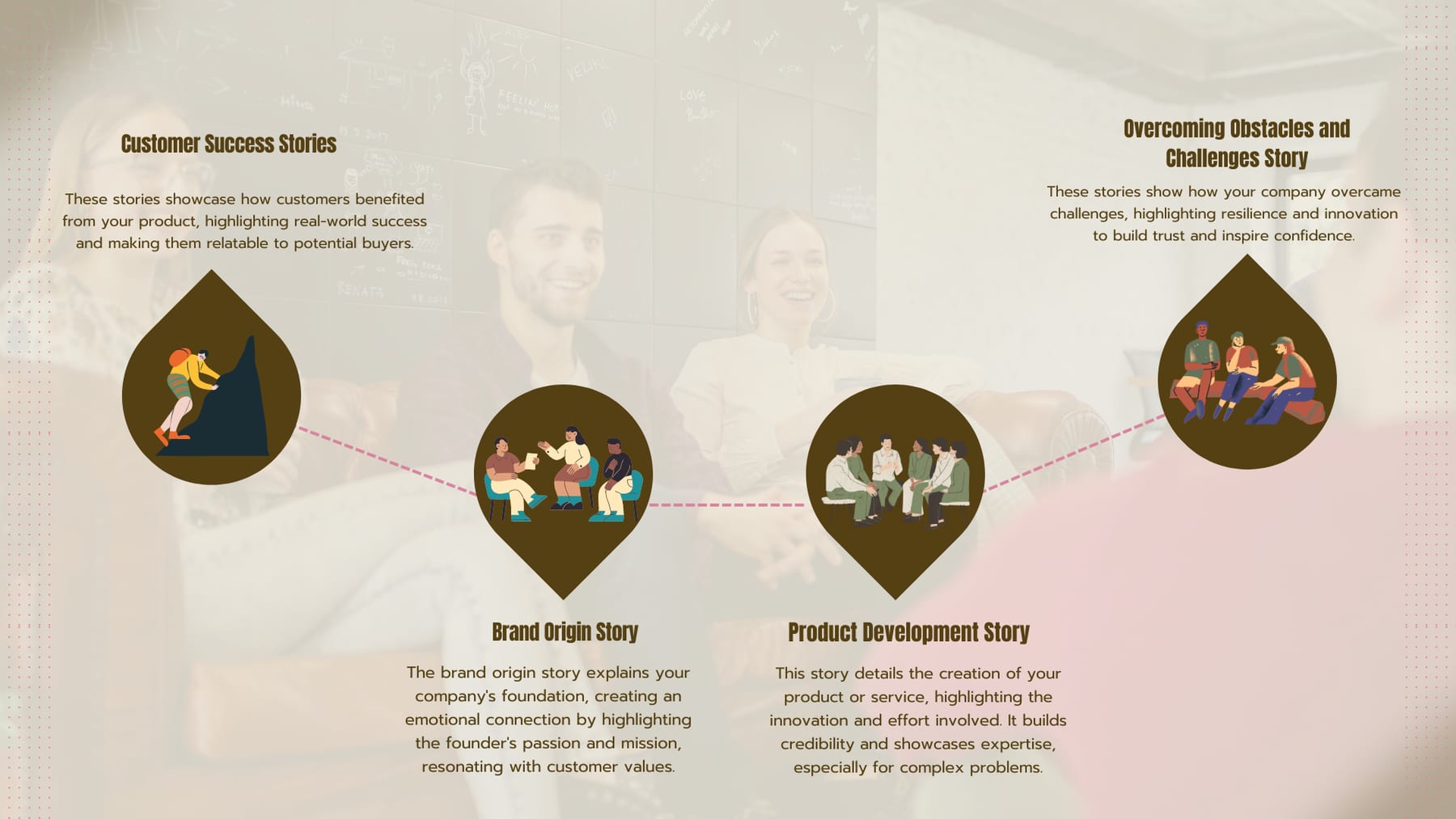
The adjacent version of this problem shows up in customer success and partner enablement, and the same session structure fixes both. A CSM renewing an account needs an expansion story from a comparable account. A channel partner pitching your product on your behalf has even thinner access to your customer proof than your own reps do. If you are already running the workshop, invite one CSM and one partner manager. The stories they carry back move deals you never touch directly.
How the mechanism actually works
The framework is four moves, and the order matters because each one constrains the next.
Case capture. Start in the CRM, not in the marketing folder. Pull closed-won opportunities from the last four quarters, filtered by segment and deal size, and look for ones where the close notes contain a number. Then pull the call recordings from those opportunities. Conversation-intelligence platforms — Gong, Chorus, Clari's call capture — exist to make this searchable; if you have none, the AE's own notes plus a fifteen-minute call with the CSM will do. What you are hunting for is one verbatim line from the champion describing the pain in their own words. A rep-paraphrased pain is generic. A customer-spoken pain is specific and unfakeable, and it is the single highest-leverage artifact in the whole exercise.

Capture five fields and nothing more: customer identifier (or an anonymized descriptor if the logo is not referenceable), industry and rough size, the pain with a baseline number, what was deployed, and the outcome with a number and a time window. Five fields on one index card. Reps who are allowed to capture ten fields write paragraphs, and paragraphs do not survive being spoken.
Narrative arc. Situation establishes a recognizable peer. Complication states the cost of inaction — the thing that was actively getting worse. Resolution is deliberately the shortest beat; this is where reps want to describe the product and where they must not. Result closes on a number with a unit and a timeframe. The failure mode here is nearly universal: reps spend sixty of ninety seconds on resolution because that is the part they know best. Enforce a rough budget out loud — twenty seconds situation, thirty complication, fifteen resolution, twenty-five result — and reps self-correct within two attempts.
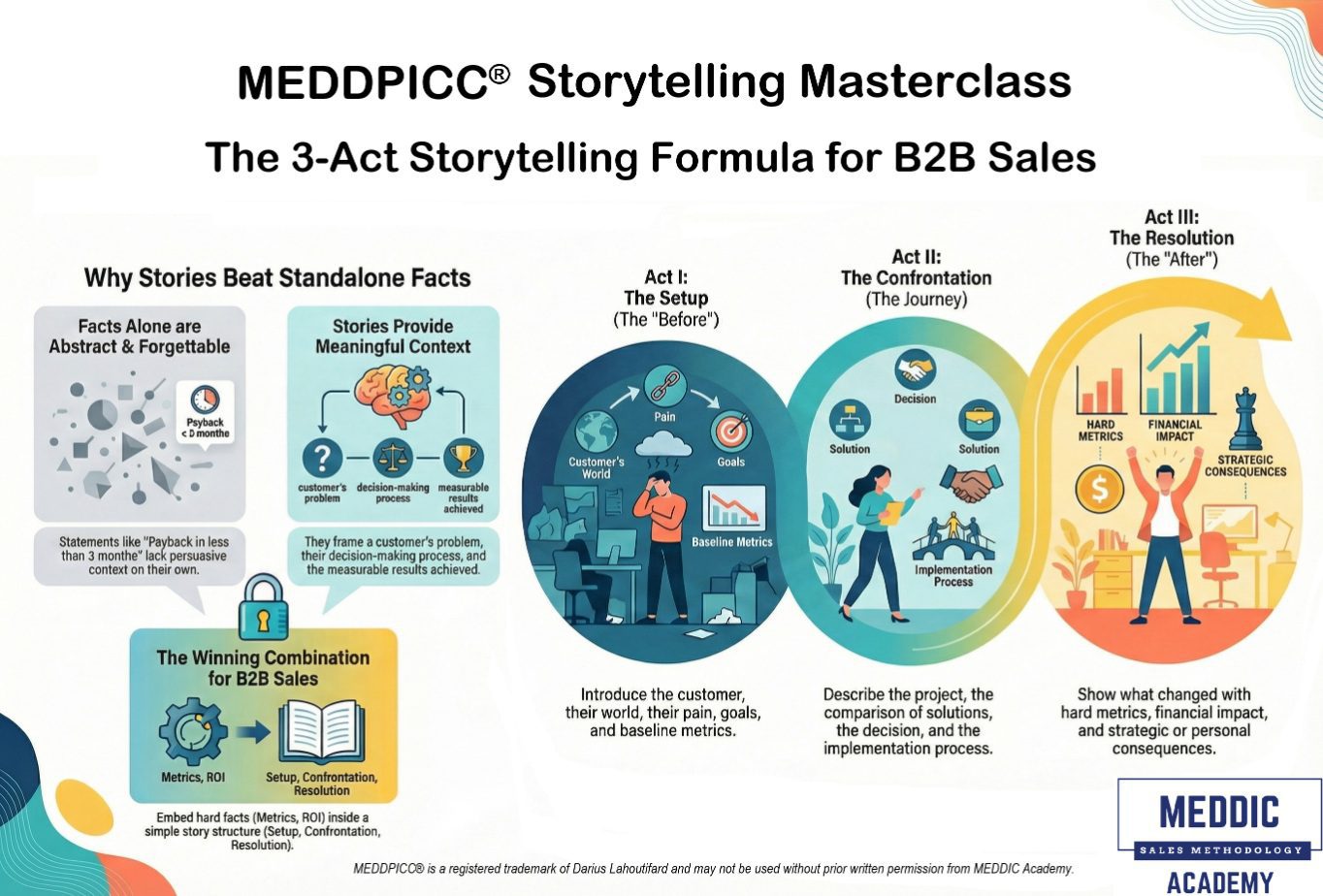
Qualification mapping. Whatever framework the team already runs — MEDDPICC, MEDDIC, SPICED, BANT — the story must land on its elements or it is entertainment. Under MEDDPICC that means the story surfaces Metrics, names the Economic Buyer role, reveals Decision Criteria, hints at the Decision Process, states Pain, identifies the Champion, addresses Compete, and ideally touches Paper Process. Do not invent a second framework for storytelling. Reps will not maintain two. Map onto the existing one and the story becomes a qualification instrument: as the rep tells it, the buyer's reaction to each beat reveals which elements are missing in the live deal.
Delivery rehearsal. Spoken, timed, recorded, no slides. The recording is non-negotiable because reps consistently believe they hit the number and consistently do not until they hear themselves.
The loop back from live calls to capture is the part most programs skip, and it is why most storytelling training decays within a quarter. Every time a story gets told on a recorded call, that call becomes new capture material — better phrasing, sharper objection handling, a version that survived contact with a skeptical buyer.
Real numbers, ranges, and benchmarks
Design the session against concrete constraints rather than vibes.
Length and pacing. Ninety minutes is the practical sweet spot for a first session: roughly 10 minutes of warm-up, 20 on the framework, 20 on drafting, 15 on qualification mapping, 15 on recorded delivery, 10 on roleplay. Under 60 minutes you can teach the framework but nobody rehearses, and unrehearsed frameworks do not transfer. Over two hours, attention collapses and the last two exercises get rushed anyway.
Group size. Six to twelve reps. Below six, the pair exercises run out of variety. Above twelve, you cannot hear enough recordings in the playback segment for the feedback to feel real, and reps who never get played back treat the session as optional. If the team is larger, run two cohorts rather than one big room — and put your strongest storyteller in each cohort rather than both in the first one.
Story length. Ninety seconds spoken is roughly 200–240 words. A thirty-second qualification-mapped version is 70–90 words. Have every rep produce both, because the ninety-second version is for discovery and the thirty-second version is for objection handling, where you have no runway.

Library size. A functioning story library is smaller than people expect. Aim for one story per major persona times one per top pain — for most mid-market teams that is somewhere between eight and fifteen entries. Beyond about twenty, reps stop browsing and default to whichever story they told last. Prune quarterly. A story whose numbers are more than about eighteen months old reads as stale to a buyer who can check your funding round and headcount on the way into the meeting.
Cadence. Run the full workshop once, then a 25-minute recurring drill — one rep tells, the room scores on four criteria, next rep — at whatever rhythm your team already meets. Weekly beats monthly for retention, but a monthly drill that actually happens beats a weekly one that gets cancelled twice and then quietly dies.
What to measure. Do not promise a win-rate lift; the confound density in sales data makes that claim unprovable at most companies' volumes. Measure things you can actually observe: percentage of recorded discovery calls containing a named customer plus a number; number of distinct stories in circulation per rep; the gap between what your top quartile and bottom quartile do on those two metrics. If conversation intelligence is in place, keyword-search customer names across calls and count. That baseline, taken before the workshop, is the only honest before-and-after you will get. Take it a week ahead of the session.
Cost. Internal facilitation is your time plus the room. If you bring in an outside facilitator, the meaningful question is not the day rate but whether they build the library with you or hand you a framework and leave. A framework without a populated library dies in about three weeks.
Trade-offs and alternatives
There are real choices here and defensible answers on both sides.

Rep-drafted versus centrally-written stories. Central authoring by enablement or product marketing produces cleaner, legally-safer copy with consistent numbers. Rep-drafted stories are messier and get used. The tension is ownership: a rep who drafted a story from a deal they ran will tell it unprompted; a rep handed a polished script will read it, badly, once. The pragmatic split is central control of the facts — approved logos, approved metrics, approved claims — and rep control of the telling. Publish a fact sheet per story and let reps build their own arc from it.
Named logos versus anonymized composites. Named customers are dramatically more persuasive and require permission that often takes weeks and sometimes never arrives. Anonymized versions — "a 200-person logistics firm in the Midwest" — are always available and land at maybe seventy percent of the force. Do not split the difference by hinting at an identifiable customer you lack permission to name; that is a real commercial risk and it is the kind of thing that ends up in a legal review of your enablement content. Build the anonymized version first so reps have something usable this week, and pursue named permission in parallel for your two or three best stories.
Workshop versus embedded coaching. A workshop creates shared vocabulary in one sitting and is efficient. One-on-one call coaching produces deeper change per rep and costs far more manager hours. Most teams need the workshop to establish the standard, then coaching to enforce it — the workshop alone reliably decays, and coaching alone means every manager teaches a different structure.
Recording versus live-only rehearsal. Recording is uncomfortable and some reps resist it hard. It is also the only mechanism that shows a rep the gap between their intended and actual delivery. If resistance is high, let reps record privately and share only if they choose; the self-review does most of the work even when nobody else watches.
Storytelling training versus fixing the upstream asset problem. Sometimes the honest diagnosis is that your case studies contain no usable numbers — the customer would not approve them, or nobody measured. In that case a storytelling workshop is treating a symptom. The higher-leverage move is instrumenting outcome measurement at implementation so that in two quarters you have real numbers to tell stories about. Say this out loud if it is true, because running a narrative workshop on top of numberless case studies produces confident reps telling vague stories, which is worse than what you started with.
Common pitfalls and how to avoid them
Vague benefit language. "Improved efficiency," "streamlined operations," "better visibility." These survive because they are unfalsifiable and therefore safe. Kill them with a hard rule: no story ships without a number, a unit, and a timeframe. If the rep cannot produce one, the story is not ready — send them back to the CSM for fifteen minutes.
Inflating or borrowing numbers. A rep under pressure will stretch a single account's result into "our customers typically see." If you have a defensible cross-customer figure, cite it as such and name where it came from. If you do not, say "one customer, this result, here is the context." Buyers who have sat through a hundred pitches have a finely-tuned detector for numbers that cannot be sourced, and getting caught costs more than the vague version would have.
Product-centric resolution. Reps balloon the resolution beat because product is the comfortable ground. The tell is a story where you could not restate the customer's problem afterward. Fix it by timing the beats in rehearsal and reading the budget back to them.
One story, every call. Reps find one story that worked and tell it to a CFO, a VP of Sales, and a security reviewer alike. Force rotation by tagging library entries with persona and pain, and in the recurring drill require a story the rep has not told in the last two sessions.
No question at the end. A story that ends on its result is a monologue. A story that ends on "does that pattern look like what you're dealing with?" is qualification. This one line change does more for call quality than anything else in the session, and it costs four seconds.
Treating the story as a script. Buyers push back — "that was a different industry," "we're much larger than that." The correct move is to concede the difference immediately and pivot to a question rather than defending the analogy. Rehearse exactly that pushback in the roleplay segment; it is the most common objection a story draws and the one reps handle worst.
No follow-through. The most common failure is not a bad session; it is a good session with no cadence after it. Before anyone leaves the room, put the first recurring drill on the calendar and name who runs it. A workshop without a next date is theater.
Related questions
How do I run this if we have no case studies at all?
Run it on live deals instead. Have each rep pick one closed-won opportunity and interview the CSM for fifteen minutes to extract a baseline and an outcome. You end the session with both a story library and the beginnings of a real case-study pipeline.
Can this work for a solo founder or a two-person team?
Yes, and the constraint is different: you have fewer stories but far deeper knowledge of each. Compress to 45 minutes, skip the pair exercises, and focus entirely on drafting and recording. Self-review on a recording works without a partner.
Should marketing or sales own the story library?
Whoever will actually maintain it. Marketing typically owns fact accuracy and permissions; sales owns the spoken versions and which stories are in rotation. A shared owner in enablement, if you have one, is the cleanest arrangement.
How do I keep stories from going stale?
Prune quarterly and re-verify any number older than about eighteen months. When a story gets told well on a recorded call, replace the library version's phrasing with what the rep actually said.
Does this apply to customer success and renewals?
Directly. A renewal conversation needs an expansion story from a comparable account, built the same way. Invite CSMs to the workshop rather than running a separate one.
FAQ
How long should a spoken sales story be?
Ninety seconds is the working ceiling for discovery, roughly 200–240 spoken words. Also build a 30-second version for objection handling, where you have no runway. Anything past two minutes stops being a story and becomes a presentation, and buyers start waiting for their turn rather than listening.
What if my case study has no specific number in it?
Then you do not have a story yet — you have a testimonial. Go get the number: fifteen minutes with the CSM or the account's champion usually surfaces a baseline and an outcome that never made it into the published PDF. Do not substitute a borrowed industry average and imply it is your customer's result.
Can I use a story from a different industry than my prospect's?
Yes, if you name the difference before the buyer does. Lead with "different industry, same failure mode" and then map the mechanism, not the vertical. What transfers is the shape of the problem — manual handoffs, delayed close, no forecast confidence — not the sector.
Do I need conversation-intelligence software for this?
No. It makes capture and measurement much faster, and it gives you a searchable record of which stories actually get told. Without it, use rep notes plus CSM interviews for capture, and phone recordings or a laptop mic for the rehearsal segment. The framework does not depend on tooling.
What is the single biggest mistake reps make?
Telling a well-constructed story that has nothing to do with the buyer's actual pain. A story that does not connect to something the buyer said in the last ten minutes is noise, however polished. Qualify first, then select the story — never the reverse.
How soon should I expect to see anything change?
You should see delivery change inside the session itself — that is what the recording is for. Behavior on live calls takes a few weeks and only holds if a recurring drill exists. Judge it on observable inputs: how many recorded calls contain a named customer and a number, measured against your pre-workshop baseline.
Sources
- Gartner — The B2B Buying Journey
- Harvard Business Review — Sales and storytelling coverage
- MEDDICC — qualification framework overview
- Winning by Design — revenue architecture resources
- Gong Labs — sales conversation research
- Challenger — teaching-based selling research
- Forrester — B2B sales and marketing research
- Nielsen Norman Group — storytelling in user-facing content
Related on PULSE
- [Value Proposition Crafting Workshop Template](/knowledge/st0755)
- [Value Proposition Crafting: Interactive Template for a Weekly Sales Training](/knowledge/st0780)
- [Top 10 Sales Training Templates for Value Proposition Crafting](/knowledge/st0692)
- [Top 10 Customer Storytelling Templates for Sales Meetings](/knowledge/st0739)
- [Top 10 storytelling role-play scenarios for sales teams](/knowledge/st0562)
- [Top 10 storytelling training drills for B2B sales reps](/knowledge/st0561)
This page will be disappearing soon. Save it to your device for $1 — or read it free while it is here.
@Kory-White- · if Venmo asks, the last 4 of my number are 2012
 pulse-sales-trainingsProduct Knowledge Quick-Start Training Kit
 pulse-sales-trainingsAccount Planning for Enterprise Deals: Template for a Collaborative Team Exercise
 pulse-sales-trainingsTop 10 NEAT Selling training exercises for sales managers in 2027
 pulse-sales-trainingsClosing Techniques Drill Template for Teams
 pulse-sales-trainingsWhat should you know before investing in Sales Trainings in 2027?
 pulse-sales-trainingsCompetitive Battle Card Review: A Gamified Team Quiz Template
 pulse-sales-trainingsCold Calling Script Practice Session Guide
 pulse-sales-trainingsTop 10 closing training drills for B2B sales reps in 2027
 pulse-sales-trainingsThe Gong Call-Review Clinic: Scoring Discovery in 60 Minutes
 pulse-sales-trainingsThe Challenger Sale Method: Ready-to-Use Facilitator Deck for a 60-Minute Class