
Chief Joseph’s I Will Fight No More Forever (1877) — Text and Lessons
 Curated byKory White · Fractional CRO · Maryland
 PULSEKNOWLEDGE LIBRARY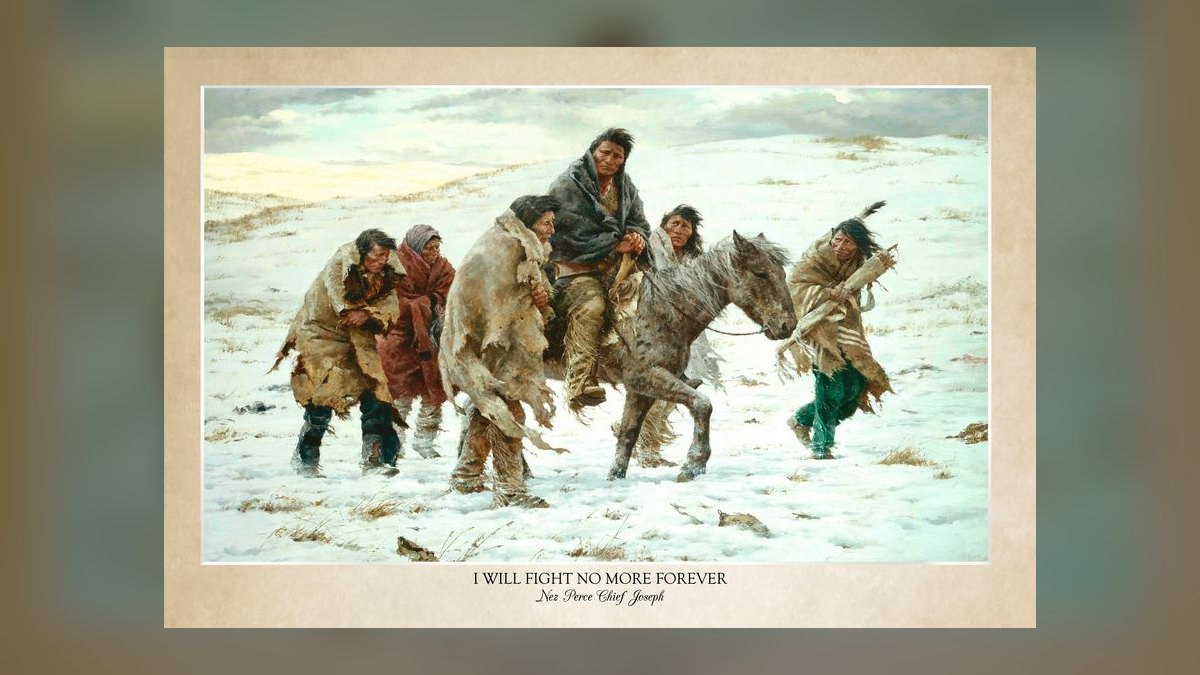
Chief Joseph's 1877 surrender speech, commonly known as "I Will Fight No More Forever," is a short but powerful statement delivered as the Nez Perce were cornered near the Canadian border after a months-long retreat. The text expresses his grief over the loss of his people and leaders, stating he will cease fighting because the young men are dead and the elders are cold. The speech is a lesson in the tragic costs of forced removal, the futility of resistance against overwhelming odds, and the dignity of a leader choosing peace for his survivors. Its enduring power lies in its stark honesty, concrete imagery, and refusal to romanticize defeat, making it a timeless document of human resilience and the moral weight of leadership in crisis.
The Nez Perce War of 1877 was the culmination of decades of broken treaties and forced land cessions that pushed the Nimiipuu people from their ancestral lands in the Pacific Northwest. Chief Joseph, though not a traditional war chief, became the public face of a desperate retreat that covered over 1,170 miles across four present-day states, as approximately 800 Nez Perce—including women, children, and the elderly—outmaneuvered a pursuing U.S. Army force of over 2,000 soldiers. The speech, delivered through an interpreter on October 5, 1877, at the Bear Paw battlefield in Montana, just 40 miles short of the Canadian border and the refuge they sought, remains one of the most quoted and analyzed surrender statements in American history.
What were the precise historical circumstances that led Chief Joseph to deliver his surrender speech?
The Nez Perce War erupted in June 1877 after years of escalating tensions between the tribe and white settlers encroaching on their lands in the Wallowa Valley of Oregon. The U.S. government had repeatedly pressured the Nez Perce to cede their territory and move to a drastically reduced reservation in Idaho, culminating in an ultimatum that all bands must relocate by June 1877. When violence broke out following the murder of a Nez Perce man by a white settler, the U.S. Army launched a military campaign to force compliance, triggering a conflict that would define Chief Joseph's legacy.
What followed was one of the most remarkable military retreats in American history. Chief Joseph, along with other leaders like Looking Glass, White Bird, and Toohoolhoolzote, led approximately 800 Nez Perce through a series of running battles across Idaho, Wyoming, and Montana. The Nez Perce achieved tactical victories at the Battle of the Clearwater, the Battle of the Big Hole, and the Battle of Canyon Creek, consistently outmaneuvering larger, better-equipped Army units through superior knowledge of terrain and innovative tactics. However, by late September 1877, with winter approaching, their horses exhausted, and ammunition nearly gone, the remaining Nez Perce were surrounded by Colonel Nelson Miles's cavalry at the Bear Paw Mountains in Montana—just 40 miles from the Canadian border where they had hoped to find refuge with Sitting Bull's Lakota. For a deeper understanding of how military rhetoric shapes historical narratives, see Churchill's We Shall Fight on the Beaches (1940) — Text and Why It Endures.
How does the full text of Chief Joseph's surrender speech read?
The complete surrender statement, as recorded by Army interpreter Arthur Chapman and published in contemporary newspapers, contains approximately 120-150 words delivered in a single, unbroken narrative. The most commonly cited version reads: "Tell General Howard I know his heart. What he told me before, I have it in my heart. I am tired of fighting. Our chiefs are killed. Looking Glass is dead. Toohoolhoolzote is dead. The old men are all dead. It is the young men who say yes or no. He who led on the young men is dead. It is cold, and we have no blankets. The little children are freezing to death. My people, some of them, have run away to the hills, and have no blankets, no food. No one knows where they are—perhaps freezing to death. I want to have time to look for my children, and see how many of them I can find. Maybe I shall find them among the dead. Hear me, my chiefs! I am tired; my heart is sick and sad. From where the sun now stands, I will fight no more forever."
The speech's structure follows a deliberate rhetorical arc: Joseph begins by acknowledging his physical and emotional exhaustion, then systematically catalogs the human losses—killed chiefs, missing children, freezing elderly—before arriving at the devastating conclusion. The repetition of "dead" and "freezing" creates a rhythmic accumulation of grief that makes the final line land with the weight of inevitability. The phrase "From where the sun now stands" anchors the vow to a specific, witnessed moment, transforming an abstract promise into something physical and irreversible. Scholars note that the speech's power derives from its refusal to employ metaphor or elevated language, instead relying on plain, concrete nouns—blankets, children, cold, death—that create an inescapable moral imperative.

What rhetorical techniques make Chief Joseph's speech so enduringly powerful?
Chief Joseph's speech is a masterwork of rhetorical restraint and moral authority, employing several techniques that elevate it beyond a simple surrender statement into a timeless document of human dignity. The most striking technique is the use of asyndeton—the deliberate omission of conjunctions—which creates a breathless, cumulative effect as Joseph lists losses without pause: "Our chiefs are killed. Looking Glass is dead. Toohoolhoolzote is dead. The old men are all dead." This structure mirrors the relentless nature of grief, where one loss follows another without relief, forcing the listener to feel the weight of each death individually rather than as a collective abstraction.
The speech also employs anaphora—the repetition of a word or phrase at the beginning of successive clauses—through the repeated use of "It is" and "I am" constructions: "It is cold, and we have no blankets. The little children are freezing to death. My people, some of them, have run away to the hills, and have no blankets, no food." This repetition creates a rhythmic, almost liturgical quality that underscores the universality of suffering. Joseph's choice to frame the decision in terms of physical necessity rather than military defeat is another powerful move: he does not say "we have lost the battle" but "we have no blankets" and "the little children are freezing." This shifts the moral framework from one of conquest to one of survival, making it impossible for his audience to argue against his decision. The speech's brevity—roughly 120 words—is itself a rhetorical choice. Joseph stops exactly when he has made his point, trusting the accumulated weight of concrete losses to do what elaborate argument cannot. For more on how rhetorical structure shapes powerful speeches, explore What Makes Churchill's "We Shall Fight on the Beaches" a Great Speech.
What happened to Chief Joseph and the Nez Perce after the surrender?
Despite the dignity and clarity of Chief Joseph's surrender, the U.S. government did not honor the terms he believed he had secured. Joseph had been promised by Colonel Miles that his people would be allowed to return to the Nez Perce reservation in Idaho, but this promise was overruled by higher military and political authorities. Instead, the Nez Perce were immediately taken as prisoners of war and shipped first to Fort Leavenworth, Kansas, then to a malaria-infested reservation in Indian Territory (present-day Oklahoma). Nearly half the tribe died from disease, malnutrition, and harsh conditions during their forced exile, a tragedy that Joseph spent the rest of his life trying to reverse.
Chief Joseph became a tireless advocate for his people's right to return home, petitioning government officials, meeting with President Rutherford B. Hayes in 1879, and even traveling to Washington, D.C., to deliver eloquent appeals before Congress. His speeches during this period echoed the same rhetorical strategies of his surrender statement—plain language, concrete losses, and moral clarity—but they were largely ignored by officials who viewed Native American land claims as an obstacle to westward expansion. In 1885, the Nez Perce were finally allowed to return to the Pacific Northwest, but Joseph and his band were sent to the Colville Reservation in Washington State, not their ancestral homeland in Oregon's Wallowa Valley. Joseph lived there until his death in 1904, reportedly of a broken heart. The doctor who attended him claimed he "died of a broken heart" after being denied permission to visit his homeland one last time. Modern historians debate the accuracy of Joseph's speech as recorded—some argue that the interpreter may have condensed or embellished Joseph's words, while others point to multiple contemporary accounts that confirm the speech's core sentiments. Today, Chief Joseph is remembered not as a defeated warrior but as a powerful voice for Native American rights, whose words continue to resonate in discussions about peace, justice, and the human cost of conflict.

How has Chief Joseph's speech been interpreted and used in modern culture?
Chief Joseph's "I Will Fight No More Forever" has transcended its original context to become a cultural touchstone referenced in literature, film, music, and political discourse. The speech has been quoted in countless contexts—from anti-war protests to civil rights rallies—as a universal statement of principled surrender and moral exhaustion. Its most famous line has been adapted into book titles, documentary films, and even song lyrics, demonstrating how a single phrase can carry immense symbolic weight across generations.
The speech's interpretation has evolved significantly over time. In the early 20th century, it was often romanticized as a noble savage's farewell, stripped of its political context and used to reinforce stereotypes of Native American stoicism. Later, during the civil rights movement, activists reclaimed the speech as a testament to the human cost of oppression and the dignity of resistance against overwhelming force. Contemporary scholars emphasize the speech's role as a survivance narrative—a term coined by Native American studies scholar Gerald Vizenor to describe stories that combine survival and resistance—rather than a simple surrender. The speech refuses to accept defeat as the final word; instead, it documents loss while preserving the speaker's moral authority and humanity. Modern educators use the speech to teach about the Nez Perce War, the history of U.S.-Native American relations, and the power of rhetorical restraint. For a comparison with other historical speeches that shaped American identity, see Abraham Lincoln's Farewell to Springfield (1861) — Text and Lessons.

What practical lessons can modern leaders and communicators learn from Chief Joseph's speech?
Chief Joseph's surrender speech offers timeless lessons for anyone who must communicate in moments of crisis, loss, or difficult decision-making. The first lesson is to lead with the cost, not the conclusion. Joseph earns his final line by naming losses first—killed chiefs, missing children, no blankets—before stating his decision. This structure creates emotional buy-in from the audience, who must confront the human reality before they can accept the outcome. In any difficult communication—a resignation, an apology, a concession speech—stating what something cost before stating what you decided makes the decision feel inevitable rather than arbitrary.
The second lesson is to use concrete nouns, not abstractions. "No blankets" and "the little children are freezing" do more than any phrase about hardship or sacrifice. Reach for the specific, physical detail that makes the abstract tangible. Joseph never uses words like "suffering," "oppression," or "tragedy"—he shows them through children, cold, and the absence of blankets. This technique is especially powerful because it leaves no room for argument: no one can dispute that children are freezing. The third lesson is to let one line carry the speech. Everything builds to "I will fight no more forever." Decide your single sentence in advance and clear the runway so nothing competes with it. This focus gives the audience a single, unforgettable takeaway that they will carry long after they forget the details. The fourth lesson is to anchor a vow to a moment. "From where the sun now stands" fixes the promise in time and place, making it irreversible. Tie commitments to a witnessed now—a date, a room, a handshake, a sunset—to give them weight and permanence. The fifth lesson is to say you are tired, if you are. Admitting depletion is not weakness on a stage; it is the fastest way to make a room stop arguing and start listening. Joseph's repeated "I am tired" disarms his audience by removing any pretense of strength, leaving only truth. Finally, stop when you are done. The speech is roughly 120 words. It does not explain itself or soften the blow. Brevity is the respect you pay a heavy moment, and Joseph trusted his audience to understand without elaboration.
Related questions
What was the Nez Perce War of 1877?
The Nez Perce War was a conflict between the Nez Perce tribe and the U.S. Army that lasted from June to October 1877, triggered by forced removal from ancestral lands in Oregon and resulting in a 1,170-mile retreat across four states.
How long was Chief Joseph's surrender speech?
The most commonly recorded version of the speech contains approximately 120 to 150 words, delivered in about one minute, making it one of the shortest and most powerful surrender statements in history.
Where did Chief Joseph surrender?
Chief Joseph surrendered at the Bear Paw battlefield in Montana, just 40 miles south of the Canadian border, on October 5, 1877, after a desperate five-day siege.
What happened to Chief Joseph after his surrender?
Joseph and his people were sent as prisoners of war to Kansas and Oklahoma, where nearly half died from disease, before being relocated to the Colville Reservation in Washington, where Joseph lived until his death in 1904.
Is the speech considered historically accurate?
Scholars debate the exact wording since it was recorded through an interpreter and later published by reporters, but multiple contemporary accounts confirm the core sentiments and structure of Joseph's statement.
What is the main theme of "I Will Fight No More Forever"?
The main theme is the human cost of forced removal and the moral weight of choosing peace over continued suffering, expressed through concrete images of loss rather than abstract principles.
FAQ
What is the exact text of Chief Joseph's surrender speech? The most commonly cited version begins "Tell General Howard I know his heart" and concludes with "From where the sun now stands, I will fight no more forever," containing approximately 120-150 words delivered in a single narrative.
Why did Chief Joseph surrender if his people were still fighting? After a 1,170-mile retreat and multiple battles, the Nez Perce were surrounded, low on supplies, and many of their leaders had been killed. Joseph chose surrender to prevent further loss of life, especially among women, children, and the elderly who were freezing without blankets or food.
How many Nez Perce died during the 1877 war? Estimates range from roughly 200 to 300 Nez Perce killed, with U.S. military casualties around 100 to 150. The exact numbers are debated among historians, but the war devastated the Nez Perce population and their way of life.
Was Chief Joseph a war chief or a peace leader? Chief Joseph was primarily a peace leader and diplomat rather than a war chief. Much of the actual fighting during the retreat was directed by other leaders like Looking Glass and White Bird, but Joseph became the public face of Nez Perce resistance and their tireless advocate after surrender.
What happened to Chief Joseph's people after the surrender? The Nez Perce were sent as prisoners of war to Fort Leavenworth, Kansas, then to a malaria-infested reservation in Indian Territory (Oklahoma), where nearly half died from disease. They were finally allowed to return to the Pacific Northwest in 1885, but not to their ancestral Wallowa Valley homeland.
Is the speech considered historically accurate? Scholars debate the exact wording since it was recorded through interpreter Arthur Chapman and later published by reporters, but multiple contemporary accounts confirm the core sentiments and structure of Joseph's statement. The speech's power derives from its emotional truth rather than precise transcription.
What lessons can modern readers take from this speech? The speech illustrates the human cost of forced removal and broken treaties, the moral weight of choosing peace over continued suffering, and the power of plain, concrete language to convey profound truth. It remains a study in rhetorical restraint and dignified leadership under impossible circumstances.
How has the speech been used in popular culture? The speech has been referenced in literature, film, music, and political discourse as a universal statement of principled surrender and moral exhaustion, with its most famous line adapted into book titles, documentary films, and song lyrics across multiple generations.
Sources
- National Archives — Chief Joseph Surrender Speech
- Smithsonian National Museum of the American Indian — Nez Perce History
- Library of Congress — Native American Historical Collections
- Oregon Historical Society — Chief Joseph and the Nez Perce
- PBS LearningMedia — Chief Joseph and the Nez Perce War
- History.com — Nez Perce War and Chief Joseph
- University of Montana — Bear Paw Battlefield Resources
- Nez Perce National Historical Park — National Park Service
- American Rhetoric — Chief Joseph Speech Analysis
Related on PULSE
- [Patrick Henry’s Give Me Liberty or Give Me Death (1775) — Text and Lessons](/knowledge/sp0007)
- [Churchill’s We Shall Fight on the Beaches (1940) — Text and Why It Endures](/knowledge/sp0004)
- [Abraham Lincoln’s Farewell to Springfield (1861) — Text and Lessons](/knowledge/sp0040)
- [Susan B. Anthony’s On Women’s Right to Vote (1873) — Text, Context, and Lessons](/knowledge/sp0010)
- [Booker T. Washington’s Atlanta Compromise (1895) — Text and Lessons](/knowledge/sp0035)
- [Winston Churchill’s Blood, Toil, Tears and Sweat (1940) — Text and Lessons](/knowledge/sp0031)
@Kory-White- · if Venmo asks, the last 4 of my number are 2012
 pulse-moviesTop 10 Movies on Netflix 2027
 pulse-moviesTop 10 Movies on Max 2027
 pulse-moviesTop 10 Fantasy Movies of All Time in 2027
 pulse-moviesTop 10 Documentaries of All Time in 2027
 pulse-moviesTop 10 Superhero Movies of All Time in 2027
 pulse-moviesTop 10 Romance Movies of All Time in 2027
 pulse-moviesTop 10 Westerns of All Time in 2027
 pulse-moviesTop 10 Musical Movies of All Time in 2027
 pulse-moviesTop 10 Thriller Movies of All Time in 2027
 pulse-moviesTop 10 Crime Movies of All Time in 2027