 Pulse Reviews and Analysis
The Complete RevOps Tech Stack for a Mid-Market SaaS Company in 2027
 Curated by Kory White · Fractional CRO, CRO Syndicate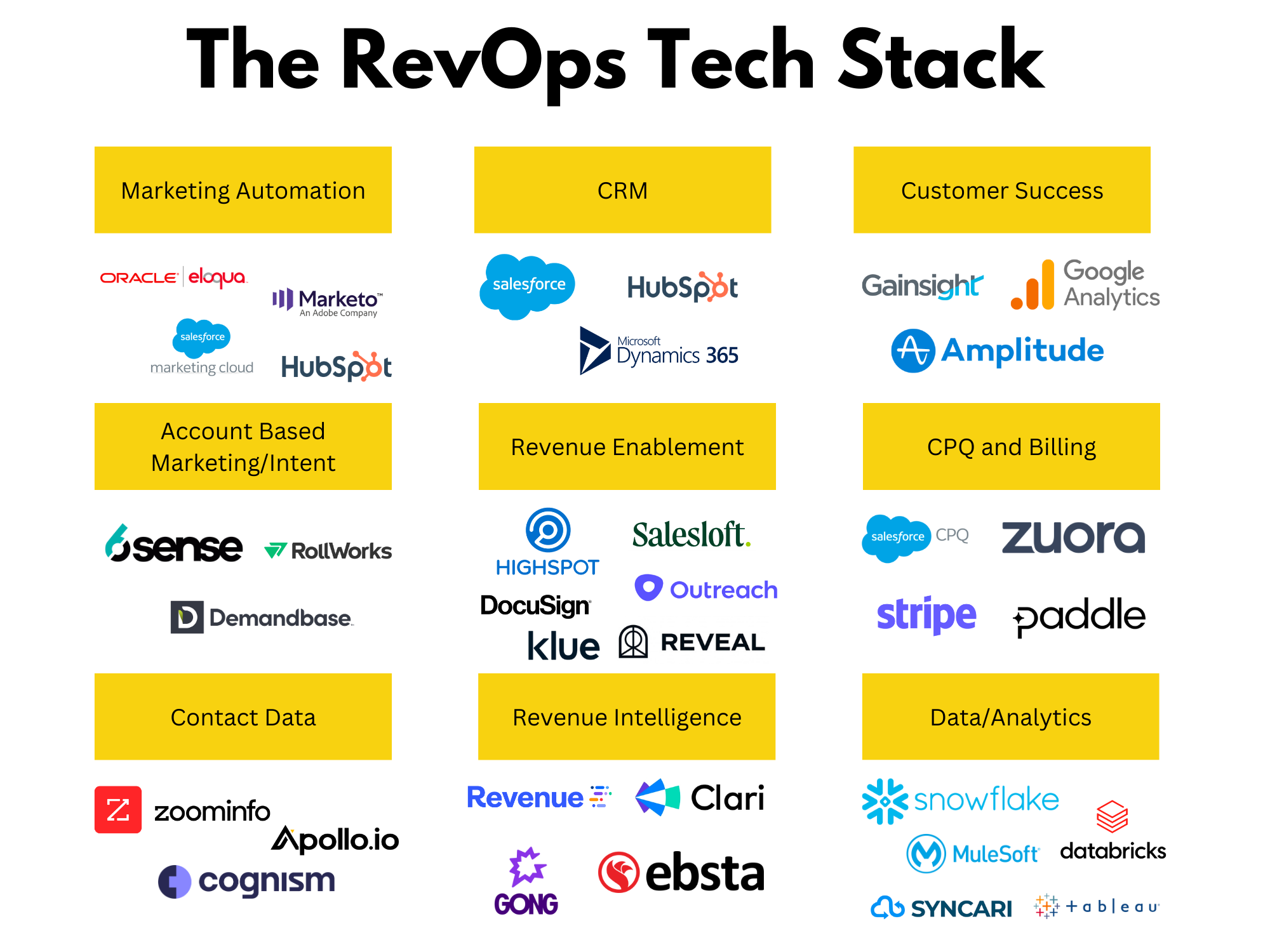
Direct Answer
The 2027 RevOps tech stack for a mid-market SaaS company is not a collection of point solutions but a tightly integrated, AI-first operating system. Automation handles 70% of routine data entry and lead qualification, while AI agents manage initial buyer conversations and pipeline forecasting.
The core stack has consolidated around Salesforce as the system of record, HubSpot for mid-funnel engagement, and a new category of AI-native Revenue Orchestration Platforms (like Clari and Gong) that replace traditional SDR/BDR tools. Buying committees of 8-12 people and 6-9 month sales cycles are the norm, demanding tools that provide real-time intent signals and automated stakeholder mapping.
The winning stack prioritizes vendor consolidation (5-7 core tools max) and API-first architecture to support AI agents that execute workflows across CRM, email, and meeting platforms.
The 2027 RevOps Reality: Why Your Stack Must Change
By 2027, the mid-market SaaS market has been reshaped by three forces: AI commoditization of SDR/BDR roles, buying committee expansion (Gartner reports 8-12 stakeholders involved in B2B purchases), and cycle length inflation (Forrester data shows average deal cycles of 8-9 months for mid-market).
Your tech stack must now orchestrate multi-threaded conversations, predict churn from product usage, and automate compliance for GDPR/CCPA 2.0. The era of "best-of-breed" point solutions is dead; vendor consolidation (from 12+ tools to 5-7) is mandatory to reduce integration debt and data silos.
The Core Stack: 5 Layers, 7 Tools
Layer 1: System of Record & Data Foundation
Tool: Salesforce (mandatory) or HubSpot CRM (for sub-$10M ARR). By 2027, Salesforce has absorbed Tableau and Mulesoft into its core, offering real-time data streaming for AI models. For mid-market, Salesforce Data Cloud is the single source of truth, unifying CRM, product usage (via Snowflake), and intent data (via 6sense).
HubSpot remains viable for companies under $10M ARR, but its AI-powered lead scoring (launched 2025) still lags Salesforce's Einstein GPT for complex buying committees.
Layer 2: Revenue Orchestration & AI Agents
Tool: Clari (for forecasting) + Gong (for conversation intelligence). Clari's AI agents now automatically generate weighted forecasts from CRM, email, and meeting data, reducing manual pipeline reviews by 80%. Gong's Revenue Intelligence has evolved into an AI SDR that drafts personalized sequences, books meetings, and updates CRM fields after calls.
Both tools natively integrate with Salesforce and Slack, triggering alerts when a buying committee member engages.
Layer 3: Engagement & Sequence Automation
Tool: Outreach (enterprise) or Salesloft (mid-market). These platforms have become AI-native sequence engines. Outreach's AI now drafts multi-channel sequences (email, LinkedIn, phone) based on intent signals from 6sense or ZoomInfo.
Salesloft offers AI-powered cadence optimization that pauses sequences when a prospect replies, then hands off to a human rep. Both tools now include built-in conversation intelligence (competing with Gong), but mid-market teams still prefer Gong for its buying committee detection feature.
Layer 4: Intent Data & Buyer Intelligence
Tool: 6sense (for account-based) or ZoomInfo (for contact-level). 6sense's AI now predicts buying committee members from public data and product usage patterns. ZoomInfo has absorbed Lusha and Apollo, offering real-time contact updates and AI-generated persona maps.
For mid-market, 6sense is the standard for ABM orchestration, while ZoomInfo provides direct dials and org charts for multi-threaded outreach.
Layer 5: Product-Led Growth & Customer Success
Tool: Pendo (for product analytics) + ChurnZero (for CS). Pendo's AI now auto-tags feature usage and predicts churn 30 days in advance. ChurnZero integrates with Salesforce to trigger automated renewal workflows and AI-driven health scores.
For PLG companies, Pendo replaces traditional CRM for lead scoring based on product-qualified accounts (PQAs).

👉 Quick Call with Kory White, Fractional CRO · See Kory on LinkedIn · CRO Syndicate
Decision Tree: Which Stack for Your Revenue Model?
The 2027 AI Agent Workflow
Implementation Roadmap for 2027
Phase 1: Foundation (Months 1-2)
- Audit existing stack against the 5 layers. Cut 50% of tools (e.g., replace 3 separate email, phone, and LinkedIn tools with Outreach or Salesloft).
- Migrate to Salesforce Data Cloud or HubSpot Enterprise for unified data.
- Integrate Gong with Salesforce for real-time call data.
Phase 2: AI Agent Deployment (Months 3-4)
- Configure Clari's AI forecasting with 6 months of historical data.
- Set up Gong's AI SDR to handle first-touch outreach for inbound leads.
- Train AI agents on your MEDDIC or Challenger framework.
Phase 3: Optimization (Months 5-6)
- A/B test sequence variants using Salesloft's AI optimization.
- Monitor buying committee expansion via 6sense's intent alerts.
- Build automated handoff rules between AI agents and human reps.
FAQ
What is the single most important tool for a mid-market RevOps stack in 2027? Clari or Gong — depending on whether forecasting or conversation intelligence is your priority. Both are now AI-first platforms that replace 3-4 legacy tools.
How do I handle buying committees of 12 people with a small team? Use 6sense to auto-map stakeholder roles and Gong to detect who engages in meetings. Outreach can then multi-thread sequences to all identified members.
Is HubSpot still viable for mid-market in 2027? Yes, for companies under $10M ARR with PLG motions. Above that, Salesforce is mandatory for complex deal structures and custom reporting.
How much can I automate with AI agents? 70% of first-touch outreach and 80% of pipeline forecasting can be automated. Human reps handle complex objections, contract negotiations, and executive meetings.
What's the biggest mistake mid-market RevOps teams make in 2027? Over-integrating — trying to connect 12+ tools instead of consolidating to 5-7. This creates data silos that AI agents can't access.
Do I still need a CRM if I have AI agents? Yes — Salesforce or HubSpot remains the system of record for all deal data. AI agents read and write to the CRM, but they don't replace it.
Bottom Line
The 2027 RevOps stack is about intelligent orchestration over tool proliferation. Consolidate to 5-7 core platforms (Salesforce, Clari/Gong, Outreach/Salesloft, 6sense/ZoomInfo, Pendo/ChurnZero) and let AI agents handle 70% of routine work. Buying committees and longer cycles demand real-time intent data and automated stakeholder mapping — not more manual processes.
The winners will be teams that reduce integration debt and train AI agents on their specific sales methodology.
Sources
- Gartner: The Future of B2B Buying in 2027
- Forrester: AI in Revenue Operations, 2027
- McKinsey: The New B2B Sales Playbook
- Gong Labs: Buying Committee Detection Trends
- SaaStr: The Mid-Market Tech Stack in 2027
- Bessemer Venture Partners: Cloud 2027 Report
- Salesforce: Einstein GPT for Revenue
- Clari: AI-Powered Forecasting Guide
- HubSpot: AI Lead Scoring Update
*The 2027 RevOps tech stack for mid-market SaaS consolidates around AI-first platforms like Salesforce, Clari, and Gong, with automation handling 70% of routine work and buying committees of 8-12 stakeholders driving longer cycles.*