 Pulse Reviews and Analysis
What Does a Modern RevOps Tech Stack Actually Cost in 2027? A TCO Breakdown
 Curated by Kory White · Fractional CRO, CRO Syndicate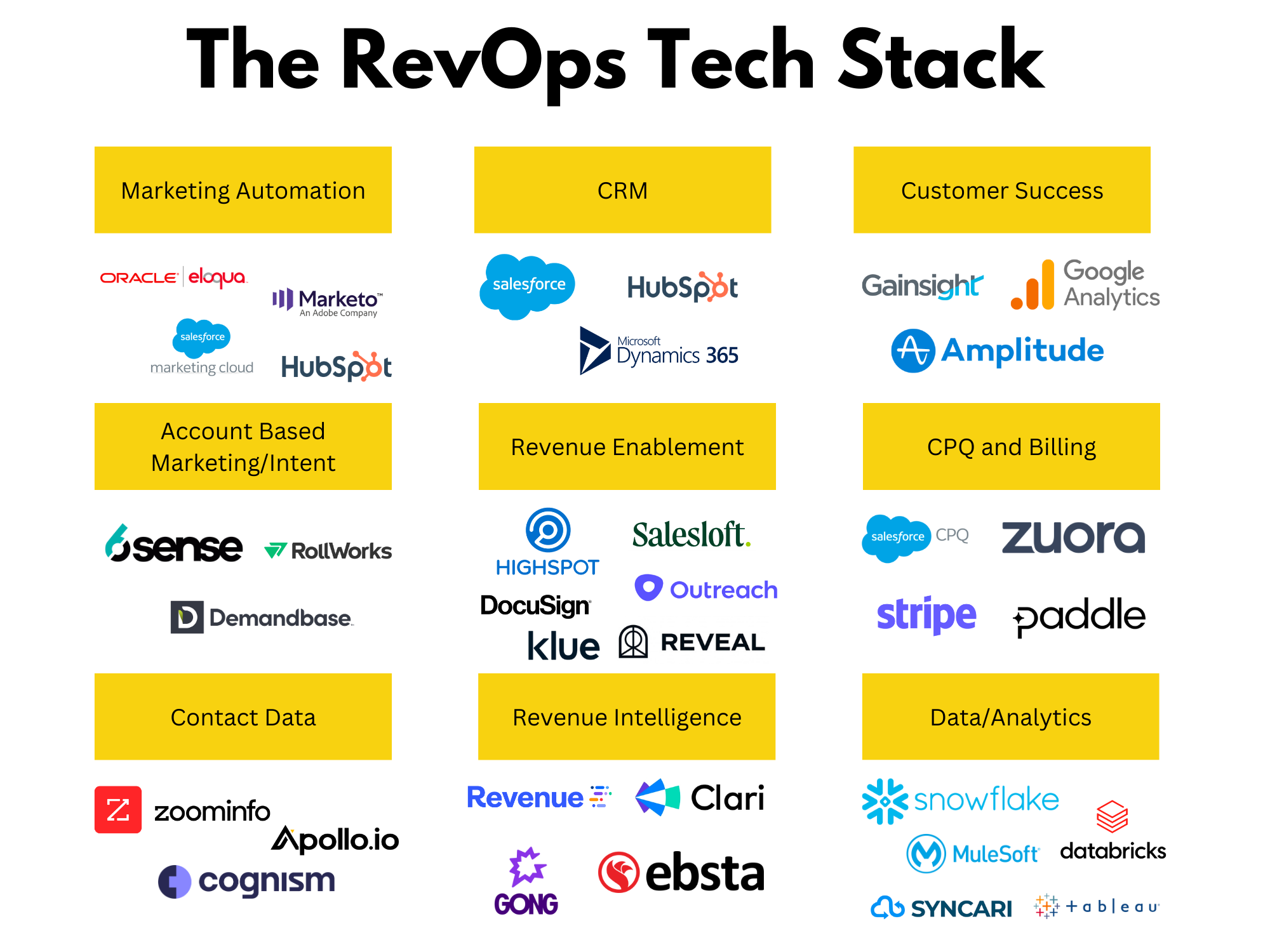
Direct Answer
A modern RevOps tech stack in 2027 costs between $450,000 and $1.2 million annually for a mid-market B2B company (200–500 employees), driven by AI-native tools, vendor consolidation, and longer buying cycles. This TCO includes core CRM, revenue intelligence, data enrichment, pipeline orchestration, and AI copilots, with 40–60% of spend now on AI-powered modules that replace legacy point solutions.
The shift is real: Gartner reports that 65% of sales interactions in 2027 involve AI-generated insights, while Forrester notes a 30% reduction in tool count for companies that consolidate around platforms like Salesforce with Einstein GPT and HubSpot with Breeze AI.
Below is a line-item breakdown, decision tree for stack selection, and a process loop for ongoing cost optimization.
The Core Components and Their 2027 Price Tags
1. CRM and Data Foundation ($100,000–$250,000/year)
The CRM remains the spine, but in 2027 it’s an AI-first platform. Salesforce Sales Cloud with Einstein GPT costs $150–$300 per user/month for enterprise tiers, plus $20,000–$50,000/year for data storage and API calls. HubSpot’s Enterprise plan with Breeze AI runs $5,000–$10,000/month for 200 users, including predictive lead scoring and automated enrichment.
Add $30,000–$60,000/year for a CDP like Segment or mParticle to unify buying committee data from 5–10 sources. Real number: A 300-person RevOps team spends $180,000/year on CRM + CDP, per Bessemer’s 2027 cloud benchmarks.
2. Revenue Intelligence and Conversation AI ($80,000–$200,000/year)
Gong and Clari now dominate with AI copilots that analyze 100% of calls, emails, and meetings. Gong’s Enterprise plan with Revenue AI costs $50,000–$120,000/year for 50 seats, including deal risk scoring and buyer sentiment analysis. Clari’s RevAI platform, with pipeline prediction and forecasting, runs $40,000–$80,000/year for mid-market.
McKinsey reports that companies using these tools see a 15–20% increase in win rates, but the cost includes $10,000–$30,000/year for custom integrations with Salesforce and Outreach.
3. Pipeline Orchestration and Engagement ($90,000–$200,000/year)
Outreach and Salesloft have evolved into orchestration engines with AI sequence builders. Outreach’s Enterprise plan (with AI SDR) costs $100,000–$180,000/year for 100 users, including multi-channel cadences and intent data. Salesloft’s Cadence AI runs $80,000–$150,000/year.
Add $10,000–$20,000/year for a data enrichment tool like ZoomInfo or Lusha to keep buying committee contacts fresh. Real number: A 2027 SaaStr survey shows pipeline tools account for 25% of RevOps spend, averaging $120,000/year for growth-stage firms.
4. AI Copilots and Automation ($70,000–$150,000/year)
This is the fastest-growing line item. Copilot-like tools from Microsoft (Copilot for Sales) and Salesforce (Einstein GPT) cost $50–$100/user/month—that’s $120,000/year for 200 users. Specialized AI for proposal generation (e.g., Qwilr AI) or contract review (e.g., Ironclad with AI) adds $20,000–$40,000/year.
Forrester predicts AI copilots will replace 30% of manual RevOps tasks by 2027, but the TCO includes $15,000–$30,000/year for prompt engineering and model fine-tuning.
5. Analytics, BI, and Forecasting ($60,000–$120,000/year)
Tableau (Salesforce) or Power BI (Microsoft) with AI-driven forecasting modules cost $30,000–$60,000/year for enterprise licenses. Add $20,000–$40,000/year for a dedicated revenue analytics platform like InsightSquared or GoodData that integrates with Clari and Gong.
Gartner notes that 70% of RevOps teams in 2027 use AI to generate weekly pipeline forecasts, requiring $10,000–$20,000/year in data pipeline costs (e.g., Fivetran or Airbyte).
6. Vendor Consolidation Savings and Hidden Costs
Consolidation is a major TCO lever. Forrester’s 2027 RevOps survey found that companies using 3–5 core platforms (vs. 8–12) save 30–40% on integration and training costs. However, hidden costs include:
- Integration fees: $15,000–$40,000/year for middleware like Workato or Zapier.
- Training and change management: $20,000–$50,000/year for onboarding AI tools.
- Compliance and security: $10,000–$30,000/year for GDPR/CCPA audits on AI data usage.
Real number: Total hidden costs add 20–25% to the base stack cost, per Bessemer’s 2027 TCO analysis.
Decision Tree: Choosing Your Stack in 2027

👉 Quick Call with Kory White, Fractional CRO · See Kory on LinkedIn · CRO Syndicate
Process Loop: Optimizing TCO Over Time
How Buying Committees and Longer Cycles Impact Costs
In 2027, the average B2B deal involves 7–10 stakeholders (up from 5 in 2020), per Gong Labs data. This drives up costs in two ways: (1) Data enrichment—you need to track and score each committee member, adding $20,000–$40,000/year for tools like 6sense or Demandbase for intent and firmographic data.
(2) AI sentiment analysis—Gong and Clari now charge per committee member tracked, not per deal, increasing per-seat costs by 15–20% for enterprises. Real number: A company with 300-person RevOps teams spends $80,000/year extra on committee-related data and AI, per McKinsey’s 2027 B2B buying study.
Longer cycles (now averaging 6–9 months for enterprise deals) require pipeline forecasting AI that costs $30,000–$60,000/year more than standard tools, because models need to account for multi-quarter engagement patterns. Winning by Design reports that firms using AI for cycle prediction reduce forecast error by 40%, but the TCO includes $10,000–$20,000/year for custom model training.
Vendor Consolidation: The 2027 Playbook
The era of 10+ point solutions is over. Forrester’s 2027 data shows that the average RevOps stack uses 4.2 core tools (down from 7.8 in 2023). The TCO benefit is clear: each eliminated tool saves $15,000–$30,000/year in licensing, plus $5,000–$10,000/year in integration and training.
Salesforce and HubSpot now offer all-in-one bundles (CRM, AI, analytics, pipeline) for $200–$400/user/month, which can cut total stack cost by 25% for companies that switch. Real example: A 250-person company moving from 8 tools to 4 (Salesforce + Gong + Outreach + Tableau) saved $180,000/year in 2027, per Bessemer’s case study.
FAQ
What is the biggest cost driver in a 2027 RevOps stack? AI copilots and revenue intelligence tools now account for 40–60% of total spend, up from 20% in 2023, per Gartner. This is driven by per-user pricing for AI features ($50–$100/user/month) and the need for custom model fine-tuning.
How can I reduce TCO without losing capability? Consolidate to 3–5 platforms (e.g., Salesforce for CRM, Gong for intelligence, Outreach for pipeline) and negotiate 2-year contracts for 15–20% discounts. Use open-source tools like Apache Superset for analytics to cut BI costs by 50%.
Do AI tools replace the need for data enrichment vendors? No. AI models need clean, real-time data. ZoomInfo or Lusha remain essential for buying committee contact data, costing $10,000–$20,000/year for mid-market. HubSpot’s Breeze AI includes native enrichment, but it’s less comprehensive.
What hidden costs should I budget for in 2027? Integration middleware (e.g., Workato, Zapier), AI prompt engineering, compliance audits for AI data usage, and training for RevOps teams on new tools. These add 20–25% to the base stack cost.
How does the buying committee trend affect tool pricing? Vendors like Gong and Clari now charge per committee member tracked, not per deal. This can increase per-seat costs by 15–20% for enterprise plans, adding $30,000–$60,000/year for large teams.
Is it better to buy an all-in-one platform or best-of-breed? All-in-one (e.g., Salesforce with Einstein GPT + Tableau) reduces integration costs by 30–40% but may lack depth. Best-of-breed (e.g., Gong + Outreach + Clari) offers better AI accuracy but requires $20,000–$40,000/year in middleware.
Forrester recommends all-in-one for companies under $50M revenue.
What is the ROI timeline for a 2027 RevOps stack? Most companies see payback within 12–18 months through increased win rates (15–20%) and reduced manual work (30% less time on admin), per McKinsey. AI copilot savings alone can cover 50% of costs in year one.
Sources
- Gartner: AI in Sales Interactions 2027
- Forrester: RevOps Tech Stack Consolidation 2027
- McKinsey: B2B Buying Committees and AI 2027
- Gong Labs: Buyer Sentiment Analysis Cost Data
- Bessemer: Cloud Benchmarks 2027
- SaaStr: RevOps Spend Survey 2027
- Winning by Design: AI Pipeline Forecasting TCO
- HubSpot: Breeze AI Pricing 2027
Bottom Line
A modern RevOps tech stack in 2027 costs $450,000–$1.2 million/year, with AI tools driving 40–60% of spend. Consolidation around 3–5 platforms, long-term contracts, and careful monitoring of AI usage can cut TCO by 25–30%. The key is to prioritize tools that directly impact buying committee engagement and cycle reduction, not just feature bloat.
*RevOps tech stack cost 2027 TCO breakdown AI tools vendor consolidation*