

Best Cellular and Wireless Carrier in Arizona in 2027
 Curated byKory White · Fractional CRO · Maryland
Quality
Certified

For 2027, Verizon is the best overall cellular and wireless carrier in Arizona because its LTE and 5G footprint holds signal across rural highways, tribal lands, and mountain corridors where competitors gap out. T-Mobile is the better pick if you stay inside Phoenix, Tucson, or Flagstaff, where it delivers faster 5G at a lower monthly price.
The outcome you should expect
Before you switch anything, set expectations honestly: in Arizona, choosing a carrier is not a choice between "good service" and "bad service." It is a choice about *where* your service degrades. Every national network in this state is excellent somewhere and unusable somewhere else, and the geography decides which is which. A person who commutes between Chandler and downtown Phoenix and a person who drives US-191 through Greenlee County twice a month should not end up on the same plan, and if they do, one of them is overpaying or underserved.
The realistic outcome of picking correctly is not dramatic. It looks like this: your calls stop dropping on the specific stretch of road you drive every week, your hotspot actually works from the job site, and your bill lands within a few dollars of what the salesperson told you. That is the whole win. Nobody notices a carrier that works. People only notice the twenty minutes of dead air on I-17 north of Black Canyon City, or the $28 of taxes and fees that appeared on a "$65" line.
If you are a rural or high-mileage Arizona resident and you move to Verizon from a T-Mobile-based network, expect the change to show up as coverage *duration* rather than coverage *speed*. You will probably see lower peak download numbers in the city — Verizon's median 5G speeds in Phoenix trail T-Mobile's by a wide margin — and yet you will notice fewer of the ten-to-thirty-minute blackouts that make navigation, dispatch apps, and card readers fail. For anyone running a field service business, that trade is not close. A tech whose payment terminal cannot reach the network in Payson costs you a truck roll; a tech whose file download took 40 seconds instead of 15 costs you nothing.
If you are an urban resident and you move to T-Mobile, expect the opposite profile: noticeably faster large-file transfers, better performance in dense venues, taxes and fees folded into the advertised price so budgeting is simpler, and a real risk that a weekend trip to Show Low, Safford, or the White Mountains leaves you without usable data. That risk is manageable if you know it exists. It is infuriating if you discovered it on the drive.

The third outcome — the one most people should consider and few do — is that you stop paying postpaid prices entirely. Prepaid brands riding the same physical networks (Visible on Verizon, Cricket on AT&T, Mint on T-Mobile) deliver the same towers with lower data priority. If you are not regularly in congested places at congested times, deprioritization is a theoretical penalty you will never feel, and the savings are real money every month. If you *are* at Sky Harbor on a Friday afternoon or on the ASU Tempe campus at 2 p.m., deprioritization is the difference between a working phone and a paperweight.
One more expectation to set: nothing here replaces checking your own ZIP code and, more importantly, your own routes. Arizona's terrain creates local variation that no statewide ranking can capture. A canyon rim, a mesa, or a single ridgeline changes the answer.
What drives that outcome
Four variables do almost all the work in determining which Arizona carrier you should be on, and they interact in ways that make the "best carrier" question genuinely different here than in a flat, dense state.
Terrain and population sprawl. Arizona is enormous, mostly empty, and vertically dramatic. The Mogollon Rim, the Superstitions, the canyon country north of Flagstaff, and the long empty runs of I-10 and I-40 create the coverage problem. Cell coverage is fundamentally a line-of-sight business at higher frequencies, and the frequencies that carry the fastest 5G travel the shortest distances and penetrate terrain the worst. A carrier that leans on mid-band and millimeter-wave spectrum for its headline speeds is, by physics, going to have a smaller effective rural footprint than one leaning on low-band LTE. This is why the speed leader and the coverage leader are different companies.
Spectrum mix. T-Mobile's advantage in the metro comes from a deep mid-band position that supports high capacity across a wide area — excellent in cities, thinner where towers are sparse. Verizon's advantage outside the metro comes from a long-built LTE layer that blankets essentially every paved road, with faster 5G concentrated where the population is. AT&T sits between them: highway coverage broadly comparable to Verizon on the interstate corridors, mid-band 5G less widespread than T-Mobile's, and known soft spots around the Rim.
Network priority tier. This is the variable most buyers never see on the marketing page and the one that most often explains "my phone says 5G but nothing loads." Every plan has a priority level. Postpaid premium plans get served first, cheaper postpaid tiers next, MVNO and prepaid customers last. When a tower is uncongested, priority is invisible — a Visible customer and a Verizon Unlimited Plus customer get the same experience. When a tower is saturated, the low-priority customer's throughput collapses first. Arizona has relatively few chronically saturated sites compared to the Northeast corridor, which is exactly why prepaid works better here than the horror stories suggest.
Total cost, not headline price. T-Mobile includes taxes and fees in its advertised prices; Verizon and AT&T add them on top. A $65 Verizon line and a $65 T-Mobile line are not the same bill. Add autopay requirements, line-count discounts, device subsidies amortized over 36 months, and bundled streaming you may or may not use, and the real comparison requires a spreadsheet, not a storefront conversation.

Notice what the diagram does *not* ask: which carrier has the best ad campaign, the best store, or the best phone deal. Those matter at the margin. Route geography and priority tier decide the outcome.
Benchmarks and realistic ranges
Concrete numbers make this decision tractable. The figures below reflect publicly published plan pricing and widely reported speed-test market data as of the 2026–2027 period; carriers change pricing frequently, so treat these as ranges to sanity-check against, not quotes.
Speed in the metro. Independent crowd-sourced testing has consistently put T-Mobile's median 5G download speed in Phoenix far ahead of the field — roughly 285 Mbps in late-2026 measurement, against roughly 145 Mbps for Verizon and roughly 120 Mbps for AT&T. Two things about those numbers. First, the gap is real and reproducible in the metro core. Second, almost nobody needs 285 Mbps on a phone. Streaming 4K video tops out around 25 Mbps. The practical difference between 120 and 285 Mbps shows up in large downloads, tethered laptop work, and heavily congested venues — not in ordinary use.

Postpaid single-line pricing. Verizon's entry unlimited tier sits around $65/month with autopay, its mid tier around $80 with roughly 30 GB of premium data and 50 GB of hotspot, and its top tier around $90 bundling several streaming services. T-Mobile's entry tier lands near $50, its main mid tier near $75 with roughly 50 GB premium data, 40 GB hotspot, and an included streaming service, and its top tier near $100 with a device-upgrade cadence attached. AT&T's ladder runs roughly $66 / $76 / $86, with premium data allotments of unlimited-but-deprioritized, 50 GB, and 60 GB respectively, and hotspot allotments of a token amount, 15 GB, and 30 GB.
Prepaid and MVNO pricing. This is where Arizona's low congestion pays off. Visible, on Verizon's network, runs roughly $25/month for unlimited data with a speed cap and roughly $35/month for a plan adding premium data, faster 5G access, and unlimited hotspot at a modest throughput ceiling. Mint, on T-Mobile's network, prices in twelve-month blocks — roughly $15/month at 5 GB, $20/month at 15 GB, $30/month unlimited with a premium-data threshold before throttling. Cricket, on AT&T's network, runs roughly $55–$60/month unlimited with 15–20 GB of hotspot. A single Arizona user who genuinely needs Verizon-grade coverage can get it for about a third of Verizon's postpaid price by accepting bottom-tier priority.
Hotspot as the hidden differentiator. If you work from a truck, a job site, or a second home in Prescott, hotspot allotment matters more than phone data. Postpaid mid-tiers cluster at 15–50 GB of full-speed tethering. Prepaid plans either cap hard at around 5 GB or give unlimited tethering at a throttled speed. Neither is strictly better: 5 GB at full speed and unlimited at 5 Mbps serve completely different jobs. Decide which failure you can live with.
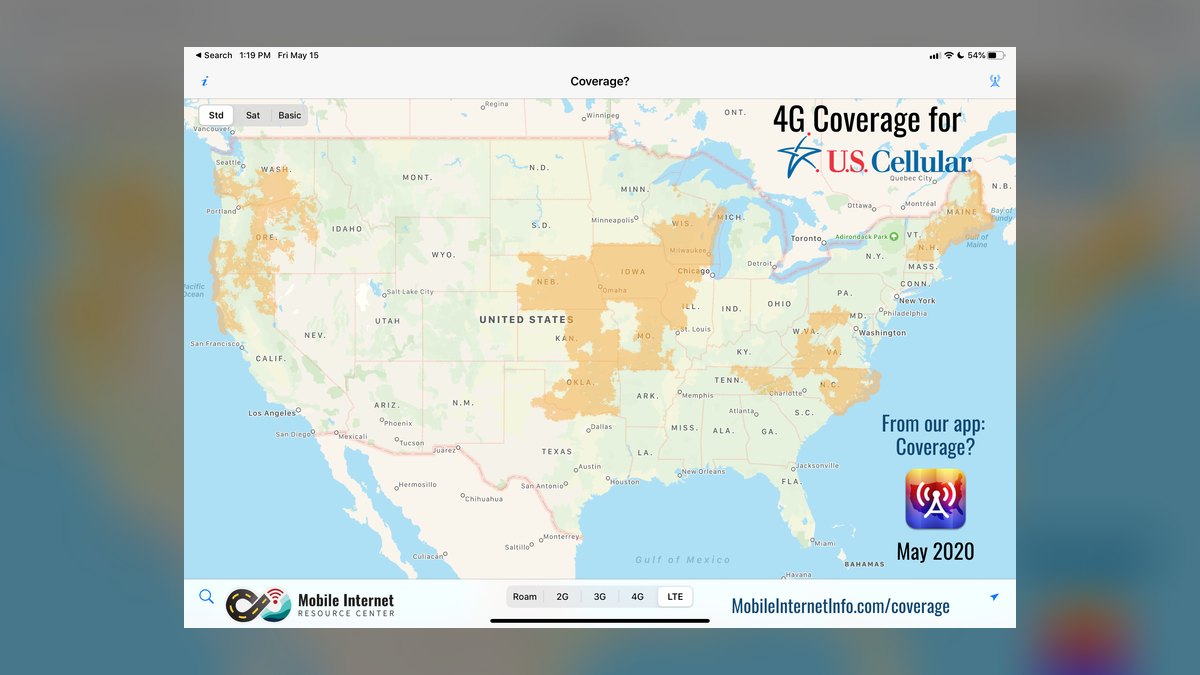
Regional and bundled options. UScellular runs its own network across parts of northern and eastern Arizona — Flagstaff, Prescott, Kingman, Lake Havasu City — and roams onto Verizon elsewhere, with plans around $55–$65 and included Canada/Mexico roaming that matters for Nogales and Yuma residents. Google Fi defaults to T-Mobile in Arizona at roughly $50–$65 and is the standout for anyone crossing into Mexico or traveling abroad, with free data and texting in a very large list of countries. Spectrum Mobile rides Verizon's network at around $30/month for unlimited but requires Spectrum home internet, which effectively limits it to Maricopa and Pima County cable footprints. Boost, on a mix of T-Mobile and AT&T infrastructure, offers promotional first-months pricing that steps up sharply afterward.

A realistic four-line family range. Expect $120–$160/month all-in for four lines on a mid-tier T-Mobile plan with taxes included, versus $160–$220 on a comparable Verizon or AT&T plan once taxes and fees are added. Four prepaid lines on Cricket or Visible land in the $100–$130 range. The spread between the cheapest and most expensive credible option for a family of four in Arizona is roughly $1,200 a year — real money, and the reason it is worth doing the arithmetic rather than defaulting to whatever you had.
Risks, edge cases, and failure modes
The ranking above is a starting point. Here is where it breaks.
The single-route veto. Statewide coverage claims are averages, and you do not live on an average. If your commute includes one dead canyon, one tunnel, or one stretch behind a ridgeline, that single segment can veto an otherwise correct choice. The fix is embarrassingly simple and almost nobody does it: before porting, borrow a phone on the candidate network, or buy a $15 prepaid SIM for that network, and drive your actual routes with it for a week. Watch where the bars die. Fifteen dollars of testing beats a year of regret.

Coverage maps overstate reality. Every carrier's published map is a propagation model, not a measurement. Models assume ideal conditions and do not know about your building's low-E windows, the metal roof on your shop, or the hill between you and the tower. Treat maps as a way to rule options *out* — if the map already shows a gap, believe it — and never as proof that service will be good.
In-building penetration in the Valley. Newer construction in Phoenix, Scottsdale, and Chandler uses energy-efficient window coatings and heavy insulation that attenuate cellular signal badly. It is common to have four bars in the driveway and nothing in the back bedroom. Wi-Fi calling solves this for voice and texting and is supported by every major carrier, but it requires decent home internet, which loops the decision back into your broadband situation.
Congestion is temporal, not just geographic. A prepaid plan that performs perfectly for eleven months can fail you on exactly the days you need it: a Cardinals game, a Suns playoff run, the Waste Management Open, spring training week in Scottsdale, or graduation weekend at ASU. If your livelihood depends on connectivity during large events — you sell there, you deliver there, you run payments there — pay for priority. If not, do not.
Extreme heat and infrastructure stress. Arizona summers put real load on power infrastructure, and cell sites depend on it. During prolonged heat events and monsoon-season storms, sites can lose commercial power and run down their battery reserve. Redundancy varies by site and carrier and is not something a consumer can research directly. The practical hedge is not a different carrier — it is a charged battery bank, a downloaded offline map of your area, and, if you are genuinely remote, a satellite messaging device. Modern flagship phones increasingly include emergency satellite messaging; if you spend time on backcountry roads in Coconino, Apache, or Mohave County, that feature is worth more to you than 100 Mbps of extra 5G throughput.

Tribal lands and jurisdictional coverage gaps. Coverage on the Navajo Nation, Hopi, San Carlos Apache, and Tohono O'odham lands is materially thinner than in the rest of the state, for reasons involving land tenure, permitting, population density, and economics that no consumer decision fixes. Verizon and AT&T generally have the strongest presence on the highway corridors crossing these lands, but "strongest" still means expect gaps. Plan for them.
Border-adjacent roaming surprises. In Nogales, San Luis, Douglas, and along stretches of I-19, phones can latch onto Mexican networks. On plans with included Mexico roaming this is harmless. On plans without it, it can generate charges or simply drop you into a worse experience. Confirm the international roaming terms if you live or work near the line, and consider a carrier that includes Mexico natively.
The MVNO support cliff. Prepaid savings come partly out of the support budget. Mint is online-only with no Arizona retail presence. Visible is app-and-chat based. Boost's support reputation is poor. If you are the household's tech support and you are comfortable troubleshooting an eSIM activation, this is a non-issue. If you are buying a line for a parent who will want to walk into a store when something breaks, the $20/month you save is a bad trade.

Porting and device compatibility. Bringing an unlocked phone to a new network can go badly if the device lacks the right bands — especially for 5G on the new network — or if the original carrier has not fully released the IMEI. Verify compatibility with the receiving carrier's IMEI checker *before* porting, keep the old line active until the port completes, and never cancel the old account manually (canceling first breaks the port and can lose your number).
Business and multi-site considerations. If you are choosing for a company rather than a household, the calculus shifts: pooled data, device management, priority access programs for public-safety-adjacent work, and line-level cost reporting matter more than headline speed. Fleet-heavy operations across rural Arizona almost always land on Verizon or AT&T for coverage reasons and negotiate on volume, not list price. Anyone running fixed wireless access at a remote office should evaluate that separately from the phone decision — the best mobile carrier at your address is not automatically the best home-internet answer, and a bad fixed wireless install can be worse than a slow DSL line.
A practical rollout plan
Treat a carrier switch like a small migration project, because that is what it is. Below is a sequence that avoids nearly every common failure.
Step one — map your actual life, not your address. Write down the five places you most need service: home, work, the school pickup line, the two highways you drive most, and the weekend destination you visit most. Any candidate carrier must work at all five. This list, not a review article, is your requirements document.
Step two — screen with maps, decide with a SIM. Pull up each candidate's official coverage map and eliminate anyone showing a hole at one of your five places. Then take the survivors and test them physically. Prepaid SIMs on each of the three underlying networks cost very little and can be activated in minutes. Run each for a week. Record where it fails.
Step three — price the total, over 24 months. Build a simple table: base rate, autopay discount, taxes and fees (zero for T-Mobile, meaningful for Verizon and AT&T), device installment, trade-in credit, and the value of any bundled streaming you would otherwise pay for. Multiply by 24. Promotional pricing that expires after three or twelve months should be modeled at the post-promo rate, because that is what you will actually pay for most of the term.
Step four — verify device compatibility before you commit. Run your IMEI through the receiving carrier's compatibility checker. Confirm your phone is unlocked. Confirm it supports the bands the new network uses in your area, particularly for 5G.
Step five — port, do not cancel. Gather your account number and transfer PIN from the current carrier, then initiate the port from the *new* carrier. Keep the old line live throughout. Numbers are lost when people cancel first.
Step six — validate before the return window closes. Most carriers offer a 14-to-30-day trial period. Use every day of it. Re-drive the routes. Make calls from inside the back of your house. Run a hotspot session from the job site. If it fails, you are still inside the window.
A note on sequencing for households and small businesses. Do not migrate everyone at once. Move one line first — ideally the heaviest user with the most demanding routes — and live with it for a full billing cycle. If it holds up, move the rest and capture the multi-line discount. If it does not, you have one line to unwind instead of five. The same logic applies to a business fleet: pilot on two or three vehicles across your worst coverage territory before signing a volume agreement.
What to revisit annually. Networks change. Spectrum gets deployed, towers get built, and pricing resets. Re-run this evaluation once a year, or any time your routine changes materially — a new job across the valley, a move to Prescott, a kid starting at NAU in Flagstaff. The right carrier in Arizona is a function of your geography, and when your geography changes, so does the answer.
Related questions
Which carrier is best for rural Arizona specifically?
Verizon, by a clear margin, followed by AT&T on the main interstate corridors. Both maintain broad LTE coverage across highways and remote areas where T-Mobile's footprint thins out. Prepaid brands riding Verizon's network deliver the same coverage at lower cost with lower data priority.
Is prepaid service actually usable in Arizona, or is it a downgrade?
It is genuinely usable for most people here. Prepaid and MVNO lines use the same physical towers as their parent network; the only difference is data priority during congestion. Arizona has fewer chronically saturated sites than dense metros, so the penalty rarely surfaces outside major events.
Do I need 5G, or is LTE enough?
For typical phone use — messaging, navigation, streaming, social, video calls — LTE is entirely sufficient. 5G matters for large downloads, laptop tethering, and performance in crowded venues. Prioritize coverage breadth over 5G speed unless you routinely move large files on mobile.
How much does terrain really change coverage in Arizona?
Substantially. Higher-frequency 5G bands carry more capacity but travel shorter distances and handle terrain poorly, so canyons, mesas, and the Mogollon Rim create sharp local dead zones. A ridgeline can flip the best carrier at two addresses ten miles apart.
What is the cheapest way to get Verizon-grade coverage?
A prepaid brand operating on Verizon's network. You get the identical tower footprint at roughly a third of postpaid pricing, trading away data priority during congestion and in-store support. For low-congestion areas like Prescott or Sedona, the trade is strongly favorable.
FAQ
Which carrier has the best coverage in rural Arizona? Verizon holds the broadest LTE and 5G coverage across rural Arizona, including tribal land highway corridors, the White Mountains region, and long desert stretches. AT&T is competitive on the main interstates. T-Mobile has meaningful gaps once you leave the metro areas and the I-10 corridor.
Is T-Mobile's 5G genuinely faster than Verizon's in Phoenix? Yes, and by a wide margin in independent crowd-sourced testing — roughly double the median download speed in the metro core. Whether that matters depends on your use. It is decisive for tethered laptop work and large file transfers, and largely irrelevant for streaming, navigation, and messaging.
What is the cheapest unlimited plan available in Arizona? The lowest credible unlimited pricing comes from prepaid brands: roughly $25–$30 per month from Visible on Verizon's network or Mint on T-Mobile's, with Mint requiring an annual prepayment for its best rate. Both accept bottom-tier data priority in exchange for the price.
Does UScellular work well in Phoenix? Not on its own network — UScellular does not operate native infrastructure in the Phoenix metro and roams there instead. Its strength is northern and eastern Arizona, including Flagstaff, Prescott, Kingman, and Lake Havasu City, where its own tower density often beats the national carriers indoors.
Can I use one carrier for frequent trips into Mexico? Yes. Google Fi is the standout for international use, with data and texting included across a very large country list. UScellular and Spectrum Mobile include Canada and Mexico roaming, which matters for Nogales, Douglas, and Yuma residents. Confirm current terms before relying on it.
How do I switch carriers without losing my phone number? Initiate the port from the new carrier, never by canceling the old one first. You will need your existing account number and a transfer PIN from your current provider. Keep the old line active until the port completes, then cancel. Verify your device's IMEI compatibility beforehand.
Sources
- Verizon Coverage Map
- T-Mobile Coverage Map
- AT&T Wireless Coverage Map
- UScellular Coverage Map
- Ookla Speedtest United States Market Reports
- J.D. Power U.S. Wireless Customer Care Study
- FCC National Broadband Map
- Visible Plans
- Mint Mobile Plans
- Google Fi Wireless Plans
Related on PULSE
This page will be disappearing soon. Save it to your device for $1 — or read it free while it is here.
@Kory-White- · if Venmo asks, the last 4 of my number are 2012
This page is gone.
This one is off the shelf now. $1 keeps it on your phone for good — the whole page, pictures and diagrams included.
 telcoBest Carriers for Rural Coverage in 2027
 telcoWhat are the most common mistakes in Telco in 2027?
 telcoIs carrier phone insurance worth it in 2027?
 telcoHow does mobile hotspot and tethering work in 2027?
 telcoShould I get a contract or no-contract phone plan in 2027?
 telcoBest Cellular and Wireless Carrier in Florida in 2027
 telcoHow do I switch carriers without changing my phone number in 2027?
 telcoHow do I test a carrier's coverage before fully switching in 2027?
 telcoT-Mobile vs Verizon 5G home internet: which is better in 2027?
 telcoStraight Talk vs Total Wireless: which is better in 2027?