

Best Cellular and Wireless Carrier in Oregon in 2027
 Curated byKory White · Fractional CRO · Maryland
Quality
Certified

Verizon is the best overall cellular and wireless carrier in Oregon for 2027, because its LTE and 5G footprint holds up across the Coast Range, Cascade passes, and eastern high desert where rivals thin out. T-Mobile wins on raw urban 5G speed and price in Portland, Salem, and Eugene; Visible offers Verizon coverage at budget cost.
What carrier choice actually means in a state shaped like Oregon
Oregon is not one coverage market. It is at least four, and the mistake most buyers make is picking a carrier based on a national ad campaign or a friend's experience in a different geography. The state runs from a dense, tower-saturated metro core in the Portland–Beaverton–Hillsboro triangle, west across the Coast Range to a thin ribbon of coastal towns, east over the Cascades into the Bend/Redmond corridor, and then out into a high-desert quarter — Harney, Lake, Malheur, Grant counties — where population density drops into the low single digits per square mile and tower economics stop working. A carrier that is excellent in one of those zones can be functionally unusable in another.
That geography drives the whole ranking. Coverage in a low-density county is a function of low-band spectrum and tower count, not of marketing. Verizon and AT&T built out rural LTE for years before 5G existed, and that legacy footprint still carries eastern and coastal Oregon. T-Mobile's advantage — mid-band 2.5 GHz spectrum inherited from the Sprint merger — is genuinely transformative in cities, where it delivers the fastest median speeds in the state, but mid-band propagates poorly and needs dense siting. Outside the metros, T-Mobile falls back to low-band 5G that behaves much like good LTE: usable, not fast.
The practical consequence: your commute and your recreation pattern matter more than your home address. Somebody who lives in Southeast Portland and never leaves the metro should almost certainly buy on price and speed, which points to T-Mobile or an MVNO on T-Mobile's network. Somebody who lives in the same house but drives US-26 to Mount Hood every weekend, or takes I-5 south through the Siskiyou pass, or works a territory that includes Pendleton and The Dalles, is buying insurance — and that points to Verizon or AT&T.
There is a second, underappreciated dimension: who your carrier is upstream of. A wireless carrier in 2027 is rarely just a phone line. It is increasingly the home internet provider (fixed wireless access on 5G), the connectivity layer for a small business's point-of-sale and field tablets, the backup WAN link behind a cable or fiber circuit, and the network your vehicle, watch, and security camera ride on. Choosing a carrier for the phone and then discovering the same carrier's fixed wireless is unavailable at your address is a common and avoidable annoyance. Evaluate the bundle, not the line.

Finally, terminology worth getting straight, because it drives buying mistakes. 5G Ultra Wideband (Verizon), 5G UC (T-Mobile), and 5G+ (AT&T) all denote the fast mid-band or millimeter-wave tiers. Plain "5G" or "5G Nationwide"/"5G Extended Range" denotes the low-band tier, which is often no faster than good LTE and sometimes slower. Coverage maps that show a state blanketed in 5G are almost always showing the low-band layer. When comparing carriers, compare the *fast* layer and the *any-signal* layer separately — they answer different questions.
Mapping the field: who actually serves which part of Oregon
Verizon is the default recommendation for statewide use. Its 5G Ultra Wideband concentrates in Portland, Salem, Eugene, Bend, and Medford, while its LTE backbone extends into places like Joseph, Gold Beach, and Lakeview where competitors go dark. Verizon's Unlimited Plus tier sits around $75/month for a single line with autopay, dropping into the $45/line neighborhood on four lines, with roughly 50GB of premium (non-deprioritized) data before network-management throttling applies. It is not the cheapest and it is not the fastest. It is the one least likely to leave you without bars in a canyon.
T-Mobile is the speed and value leader in the Willamette Valley corridor. Go5G-tier plans land near $60/month single-line and around $35/line at four lines, with the same ~50GB premium-data allotment and a meaningful high-speed hotspot bucket. In downtown Portland and along the I-5 spine through Salem, Corvallis, and Eugene, T-Mobile's 5G Standalone network on 2.5 GHz posts the fastest median downloads in the state. In Astoria, Enterprise, or the Wallowas, you are frequently on low-band and should expect double-digit megabit speeds rather than triple.
AT&T is the third national option and the specific right answer for two Oregon populations. First, anyone working the I-84 corridor east — The Dalles, Hermiston, Pendleton — where AT&T's rural LTE is competitive with Verizon's. Second, and more decisively, first responders and public-safety-adjacent workers, who get FirstNet: a dedicated public-safety core with priority and preemption on the network. If you are a volunteer firefighter in a rural district, an EMT, or a contractor supporting a public-safety agency, FirstNet eligibility is worth more than any speed test. AT&T's Unlimited Premium tier runs around $85/month single-line with a larger hotspot allotment.

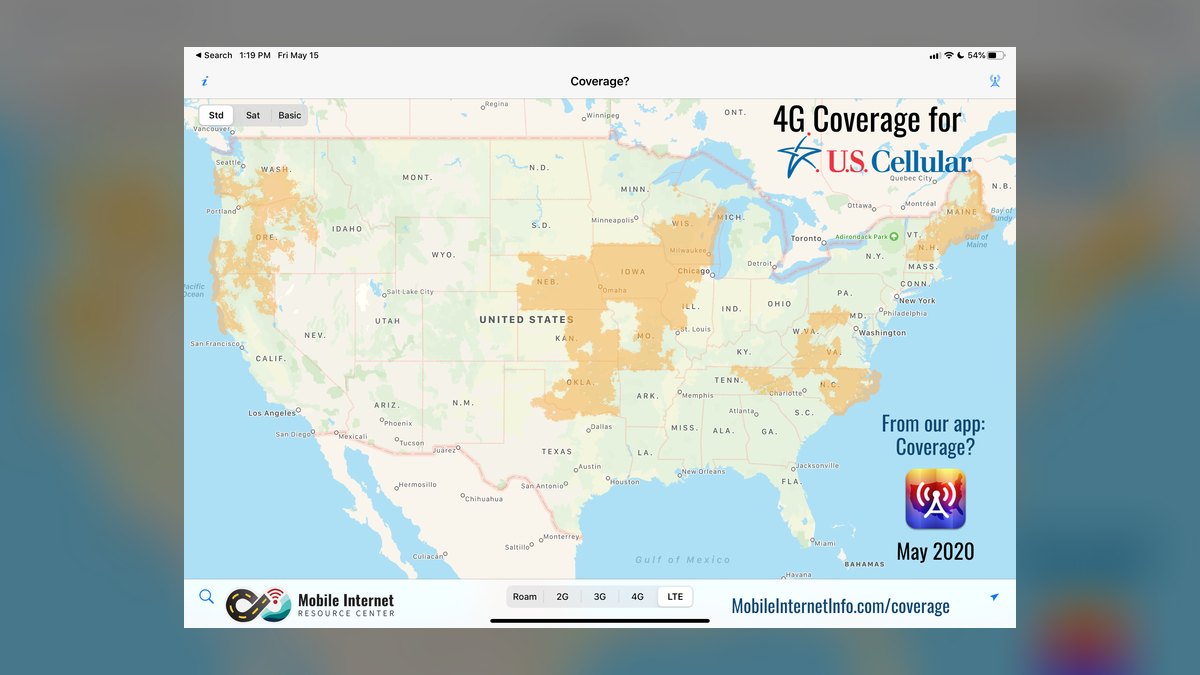
UScellular remains a real regional player in southern and central Oregon — Jackson, Josephine, Klamath, Deschutes counties — with coverage around Medford, Ashland, Grants Pass, and Bend, and notably into recreational areas like Crater Lake and Mount Ashland where the nationals can be spotty. Its pitch is local retail support and staff who know the terrain. The strategic caveat: UScellular has been divesting spectrum and network assets to the national carriers, so evaluate it as a strong near-term option with a longer-term migration question attached. Ask any store directly what the roadmap is for your county before signing a device contract.
The MVNO layer is where most of the value hides, and it is the tier Oregonians most often overlook. Visible runs on Verizon and sells truly unlimited data at roughly $25/month on its base tier — the same towers as Verizon, at a third of the price — with the trade-offs being hard speed caps, aggressive deprioritization during congestion, and no phone support or stores at all. Its higher tier, around $35/month, restores premium data and Ultra Wideband access. Mint Mobile rides T-Mobile, sells in 3-, 6-, and 12-month prepaid blocks, and gets its low headline price by making you pay upfront; renewal pricing is materially higher than the intro rate, which is the single most common Mint surprise. Cricket rides AT&T and is unusual among MVNOs in having real Oregon storefronts, which matters enormously for people who want a human to fix a SIM problem. Consumer Cellular targets seniors and AARP members with low-data plans in the $20/month range, US-based support, and multi-network access. Google Fi rides T-Mobile plus partners and is the correct answer almost exclusively for people who travel internationally, where its no-surcharge global data is genuinely differentiated. Boost is a budget urban option whose own network buildout is real but geographically narrow.
The deprioritization mechanic deserves its own paragraph because it is where MVNO expectations break. On a postpaid plan, your data traffic sits high in the QoS queue; on most MVNO plans, it sits below the host carrier's own subscribers. When a tower is uncongested — which in Bend at 10am is most of the time — the difference is invisible. When a tower is congested — Providence Park at halftime, a coastal town on a summer Saturday, PSU campus between classes — the MVNO user is the one who notices. That is not a defect; it is the product. If your usage pattern is dense-crowd-heavy, pay for postpaid. If it is dispersed, the MVNO discount is nearly free money.
How to run the evaluation, step by step
Do not buy from a map screenshot. Run this sequence; it takes about a week of elapsed time and maybe ninety minutes of actual effort, and it is the difference between a good decision and two years of regret.
Step one: write down your five addresses. Home, work, and the three places you most reliably lose signal or most need service — a trailhead, a parent's house in a small town, a job site, a stretch of highway. Be specific to the street address; coverage varies block to block, especially in terrain-shadowed neighborhoods in the West Hills or on the coast.

Step two: check the independent map before the carrier maps. The FCC's National Broadband Map publishes carrier-reported coverage with a consumer challenge process, which makes it less flattering than carrier-owned maps and therefore more useful. Check each address there first, then cross-reference against the carrier's own map. Where the two disagree, believe the pessimistic one.
Step three: read crowdsourced data, not just modeled data. Coverage maps are propagation models. Speedtest-style crowdsourced datasets and drive-test reports reflect what devices actually experienced. For an Oregon buyer, the crowdsourced view is where you learn that a carrier "covers" the Santiam Pass on paper but that real-world throughput there is marginal.
Step four: buy the free trial, not the plan. Every major carrier now offers a trial eSIM that runs alongside your existing line on a modern phone. This is the single highest-value step in the process and it costs nothing. Activate the trial, then deliberately drive your actual routes with it — not a test route, your routes. Commute, weekend trip, the drive to the in-laws.
Step five: instrument the trial. Don't rely on the bar indicator, which is nearly meaningless. Use a field-test or signal-logging app to record dBm and band, or at minimum run a speed test at each of your five addresses at a busy hour and a quiet hour. A signal of -95 dBm or better is comfortable; -110 dBm and worse is the zone where calls drop and data stalls. Record numbers, not impressions.

Step six: test the things that aren't the phone. If you plan to use fixed wireless home internet, check availability at your exact address — FWA is capacity-gated per sector and can be sold out on your block while available two streets over. If you tether for work, test hotspot throughput specifically, because hotspot data is often prioritized differently than on-device data. If you rely on a smartwatch, confirm the carrier supports your model's number sharing.
Step seven: check Wi-Fi calling and satellite fallback. In a house at the end of a canyon, the practical fix is often not a different carrier but Wi-Fi calling over home broadband plus a carrier that supports it well. Modern phones also increasingly support satellite messaging for emergencies, which changes the risk calculus for backcountry use in the Cascades and the Wallowas — it is not a coverage substitute, but it is a meaningful safety floor.
Step eight: verify your device and its bands. A phone bought for a different carrier may lack the specific mid-band support that makes the new carrier fast. Check that your handset supports n41 (2.5 GHz) for T-Mobile, or the relevant C-band for Verizon's Ultra Wideband, before concluding a network is slow.
Two operational notes on porting. First, never cancel the old line before the port completes — porting requires the account be active, and cancelling first can strand your number. Second, port-in credits and device credits are usually spread over 24–36 months and evaporate if you leave early; treat any advertised "free phone" as a contract with a different name. Read the credit schedule before you take the handset.

What it costs, what the ranges look like, and where the money actually goes
Single-line postpaid unlimited plans in Oregon in 2027 broadly cluster in a $55–$90/month band before taxes and fees, depending on tier. Entry unlimited tiers sit at the low end with less premium data and limited hotspot; mid-tiers around $70–$80 add substantial premium data, meaningful hotspot allotments, and often a streaming perk; top tiers push past $85 and add larger hotspot buckets, better international allowances, and richer device-upgrade terms. Autopay and paperless billing discounts of roughly $5–$10 per line are near-universal and are baked into every advertised price — the number on the billboard usually assumes you take them.
Multi-line economics are aggressive and are the biggest lever most households have. Per-line cost typically falls 35–50% between one line and four: a plan at $75 single-line commonly lands near $45/line at four lines, and a $60 single-line plan can land near $35/line. This is why family plans, roommate plans, and small-business lines are consistently better value than any individual optimization — and it is why an MVNO that looks cheap against a single postpaid line often looks merely comparable against a four-line postpaid account.
The MVNO tier runs $15–$50/month, and the correct way to read those prices is to look at the *renewal* rate rather than the promotional rate. A prepaid plan advertised at $15/month for the first three months and $30 thereafter costs $30 in steady state. Amortize honestly. On the other end, a $25/month unlimited plan on a national network is a genuinely large structural saving — roughly $600/year against a $75 postpaid line — in exchange for deprioritization and chat-only support.
Fixed wireless home internet typically prices around $35–$70/month, with the low end reserved for existing mobile customers as a bundle discount, and delivers real-world speeds commonly in the 100–300 Mbps range depending on sector load and distance. For a household paying $90 for cable broadband, swapping to FWA is often a $30–$50/month saving with a modest performance trade and no data cap. The catch is availability: FWA is sold against spare radio capacity, so a given address is either eligible or it is not, and eligibility can change.

Costs people forget to budget: taxes and regulatory fees add roughly 8–15% on top of the plan price in most jurisdictions; device protection plans run $10–$18/line/month and are frequently unnecessary if you have a credit card or homeowner's policy that covers electronics; activation or upgrade fees of $35 per line are standard and are sometimes waived if you ask or if you activate online rather than in-store; and international day passes typically run $10–$12/day, which makes a Google Fi-style global plan cheaper for anyone traveling more than about eight days a year.
On timelines: a number port completes in minutes to a few hours for wireless-to-wireless, but can take 1–3 business days if it comes from a landline or VoIP provider. eSIM activation is usually instant; physical SIM shipping adds 2–5 days. Device credit schedules run 24–36 months. A trial eSIM period is typically 15–30 days, and you should use the entire window rather than deciding on day two.
One adjacent cost worth naming: for a small business in Oregon — a landscaping crew in Gresham, a mobile veterinary practice outside Corvallis, a food cart operator downtown — connectivity is a line item that touches payment processing, dispatch, and scheduling. A single dropped connection at a job site costs more in a rescheduled visit than a year of the price difference between the cheapest and best carrier. Businesses should optimize for reliability and for the carrier's business-line support queue, which is materially faster than consumer support, rather than for the lowest per-line rate.
Where Oregon buyers get this wrong
Mistake one: trusting the coverage map's green. Carrier maps are propagation models with generous assumptions. They model outdoor signal at a device held in the open. They do not model the inside of a metal-sided shop building in Prineville, or a basement apartment in Northwest Portland, or a canyon in the Columbia Gorge. Treat green as "possible," not "guaranteed," and always validate with a trial.

Mistake two: optimizing for peak speed. Peak 5G numbers in the gigabit range are real and they are also almost entirely irrelevant to daily use. Streaming video needs single-digit megabits. A video call needs a few more. What actually determines whether your phone feels good is *consistency* — the 10th-percentile experience, not the 90th. A carrier that never drops below 20 Mbps beats one that averages higher but stalls out in the places you actually stand.
Mistake three: buying the household plan for the heaviest user. Households routinely put four people on a premium tier because one person tethers a laptop. Most carriers allow mixed tiers within one account: put the tetherer on the high tier and everyone else on the entry unlimited, and the account bill drops meaningfully with zero experience change for three of the four people. Ask specifically for mixed-line pricing; it is rarely volunteered.
Mistake four: ignoring the rural failure mode. In eastern Oregon the question is not "how fast" but "does a call connect at all, and can I text when data is too weak for a call." Low-band coverage and Wi-Fi calling support matter far more than any 5G tier. Rural buyers should also verify that their chosen carrier supports VoLTE and Wi-Fi calling on their specific handset, since a phone that falls back to a retired 3G path has no path at all.
Mistake five: not testing during congestion. Testing at 10am on a Tuesday tells you what an empty tower does. Test during evening prime time, during a Timbers or Ducks game if that is your pattern, and on a summer weekend at the coast when the population of Cannon Beach multiplies. Deprioritized MVNO plans reveal themselves precisely then, and only then.

Mistake six: forgetting about the second line. For anyone whose income depends on connectivity — realtors, contractors, field service techs, rideshare drivers — the highest-value configuration is often not "the best carrier" but "two carriers." A $25/month MVNO line on a network different from your primary, kept in a dual-SIM phone or a cheap backup handset, converts a total outage into an inconvenience. That redundancy costs less than most device protection plans.
Mistake seven: assuming the MVNO is identical to its host. MVNOs on the same network get the same *towers* but not the same *treatment*. Beyond deprioritization, some MVNOs restrict video streaming resolution, cap hotspot use, restrict roaming onto partner networks, or lack access to the host's fastest 5G tier without an upgrade. Read the plan detail page, not the comparison chart.
Mistake eight: letting a device promotion pick the carrier. A $1,000 device credit spread over 36 months is worth about $28/month, and it evaporates if you switch. If carrier A costs $20/month more than carrier B and hands you that credit, you have signed up for three years to net about $8/month — while locking yourself out of switching if coverage disappoints. Decide on the network first. Take the promotion second, and only from the carrier you already chose.
Choosing: a decision framework by user profile
The honest answer to "best carrier in Oregon" is conditional, and the condition is *your usage geometry*. Here is how to resolve it quickly.
If you never leave the Portland metro and want the best experience per dollar: T-Mobile. The mid-band buildout in the metro is genuinely the fastest thing in the state, and the four-line pricing is the best among nationals. If you want that network cheaper and can tolerate deprioritization, Mint on the same network; if you want a physical store on AT&T's network instead, Cricket.
If you split time between metro and rural, or drive mountain passes regularly: Verizon. This is the insurance purchase, and the premium over T-Mobile is roughly $15/month single-line — cheap for not being stranded on the Santiam. If the price stings, Visible gives you those same towers for far less, at the cost of speed caps and no human support.
If you live and work east of the Cascades or on the coast: compare Verizon and AT&T head to head at your exact addresses; do not assume. In parts of the I-84 corridor AT&T is the stronger signal. In the Wallowas and along the southern coast, Verizon usually is. Trial both.
If you are a first responder or work in public safety: AT&T with FirstNet, effectively without competition. Priority and preemption on a congested scene is a category of value no consumer plan replicates.
If you're in southern or central Oregon and want local support: UScellular is worth a serious look, particularly for Medford, Ashland, Grants Pass, and Bend, and particularly for Crater Lake–area recreation. Weigh the network's longer-term consolidation trajectory before committing to a 36-month device credit.
If you're a senior or on a fixed income with light data use: Consumer Cellular. Unlimited is the wrong product for someone using 2GB a month; a $20/month plan with US-based support and AARP pricing is a better fit than a discounted premium tier.
If you travel internationally more than a week or two a year: Google Fi. The math is straightforward — international day passes at $10–$12/day beat Fi's included global data only if you travel almost never.
If connectivity is load-bearing for your income: two carriers on two networks. Primary postpaid on the network that covers your territory, secondary cheap MVNO on a different underlying network, in a dual-SIM phone. This is the configuration that professionals converge on.
A closing note on revisiting the decision: networks change faster than contracts do. Mid-band buildouts, spectrum divestitures, and new tower sites can flip a county's best carrier within eighteen months. Set a calendar reminder to re-run the trial-eSIM test annually. It costs an hour and it is the only way to know whether the carrier that was right in 2027 is still right in 2028.
Related questions
Does 5G actually matter for rural Oregon coverage?
Less than advertised. Rural 5G is almost always low-band, which performs similarly to strong LTE. For eastern Oregon and the coast, the meaningful questions are low-band LTE reach, VoLTE support, and Wi-Fi calling — not which 5G brand name appears in the status bar.
Can I use two carriers on one phone?
Yes. Most phones sold since roughly 2020 support dual SIM via eSIM plus physical SIM, letting you run a primary postpaid line and a cheap secondary line on a different network simultaneously. It is the standard redundancy setup for anyone whose work depends on connectivity.
Is fixed wireless home internet a real cable replacement in Oregon?
For many households, yes. Speeds commonly land in the 100–300 Mbps range at $35–$70/month with no data cap. It is capacity-gated per sector, so availability is address-specific and can be unavailable on your block while offered nearby. Latency is higher than fiber.
How much do I really save switching to an MVNO?
Typically $30–$50/month per line versus postpaid, or roughly $400–$600/year. You trade priority during congestion, phone support, and sometimes hotspot and streaming quality. On uncongested towers the experience is indistinguishable from the host network.
Should I take the free-phone promotion?
Only after you have chosen the network. Device credits spread over 24–36 months and cancel if you leave, so a promotion is a multi-year commitment priced as a gift. Choose coverage first, then take whatever promotion your chosen carrier offers.
FAQ
Which carrier has the best coverage in rural Oregon?
Verizon generally has the most extensive rural LTE and low-band 5G reach across the Coast Range, the Cascades, and eastern counties like Harney, Lake, and Wallowa. AT&T is competitive along the I-84 corridor east through The Dalles and Pendleton, and in some specific eastern locations is the stronger signal. Because rural coverage is highly address-specific, trial both with free eSIMs at your actual home, work, and route locations before committing.
Is T-Mobile good in Portland?
Yes — T-Mobile's mid-band 5G buildout makes it the fastest network in the Portland metro and along the I-5 corridor through Salem, Corvallis, and Eugene, and its four-line pricing is the most aggressive among the national carriers. The caveat is that mid-band does not propagate far, so performance drops toward low-band levels once you head into the Coast Range, over the Cascades, or into the northeast corner of the state.
What is the cheapest unlimited wireless plan in Oregon?
Visible, running on Verizon's network, is generally the cheapest true unlimited option at roughly $25/month, with a higher tier near $35/month that restores premium data and Ultra Wideband access. Mint Mobile's unlimited tier on T-Mobile is also competitive but requires prepaying in multi-month blocks. Both trade away priority during congestion and, in Visible's case, all phone and in-store support.
Does it matter which carrier my MVNO runs on?
Enormously. An MVNO inherits its host's towers, so a T-Mobile-based MVNO has T-Mobile's rural gaps and a Verizon-based one has Verizon's rural reach. Identify the host network first, evaluate that network's coverage at your addresses, and only then compare MVNO prices. Two MVNOs at identical prices on different hosts are not remotely equivalent products in Oregon.
How do I test coverage before I switch?
Activate a free trial eSIM from each shortlisted carrier — nearly all majors offer one, running alongside your existing line — then drive your real routes for the full trial window. Log actual signal strength in dBm and run speed tests at both busy and quiet hours rather than trusting the bar indicator. Test at your home, workplace, and the specific places you currently lose service.
Which carrier is best for first responders in Oregon?
AT&T, through FirstNet, is the clear choice for police, fire, EMS, and eligible supporting personnel. FirstNet provides priority and preemption on a dedicated public-safety core, meaning your traffic keeps moving when a tower is saturated during an incident — exactly the scenario where a consumer plan degrades. Eligibility extends beyond full-time responders in many cases, so it is worth checking even for volunteer roles.
Sources
- FCC National Broadband Map
- FCC Consumer Guide: Wireless Coverage and Service
- Ookla Speedtest Global Index and US Market Reports
- J.D. Power Telecommunications Studies
- Verizon Coverage Map
- T-Mobile Coverage Map
- AT&T Wireless Coverage Map
- FirstNet (built with AT&T)
- UScellular Coverage Map
- Oregon Broadband Office
Related on PULSE
This page will be disappearing soon. Save it to your device for $1 — or read it free while it is here.
@Kory-White- · if Venmo asks, the last 4 of my number are 2012
This page is gone.
This one is off the shelf now. $1 keeps it on your phone for good — the whole page, pictures and diagrams included.
 telcoBest Cellular and Wireless Carrier in Montgomery in 2027
 telcoWhat is the catch with cheap MVNO carriers in 2027?
 telcoAT&T vs T-Mobile: which is better in 2027?
 telcoDo I really get free streaming (Netflix, Apple TV) with my plan in 2027?
 telcoWhy are taxes and fees so high on my phone bill in 2027?
 telcoWhat are the most common mistakes in Telco in 2027?
 telcoIs Mint Mobile worth it in 2027?
 telcoIs a prepaid carrier as good as Verizon, AT&T, or T-Mobile in 2027?
 telcoBest Carriers for Rural Coverage in 2027
 telcoHow does mobile hotspot and tethering work in 2027?