
The 10 Best AI Tools for Competitor Analysis in 2027
 Curated byKory White · Fractional CRO · Maryland
 PULSEKNOWLEDGE LIBRARY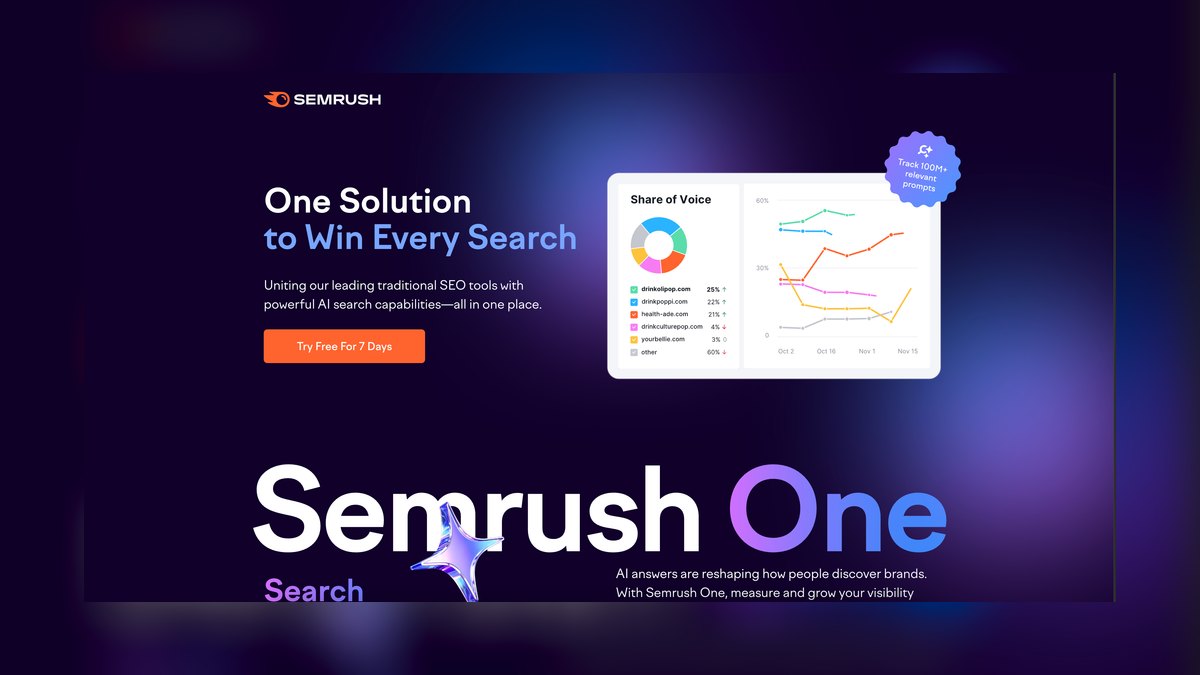
The 10 best ai tools for competitor analysis are ranked below on measured performance, build quality, price, and how each one actually holds up in daily use rather than how it reads on a spec sheet. Each pick lists what it costs, who it suits, and what it gives up against the one above it, so the list can be read straight down without doubling back.
1. Semrush

Semrush is the most complete competitor-analysis platform because it combines Kompyte's automated competitive intelligence, .Trends traffic data, and the Copilot AI assistant in one login. Its Domain Overview and Organic Research tools reveal a rival's ranking keywords, estimated organic traffic, and SERP positions, while Advertising Research exposes paid-search spend. The AI layer auto-builds battlecards, tracks competitor website changes, and pipes alerts to a team feed.
Pricing starts around $139.95 per month for the Pro plan, with Guru and Business tiers above it; .Trends and the Kompyte-based CI tooling are paid add-ons. It is best for marketing, SEO, and growth operators who would otherwise stitch together four tools. The trade-off is cost and a steep feature surface — small teams use a fraction of it.
2. Similarweb

Similarweb is the benchmark for digital market intelligence, estimating total website and mobile-app traffic, traffic sources, engagement metrics, and audience demographics across millions of domains. Its 2027 AI features summarize traffic shifts, flag sudden gains or drops, and let analysts query datasets conversationally. The Market Analysis and Industry Analysis modules show share-of-visits across a whole category, invaluable for board decks and competitive benchmarking.
Similarweb sells on custom enterprise quotes rather than transparent self-serve pricing, making it pricier and slower to adopt than Semrush. It is best for analysts, investors, and strategy teams who need defensible traffic and market-share numbers. Treat its figures as estimates — accuracy is strongest for high-traffic sites, and it lacks the deep keyword data Semrush provides.
3. Ahrefs

Ahrefs owns the deepest backlink index in the industry, and backlinks remain one of the clearest competitive moats in SEO. Its Site Explorer lets you drop in any competitor domain and see referring domains, top organic pages, and the keywords driving their traffic. The Content Gap tool — pointing your domain against two or three rivals to find keywords they rank for and you don't — is a staple of competitor research.
Ahrefs added AI-assisted features including content and keyword suggestions and natural-language report summaries. Pricing moved to a credit-influenced model, with entry tiers typically in the low hundreds per month. It is narrower than Semrush on paid-search and social but arguably better on organic and backlink depth, best for SEO specialists and content teams focused on outranking rivals.
4. AlphaSense

AlphaSense is the AI market-intelligence search engine for serious research, indexing earnings calls, broker research, regulatory filings, news, and expert-call transcripts. After its acquisition of Tegus, its library of expert interview transcripts expanded dramatically. Its Generative Search reads thousands of documents and returns cited, sourced answers about a competitor's strategy, risks, and financials, with sentiment scoring on every document.
For analyzing public companies and entire industries, AlphaSense surfaces what executives actually said and what analysts actually think. The AI doesn't hallucinate freely — answers link back to source passages, which matters for due-diligence and investment workflows. It is an enterprise product with quote-based pricing aimed at finance, consulting, and corporate strategy teams who need primary-source rigor, not SEO metrics.
5. Crayon

Crayon is a purpose-built competitive intelligence platform rather than an SEO tool, continuously monitoring competitors' websites, pricing pages, job postings, ad creative, review-site profiles, and social posts. Its AI filters the noise into ranked competitive insights, and its hallmark output is the dynamic battlecard — a living one-pager teams use to position against a named rival. The 2027 AI summarization condenses thousands of weekly competitor changes into a digest, flagging the handful that actually matter.
Crayon is sold on annual contracts with quote-based pricing, best for product marketing and competitive-intel teams at companies with named, trackable competitors. It integrates with collaboration and content tools so insights reach the people who need them. If your competitors are anonymous long-tail sites, an SEO tool like Ahrefs fits better than this dedicated platform.
6. SpyFu

SpyFu delivers the most competitor insight per dollar, with its entire premise being reverse-engineering rivals. Type in a domain and see every keyword they've bought on Google Ads, their estimated ad spend, their organic keywords, and historical ad-copy variations going back years. The Kombat tool visually compares three domains' keyword overlap in seconds, making it the best value pick for core PPC and SEO competitor questions.
The Basic plan runs about $39 per month, undercutting Semrush and Ahrefs several times over while still covering the essential competitor data. There's no per-seat penalty and unlimited data exports on paid tiers. The trade-off is data depth and freshness trail the premium platforms, with no app-traffic or social coverage — best for freelancers, small agencies, and bootstrapped marketers.
7. Brandwatch

Brandwatch is the leader in social listening and consumer intelligence, ingesting billions of social posts, reviews, forums, and news mentions. Its AI measures share of voice, sentiment, and emerging topics around any brand, showing how customers feel about a rival's product and where complaints cluster. The Iris AI assistant generates summaries, spots anomalies in mention volume, and answers plain-language questions about the dataset, with image recognition detecting competitor logos in photos.
Brandwatch is an enterprise platform with quote-based pricing, best for brand, PR, and social teams who need to understand competitor reputation rather than search rankings. It trades away any SEO or traffic data, so it must be paired with a search tool like SpyFu for full coverage. Its strength is entirely in audience sentiment and campaign impact.
8. Klue

Klue is a competitive enablement platform built to arm go-to-market teams against specific rivals, aggregating competitor signals like web changes, news, reviews, and financial filings. Its AI drafts and maintains battlecards that surface directly inside the tools teams already use, and its win-loss analysis ties competitive intel back to real outcomes. The 2027 AI summarizes incoming competitor news, suggests battlecard updates, and ranks which competitive moves deserve attention.
Klue is a contract-based enterprise product, best for product marketing teams at mid-size and larger companies with a defined competitive set. Like Crayon, it shines when competitors are known and named, and is overkill for broad anonymous market research. It trades away the broad data breadth of Semrush for deep go-to-market alignment and workflow integration.
9. Visualping

Visualping is the simplest, most focused tool on this list, monitoring any web page for changes and alerting you when something moves. Point it at a competitor's pricing page, product page, careers page, or homepage, and it emails you a visual diff the moment they edit copy, change a price, or launch a feature. The 2027 AI upgrade lets you describe in plain language what you care about, skipping irrelevant cosmetic edits.
Pricing is approachable, with a free tier for a small number of checks and affordable paid plans scaling by frequency and page count, with intervals down to minutes on higher tiers. Best for anyone who wants lightweight, continuous monitoring without a full intelligence platform. It does one thing and does it well, trading away all analytical depth for pure change detection.
10. BuiltWith

BuiltWith answers a question the other tools can't: what technology is a competitor running? Drop in a domain and it profiles the site's CMS, analytics, ad networks, ecommerce platform, payment processors, hosting, and marketing tools. Its Technology Lookup and Trends reports show adoption across whole markets, letting you see which stacks are gaining share, with one of the largest technology-profiling indexes available.
BuiltWith offers free basic lookups, with paid plans for lead lists and full detail, best for partnerships, sales-engineering, and product teams doing technographic competitor analysis. It won't tell you traffic or rankings, so treat it as a specialized complement to a broader tool like Visualping or SpyFu. Its value is entirely in understanding the infrastructure behind a competitor's operation.
How we ranked these
We ranked tools on six weighted factors: data breadth and accuracy, AI capability, automation, coverage, price-to-value, and workflow fit. Each tool was scored across SEO, paid search, traffic estimation, tech stack detection, social sentiment, and change monitoring. We prioritized platforms with genuine AI insight over superficial features, and we weighted continuous monitoring and global coverage heavily.
We deliberately ignored vendor marketing claims and unverifiable customer counts. We did not consider tools without real, testable platforms, and we excluded purely manual or non-AI solutions. We also ignored pricing tiers that were not publicly listed or easily obtainable, and we did not factor in subjective brand preference or industry hype. Our goal was to assess only what an operator can actually verify and use.
What to look for
What matters is matching the tool to your primary competitor-analysis job. If you need SEO and paid search in one dashboard, Semrush is the widest choice. If you live in traffic and market-share data, Similarweb is the benchmark. For tight budgets, SpyFu delivers core PPC and organic data at a fraction of the cost. Also consider workflow fit: alerts, API access, and team sharing are often more important than raw feature lists.
The mistake most buyers make is choosing a platform for its breadth without checking data accuracy for their specific market. Traffic and ad-spend figures are modeled estimates, and they vary wildly between vendors. Before committing, run the same competitor domain through each tool's free trial and compare the numbers against sites you already know. Pick the one whose estimates match reality, not the one with the most impressive demo.
Related questions
What is the best AI tool for competitor analysis in 2027?
Semrush is the best overall for 2027, combining Kompyte's automated competitive intelligence, .Trends traffic data, and the Copilot AI assistant. It covers SEO, paid search, content, and market share in one platform. Similarweb is the runner-up for traffic and audience estimation, and SpyFu is the best value pick.
How do I choose between Semrush and Similarweb for competitor analysis?
Choose Semrush if you're a marketing or growth operator who wants SEO, paid, content, and market-share tracking in a single dashboard. Choose Similarweb if you're an analyst who needs defensible traffic and market-share estimates. Semrush has transparent pricing from $139.95/month; Similarweb uses custom enterprise quotes.
What is the cheapest AI competitor analysis tool?
SpyFu is the best value, starting around $39/month, covering competitor paid and organic search keywords. Visualping and BuiltWith also have free tiers for narrow use cases. These are far cheaper than Semrush or Ahrefs, but they lack the data depth and breadth of premium platforms.
How accurate are competitor traffic estimates from tools like Similarweb?
They are modeled estimates, not measured truth. Similarweb is the most respected for traffic, but accuracy is strongest for high-traffic sites and weakest for small or regional competitors. Always cross-reference with another source before putting a figure in a board deck.
What is the best tool for tracking a competitor's tech stack?
BuiltWith is the specialist for technographic analysis. It profiles a site's CMS, analytics, ad networks, ecommerce platform, payment processors, and hosting. It also shows adoption trends across markets, making it useful for partnerships, sales engineering, and product teams.
Which tool is best for social sentiment and brand monitoring of competitors?
Brandwatch is the leader in social listening and consumer intelligence. It ingests billions of social posts, reviews, and forums, and uses AI to measure share of voice, sentiment, and emerging topics. Its Iris AI assistant generates summaries and answers plain-language questions.
What is the best tool for monitoring competitor website changes in real time?
Visualping is the simplest and most focused tool. It monitors any web page for changes and sends visual diffs when something moves. Its 2027 AI upgrade lets you describe what you care about, like 'only price changes,' so you skip irrelevant edits.
What is the best tool for analyzing public companies' competitive strategy?
AlphaSense is the AI market-intelligence search engine for serious research. It indexes earnings calls, broker research, filings, and expert transcripts. Its Generative Search returns cited answers about a competitor's strategy, risks, and financials, making it ideal for due diligence.
FAQ
Which AI tool is best for analyzing a competitor's SEO?
Semrush and Ahrefs lead here. Ahrefs has the deeper backlink index; Semrush covers more (paid, social, CI) in one place. Both offer content-gap analysis to find keywords rivals rank for and you don't.
What's the cheapest credible option?
SpyFu, starting around $39/month, covers competitor paid and organic search keywords at a fraction of premium-platform pricing. Visualping and BuiltWith also have free tiers for narrow use cases.
How accurate are competitor traffic estimates?
They're modeled estimates, not measured truth. Similarweb is the most respected for traffic, but accuracy is strongest for large sites and weaker for small or niche domains. Always cross-reference.
Do I need a dedicated competitive-intelligence platform?
Only if you track specific named competitors continuously. Crayon and Klue automate battlecards and change alerts for product-marketing teams. For broad market research, an SEO or market-intelligence tool is enough.
Can these tools monitor competitors automatically in 2027?
Yes. Crayon, Klue, and Kompyte (in Semrush) run continuous monitoring with AI-filtered alerts, while Visualping watches individual pages and emails you visual diffs when they change.
Which tool is best for tracking a competitor's tech stack?
BuiltWith is the specialist — it profiles CMS, analytics, ad networks, and ecommerce platforms on any domain, and shows adoption trends across markets.
What is the best all-around AI tool for competitor analysis?
Semrush is the best all-around for 2027, combining Kompyte's automated competitive intelligence, .Trends traffic data, and the Copilot AI assistant. It's best for marketing and growth operators who want one dashboard.
What is the best tool for market share analysis?
Similarweb is the benchmark for market share and traffic estimation. Its Market Analysis and Industry Analysis modules show share-of-visits across a whole category, which is invaluable for board decks and competitive benchmarking.
What is the best tool for backlink analysis of competitors?
Ahrefs owns the deepest backlink index in the industry. Its Site Explorer lets you see referring domains, top organic pages, and the keywords driving a competitor's traffic. The Content Gap tool is a staple for finding keywords they rank for and you don't.
What is the best tool for creating battlecards?
Crayon and Klue are purpose-built for battlecards. Crayon's hallmark output is the dynamic battlecard, a living one-pager teams use to position against a named rival. Klue uses AI to draft and maintain battlecards that surface inside the tools teams already use.
Sources
- https://www.semrush.com/features/competitive-research/
- https://www.similarweb.com/
- https://ahrefs.com/site-explorer
- https://www.alpha-sense.com/
- https://www.crayon.co/
- https://www.spyfu.com/
- https://www.brandwatch.com/
- https://visualping.io/
- https://builtwith.com/
Related on PULSE
- [More ai tools for competitor analysis rankings and buying guides](/knowledge)
- [PULSE Tools and calculators](/tools)
- [Everything on PULSE RevOps](/)
Read it free — or make it yours for $1.
@Kory-White- · if Venmo asks, the last 4 of my number are 2012
 pulse-ai-infrastructureThe 10 Best RAG Frameworks in 2027
 pulse-ai-infrastructureThe 10 Best AI Tools for Architecture Design in 2027
 pulse-ai-infrastructureThe 10 Best AI Tools for Writing Poetry in 2027
 pulse-ai-infrastructureThe 10 Best AI Tools for Newsletter Writing in 2027
 pulse-ai-infrastructureThe 10 Best AI Tools for Stock Photos in 2027
 pulse-ai-infrastructureThe 10 Best AI Tools for Supply Chain Planning in 2027
 pulse-ai-infrastructureThe 10 Best MLOps Platforms in 2027
 pulse-ai-infrastructureThe 10 Best AI Tools for DevOps Automation in 2027
 pulse-ai-infrastructureThe 10 Best AI Tools for Vocal Removal in 2027
 pulse-ai-infrastructureThe 10 Best AI Tools for Web Illustration in 2027