 Pulse Reviews and Analysis
The 10 Best MLOps Platforms in 2027
 Curated by Kory White · Fractional CRO, CRO Syndicate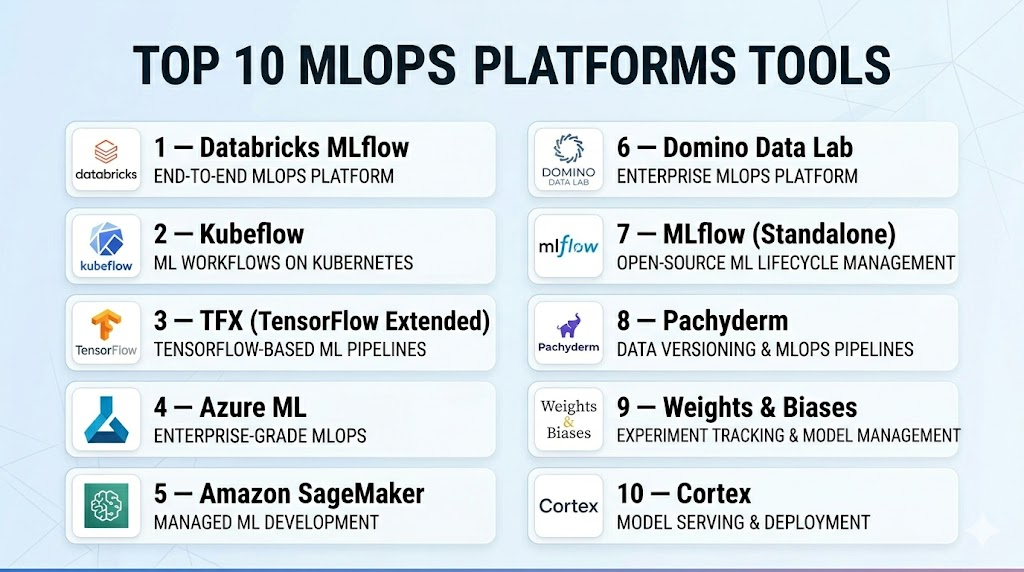
The 10 Best MLOps Platforms in 2027
An MLOps platform is the connective tissue that takes machine-learning models from a notebook to reliable production: it tracks experiments, versions data and models, orchestrates training pipelines, deploys models behind APIs, and monitors them once they are live. The right platform turns ad-hoc scripts into a repeatable, governed lifecycle.
This ranking covers the ten MLOps platforms production teams depend on in 2027, from open-source toolkits like MLflow and Kubeflow to managed clouds like SageMaker and Vertex AI.
Direct Answer
MLflow is the best overall MLOps platform for most teams because it is open source, framework-agnostic, and covers the core lifecycle — experiment tracking, model registry, packaging, and deployment — without locking you into one cloud. ZenML is a strong best-value pick for teams that want a lightweight, open-source orchestration layer that plugs into tools they already use.
The right choice depends on whether you want an open standard, a fully managed cloud platform, or a Kubernetes-native stack.
How We Ranked These
We evaluated each platform on five criteria: lifecycle coverage (experiment tracking, data and model versioning, pipelines, deployment, monitoring), openness and portability (open source vs. Managed, cloud lock-in), scalability (does it handle large teams and large pipelines), integration (how well it fits existing tools and infrastructure), and operational burden (how much you must run yourself).
Because pricing for managed platforms changes frequently and depends on usage, we describe cost in generic terms; confirm current rates and run a proof of concept on your own workflow before committing.
1. MLflow 🏆 BEST OVERALL
MLflow is the de facto open-source standard for the machine-learning lifecycle. Its four pillars — Tracking (log parameters, metrics, and artifacts for every run), Models (a standard packaging format), Model Registry (versioning, stage transitions, and approvals), and Projects/Deployments — cover the spine of MLOps without prescribing your training framework or infrastructure.
It works with virtually every ML library and can be self-hosted or consumed as a managed service through providers like Databricks.
In 2027 MLflow has extended naturally into LLM and GenAI workflows, adding tracing, prompt and evaluation tracking, and support for serving generative models, which keeps it relevant as teams blend classic ML with LLM apps. Its ubiquity means strong community support, broad integrations, and easy hiring.
Strengths: open standard, framework-agnostic, complete core lifecycle, huge ecosystem, GenAI tracing. Best for: teams wanting a portable, vendor-neutral backbone they can host anywhere. Pricing/availability: free and open source; managed offerings (e.g., on Databricks) add hosting and collaboration.
2. Kubeflow
Kubeflow is the Kubernetes-native MLOps toolkit, providing Pipelines for orchestrating ML workflows as containers, plus components for training operators, hyperparameter tuning (Katib), and model serving (KServe). If your organization runs on Kubernetes and wants ML workloads to follow the same operational model as the rest of your platform, Kubeflow is the natural fit.
Strengths: Kubernetes-native, scalable pipeline orchestration, strong serving via KServe, cloud-portable. Best for: platform teams standardized on Kubernetes who want full control. Pricing/availability: free and open source; you operate it on your own cluster, which means real operational investment.
3. Amazon SageMaker
SageMaker is AWS's end-to-end managed ML platform, covering data labeling, notebooks, managed training, hyperparameter tuning, a model registry, pipelines, real-time and batch inference endpoints, and built-in monitoring. It integrates tightly with the rest of AWS, which makes it the default for teams already on Amazon's cloud.
Strengths: broad managed lifecycle, deep AWS integration, autoscaling endpoints, monitoring built in. Best for: AWS-centric teams wanting a managed platform end to end. Pricing/availability: usage-based across training, hosting, and tooling; managed convenience at a premium over self-hosting.

Reach Kory White, Fractional CRO: 📅 Book a Quick Call · 💼 Kory on LinkedIn · 🏢 CRO Syndicate
4. Google Vertex AI
Vertex AI is Google Cloud's unified ML platform, with managed training, pipelines (built on Kubeflow Pipelines), a feature store, a model registry, endpoints, and model monitoring, plus tight access to Google's foundation models and TPUs. It appeals to teams optimizing for Google's accelerators or already on GCP.
Strengths: unified managed lifecycle, TPU access, strong pipelines and monitoring, GenAI integration. Best for: GCP teams and those wanting managed pipelines plus foundation-model access. Pricing/availability: usage-based across compute and platform services.
5. Azure Machine Learning
Azure ML is Microsoft's managed platform offering designer and code-first workflows, managed compute, pipelines, a model registry, managed online and batch endpoints, and responsible-AI and monitoring tooling. Its enterprise governance and compliance posture make it common in regulated industries.
Strengths: strong enterprise governance, managed endpoints, responsible-AI tooling, Azure integration. Best for: enterprises on Microsoft cloud and regulated organizations. Pricing/availability: usage-based across compute and managed services.
6. Databricks (Mosaic AI)
Databricks unifies data engineering, analytics, and ML on the lakehouse, with managed MLflow at its core, Unity Catalog for governed data and model assets, feature engineering, and the Mosaic AI tooling for training and serving models including LLMs. It is strong for teams that want data and ML in one governed platform.
Strengths: data + ML in one place, governed lakehouse, managed MLflow, LLM training and serving. Best for: data-heavy organizations consolidating analytics and ML. Pricing/availability: consumption-based across compute and platform tiers.
7. ZenML 💎 BEST VALUE
ZenML is a lightweight, open-source MLOps framework that lets you define portable pipelines in Python and run them on whatever stack you choose — orchestrators, experiment trackers, model registries, and deployers are pluggable backends. Instead of replacing your tools, it standardizes how they connect, so you avoid lock-in while gaining reproducibility.
Strengths: open source, framework- and cloud-agnostic, plugs into existing tools, easy to adopt incrementally. Best for: teams wanting reproducible pipelines without committing to a heavyweight platform. Pricing/availability: open source core; a managed cloud option adds collaboration and hosting.
8. Weights & Biases
Weights & Biases is a widely used platform for experiment tracking, visualization, hyperparameter sweeps, artifact and model versioning, model registry, and now LLM evaluation and tracing through its Weave tooling. Many teams pair it with another orchestrator and use W&B as their tracking and collaboration layer.
Strengths: best-in-class experiment tracking and visualization, sweeps, model registry, LLM eval tooling. Best for: research and applied teams who want excellent tracking and collaboration. Pricing/availability: free tier for individuals; team and enterprise plans billed by usage and seats.
9. Metaflow
Metaflow, originally from Netflix, is an open-source framework for building and managing real-life ML and data-science workflows, emphasizing developer productivity. It lets data scientists write Python and scale from a laptop to the cloud with versioning, dependency management, and orchestration handled for them.
Strengths: excellent developer ergonomics, easy local-to-cloud scaling, built-in versioning, AWS-friendly. Best for: data-science teams who want to stay in Python and scale without DevOps overhead. Pricing/availability: free and open source; a managed offering (Outerbounds) adds hosting and scale.
10. ClearML
ClearML is an open-source MLOps suite covering experiment tracking, orchestration, data management, model serving, and pipelines in one platform. It aims to be an all-in-one open alternative to the managed clouds, with a self-hosted server and a managed option.
Strengths: broad open-source coverage in one tool, experiment management, orchestration, serving. Best for: teams wanting an integrated open-source platform without assembling many tools. Pricing/availability: open source self-hosted; managed tiers add hosting and enterprise features.
How to Choose
Why a platform beats glue scripts
Teams often start with notebooks and shell scripts: someone trains a model, copies weights to a server, and the next person cannot reproduce the result. The first thing an MLOps platform buys you is reproducibility — every run records its code, data version, parameters, and metrics, so you can rebuild any model exactly.
The second is governance — a model registry with staged promotions and approvals means you know which model is in production and who signed off. The third is monitoring — once a model is live, the platform watches inputs and outputs for drift and performance decay so you catch problems before users do.
These three capabilities are why even small teams outgrow glue scripts quickly.
Frequently Asked Questions
What is the difference between MLOps and LLMOps? MLOps covers the full lifecycle of any ML model — training, versioning, deployment, monitoring. LLMOps is a specialization focused on large-language-model apps, adding concerns like prompt management, evaluation of generative output, retrieval pipelines, and token-cost governance.
Many platforms here (MLflow, W&B, Vertex AI) now cover both.
Do I need a managed platform or can I use open source? Open-source tools like MLflow, Kubeflow, ZenML, and ClearML cover the full lifecycle if you can operate them. Managed platforms (SageMaker, Vertex AI, Azure ML, Databricks) trade cost for removing that operational burden. Teams without a platform group usually start managed or with hosted MLflow.
Can I mix and match tools? Yes, and many teams do. A common pattern is MLflow or Weights & Biases for tracking, a separate orchestrator like Kubeflow or ZenML for pipelines, and a cloud for compute. Frameworks like ZenML exist specifically to standardize how these pieces connect.
Which platform is best for LLM applications? Platforms with strong tracing, prompt, and evaluation support — MLflow's GenAI features, Weights & Biases (Weave), Vertex AI, and Databricks Mosaic AI — fit LLM apps well. The best choice still depends on your existing stack and whether you self-host models.
How important is a model registry? Very. A registry is the single source of truth for which model version is staged, in production, or archived, with approvals and lineage. Without it, teams lose track of what is deployed, which causes outages and compliance gaps. Every serious platform here provides one.
How do these platforms handle monitoring? Managed platforms (SageMaker, Vertex AI, Azure ML) include built-in data-drift and performance monitoring for deployed endpoints. Open-source stacks typically pair with dedicated monitoring tools. Either way, monitoring is essential because model quality decays as real-world data shifts.
Sources
- MLflow official documentation
- Kubeflow and KServe documentation
- Amazon SageMaker documentation
- Google Vertex AI documentation
- Microsoft Azure Machine Learning documentation
- Databricks Mosaic AI and Unity Catalog documentation
- Weights & Biases, ZenML, Metaflow, and ClearML documentation