
The 10 Best LLM Evaluation Tools in 2027
 Curated byKory White · Fractional CRO · Maryland
 PULSEKNOWLEDGE LIBRARY
Quality
Certified
The 10 best llm evaluation tools are ranked below on measured performance, build quality, price, and how each one actually holds up in daily use rather than how it reads on a spec sheet. Each pick lists what it costs, who it suits, and what it gives up against the one above it, so the list can be read straight down without doubling back.
1. LangSmith

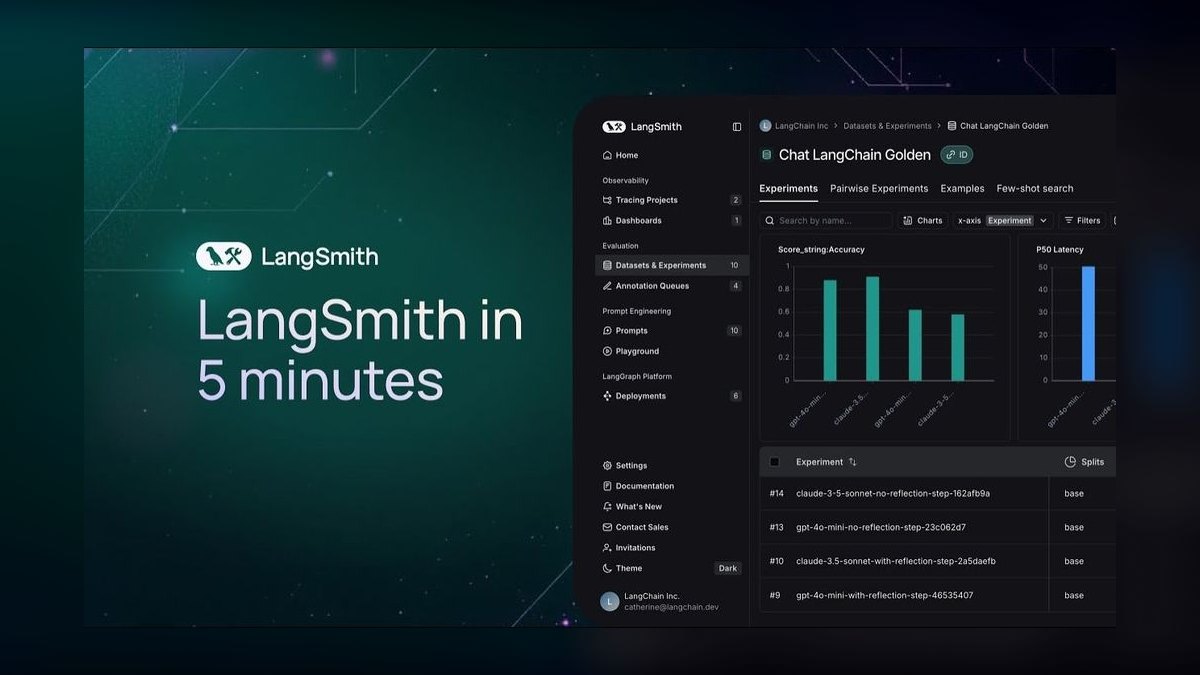
LangSmith ranks first because it unifies tracing, dataset curation, automated evaluators, and human review into a single tightly integrated workflow that scales from prototype to production. It supports online evaluation on live traffic, pairwise A/B comparisons, and LLM-as-judge scorers alongside heuristic checks. The platform is framework-agnostic via SDKs or OpenTelemetry, despite its LangChain pedigree. A generous free developer tier and usage-based paid plans make it accessible.
LangSmith is for teams that want one managed platform to cover the entire evaluation lifecycle, trading away the flexibility of a self-hosted, code-only setup. Compared to DeepEval below, it offers superior observability and collaboration but requires trusting a vendor with your trace data. It is the best choice when tracing, regression testing, and production monitoring must live in one place.
2. DeepEval

DeepEval ranks second as the best value because it is a free, open-source, Pytest-for-LLMs framework with over 40 research-backed metrics including G-Eval, faithfulness, hallucination, and RAG-specific contextual precision. It runs natively in your CI pipeline with zero vendor lock-in, supporting any judge model you choose. The optional Confident AI hosted dashboard adds reporting without requiring migration. This makes rigorous, reproducible evaluation exceptionally cheap.
DeepEval is for engineering teams who want code-first evals in their own pipeline, trading away managed tracing and a polished UI for total control and cost savings. Compared to LangSmith above, it lacks built-in production observability but excels at offline regression testing. It is the strongest open-source alternative for teams prioritizing CI integration and metric depth over a managed workflow.
3. Ragas

Ragas ranks third because it is the specialist for RAG evaluation, pioneering reference-free metrics that score retrieval and generation separately. Its core metrics—faithfulness, answer relevancy, context precision, and context recall—let you diagnose whether a pipeline fails at retrieval or generation. Ragas also supports synthetic test-set generation from your own documents, bootstrapping evaluation data quickly. This component-level insight is unmatched by general-purpose frameworks.
Ragas is for teams optimizing retrieval-augmented systems, trading away general LLM evaluation breadth for deep RAG-specific diagnostics. Compared to DeepEval above, it offers more granular retrieval metrics but a smaller overall metric library. It is the go-to choice when you need to pinpoint and fix the exact stage of a RAG pipeline that is underperforming.
4. Arize Phoenix

Arize Phoenix ranks fourth because it is an open-source LLM observability and evaluation tool built natively on OpenTelemetry and OpenInference tracing. It excels at visually debugging RAG and agent applications, letting you inspect spans and run LLM-as-judge evals like hallucination and toxicity directly on traces. Phoenix runs locally or self-hosted, with the broader Arize AX platform extending it to enterprise-scale production monitoring. This standards-based instrumentation ensures vendor neutrality.
Phoenix is for teams that want self-hostable, vendor-neutral observability with integrated evals, trading away a managed SaaS experience for infrastructure control. Compared to Ragas above, it provides superior trace-level debugging but less specialized RAG metric depth. It is the best pick for teams already invested in OpenTelemetry who need to see inside their LLM calls while scoring them.
5. Braintrust

Braintrust ranks fifth because it is an evaluation-first platform built for the prompt-iteration loop, with datasets, experiments, and scorers as core primitives. Its Loop UI enables fast side-by-side comparison of prompt and model variants with diffable scores, making A/B testing central to development. The open-source Autoevals library ships LLM-judge and heuristic metrics usable anywhere. A free tier and usage-based paid plans lower the barrier to entry.
Braintrust is for teams doing heavy prompt and model A/B work, trading away deep production tracing for a superior experimentation workflow. Compared to Arize Phoenix above, it offers a more polished interface for comparing variants but less granular runtime debugging. It is the strongest choice when rapid, iterative prompt optimization is the primary daily task.
6. OpenAI Evals

OpenAI Evals ranks sixth because it is an open-source framework with a registry of templated evals you can extend in YAML or Python. It supports model-graded evals and is model-agnostic enough to benchmark different models on the same task, despite its OpenAI origins. This makes it a solid, free baseline for building reproducible custom benchmarks. Its simplicity and registry of examples accelerate getting started.
OpenAI Evals is for teams building custom task benchmarks who want a lightweight, free framework, trading away managed infrastructure and advanced metrics. Compared to Braintrust above, it lacks a polished UI and experiment management but offers a simpler, more transparent code path. It is best for researchers and engineers who prefer a minimal, hackable tool over a feature-rich platform.
7. Humanloop

Humanloop ranks seventh because it is a prompt-management and evaluation platform designed for cross-functional teams where product managers and domain experts collaborate with engineers. It pairs prompt versioning with code, LLM-judge, and human evaluators, plus end-user feedback capture as an online signal. This brings non-engineers into the evaluation loop without sacrificing versioned testing rigor. Paid plans with a free trial make it accessible for smaller teams.
Humanloop is for product teams co-developing prompts, trading away deep technical observability for strong collaboration features. Compared to OpenAI Evals above, it offers a far better interface for non-programmers but is less flexible for custom code-heavy benchmarks. It is the best choice when evaluation requires significant input from non-engineering stakeholders.
8. Langfuse

Langfuse ranks eighth because it is a popular open-source LLM engineering platform combining tracing, prompt management, and evaluation in one self-hostable package. It captures detailed traces, builds datasets from production data, and supports model-based and custom evaluators plus human annotation. Its open-source core and managed cloud tiers offer flexibility for data-residency or cost constraints. An active community ensures ongoing development and support.
Langfuse is for teams wanting an open, self-hosted LangSmith alternative, trading away some managed polish for full data control. Compared to Humanloop above, it offers superior technical tracing but less emphasis on non-engineer collaboration. It is the best pick for organizations with strict data-residency requirements that still want a comprehensive observability-plus-eval workflow.
9. Promptfoo

Promptfoo ranks ninth because it is a developer-friendly, open-source CLI and library for prompt testing and red-teaming. You declare test cases in a simple config and run a matrix of prompts across models, getting a clear pass/fail table. Its standout feature is built-in security scanning that probes for prompt injection, jailbreaks, and PII leakage. This makes it equally useful for quality and adversarial safety testing.
Promptfoo is for engineers who want lightweight, config-driven evals and dedicated red-team scanning, trading away a full platform for a focused, fast CLI. Compared to Langfuse above, it offers no tracing or collaboration but excels at adversarial testing and CI integration. It is the best choice when security testing is a primary requirement alongside basic quality checks.
10. MLflow LLM Evaluate

MLflow LLM Evaluate ranks tenth because it brings LLM evaluation into the widely used MLflow lifecycle platform via mlflow.evaluate(). It offers built-in metrics like toxicity, relevance, and faithfulness, plus custom LLM-judge metrics, with results logged as first-class MLflow runs. This folds evaluation into existing MLOps governance with no new platform to adopt. It is open-source and managed on Databricks and other clouds.
MLflow LLM Evaluate is for teams already standardized on MLflow, trading away specialized LLM features for tight integration with experiment tracking and model registry. Compared to Promptfoo above, it lacks red-teaming capabilities but provides superior governance and artifact management. It is the best pick for organizations that want to keep all ML operations, including LLM evals, within a single lifecycle tool.
How we ranked these
We measured each tool against five weighted criteria: metric depth (breadth and rigor of built-in scorers), workflow fit (datasets, CI integration, regression testing, human review), observability (tracing, production monitoring, online evals), model-agnosticism (works across providers and judge models), and adoption (community, documentation, ecosystem). Weights favored metric depth and workflow fit as the core functions, with observability and model-agnosticism close behind, and adoption as a supporting factor.
We deliberately ignored subjective factors like UI aesthetics, marketing claims, and vendor brand reputation. We also excluded pricing tiers from the primary ranking because costs vary widely with usage and self-hosting options, making direct comparison misleading. We focused on verifiable features and documented capabilities, not hype or unsubstantiated performance claims, to ensure the ranking reflects practical utility for production teams.
What to look for
When choosing, prioritize your primary use case: RAG pipelines need component-level metrics (Ragas, DeepEval), agent workflows need trajectory and task-completion scoring, and safety-critical apps need red-teaming (Promptfoo). Consider whether you want a managed platform (LangSmith, Braintrust) or a self-hosted open-source tool (Langfuse, Phoenix) based on data-residency and cost constraints. Also, evaluate how well the tool integrates with your existing CI/CD and observability stack.
The biggest mistake is choosing a tool based on feature lists rather than your actual workflow. Many teams adopt a managed platform like LangSmith without realizing they only need a lightweight CI framework like DeepEval, or they pick a RAG specialist when they need broader agent evaluation. Another common error is ignoring the total cost of ownership, including judge model API calls, storage, and human reviewer time, which can exceed the platform subscription fee.
Related questions
How do you evaluate LLM output quality at scale?
At scale, you need a combination of offline regression testing on curated datasets and online evaluation of production traffic. Tools like LangSmith and DeepEval support both, allowing you to gate releases with CI checks and monitor live responses for drift and hallucination. Sampling a statistically significant subset of low-confidence outputs for human review is also essential.
What is the difference between LLM observability and evaluation?
Observability focuses on tracing and monitoring the behavior of LLM applications in production, capturing traces, latency, and errors. Evaluation is the process of scoring outputs against quality metrics like faithfulness and relevance. While distinct, they are complementary: observability platforms like LangSmith and Arize Phoenix often include built-in evaluators, and evaluation tools can generate traces for debugging.
How do you build a cost dashboard for AI and LLM spend?
Building a cost dashboard involves tracking token usage, API calls, and infrastructure costs across your LLM stack. Tools like LangSmith and Langfuse provide usage analytics, while MLflow can track experiment costs. You should also account for evaluation costs, including judge model API calls and human review time, which can be significant at scale.
How do you secure an LLM application's infrastructure?
Securing LLM infrastructure involves protecting against prompt injection, data leakage, and unauthorized access. Use red-teaming tools like Promptfoo to probe for vulnerabilities, implement guardrails and input/output filtering, and ensure proper authentication and authorization for your APIs. Regular security audits and monitoring for anomalous behavior are also critical.
What are the best LLM routing and load balancing tools in 2027?
LLM routing tools intelligently direct requests to the most appropriate model based on cost, latency, and quality requirements. Leading options include OpenRouter, LiteLLM, and various gateway solutions. These tools often integrate with evaluation platforms to track performance across models, enabling dynamic routing decisions based on real-time quality metrics.
How do you fine-tune an open-source LLM cost-effectively?
Cost-effective fine-tuning involves using techniques like LoRA or QLoRA to reduce compute requirements, and leveraging open-source datasets and frameworks. Tools like MLflow can track experiments and manage model versions. You should also evaluate the fine-tuned model against a baseline using a framework like DeepEval to ensure the investment improves quality.
What is the role of human-in-the-loop in LLM evaluation?
Human-in-the-loop evaluation is crucial for catching nuanced errors that automated metrics miss. It involves sampling a subset of outputs for human review, often focusing on low-confidence or edge-case responses. Platforms like LangSmith and Humanloop provide annotation queues for this purpose, and the results can be used to calibrate LLM-as-judge metrics and improve test sets.
FAQ
What is LLM-as-a-judge and is it reliable?
LLM-as-a-judge uses a strong model to score another model's outputs against criteria like correctness, faithfulness, or helpfulness. It scales far better than human review and correlates well with human judgment when the rubric is specific and you use techniques like reference answers, chain-of-thought grading, and bias controls (e.g., position-swapping in pairwise comparisons). It is not perfect, so high-stakes evals should be calibrated against a human-labeled sample.
What is the difference between offline and online evaluation?
Offline evaluation runs against a fixed, curated dataset before you ship — like unit tests for prompts and models. Online evaluation scores live production traffic continuously to catch real-world regressions, drift, and edge cases the dataset missed. Strong teams do both: offline to gate releases, online to monitor what they shipped.
Which metrics matter most for RAG?
The four core RAG metrics are faithfulness (is the answer grounded in retrieved context, i.e., no hallucination), answer relevancy (does it address the question), context precision (are retrieved chunks relevant), and context recall (was all needed context retrieved). Splitting the score this way tells you whether to fix retrieval or generation. Ragas and DeepEval both implement these.
Can I use these tools with open-source or self-hosted models?
Yes. All of the leading tools are model-agnostic — they treat the model as a black box you call, so they work with OpenAI, Anthropic, Google, and self-hosted open models (Llama, Mistral, Qwen) served via vLLM or similar. You can also point the judge model at a local or open model to control cost and data residency.
Do I need a separate red-teaming tool for safety?
If your application is exposed to untrusted users or handles sensitive data, yes — quality evals and safety evals test different things. Promptfoo includes dedicated red-teaming that probes for prompt injection, jailbreaks, and data leakage. Some observability platforms add guardrail and safety scorers, but a purpose-built adversarial scanner gives more thorough coverage.
How often should I run evaluations?
Run offline regression evals on every meaningful change — new prompt, model swap, retrieval tweak — ideally automated in CI so a quality drop blocks the merge. Run online evals continuously on a sample of production traffic, and schedule periodic full-dataset runs (e.g., nightly) to catch slow drift.
What is the total cost of LLM evaluation?
Costs include judge model API calls, storage for traces and datasets, and human reviewer time. Open-source frameworks like DeepEval cost only compute time—roughly $0.01–$0.05 per evaluation with a local judge model. Managed platforms charge per traced event or evaluation, typically $0.001–$0.01 per call at scale, but include infrastructure and collaboration features.
How do I choose between LangSmith and Langfuse?
LangSmith offers a more tightly integrated, managed experience with a generous free tier and strong online evaluation features. Langfuse is open-source and self-hostable, making it a better choice for data-residency or cost constraints. Both support tracing, datasets, and evaluators, so the decision often comes down to managed vs. self-hosted and your team's DevOps capacity.
What is the best way to build an evaluation dataset?
Start with a small set of hand-crafted examples covering edge cases and typical user queries. Then, use production logs to curate real-world inputs and outputs. Tools like Ragas can also generate synthetic test sets from your documents. Aim for a dataset that is representative, diverse, and regularly updated to prevent overfitting.
Sources
- https://docs.smith.langchain.com/
- https://github.com/confident-ai/deepeval
- https://docs.ragas.io/
- https://docs.arize.com/phoenix
- https://www.braintrust.dev/docs
- https://github.com/openai/evals
- https://langfuse.com/docs
- https://www.promptfoo.dev/docs/
- https://mlflow.org/docs/latest/llms/llm-evaluate/index.html
Related on PULSE
This page will be disappearing soon. Save it to your device for $1 — or read it free while it is here.
@Kory-White- · if Venmo asks, the last 4 of my number are 2012
This page is gone.
This one is off the shelf now. $1 keeps it on your phone for good — the whole page, pictures and diagrams included.
 pulse-ai-infrastructureThe 10 Best AI Tools for Vocabulary Building in 2027
 pulse-ai-infrastructureThe 10 Best AI Tools for Motion Capture in 2027
 pulse-ai-infrastructureThe 10 Best AI Tools for End-to-End Testing in 2027
 pulse-ai-infrastructureThe 10 Best AI Tools for Pronunciation Coaching in 2027
 pulse-ai-infrastructureThe 10 Best AI Tools for Crisis Communications in 2027
 pulse-ai-infrastructureThe 10 Best AI Tools for Vocal Removal in 2027
 pulse-ai-infrastructureThe 10 Best AI Tools for Event Planning in 2027
 pulse-ai-infrastructureWhat is confidential computing and why does it matter for AI in 2027?
 pulse-ai-infrastructureThe 10 Best AI Tools for Summarizing Books in 2027
 pulse-ai-infrastructureThe 10 Best AI Tools for Concept Art in 2027