


How much does an RTX 5070 Ti cost in 2027?
Quality
Certified
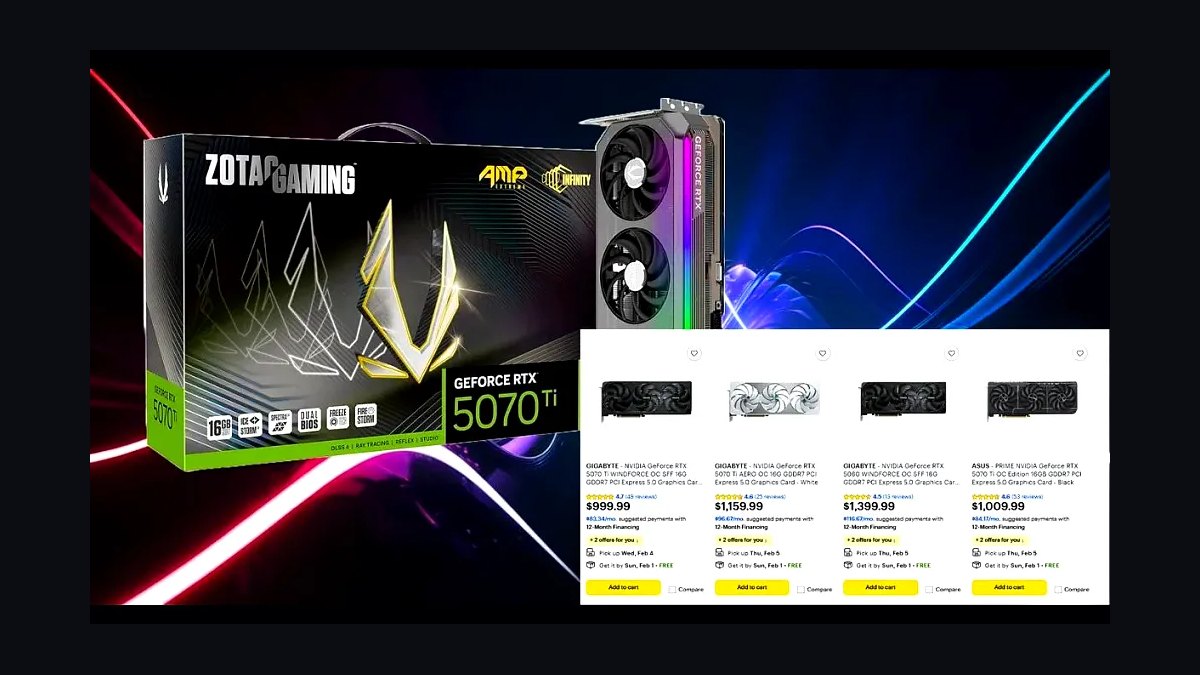
Nobody can quote one fixed 2027 figure. By then the RTX 5070 Ti is a one-generation-old card, so expect street prices to drift toward or below its launch MSRP, with used and open-box units discounted furthest. The real cost depends on whether a successor has shipped, how hard AI and mining demand pull supply, and which channel you buy through.
The scenario: a buyer with $700 and a dying GPU
Picture a specific situation, because "how much does it cost" only becomes answerable once you pin down who is asking. It is early 2027. Your GTX 1080 Ti or RTX 3070 is starting to stutter in the games you actually play at 1440p, one of the fans has developed a bearing rattle, and you have roughly $700 set aside. You open three tabs — a big-box retailer, a price-history tracker, and a secondhand marketplace — and you see three genuinely different numbers for what appears to be the same RTX 5070 Ti. One is a board-partner triple-fan model at full retail. One is an open-box listing from a return. One is a private-party sale forty minutes away, cash only, "used for gaming, adult owned."
Those three numbers are not errors or noise. They are three different products wearing the same GPU. The retail unit carries a multi-year board-partner warranty, a return window, and consumer protection if it dies in month eight. The open-box unit carries a shortened warranty and an unknown reason for the original return. The private sale carries nothing at all — no warranty, no recourse, and no verifiable history of whether it spent eighteen months at 100% utilization in a compute rig. When you ask "how much does an RTX 5070 Ti cost in 2027," you are actually asking one of at least three separate questions, and the spread between the cheapest and most expensive answer will typically be wider than the spread between two adjacent GPU tiers.
The second thing that scenario exposes is timing. If you walk into that purchase the week a successor generation is announced, the retail price you were quoted on Monday may be materially lower by the following month, because retailers and board partners clear outgoing inventory ahead of new stock. If you walk in during a demand spike — an AI inference boom that repurposes consumer cards, a mining cycle that suddenly makes GPU compute profitable again, a memory shortage that constrains every board partner at once — that same card can sell above its original MSRP two years after launch. GPUs are one of the few consumer electronics categories where a two-year-old product can cost more than it did new.
So the honest framing is this: your $700 buyer does not have a price problem, they have an information problem. They need to know which channel they are shopping, what phase of the generational cycle they are in, and what the current demand environment looks like. Get those three inputs right and the price falls out of them. Get them wrong and you either overpay during a spike or buy a card that drops in value the month after you take delivery.
How GPU pricing actually gets set
The mechanism is worth understanding because it explains why the number moves. NVIDIA announces an MSRP — a manufacturer's suggested retail price — at launch. That figure is genuinely a suggestion. It anchors expectations and it typically governs NVIDIA's own Founders Edition cards where those exist, but it does not bind anyone else in the chain. NVIDIA sells GPU dies and reference designs to add-in board partners. Those partners build their own cards with their own coolers, power delivery, factory overclocks, backplates, RGB, and warranty terms, and they price accordingly. A premium triple-fan overclocked model with a five-year warranty costs meaningfully more than a basic dual-fan blower-style card built to hit the MSRP target, even though the silicon underneath is identical.

Then retailers apply their own margin, which flexes with inventory. A retailer sitting on excess stock of an outgoing tier will discount to clear shelf space, because carrying cost is real and a card that has been in the warehouse for six months is a liability. A retailer with three units left during a shortage will hold or raise price, because the next shipment is uncertain. This is the layer where most of the visible week-to-week price movement happens, and it is why price-history trackers are more useful than any single listing.
Underneath all of that sits the actual supply constraint: foundry capacity and memory. GPU dies are fabricated on leading-edge process nodes at a small number of foundries, and that capacity is allocated across competing customers — including data-center and AI accelerator products that carry far higher margins than consumer graphics cards. When AI demand surges, allocation shifts, consumer supply tightens, and prices rise regardless of what gamers are willing to pay. Memory is the same story: GDDR modules come from a handful of suppliers, and a memory shortage lifts the bill of materials for every card simultaneously.
The secondhand market runs on a parallel mechanism. Used prices are anchored to new prices with a discount that reflects risk and remaining warranty, and that anchor moves whenever the new price moves. But used supply also has its own shock source: when a successor generation launches, a wave of upgraders list their old cards at roughly the same time, and that supply surge pushes used prices down faster than new prices fall. Mining cycle endings produce the same effect at much larger scale, dumping thousands of high-utilization cards into the market at once.
The practical consequence of this chain is that the levers closest to you — which retailer, which board partner, which channel — are the ones you can act on immediately, while the levers furthest upstream — foundry allocation, AI demand — are the ones you can only watch and time around. Most buyers spend their energy on the wrong end, hunting a coupon while ignoring that a generational transition six weeks out would have saved them more than any promo code.
Reading the actual numbers instead of guessing them

There is no responsible way to print a specific 2027 dollar figure here, and you should be skeptical of any page that does. What you can do is build the number yourself from live inputs, which is more useful anyway because it stays correct as the market moves.
Start with the launch MSRP as your reference point, not your target. Look up the RTX 5070 Ti's official launch price from NVIDIA's own product pages or the TechPowerUp GPU database, which records launch pricing alongside full specifications. That number is your anchor. Everything else is expressed as a relationship to it.
Next, pull the current new-retail street price from at least three independent sources: a major retailer's live listing, a price-comparison tool such as PCPartPicker that aggregates across vendors, and a price-history view so you can see direction of travel. Direction matters more than the instantaneous number. A card at a given price and falling week over week tells you to wait; the same price and rising tells you the window is closing. Note the spread between the cheapest listing and the most expensive board-partner variant — that spread tells you how much of what you would pay is cooler and warranty rather than silicon.
Then establish the used floor. Search completed sales, not active listings — active listings are asking prices and include wishful sellers, while completed sales are what buyers actually paid. Do this on at least two marketplaces, and note the condition mix. Separate out anything described as a former mining or compute card; those should trade at a further discount and you should price them as such if you consider them at all.

You now have four numbers: launch MSRP, current new street price, premium-variant new price, and used completed-sale median. The relationships between them tell you where in the lifecycle the card sits. If new street price is at or below MSRP and used sits well under new, the card is in normal post-launch maturity and you are shopping a buyer's market. If new street price is above MSRP two years post-launch, a demand shock is active and you should either wait it out or accept that you are paying a scarcity premium. If used has collapsed relative to new, a successor has likely shipped or a mining cycle has ended, and new clearance pricing usually follows within weeks.
Set your target band from those relationships before you shop, not after. A reasonable discipline: define a price you will pay immediately, a price you will pay if the card is a specific variant you want, and a walk-away ceiling. Write them down. The reason to commit in advance is that GPU purchases are unusually vulnerable to urgency — a dying card creates real pressure, and pressure produces overpayment. Treating the purchase like a qualified pipeline deal, with criteria set before the conversation starts, is the same discipline that keeps revenue teams from discounting under quarter-end pressure.
One more number belongs in the model: power. Check the card's rated board power in the TechPowerUp database and compare it against your existing power supply's capacity and connector type. If the card requires a connector your PSU does not have, or pushes your total system draw near your PSU's rating, you are buying a power supply too. That is a real line item, not a footnote, and it can swing the effective cost of the purchase by a meaningful fraction.
Channel trade-offs and the alternatives worth considering

Three channels, three different risk-and-cost profiles, and the right answer depends entirely on what you are optimizing for.
New retail is the highest sticker and the lowest risk. You get the full board-partner warranty — typically multiple years, though terms vary by manufacturer — a retailer return window, and a card with zero operating hours. By 2027 the constraint on this channel is availability rather than price: once a successor ships, board partners wind down production of the outgoing tier, and remaining new stock becomes clearance inventory that eventually runs out. If you want new, the generational transition is both your best pricing opportunity and your last call.
Manufacturer-refurbished and open-box sit in the middle and are underrated. Refurbished units have typically been tested and repaired by the manufacturer or an authorized partner and carry a real, if shortened, warranty. Open-box units are usually returns that were never used or used briefly, sold at a discount because the seal is broken. Both give you most of the reliability of new at a meaningful discount. The trade-off is selection — you take what is available, not the exact variant you wanted — and the warranty length, which you should verify in writing before purchase rather than assuming.
Used private-party is the cheapest and carries all the risk. You inherit the card's entire thermal and electrical history with no way to fully verify it. A card that spent two years in a gaming rig at four hours a day is in a completely different condition from one that ran sustained compute at high utilization, and both can look identical in a photograph. Fans wear out, thermal pads dry and lose conductivity, and thermal paste degrades. None of that necessarily kills the silicon, but it does mean you may be buying a repaste and a fan replacement along with the card.

The alternatives to buying a 5070 Ti at all deserve honest consideration. Buying the current-generation equivalent tier costs more up front but gives you a longer support window, better performance per watt, and stronger resale value later — the depreciation you avoid can offset a good part of the price gap over a three-year hold. Buying a tier down saves money and may be entirely sufficient if you game at 1080p or 1440p rather than 4K. Buying an equivalent AMD or Intel card changes the feature calculus — different upscaling and frame-generation implementations, different ray-tracing performance, different driver ecosystem, and different pricing pressure. And doing nothing for six months is a legitimate strategy if your current card still works and a generational transition is plausibly near.
Whichever branch you land on, decide the objective first. "Lowest total spend over three years" and "lowest price today" are different goals that point at different channels, and buyers who never articulate which one they are chasing tend to end up with neither.
Pitfalls that cost buyers real money
Treating MSRP as the price. MSRP is a launch-day marketing number. Two years later it is a historical footnote that tells you where the card was positioned, not what it trades for. Buyers who anchor on MSRP either refuse good deals because they are "above MSRP" during a genuine shortage, or accept bad ones because they are "at MSRP" when the market has moved well below it.
Buying during a demand spike. The single most expensive mistake is purchasing into an AI or mining demand surge. During these periods, every card at every tier gets bid up, used prices rise toward new prices, and inventory disappears. If your card still functions, waiting out a spike is almost always cheaper than buying through it. If it does not, buy the cheapest thing that works and upgrade later rather than paying a scarcity premium on a card you intend to keep for years.

Ignoring the supporting-hardware bill. Buyers routinely budget for the GPU and nothing else, then discover the card needs a connector their PSU lacks, or draws enough that their existing supply is marginal, or physically does not fit their case. Measure your case clearance — length, and thickness in slots — before buying, check your PSU's rating and connectors, and confirm your case has adequate front-to-back airflow. A cramped case turns a good cooler into a loud one.
Buying an ex-mining or ex-compute card without pricing the risk. These cards are not automatically bad; sustained steady-state operation is arguably gentler on silicon than thermal cycling. But they accumulate fan hours and degrade thermal interface material, and they often come from sellers with no interest in disclosing history. If you buy one, price in a repaste, new thermal pads, and possible fan replacement, and discount accordingly. If the seller will not discuss usage history at all, treat that as an answer.
Skipping the stress test on a used card. Never hand over money before running the card under sustained load. Run a demanding benchmark or stress utility for at least fifteen to twenty minutes and watch three things: does it hold clocks without crashing, do temperatures stabilize rather than climbing indefinitely, and do all fans spin smoothly without rattling. Check memory specifically, since faulty VRAM produces artifacts under load that a short test will miss. Meet somewhere you can plug the card in, or buy from a platform with buyer protection.
Overbuying for the resolution you actually play at. An upper-mid card is genuinely excessive for 1080p gaming in most titles, and the money is better spent on a monitor, more system memory, or storage. Match the card to the display you own, not the display you imagine buying.

Forgetting resale value in the cost math. The true cost of a GPU is purchase price minus what you eventually recover, plus power consumed. A card bought at a low price near the end of its depreciation curve loses little further value, which can make an apparently more expensive newer card the worse deal — or the better one, depending on how long you hold. Run the arithmetic over your actual expected ownership period rather than comparing sticker prices.
Trusting a single listing as "the price." One retailer's number on one day is a data point, not a market. Triangulate across a comparison tool, a price-history tracker, and completed secondhand sales before concluding anything about what the card costs.
Related questions
Will the RTX 5070 Ti be discontinued by 2027?
Board partners typically wind down production of a tier once its successor ships, so new stock may thin considerably. Discontinued production does not mean unavailable — the used and open-box markets stay well supplied for years after new units stop shipping.
Is a used RTX 5070 Ti in 2027 a good deal?
Frequently yes, since most depreciation has already occurred by year two. The risk is unverifiable usage history. Stress-test under sustained load, check fan and memory health, and prefer sellers offering returns or residual transferable warranty.
Should I wait for the next generation instead?
If your current card works, waiting is usually the cheaper play — a successor launch pushes outgoing-tier prices down and gives you a newer option. If your card is failing now, a mature well-reviewed part is a reasonable value buy.
Do prices vary a lot by region?

Substantially. Tariffs, import duties, VAT treatment, currency exchange rates, and local retail competition all shift effective prices between countries. Always compare against local price-history data rather than converting a figure quoted in another currency.
Does mining or AI demand still affect GPU prices?
It can, sharply. Any workload that repurposes consumer GPUs for compute tightens supply and lifts prices even on older cards. Treat mining profitability and AI hardware demand as leading indicators for consumer GPU pricing.
FAQ
Why does the price change so much over time? GPU pricing is a live market outcome, not a fixed number. MSRP is only a suggestion; board partners, retailers, and the secondhand market all price above or below it based on real-time inventory, competitive pressure, and demand shocks. Over a card's life, the largest single driver is generational cadence — once a successor launches, outgoing-tier prices typically fall as clearance inventory moves and upgraders list their old cards.
Is MSRP the same as what I will actually pay? Rarely exactly. MSRP is the manufacturer's suggested figure at launch and often applies most directly to reference or Founders Edition cards. Actual street price sits above MSRP during shortages and below it once inventory is healthy or a newer generation arrives. By 2027, current street price and completed secondhand sales are far better guides than the original MSRP.
Where can I find reliable current pricing?

Triangulate across a price-comparison aggregator like PCPartPicker, live listings at major retailers, the TechPowerUp GPU database for launch-price and spec reference, and completed sales on secondhand marketplaces. Cross-check several sources rather than trusting one figure, and pay attention to whether the trend is rising or falling — direction of travel matters more than the instantaneous number.
How much cheaper is used versus new? Used and open-box units sell at a meaningful discount to new, and that gap widens sharply right after a successor generation launches and upgraders flood the market. The exact discount depends on condition, remaining warranty, board-partner variant, and current demand, so compare the used completed-sale median against new clearance pricing before deciding which channel wins.
Will a newer generation make the 5070 Ti obsolete? Not obsolete in any practical sense — a two-year-old upper-mid card still runs modern games and workloads well. A newer generation changes value positioning, not capability: it usually pushes the older card's price down and offers better performance per dollar and per watt at the top of the stack. The 5070 Ti becomes a value option rather than a bad one.
What should I check before buying a used card in 2027? Stress-test under sustained load for fifteen to twenty minutes, watch that clocks hold and temperatures stabilize rather than climbing, confirm every fan spins smoothly without bearing noise, and check for VRAM artifacts specifically. Verify any residual warranty is transferable, ask directly about gaming versus mining versus compute history, inspect for dust and physical damage, and strongly prefer sellers who accept returns or platforms with buyer protection.
Sources
- NVIDIA GeForce Graphics Cards
- TechPowerUp GPU Database
- Tom's Hardware — GPUs
- PCPartPicker — Video Cards
- AnandTech — GPU Coverage
- Ars Technica — Gear & Gadgets
- The Verge — PC Gaming
- Newegg — Desktop Graphics Cards
Related on PULSE
This page will be disappearing soon. Save it to your device for $1 — or read it free while it is here.
@Kory-White- · if Venmo asks, the last 4 of my number are 2012
This page is gone.
This one is off the shelf now. $1 keeps it on your phone for good — the whole page, pictures and diagrams included.
 pulse-gamingTop 10 Gaming strategies for 2027
 pulse-gamingHow much does Gaming cost in 2027?
 pulse-gamingHow do you get started with Gaming in 2027?
 pulse-gamingWhat are the most common mistakes in Gaming in 2027?
 pulse-gamingIs Gaming worth it in 2027?
 pulse-gamingWhat is the best way to approach Gaming in 2027?
 pulse-gamingWhat should you know before investing in Gaming in 2027?
 pulse-gamingTop 10 best Gaming options in 2027
 pulse-gamingTop 10 VR Headsets — Best Overall + Best Value in 2027
 pulse-gamingThe 10 Best SNES Games to Collect in 2027