


BANT Qualification — Infographic
Quality
Certified

BANT Qualification scores a prospect on Budget, Authority, Need, and Timeline before a rep invests further. The Infographic condenses those four criteria into one portrait-format visual — each block paired with the diagnostic questions that surface honest answers — so teams qualify consistently on live calls instead of improvising. It is a memory aid and alignment device, not a substitute for curiosity.
What the BANT Infographic is and why it matters
The asset is a single portrait-format SVG, typically 1080×1350 px, built to be read in about eight seconds. Four numbered blocks — Budget, Authority, Need, Timeline — stack vertically, each carrying its definition and the diagnostic question a rep should actually ask. Because it ships as vector, it scales from a 40 px Slack thumbnail to a printed wall poster with no resampling artifacts. That is the practical reason it outlives the PNG cheat sheets most teams build in Canva and abandon three months later.
The format matters more than it sounds. A four-quadrant grid reads as four equal, simultaneous things — exactly the wrong mental model. BANT is not four boxes you tick in parallel; it is four signals that surface in a rough order during a conversation, with Need almost always arriving first and Budget almost always arriving last if the rep is doing it right. A vertical numbered stack encodes that sequence visually. Reps who glance at the stack mid-call are reminded not just what to ask but roughly when.
BANT itself originated inside IBM decades ago as a way to triage mainframe inquiries, long before SaaS, product-led growth, or buying committees of eight. Its persistence has less to do with sophistication than with compression: four letters cover the only four questions that reliably predict whether a deal can physically close. Can they pay? Can they say yes? Do they hurt? Do they hurt now? Every richer framework — MEDDIC, MEDDPICC, SPICED — is an elaboration on those four, and none of them fits on a wall.

The portrait aspect ratio is deliberate. 1080×1350 is the native tall format for Instagram and LinkedIn feeds, meaning the same asset that lives in an onboarding deck also works as social content or a slide in a sales-process explainer without recropping. Teams that place the Infographic in three locations — new-hire onboarding, the CRM opportunity-stage help text, and a printed card at each rep's desk — see the framework stick far better than teams that present it once in week-one training and never surface it again. Repetition of the visual is what converts a mnemonic into a habit, and habits are what protect revenue when a rep is tired at 4:45 on a Thursday.
One honest caveat about the asset: an Infographic cannot make a bad discovery call good. It is a memory aid and an alignment device — it gets ten reps asking roughly the same four things so their pipeline data is comparable. The quality of the answers still depends on whether the rep is curious. A team that treats the poster as a substitute for listening will produce tidy notes attached to unwinnable deals.
Why it matters at the team level comes down to comparability. When every rep qualifies against the same four criteria with the same phrasing, a sales manager can look at a pipeline review and compare apples to apples. Without that shared vocabulary, one rep's "qualified" means the prospect took the call, another's means budget was confirmed in writing, and forecast accuracy collapses. The Infographic is cheap insurance against that drift — it costs nothing to distribute and takes one 45-minute session to install as a shared standard. The compounding value shows up months later, when the qualification notes in the CRM can actually be analyzed for patterns instead of skimmed for vibes.
The step-by-step process behind each quadrant

Working the Infographic properly means moving through the quadrants in conversational order, not printed order. Here is the sequence that holds up on real calls.
Step one — open on Need, not Budget. Start with what prompted the meeting. "What changed recently that made this worth an hour of your time?" A prospect who cannot name a trigger event has curiosity, not need. Spend six to twelve minutes here. Ask how long the problem has existed, what they have already tried, and what "solved" looks like in twelve months. Push for a number — hours lost per week, deals slipping per quarter, headcount spent on manual work. If they cannot quantify the pain, you will not be able to build a business case later, and the Budget conversation will fail for reasons that have nothing to do with money.
Step two — surface Authority sideways. Never ask "are you the decision-maker?" It invites either an ego answer or a defensive one, and both are useless. Ask instead: "Walk me through how a purchase like this normally gets approved here — who's usually in the room?" That question is procedural, not personal, so people answer it honestly. You are listening for named roles: a technical evaluator, a budget holder, a procurement gate, sometimes a security review. In most mid-market deals you will hear two to four names. In enterprise, six or more is normal.

Step three — test Timeline against a real event. "When would you want this live?" produces fiction. "What happens if this is still unsolved in six months?" produces truth. Real timelines attach to events: a contract renewal, a fiscal-year close, a system sunset, a compliance deadline, a hiring plan. A timeline with no anchoring event is a preference, and preferences slip.
Step four — introduce Budget as a range, last. By this point you have quantified pain and mapped the approval chain, so you can anchor rather than ask. "Teams solving this at your scale usually land somewhere between X and Y all-in, including implementation. Is that in the neighborhood of what you'd expect?" This does three things at once: it discloses honestly, it tests reaction rather than extracting a number, and it flushes out the "we'd have to find that" answer that tells you budget is unfunded rather than absent.
Step five — write it down in the same four fields. Log a one-line note per quadrant into the CRM immediately after the call. Not a paragraph — one line each. "Need: 14 hrs/wk manual reconciliation, CFO complained in board deck." "Authority: VP Ops recommends, CFO signs, procurement 3-wk review." Consistency here is what makes the qualification data analyzable later.
Step six — score and route before you forget. Ten minutes after the call, assign each quadrant a simple pass/partial/fail and let the pattern route the deal. Four passes: book the technical or executive next step. Three passes with Budget partial: build the business case. Two or fewer: nurture with a specific trigger date. The routing rule matters because it removes the emotional decision — reps fall in love with interesting problems and keep working deals that fail two criteria.
Costs, timelines, and typical ranges

The asset itself carries no cost. It is a free SVG, no attribution required, downloadable as vector or raster, with a color picker so a team can recolor it to brand palette and swap the background — including transparent — before exporting. That removes the usual objection to borrowed sales collateral, which is that it looks like someone else's.
The real costs are time. Budget these honestly:
Rollout. A single 45-minute session covering the four quadrants and the question phrasing, followed by a printed card at each desk. Do not build a two-day curriculum around four letters — it signals the framework is more complicated than it is, and reps disengage.
Call-level time. In a 30-minute discovery call, a workable split is roughly five minutes of rapport and role confirmation, ten on Need, five on Authority, five on Timeline and Budget together, and five to summarize and agree on next steps. On a 45- or 60-minute enterprise call the Need block expands, not the Budget block.
Ramp to reliable data. Expect four to six weeks before qualification notes are consistent enough to compare across reps. The first two weeks produce notes that vary wildly in depth; that is normal and fixes itself with call review, not with more training.
Deal-size fit. BANT does its best work on transactional and mid-market motions — roughly deals under $50K annual contract value with one or two approvers. Above about $100K, or wherever the buying committee exceeds four people, BANT stops being sufficient on its own and becomes a first-pass filter feeding a deeper framework.

Typical answer ranges to expect. Budget answers cluster into brackets rather than figures — "under $10K," "$10K–$50K," "$50K+" — and that bracket is usually enough to route the deal. Timeline answers cluster into "this quarter," "next quarter," "3–6 months," and "someday." Anything in the "someday" bucket belongs in nurture, not forecast. Authority resolves into one of three shapes: single approver, recommender-plus-signer, or committee. Need is the only quadrant where you want a specific number rather than a bracket, because the number is what funds the other three.
Measurement, once you have a quarter of data. Track the close rate of leads that cleared all four criteria against those that cleared two or three. A healthy spread is roughly two to three times higher close rate for fully qualified leads. If the gap is narrower, your criteria are too permissive and reps are passing anything with a pulse. If the gap is very wide but volume has collapsed, you have swung to over-strict and are disqualifying findable-budget deals. Also watch where deals stall by quadrant: a cluster of deals dying right after Authority is confirmed usually means reps identified the approver and never actually got in front of them.
The cost of skipping it. Teams that run discovery without a shared qualification standard pay in a currency that is harder to see: forecast misses, surprise losses at the contract stage, and discounting to save deals that should have been disqualified in week one. A discount of 15–20% applied to rescue a marginal deal usually traces back to an unquantified Need or an unmapped Authority path. The Infographic is a cheap control against that.
Where teams get the Infographic wrong
Reading it as an interrogation script. The most common failure is a rep working top to bottom in order, firing four questions like a form. Prospects give shallow answers to end the call. The Infographic is a coverage checklist for what you must know by the end of the conversation, not a running order for the conversation itself.

Taking a budget number at face value. "We have fifty thousand set aside" can mean the money is committed elsewhere, or that the speaker cannot authorize a cent of it. The follow-ups that matter: does that figure include implementation and internal time, what else is competing for the same pool, and who releases it. Conversely, "we don't have a budget" frequently means "no one has prioritized this yet" — which is a persuasion problem, not a disqualification. Teams that reflexively disqualify on that phrase leave a meaningful share of winnable pipeline on the floor.
Confusing title with authority. A VP may have no signing power while a senior analyst writes the recommendation that finance rubber-stamps. Title tells you where someone sits, not what they can move. Always map the process, then map the people onto it.
Chasing an urgent timeline past a bad fit. "We need this live in two weeks" is intoxicating and frequently a trap. If the requirement involves integrations or workflows the product genuinely does not support, the timeline is irrelevant — you are racing toward a churned account or a refund. Validate Need against actual capability before you let urgency set the pace.
Disqualifying enterprise on fiscal timing. Large organizations routinely have money that exists only in a future fiscal period, or split across two departments' cost centers. "Nothing until Q4" is a sequencing fact, not a rejection. The right move is to ask whether any discretionary spend exists for urgent items, and if not, to build the proposal that lands in the planning cycle rather than walking away.
Treating a BANT pass as deal-ready. Clearing all four means the prospect is worth more of your time. It does not mean the deal is closeable this quarter. Teams that treat qualification as a finish line rather than a stage gate inflate their forecast and lose credibility with finance.
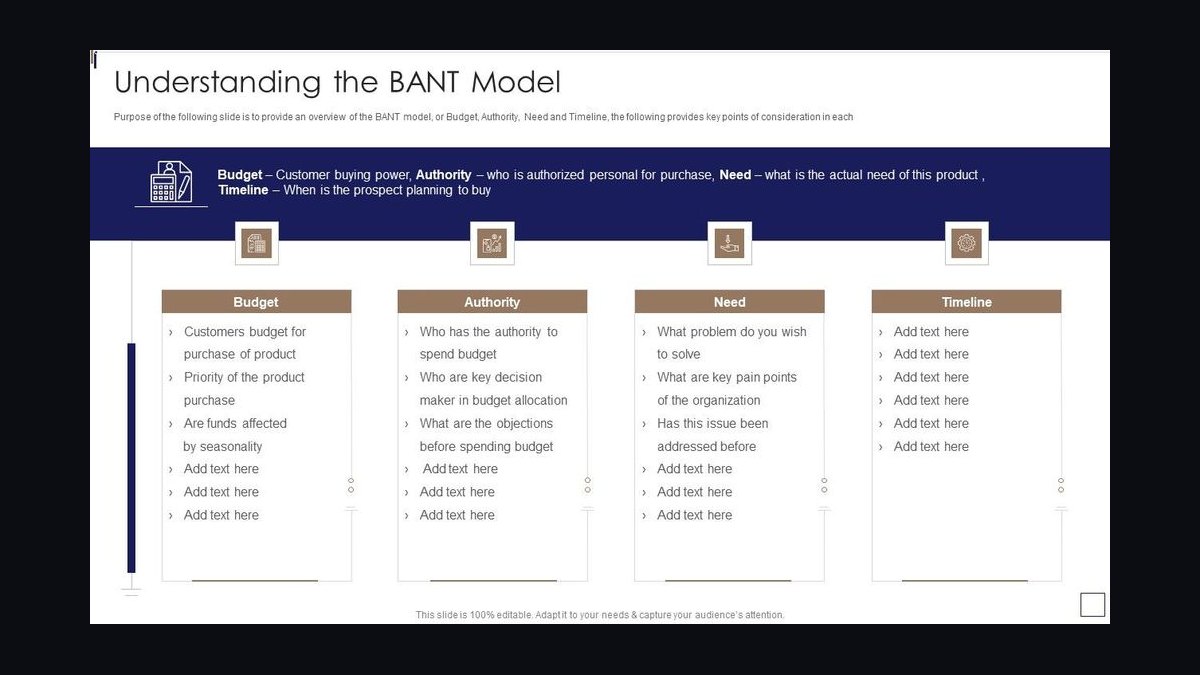
Letting the visual go stale. If the Infographic lives only in the week-one onboarding deck, it stops influencing behavior by week three. Put it where the work happens: as help text on the qualification stage in the CRM, printed at the desk, and pinned in the sales channel.
Scoring the quadrants equally. The printed poster shows four equal blocks because it is a reference, not a model. Teams that also weight them equally in their scoring end up treating a low-value Budget answer as fatal in a self-serve motion where it barely matters, and treating a vague Authority answer as acceptable in a six-figure enterprise deal where it is the single best predictor of loss.
Decision framework: when to choose what
BANT is a filter, not a full deal methodology, and the honest question is when to stop at the filter.
Stay with BANT alone when the average contract value is modest, the buying committee is one or two people, the sales cycle runs under about 60 days, and your product deploys without heavy integration. In that motion, adding MEDDIC-grade rigor slows reps down for information the deal size does not justify.
Layer MEDDIC or MEDDPICC on top when deal sizes climb past roughly $100K, when procurement and security reviews enter the picture, or when more than four people touch the decision. BANT tells you whether to keep going; MEDDIC tells you how to navigate once you are going. The handoff is clean: BANT's Authority quadrant becomes MEDDIC's Economic Buyer and Decision Process, and BANT's Need becomes Identify Pain plus Metrics. You are not replacing the framework, you are zooming in on two of its four quadrants.

Layer a teaching motion — Challenger-style — when prospects arrive with a poorly formed sense of what the problem costs them. Instead of asking what their budget is, tell them what comparable teams spend and where that spend typically gets wasted. Instead of asking who decides, describe the roles you usually see involved and ask whether that matches. Framing beats extraction when the buyer has not done the analysis themselves.
Layer value selling when Need is real but unquantified. Convert the pain into hours or dollars, then present the investment against that number. This turns Budget from a fixed wall into an ROI comparison, which is the only reliable way to unlock unfunded-but-findable money.
Weight the quadrants for your motion. Not all four deserve equal treatment. Self-serve and low-ACV motions should weight Need and Timeline heavily and treat Budget as nearly irrelevant. Enterprise motions should weight Authority most heavily, because that is where those deals actually die. The Infographic prints all four equal-sized; your scoring model does not have to.
Related questions
Can I recolor the Infographic to match our brand?
Yes. The color picker on the graphic page lets you set your team or company colors and change the background, including making it transparent, then export as SVG or PNG. No sign-up and no watermark, so it drops into a branded deck without looking borrowed.
What file format should I use for slides versus social?
Use the SVG for PowerPoint, Google Slides, Figma, and print — it scales without quality loss at any size. Use the PNG export for anywhere that only accepts raster: LinkedIn posts, email, Slack, or a CRM help-text image field.
Is BANT outdated compared to newer frameworks?

It is incomplete rather than outdated. The four signals it measures still determine whether a deal can close. What has changed is committee size and buyer self-education, which is why larger deals need MEDDIC-style depth layered on top rather than BANT thrown out.
Which quadrant should a rep ask about first?
Need, almost always. Trigger event and quantified pain give you the material to anchor Budget later and to judge whether the Timeline answer is real. Opening on Budget is the fastest way to get a defensive or fictional number.
How do I keep the Infographic from becoming shelfware?
Put it in the workflow, not the archive. Add it as help text on the qualification stage in your CRM, print it for each desk, and reference it in pipeline reviews. A visual that appears in weekly reviews stays alive; one that lives in a training folder does not.
FAQ
What does BANT stand for?
Budget, Authority, Need, and Timeline — the four criteria a rep evaluates to decide whether a prospect is worth pursuing further. Budget asks whether money exists or can be found, Authority maps who can approve, Need establishes a real quantified problem, and Timeline tests whether there is an event forcing a decision.
How do I ask about budget without killing the conversation?

Anchor instead of extract. Disclose a realistic range for teams at their scale, including implementation, then ask whether that is in the neighborhood they expected. Reaction to a range tells you more than a number they invented on the spot, and it keeps the exchange collaborative rather than adversarial.
What if the prospect says they have no budget?
Treat it as a prioritization signal, not a rejection. Ask whether any discretionary spend exists for urgent items, and whether purchases are tied to an annual planning cycle. If the pain is quantified and large, many of these become funded deals once you help build the internal case.
How is Authority different from job title?
Authority is about the approval path, not the org chart. Ask how a purchase like yours normally gets approved and who is usually involved. You are looking for the recommender, the signer, and any procurement or security gate — which frequently spans three or more people regardless of anyone's title.
Does BANT work for every kind of sale?
It fits B2B motions with meaningful deal value and a real sales cycle. It fits poorly on low-cost high-volume transactions and consumer sales, where budget and authority barely exist as concepts. Most teams adapt it by weighting the four criteria differently for their specific motion.
Where should the Infographic actually live?
Three places: new-hire onboarding, the CRM's qualification-stage help text, and printed at each rep's desk. Presenting it once in training and filing it away is why most frameworks fade by week three — the visual has to stay in the rep's line of sight to change behavior.
Sources
- https://hbr.org/2012/07/the-end-of-solution-sales
- https://www.gartner.com/en/sales/topics/sales-methodology
- https://blog.hubspot.com/sales/bant
- https://www.salesforce.com/resources/articles/sales-qualification/
- https://www.ibm.com/history
- https://hbr.org/2017/03/the-new-sales-imperative
- https://developer.mozilla.org/en-US/docs/Web/SVG
- https://www.gartner.com/en/newsroom/press-releases/2022-02-14-gartner-says-b2b-buyers-are-increasingly-self-serving
Related on PULSE
This page will be disappearing soon. Save it to your device for $1 — or read it free while it is here.
@Kory-White- · if Venmo asks, the last 4 of my number are 2012
This page is gone.
This one is off the shelf now. $1 keeps it on your phone for good — the whole page, pictures and diagrams included.
 graphicThe Demand Waterfall — Infographic
 graphicThe Customer Journey — Infographic
 graphic5 Dysfunctions of a Team — Infographic
 graphicThe Weekly Rep Cadence — Infographic
 graphicThe Sales Cycle: Lead to Closed-Won — Infographic
 graphicThe Value Selling Ladder — Infographic
 graphicThe Challenger Sale — Infographic
 graphicThe 3 Pipeline Levers — Infographic
 graphicThe Renewal Playbook — Infographic
 graphicThe Sales Funnel — Infographic