
Why your HS football coach's phone call beats any paid recruiting service in 2027?
 Curated byKory White · Fractional CRO · Maryland
 PULSEKNOWLEDGE LIBRARY
Quality
Certified

Your high school coach's call reaches a college assistant's personal cell with a decade of earned credibility behind it, while a paid recruiting service's blast lands in an inbox already drowning in hundreds of identical pitches. Coaches trust coaches who lose relationships by lying. Platforms risk nothing and charge you anyway.
The two things you are actually choosing between
Families frame this as a purchasing decision — subscribe or don't subscribe — when it is really a choice between two completely different distribution channels into a college football program. Understanding what each channel physically is, mechanically, explains why the price gap runs backward from the value gap.
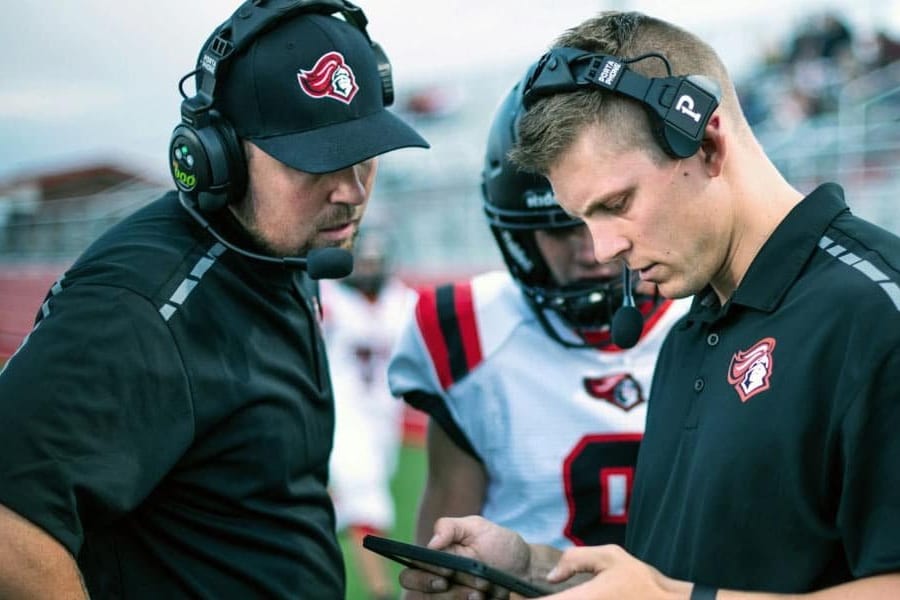
Channel one: the coach-to-coach call. Your head coach dials a number he already has stored, belonging to a position coach or recruiting coordinator he met at a spring clinic, a satellite camp, a coaching convention, or a prior recruitment out of your program. The call is answered live or returned within a few hours because the name on the caller ID is a known quantity. The coach gets somewhere between ninety seconds and three minutes of genuine attention. In that window he does three things: he names the player and the position, he gives one concrete production or measurable detail, and — critically — he offers an honest character read. If one sentence lands, the college coach opens Hudl on the second monitor while still on the phone. The cost is zero dollars and one awkward conversation you have to initiate.
Channel two: the paid recruiting service. You pay a subscription fee. In exchange you receive a hosted profile page, a highlight-video editing tool, a searchable database of college staff contact information, some volume of templated outreach emails sent on your athlete's behalf, and a defined number of consultations with an advisor. The advisor is usually a former coach or former college player, but rarely one who has recruited at the specific programs your athlete is targeting. The platform's core asset is a contact database — and every email address in it is publicly listed on the school's own athletics staff directory. You are paying for aggregation and a workflow wrapper, not for access. Access is not for sale.
The honest framing of the trade-off: the service sells you volume and organization; the coach gives you credibility and triage priority. Those are not competing versions of the same product. A college staff's bottleneck is never "we cannot find enough athletes." It is "we cannot evaluate all the athletes we already know about." Volume is the thing they already have too much of. Credibility is the thing they are starved for. You are buying more of the surplus and skipping the scarcity.
The one place services do genuine work is organization for families with no infrastructure: a parent who does not know what a National Letter of Intent is, cannot get film cut, does not know which division levels are realistic, and has no coach willing to engage. That is a real problem and a service can partially solve it. But notice that solution is administrative — it is not the offer-producing mechanism. Do not confuse a filing cabinet with a door.
How to decide between them without guessing
The decision is not "is this service good or bad." It is a sequence of diagnostic questions about your own situation, answered in order, where each answer either ends the process or advances it. Run this before you spend a dollar.
Question one: will your head coach make calls for your athlete? Book fifteen minutes in his office, alone, no parents' group, no email. Ask three specific things: which division levels and which specific programs is my son a realistic fit for; will you call those position coaches directly on his behalf; and what do you need from me to make those calls easier and more effective. Say them plainly. The answer to the second question is the whole fork in the road.
If the answer is yes, you are done shopping. Your job for the next six months is logistics: get him a clean one-page sheet with verified height and weight, testing numbers with the date and method of measurement, GPA and test scores if taken, jersey number, film link, and the three to eight target programs. Then get out of the way.
If the answer is no or a soft deflection, the critical move is to diagnose *why* — because the reason determines whether any purchase helps. There are four common reasons and only one of them is even partially addressable by a paid product.
*Reason A — the film problem.* The coach does not believe the tape supports the pitch to the programs you named. This is not a marketing problem; it is an evaluation problem. A service that "optimizes" a highlight reel is polishing the wrong variable. The fix is another year of production, a level-appropriate target list, or both.
*Reason B — the level problem.* Your son is a real prospect but not at the level the family is naming out loud. Coaches avoid this conversation because it is painful. A service will happily take your money and send blasts to programs three tiers above realistic, which produces silence that everybody misreads as "the service didn't work" rather than "the target list was fiction."
*Reason C — the relationship problem.* Your coach genuinely has no college contacts — common at small programs, new programs, or programs with high staff turnover. This is the one case where outside help has real value, but the right outside help is usually a person, not a platform: a respected 7-on-7 or club coach, a former player from your program now on a college roster, a private position trainer who places athletes, or a local college's camp where the staff evaluates in person.
*Reason D — the internal problem.* The coach will make calls, but not for your kid, for reasons of attitude, attendance, academics, or locker-room behavior. No product on earth fixes this. Fix the underlying behavior and re-ask in ninety days.
Question two, only if you reach it: what specific deliverable are you buying? If you have diagnosed reason C and still want to purchase something, buy the narrowest possible product. Pay a video editor a flat fee for a cut-up, not a platform a recurring fee for a dashboard. Pay for one hour with an independent recruiting consultant who will tell you your athlete's realistic level, not a twelve-month package. Pay camp fees at three regional schools your athlete could actually attend, because a college staff evaluating your son in person for two hours is worth more than any number of profile views. Every one of those is a bounded purchase with a defined output.
The numbers behind each option
Run the arithmetic honestly, because the marketing never does.
What the coach call costs. Zero dollars in fees. The real costs are non-monetary: one uncomfortable fifteen-minute meeting, the humility to accept a level assessment you may not like, and roughly two hours of your own time assembling the information packet that makes his calls efficient. That is the entire input.
What the coach call returns. A call to a program where the coach has an existing relationship produces a definitive answer — yes send film, no we're set at that position, or come to our camp in June — usually within days rather than weeks. Even a "no" has enormous value: it removes a school from the target list and redirects effort while there is still time in the cycle. Ten calls producing seven no's and three camp invites is a wildly better outcome than two hundred emails producing ambiguous open rates.
What paid services cost. Pricing tiers vary widely across the industry, but the shape is consistent: an entry package covering a profile and basic tools, a mid-tier adding advisor consultations and more outreach volume, and a premium "guided" tier with a dedicated advisor. Many are structured as multi-year commitments — sold to a sophomore family, billed through senior year — and many auto-renew. Read the contract term and the cancellation clause before the card goes in, because those two lines matter more than any feature list. Ask specifically: what is the total contract value, not the monthly figure; what happens if my son commits in September of his junior year; and is any portion refundable.
The denominator problem. Every service advertises aggregate scholarship dollars earned by its athletes. Treat that number as marketing, not evidence, for three structural reasons. First, it counts everything — partial NAIA awards, Division III tuition discounts (Division III does not award athletic scholarships at all, so any D-III figure in that total is need- and merit-based aid the athlete qualified for independently), preferred walk-on bids that carry no money. Second, it has no control group: it never shows how many subscribing athletes received nothing, and it never shows what those athletes would have received without the subscription. Third, it captures athletes who were going to be recruited regardless — a genuine Power Four prospect who also happened to buy a subscription is counted as a service outcome. Ask any service for the percentage of paying customers who received a scholarship offer they can causally attribute to the platform. Nobody publishes that number.
The inbox arithmetic that governs everything. A college position coach during an evaluation period receives inbound recruiting contact in volumes that make individual review physically impossible — hundreds of messages weekly for a single position group, the large majority templated and platform-generated. There is no version of a staffing model where a coach reads all of it. So they don't. They triage by source. Known coach's name on caller ID gets answered. Message from a coach they've met gets read. Everything else gets bulk-processed or ignored, and the athlete never learns which. This is not arrogance; it is the only functional response to the volume. Any product whose mechanism is "we send your profile to more programs" is adding to the pile that gets filtered, not to the queue that gets read.
What 2027 changed about the math. The House settlement's revenue-sharing framework and the associated roster limits — including football's move to a hard roster cap — compressed the number of available spots at the exact moment programs gained new revenue obligations to the athletes they do keep. Fewer spots plus higher per-spot cost equals lower tolerance for evaluation misses. When a staff has more spots than it can fill, it takes fliers on marginal prospects and sorts it out in camp. When every spot carries a revenue commitment and the roster is capped, a coach cannot afford a kid who quits, transfers in December, or turns out to be nothing like the tape. The premium on trusted character information went up sharply. Your coach is the only person in the process who can testify to four years of daily behavior, and that testimony became more valuable, not less, under the new economics.
Opportunity cost, the line nobody adds up. Money spent on a subscription is money not spent on the things that demonstrably move recruitments: camp fees at three to five realistic target schools, a night in a hotel to attend a junior day, a private position coach for the off-season, or the ACT/SAT prep that widens the academic band of schools that can admit him. Rank the spend by mechanism, not by how much doing-something it feels like.
Sequencing the coach relationship so the calls actually land
Deciding to use your coach is not the same as executing it. The families who get the most out of this run it as a process with a calendar.
Off-season, well before evaluation windows. Have the office meeting. Ask the three questions. Accept the level assessment you get, even if it stings — a coach who tells you the truth about FCS versus Power Four is doing you the single biggest favor available in this process, because a realistic target list is the difference between ten conversations and two hundred silences.
Build the one-pager. One page, no design flourishes, because it exists to make your coach's job faster. Include: name, graduation year, position and secondary position, verified height and weight with the date measured, testing numbers with the method noted (laser versus hand-timed matters and coaches will assume the worse one if you don't say), GPA on a stated scale, test scores if taken, NCAA Eligibility Center ID, jersey number, one film link, and coach contact info. Then a short target list grouped by tier — reach, realistic, safe — with three to eight programs total. Hand it to him physically. Email a copy so he can forward it in three seconds without retyping anything.
Get the film right before anyone calls. The tape your coach sends should open with your athlete's best four or five plays, run four to six minutes total, spot-shadow or arrow the player on the first several clips only, and include full-game film links beneath the highlight reel. College coaches watch full game film before they offer; the highlight reel exists to earn the click that leads to game film. Jersey number in the file name and the video description. No music, no intro graphics, no slow-motion.
Sequence the calls by tier, not alphabetically. Have your coach start with the programs where he has the strongest personal relationship, regardless of whether they're the dream school. A real conversation with a school that answers produces information — what they're looking for at that position this cycle, whether the roster spot exists at all, what testing numbers clear their threshold — and that information sharpens every subsequent call. Cold-calling the dream school first with no calibration wastes the one shot.
Player-initiated contact runs in parallel, on the NCAA calendar. The athlete himself should be emailing, texting, and calling coaches once the applicable contact rules permit it for his division and sport — the rules differ by division and by year in school, and the current calendar is published by the NCAA. His outreach carries far more weight after his coach has laid groundwork, because the college coach now recognizes the name. The messages should be short, specific to that program, and sent from the athlete, not from a parent's account and not from a platform's mail server.

Camps are the closing mechanism. A coach's call gets your son evaluated; a camp gets him evaluated in person by the staff that would coach him. Prioritize the camps at schools that responded to your coach's calls. Two hours in front of a position coach who already has a favorable pre-read is the highest-conversion event in the entire process.
Follow up on a schedule and report back. Have your coach re-contact interested programs after a strong game or an updated test score — new information is a legitimate reason to call again, and legitimate reasons are the only ones that don't burn goodwill. And close the loop with him: tell him which programs responded, what they said, and what happened at camps. Coaches invest more in families who make the investment feel worthwhile, and your program's next recruit inherits whatever relationship your family strengthened or damaged.
What to do if the calls produce nothing. Do not immediately conclude the channel failed and reach for a subscription. Ask your coach what he heard, verbatim. "They're set at that position this cycle" is a timing problem — revisit next cycle or widen the position group. "They want a bigger frame" is a physical threshold — you now know a real number to train toward. "They didn't call back" from a coach with a genuine relationship is itself a signal about level fit. Each of those tells you something a dashboard full of profile views never will, and each redirects the next six months of effort toward something that can actually work.
Related questions
Does it matter if my son plays at a small or rural high school?
It matters less than families assume. College staffs assign regional recruiting areas and the area coach knows the small programs in his territory. What matters more is whether your coach picks up the phone and whether the film is clean enough to evaluate. Geography is a discoverability problem, and a call solves discoverability.
Should my athlete still have an online profile at all?
Yes — but the useful version is free. A clean Hudl page with accurate stats and current measurables, plus verified NCAA Eligibility Center registration, covers what coaches actually check when a name is given to them. The profile is a landing page for interest your coach generates, not a generator of interest itself.
What if the head coach is supportive but has no college contacts?
Recruit a second advocate rather than a subscription. A respected 7-on-7 or club coach, a private position trainer with placement history, or a former player from your program now on a college roster all carry the same coach-to-coach credibility. Your head coach can also cold-call a recruiting coordinator; that still outperforms platform email.
Can a paid service hurt a recruitment?
Rarely directly, but it can hurt indirectly. Mass outreach to unrealistic programs generates silence that families misread as failure, wasting a cycle. It can also crowd out the parallel effort that works. The bigger risk is the false confidence and the multi-year auto-renewing contract, not active sabotage.
How early should the coach conversation happen?
Sophomore year is a reasonable start for a serious prospect, with the substantive target-list conversation in the spring of sophomore or early junior year. Earlier than that, there is rarely enough varsity film to evaluate. The one thing to do early is protect academic eligibility, because coursework mistakes are the hardest to reverse.
FAQ
Does a paid recruiting service guarantee my son gets recruited?
No, and any service that implies it should be disqualified on that basis alone. Nobody controls whether a college staff has a roster spot at a position in a given cycle. A service can produce a profile, a highlight cut, and outreach volume; it cannot produce a coach's evaluation or a scholarship. Ask directly for the causal offer rate among paying customers and note the answer.
How much can one call from a high school coach realistically move things?
It changes which pile the athlete lands in. A known coach's call gets answered live or returned quickly and buys a few minutes of genuine attention — often enough to get film opened on the spot and produce a definitive yes, no, or camp invite within days. Anonymous outreach produces ambiguity that can persist for an entire cycle.
Are paid services ever worth the money?
Sometimes, for narrow administrative work: film editing when your program can't produce a clean cut, NCAA rules literacy, and building a realistic target list when no one around you knows how. Buy those as bounded purchases — a flat-fee editor, one consulting hour — rather than a multi-year platform contract. Never buy one expecting access to coaches; access is not a product.
What should I actually hand my coach to make the call easier?
One page: name, grad year, position, verified height and weight with the measurement date, testing numbers with the method noted, GPA and test scores, NCAA Eligibility Center ID, jersey number, one film link, and a target list of three to eight programs grouped by realism tier. Physical copy plus an email version he can forward without retyping.
Do college coaches ever browse recruiting platforms?
Some staffs use databases for general awareness, roster-need scans, or to check a name they've already been given. That is verification, not discovery. The decisions that end in a signed letter come overwhelmingly from in-person evaluation and recommendations from coaches the staff already trusts. Being findable is table stakes; being vouched for is the differentiator.
How did the 2027 roster and revenue-sharing rules change any of this?
They raised the cost of a bad evaluation. With a hard football roster cap and revenue obligations attached to the athletes a program keeps, marginal spots that used to absorb a flier are gone. Staffs now weight trusted character and work-ethic information more heavily — exactly the information only someone who has watched four years of daily behavior can supply.
Sources
- https://www.ncaa.org/sports/2013/11/14/recruiting-calendars.aspx — official NCAA recruiting calendars and contact-period rules by sport and division.
- https://web3.ncaa.org/ecwr3/ — NCAA Eligibility Center registration and academic eligibility requirements for prospective college athletes.
- https://www.ncaa.org/sports/2021/2/9/about-ncaa-recruiting.aspx — NCAA overview of how recruiting works, including who may contact whom and when.
- https://www.nfhs.org/ — National Federation of State High School Associations: high school athletics governance and coaching standards.
- https://www.afca.com/ — American Football Coaches Association: professional resources and ethics guidance for high school and college football staffs.
- https://www.espn.com/college-football/ — ESPN college football coverage, including reporting on the House settlement, revenue sharing, and roster limits.
- https://www.si.com/college/ — Sports Illustrated college sports reporting and long-form analysis of recruiting trends.
- https://www.hudl.com/ — Hudl: the film platform most high school programs use to produce and share game and highlight video.
- https://www.ftc.gov/business-guidance/resources/negative-option-rule — FTC guidance on negative-option and auto-renewing subscription billing practices.
Related on PULSE
- [How does NIL work in high school sports in 2027?](/knowledge/hf0062)
- [How does NIL impact high school recruiting commitments in 2027?](/knowledge/hf0061)
- [How do walk-on athletes earn NIL income in 2027?](/knowledge/hf0060)
- [What is the average NIL deal size for a top-100 football recruit in 2027?](/knowledge/hf0059)
- [Final verdict on paid HS football recruiting services in 2027 — when (rarely) they're worth it](/knowledge/hf0058)
This page will be disappearing soon. Save it to your device for $1 — or read it free while it is here.
@Kory-White- · if Venmo asks, the last 4 of my number are 2012
This page is gone.
This one is off the shelf now. $1 keeps it on your phone for good — the whole page, pictures and diagrams included.
 pulse-football-recruitingWhat does Lance O's Recruiting Network actually do, and where does it fit in the 2027 college football recruiting landscape?
 pulse-football-recruitingWhy showcase camps and 7-on-7 beat paid recruiting services for HS football recruits in 2027?
 pulse-football-recruitingHow does NIL work in high school sports in 2027?
 pulse-football-recruitingWhat is LRN's NIL Consultation service and how does it help HS football prospects build a brand in 2027?
 pulse-football-recruitingDo mass marketing email campaigns to college coaches actually work in 2027? The recruiting services tactic critique
 hfWhat is the average NIL deal size for a top-100 football recruit in 2027?
 pulse-football-recruitingLance O's Recruiting Network vs NCSA vs Hudl vs FieldLevel — which one serves HS football prospects best in 2027?
 pulse-football-recruitingHow does NIL impact high school recruiting commitments in 2027?
 hfAre college football recruiting services like Lance O's Recruiting Network worth it — the industry-wide reality in 2027
 pulse-football-recruitingFinal verdict on paid HS football recruiting services — when (rarely) they're worth it in 2027