


The Sales Bible by Jeffrey Gitomer — Cliff Notes Summary & Key Takeaways
Quality
Certified

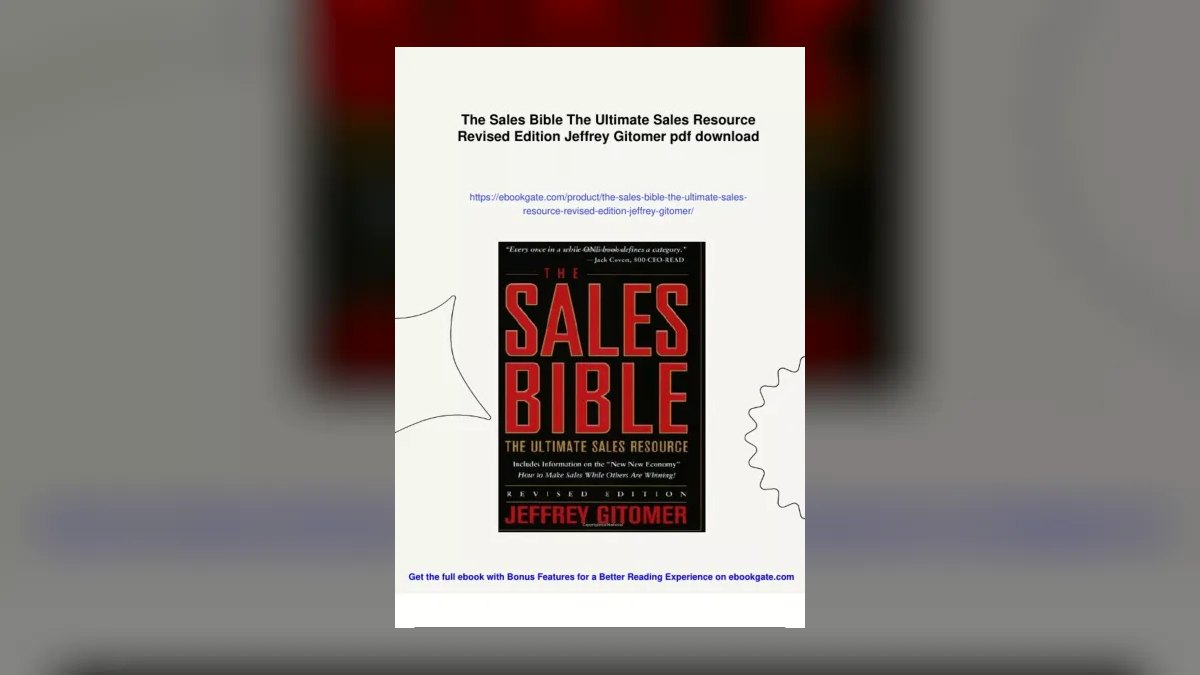
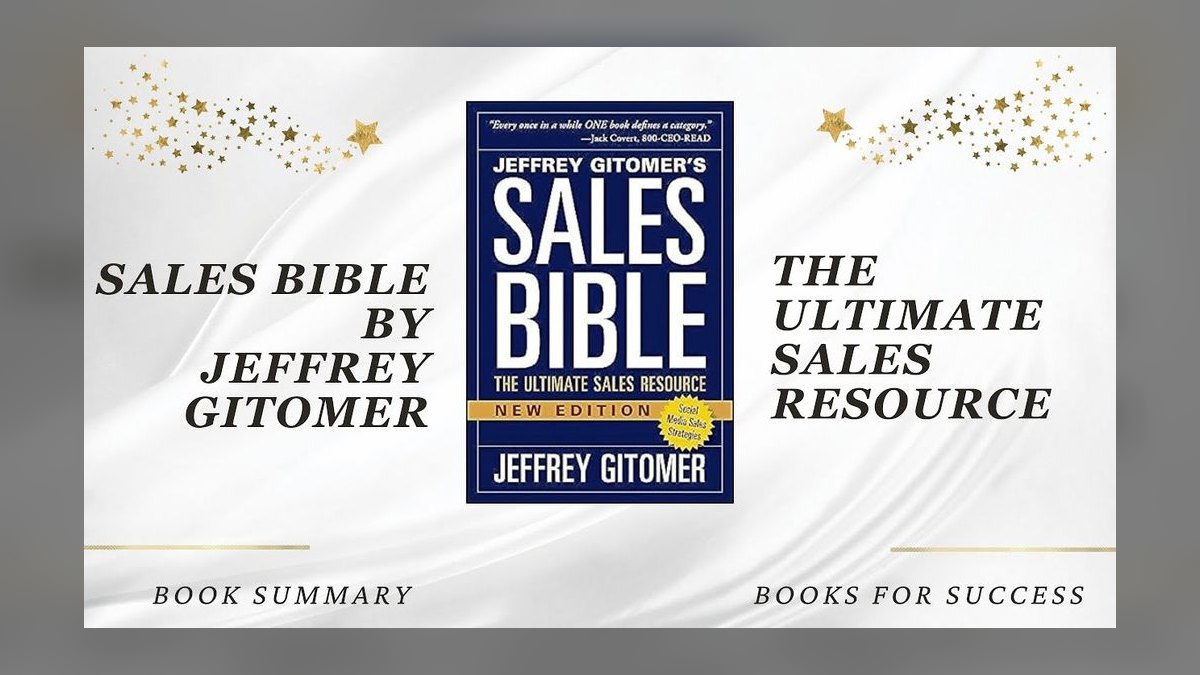
*The Sales Bible* by Jeffrey Gitomer is a 1994 reference manual built on one thesis: people don't like to be sold but they love to buy. It organizes selling into 10.5 commandments, a beg-find-sell prospecting model, a 30-second Power Statement, and a post-sale service cadence — treating relationship and reputation as the real close.
The reference manual versus the pocket book: two Gitomer entry points
Anyone deciding to read Gitomer faces a fork before page one, and getting it wrong is why so many copies of *The Sales Bible* die on the shelf at chapter three. The two live options are *The Sales Bible: The Ultimate Sales Resource* (HarperCollins, 1994; revised editions later published under Wiley) and *The Little Red Book of Selling* (Bard Press, 2004). They are not competitors. They are different form factors of the same argument, and the choice between them is genuinely a choice about how you intend to use the material.
*The Sales Bible* is a reference work. It is thick, sectioned, list-driven, and deliberately non-linear — the structure mirrors a manual you consult rather than a narrative you finish. There is a prospecting section, a sale section, a service and referral section, a networking and personal-power section, and a large back-of-book resources section full of sample scripts, sample letters, sample voicemail language, and objection responses. You are meant to flip to the part that matches this week's problem. Reading it cover to cover is possible but not the design intent, and the repetition that feels excessive in a straight read is exactly what makes it work as a lookup tool: each section restates the core thesis so you never need the chapter before it.
*The Little Red Book of Selling* is the compressed version — a short, principle-driven pocket book organized around a numbered set of principles rather than a taxonomy of sales activities. It is the book you hand a new rep on day one. It is also the book that made Gitomer a household name in sales training, which creates a common misconception that it came first. It did not. *The Sales Bible* is the original opus and the *Little Red Book* is the distillation, which means readers who start with the Red Book and then pick up the Bible often experience it as an expansion pack rather than a new argument.

The third option worth naming is not reading either one in isolation. Gitomer's later titles — *The Little Black Book of Connections* (2006) on networking, and *The Little Gold Book of YES! Attitude* (2007) on mindset — are each a full-length treatment of a single *Sales Bible* section. If the networking chapter is the part that lands for you, the Black Book is where that thread continues. If the attitude chapters land, the Gold Book is the deep dive. Treating the Bible as an index into the rest of the catalog is a more honest use of it than trying to read all 500-plus pages in a week.
The trade-off is straightforward. The Red Book gives you speed and memorability at the cost of tactical detail. The Sales Bible gives you tactical detail and reusable templates at the cost of momentum. If you have a quota this quarter and no system at all, the Red Book gets you moving faster. If you already have a system and need to fix a specific stage — prospecting is dry, objections are killing you, referrals never materialize — the Bible is the better tool because it has an actual section for each.
How to choose your entry point and what to read next
Choosing between the two is less about which is "better" and more about matching the book to your current constraint. A first-year SDR whose problem is volume and confidence needs different material than an enterprise AE whose problem is a stalled six-figure deal in legal review. Gitomer's material serves both, but through different sections and at different depths.

The decision also has a downstream leg. *The Sales Bible* is a foundation text, not a modern methodology, and treating it as your only book is the most common mistake readers make. It predates the research-driven era of sales literature: Neil Rackham's *SPIN Selling* (1988) came before it but hadn't yet fully saturated American mid-market training, and Matthew Dixon and Brent Adamson's *The Challenger Sale* (2011), Aaron Ross's *Predictable Revenue* (2011), and Chris Voss's *Never Split the Difference* (2016) all came after. Gitomer gives you the relationship-and-reputation layer. The others give you the question framework, the outbound machine, the commercial-teaching model, and the negotiation model that sit on top of it.
The practical reading sequence most sellers benefit from: Red Book in week one for orientation, Sales Bible kept on the desk as a lookup manual from week two onward, one modern methodology text per quarter after that. The Bible is the only one of those you never really finish — you return to the objection responses when your objection handling gets sloppy, and to the service cadence when renewals start slipping.
One more decision point deserves attention: whether to read an original 1994 printing or a revised edition. The revised editions update examples and trim some of the bulk, but the core commandments, the prospecting taxonomy, and the resource templates are substantially the same. If you find a used copy of any edition, the material transfers. This is not a book where the edition materially changes the strategy.
The 10.5 Commandments and what each one actually asks of you
The organizing spine of the book is Gitomer's set of 10.5 Commandments of Sales Success — the half-commandment being a deliberate stylistic tic he uses throughout his catalog, and one of the reasons the material is memorable. The scriptural conceit is not accidental; the book leans on the "bible" framing to signal that these are meant to be re-read rather than consumed once.

The first cluster is internal work. Think — orient every call around the customer's situation rather than your quota math. Believe — in your company, your product, and yourself, in that order, on the theory that a rep who doesn't believe the product is worth the price will unconsciously discount before the buyer asks. Engage — establish genuine rapport before any pitch mechanics begin. Discover — surface why *this* buyer would buy, since people buy for their own reasons and not yours. Ask — use questions that force the prospect to evaluate information they hadn't considered, rather than questions that merely confirm what they already told you.
The second cluster turns outward. Observe — the prospect's office, their walls, their desk, and in a modern reading their LinkedIn feed and their company's job postings, all telegraph what they care about. Dare — actually ask for the order, which Gitomer insists a large share of sellers never do explicitly. Differentiate — his line is that if you sound like everyone else, you are everyone else, which in 2026 reads as an argument against templated outbound. Earn — trust is earned rather than commanded, and no amount of credential-listing substitutes for demonstrated competence. Prove — testimonials, references, and third-party evidence outperform your own claims, because the buyer discounts anything you say about yourself.
The 0.5 is Be Persistent, and Gitomer treats it as the multiplier on the other ten. His argument is that most sellers abandon a prospect long before the prospect is ready to decide, and that the follow-up sequence is where the majority of closed business actually lives. Gitomer popularized a widely quoted persistence statistic in sales training decks — the sourcing on that figure is thin and it has been repeated for decades without rigorous verification, so treat it as a directional argument about follow-up discipline rather than a hard benchmark. The underlying behavioral claim holds up regardless of the number: sellers systematically under-follow-up, and a structured cadence beats improvised persistence.
What makes the commandments useful rather than motivational-poster filler is that each maps to an observable behavior you can audit. Did you research before the call? Did you explicitly ask for the business? Did you send proof or just assertions? Did you follow up a fourth time? A manager can score a rep against all ten in a single call review, which is why this list survived thirty years of sales-training churn.
Beg, Find, Sell — matching prospecting effort to the pipeline you actually have
Gitomer's most underrated contribution is a taxonomy that acknowledges something most prospecting books ignore: the right prospecting motion depends entirely on how much warm pipeline you already have. He splits it into three honest modes.
Beg is the mode for a brand-new rep, a brand-new territory, or a rep coming off a bad quarter with nothing in flight. There are no references, no warm intros, and no inbound. The prescribed activity is cold outreach, networking events, trade shows, and walk-ins — high volume, low conversion, and no shame attached. Gitomer's framing is that if you have to beg, beg with style: lead with a question rather than a pitch, and use the Power Statement as the entry tool. In the modern equivalent, this is the SDR sequence — a multi-touch cadence across phone, email, LinkedIn, and video, run at volume because there's nothing else to run.
Find is the middle mode, for reps with one or two reference customers. Here Gitomer prescribes a systematic list approach: get a directory of every company in your category and territory — his era's version was the regional Book of Lists published by local business journals, ranking area firms by revenue and headcount — mark your top hundred targets, and work that list on a repeating quarterly rhythm. The 2026 descendants are obvious: ZoomInfo, Apollo, LinkedIn Sales Navigator, Clay, and similar data platforms have replaced the printed directory, though the printed regional Books of Lists still exist. The discipline is what transfers: a bounded, named target list you work on a schedule beats an unbounded universe you work on impulse.

Sell is the mode for reps with genuine pipeline surplus. The job changes completely. Instead of generating volume, you're disqualifying aggressively, prioritizing by close probability, and harvesting referrals from every closed deal. Gitomer is blunt that a rep who can't reach the actual decision-maker is failing at the fundamental task. The modern consultative repackaging of that instinct lives in qualification frameworks like MEDDPICC, which formalizes identifying the economic buyer and the champion — the same idea with a checklist attached.
The value of the taxonomy is that it stops reps from running the wrong play. A rep with fifteen live opportunities who spends their morning cold-calling is destroying pipeline value; a rep with zero opportunities who spends their morning "nurturing" three stale deals is avoiding the work. Naming the three modes makes the mismatch visible to both the rep and their manager, which is a management strategy as much as a selling one.
The numbers Gitomer prescribes and how they hold up
Gitomer publishes activity math throughout the book, and the specific ratios matter less than the underlying practice of measuring inputs rather than only outcomes. His prescribed daily rhythm sits around 25 dials producing roughly five real conversations, those conversations producing about one booked meeting, and roughly one close per five meetings. Run consistently across a working year, that arithmetic produces a modest but predictable deal count — and the point is precisely that it is predictable. You can diagnose which ratio broke.
Those conversion rates have degraded significantly since 1994. Cold phone connect rates in most B2B segments are dramatically worse than they were before mobile screening, spam labeling, and the collapse of the direct-dial desk phone. Modern outbound teams compensate with volume and channel diversity rather than dials alone — a sequence might span eleven to sixteen touches across four channels over three to four weeks, where Gitomer's era relied on the phone plus a mailed letter. The dial-to-meeting ratio in cold outbound is now routinely an order of magnitude worse than his figures, which means anyone treating his specific numbers as a 2026 benchmark will set targets that no rep can hit.

The service cadence numbers, by contrast, have aged extremely well. Gitomer prescribes calling a new customer within 24 hours of delivery, again at seven days, and again at 30 days — deliberately before the customer has a problem. This is the customer-success onboarding motion, described roughly two decades before customer success existed as a named function with its own tooling and job titles. The specific intervals remain defensible because they track how implementation problems actually surface: immediate setup confusion, first-week usage friction, and first-month adoption stall.
His referral math is aggressive and worth testing rather than accepting. The prescription is a written list of three referrals from every new customer, collected immediately at signature rather than "sometime later." The compounding claim — that each referral becomes the root of three more — is a best-case model, not an observed rate. In practice, referral conversion depends heavily on whether the referring customer has actually realized value yet, which is exactly why the service cadence and the referral ask are chained together in the book. Asking for three names before the customer has seen results is how you get three names that never answer the phone.
The Power Statement is the other concrete artifact worth extracting. It's a roughly 30-second value proposition structured as: we help [specific persona] achieve [specific outcome] without [specific pain], in [timeframe]. Its job is to earn the next meeting, not to close anything. The parallel to modern positioning work — April Dunford's *Obviously Awesome* (2019) is the canonical treatment — is direct, though Dunford builds positioning from competitive alternatives upward while Gitomer starts from the buyer's stated pain. Both land in the same place: say something specific enough that a stranger can tell whether it's for them.
The back-of-book resources section carries similar practical density. The returned-voicemail template — short, under about 20 seconds, stating your name, your company, one specific reason the person should call back, and your number repeated twice at a pace a human can write down — is still functionally what every voicemail-coaching module teaches.
Building a weekly operating rhythm from the book
The gap between reading *The Sales Bible* and getting value from it is almost entirely a sequencing problem. The book is a pile of tactics with no implementation order, so most readers extract two ideas and drop the rest. The fix is to convert it into a weekly rhythm where each section has a designated slot.
Start with the Power Statement, because everything else depends on it. Write it, then say it out loud on ten real calls before editing it. Most first drafts fail because they describe your product rather than the buyer's outcome, and you find that out faster from a live prospect's silence than from a whiteboard.
Second, build the bounded target list. Whether the source is a modern data platform or a regional business directory, the requirement is the same: a finite, named set of accounts you commit to working on a repeating schedule. The number matters less than the boundary — an unbounded list produces avoidance.
Third, instrument your objections. Gitomer's Felt-Found-Feel pattern ("I understand how you feel, others felt the same, here's what they found") is the classic empathy move and is genuinely dated in its scripted form — modern buyers recognize it. What survives is the underlying discipline: log every objection verbatim, cluster them monthly, and write a real response to each cluster rather than improvising in the moment. Gitomer's more durable observation is that a live objection is a better signal than silence, because an engaged buyer who pushes back is at least evaluating.
Fourth, install the service cadence as calendar entries rather than intentions. The 24-hour, 7-day, 30-day calls only happen if they are booked at contract signature. This is the single highest-ROI habit in the book and the one most reps skip because it happens after commission is credited.

Fifth, make the referral ask a step in your closing process rather than a separate task. Ask at the moment of demonstrated value — after the first successful outcome, not at signature — and ask for named people, not permission to be introduced someday.
What has aged poorly is worth naming plainly. The cold-call-centric orientation reflects a pre-internet buying process where the seller controlled information access; buyers now complete most of their research independently, which changes what the first conversation should be. The persistence-bordering-on-pushy tone reads harder in a consultative era shaped by SPIN's question discipline and Challenger's teaching model. And the examples throughout reflect the demographics of 1994 American mid-market sales, which later editions softened without fully modernizing. Read those chapters as historical context rather than instruction.
What holds up is the thesis. Relationship and reputation as the actual differentiators, service as the engine of the next sale, and the observation that your reputation arrives before you do — that last one landed roughly two decades before LinkedIn made personal brand a functional sales asset, and it is now the least controversial claim in the book.
Related questions
Should I read The Sales Bible or SPIN Selling first?
Read *The Sales Bible* first for mindset, prospecting structure, and relationship discipline; read *SPIN Selling* second for the question framework that governs what you actually say in discovery. Gitomer tells you how to show up; Rackham tells you what to ask once you're in the room.
Is The Sales Bible useful for B2B SaaS sellers?
Yes, selectively. The service cadence, referral process, Power Statement, and reputation thesis transfer cleanly to SaaS. The cold-call volume prescriptions and single-channel outbound assumptions do not — replace those with modern multi-channel sequencing while keeping the underlying activity-measurement discipline.
What are the 10.5 Commandments in short form?

Think, Believe, Engage, Discover, Ask, Observe, Dare, Differentiate, Earn, Prove — plus the half-commandment, Be Persistent. The first five govern internal preparation and mindset; the second five govern external behavior with the prospect; the half is the follow-up multiplier on all ten.
How long does it take to read?
The revised editions run several hundred pages, but it isn't designed for a straight read. Plan two to three hours for the commandments and prospecting sections, then treat the resources section as a reference you consult by problem rather than by chapter order.
Does Gitomer's material work for non-sales roles?
Partly. Founders, consultants, agency owners, and anyone selling their own services get real value from the Power Statement, networking chapter, and referral system. The quota-driven activity math and territory-management material assumes a structured sales org and translates less well.
FAQ
Is The Sales Bible better than The Little Red Book of Selling?
They serve different purposes. *The Sales Bible* is the reference manual with templates, scripts, and section-by-section tactics; the *Little Red Book* is the compressed, principle-driven pocket version. Most readers get the fastest return from the Red Book first and the Bible as a desk reference afterward. Owning both is genuinely reasonable given how differently they get used.
How does Gitomer compare to Zig Ziglar?
Zig Ziglar's *Secrets of Closing the Sale* (1984) is the closing-tactics text — heavy on specific closing techniques and their psychology. Gitomer's *Sales Bible* shifts the emphasis toward relationship, reputation, and post-sale service, treating the close as a natural consequence rather than a technique to be executed. Ziglar is the earlier generation; Gitomer is the transitional voice toward relationship-led selling.
Is the book still relevant given how much buying has changed?
The relationship and reputation core is more relevant now, not less, because buyers can research you before you ever speak. What needs replacing is the channel assumption — phone-first outbound with printed directories — and the tone of the closing chapters. Substitute modern data platforms and multi-channel sequences and a large share of the material maps directly onto current practice.
What is the Power Statement and how do I write one?
It's a roughly 30-second value proposition following the shape: we help [specific persona] achieve [specific outcome] without [specific pain], in [timeframe]. Write it, test it on ten live calls, and cut anything that describes your product rather than the buyer's result. Its only job is earning the next conversation.
Should a first-year SDR read this in 2026?
Yes, in the first month — but pair it. Use Gitomer for mindset, activity discipline, and the follow-up habit, then read *Predictable Revenue* for outbound structure and *The Challenger Sale* for the commercial-teaching model. Gitomer is the foundation layer, not the complete modern stack.
What's the single highest-value section?
The service and referral material. Most sellers already prospect and pitch; almost none run a disciplined 24-hour, 7-day, 30-day post-sale cadence or ask for named referrals at the moment of demonstrated value. That section produces the largest behavior change per page of anything in the book.
Sources
- https://www.gitomer.com/
- https://www.harpercollins.com/products/the-sales-bible-jeffrey-gitomer
- https://www.wiley.com/en-us/The+Sales+Bible%2C+New+Edition%3A+The+Ultimate+Sales+Resource-p-9781118985816
- https://www.goodreads.com/book/show/158719.The_Sales_Bible
- https://www.bardpress.com/
- https://www.mheducation.com/highered/product/spin-selling-rackham/M9780070511132.html
- https://www.penguinrandomhouse.com/books/309062/the-challenger-sale-by-matthew-dixon-and-brent-adamson/
- https://www.harpercollins.com/products/never-split-the-difference-chris-voss
- https://www.dalecarnegie.com/
- https://www.aprildunford.com/obviously-awesome
Related on PULSE
- Little Red Book of Selling by Jeffrey Gitomer — Cliff Notes Summary & Key Takeaways
- The Sales Bible — Cliff Notes Summary
- How to Become a Rainmaker by Jeffrey Fox — Cliff Notes Summary
- Major Account Sales Strategy by Neil Rackham: Summary, Key Lessons, and RevOps Takeaways
- Demand-Side Sales 101 by Bob Moesta: Summary, Key Lessons, and RevOps Takeaways
- Cracking the Sales Management Code by Jason Jordan and Michelle Vazzana: Summary, Key Lessons, and RevOps Takeaways
This page will be disappearing soon. Save it to your device for $1 — or read it free while it is here.
@Kory-White- · if Venmo asks, the last 4 of my number are 2012
This page is gone.
This one is off the shelf now. $1 keeps it on your phone for good — the whole page, pictures and diagrams included.
 book-summaryLittle Red Book of Selling by Jeffrey Gitomer — Cliff Notes Summary & Key Takeaways
 pulse-recentFanatical Prospecting by Jeb Blount — Top 10 Key Takeaways for Sales Leaders in 2027
 pulse-recentSnap Selling by Jill Konrath — Top 10 Key Takeaways for Sales Leaders in 2027
 pulse-recentWhat is the first concrete step in Sandler Rule #4 for a sales leader to implement in 2027?
 book-summaryMajor Account Sales Strategy by Neil Rackham: Summary, Key Lessons, and RevOps Takeaways
 pulse-recentSell or Be Sold by Grant Cardone — Top 10 Key Takeaways for Sales Leaders in 2027
 pulse-recentHow do you implement the Sandler Rules in your first 30 days as a new sales rep in 2027?
 pulse-recentThe Collaborative Sale by Keith Eades — Top 10 Key Takeaways for Sales Leaders in 2027
 pulse-recentMonetizing Innovation by Madhavan Ramanujam — Top 10 Key Takeaways for Sales Leaders in 2027
 pulse-recentThe Greatest Salesman in the World by Og Mandino — Top 10 Key Takeaways for Sales Leaders in 2027