


Crucial Accountability by Patterson et al — Cliff Notes Summary for Sales Managers
Quality
Certified
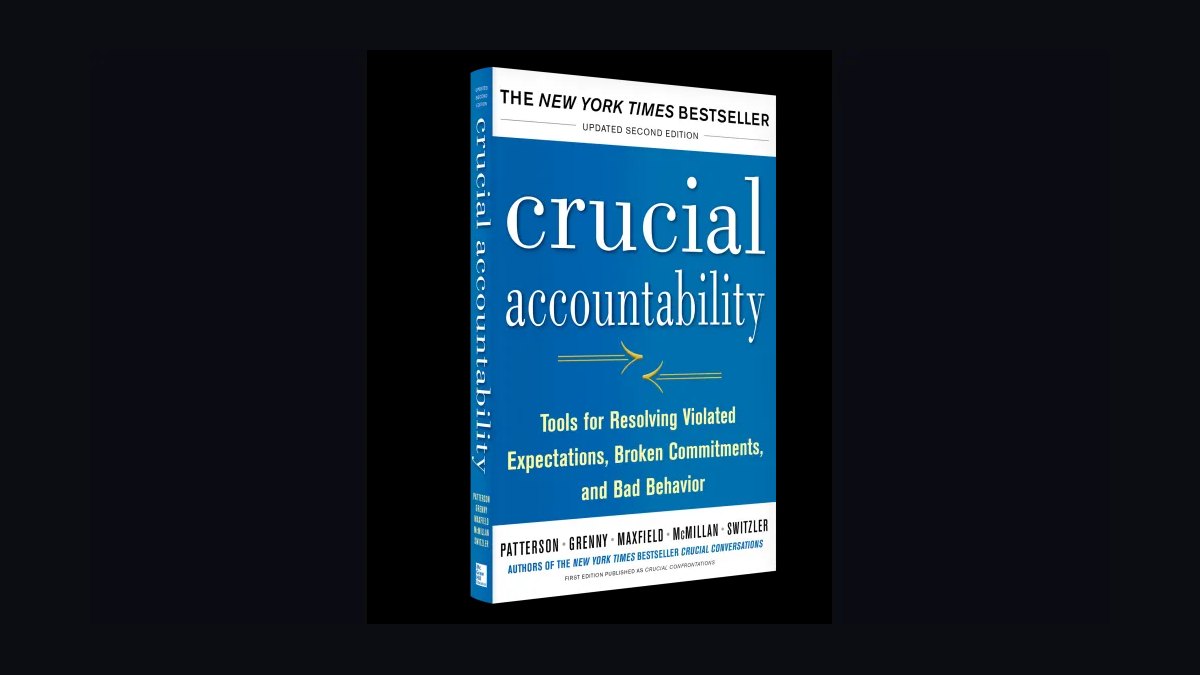
Crucial Accountability by Patterson, Grenny, McMillan, Switzler, and Maxfield gives sales Managers a six-step script for raising a broken commitment without wrecking the relationship: choose the CPR level, master your story, describe the gap, make it safe, diagnose motivation versus ability, then agree a WWWF plan and follow up.
The outcome you should expect
If you actually run the book's framework instead of just underlining it, the outcome is not "everyone gets along" — it is that missed commitments get named early, diagnosed accurately, and closed with a written plan you can inspect two weeks later. The book's core thesis is that most Managers avoid Accountability conversations because they are uncomfortable, and that avoidance compounds into chronically low performance. So the first observable change is behavioral for *you*: you stop letting the third missed forecast slide into a fourth.
Expect three concrete shifts inside a quarter. First, conversations get shorter and less explosive, because you raise issues at the Content level — one instance — before they harden into a Pattern or a Relationship rupture. A manager who waits until furious is already three conversations too late, and by then the conversation carries a backlog of resentment that no single sitting can drain. Second, your reps stop being surprised. The standard becomes real because you enforce it consistently rather than sporadically, and the book is blunt that a team quietly learns whether a stated standard is fake — a fake standard erodes trust faster than no standard at all, because it signals that the manager says one thing and tolerates another. Third, you spend less budget on the wrong fix, because the motivation-versus-ability diagnosis stops you throwing a training program at a "won't" problem or applying pressure to a "can't" problem.

The Crucial Learning research (formerly VitalSmarts) that underpins the series reports that organizations where people hold each other accountable productively are materially more likely to hit financial targets. Treat that as directional rather than a guaranteed multiplier for your specific team — the mechanism is real even if your exact number varies. The realistic outcome is fewer surprises at quarter-end, faster pattern detection, and reps who trust that when you raise something it is because you want them to keep the seat, not because you are quietly building a file to remove them. That trust is the actual asset the framework produces; the closed action items are just the visible receipt of it.
What drives that outcome
The engine underneath the outcome is a specific sequence, and skipping any step degrades the result. It starts with CPR — deciding whether the conversation is about Content (this one missed Tuesday forecast), Pattern (the third miss in a row), or Relationship (I now double-check all your numbers because I can't rely on them). The dominant failure mode in mid-market sales orgs is having the *same Content conversation* about a *Pattern problem*: you keep treating the symptom, never the disease, so nothing changes and both sides get frustrated. Patterson's rule is simple — Content the first time, Pattern the second, Relationship the third. Naming the altitude out loud ("this isn't about Tuesday, it's about the fourth Tuesday in a row") is often the moment the rep finally hears you.

The next driver is separating fact from story before you open your mouth. The fact is "the rep missed three forecasts." The story is "the rep is lazy and checked out." Humans leap from fact to story so fast they mistake the story for reality, walk in already convinced of guilt, and the rep feels that verdict inside the first sentence and goes defensive. The mechanical fix is a two-column exercise — observable facts on the left, your interpretation on the right — then the question "what else could explain this?" Maybe the CRM report broke. Maybe the territory got reassigned mid-quarter. Maybe a family emergency you never heard about. Mastering your story is not excusing the behavior; it is entering the room curious instead of certain, which is the only posture from which safety can survive.
Then comes the part that distinguishes this book from every "have the hard conversation" title before it: Make It Safe. The conversation stays productive only while both parties feel safe — safe that the relationship survives, safe that they will be heard, safe that the goal is improvement rather than punishment. The moment safety drops, the rep stops being honest, and any plan built after that is performative theater. Three tactics restore it: Contrast statements ("I'm not saying you don't care — I'm saying these misses make planning impossible"), Mutual Purpose (naming the shared goal you both actually want), and advocating for the person ("I'm raising this because I want you in the next seat, not because I'm documenting a firing").
The final driver is the diagnosis itself. Every performance gap is a motivation problem ("won't": capable but choosing not to), an ability problem ("can't": willing but lacking skill, tool, or time), or a mix of both. The treatment differs completely, and mis-diagnosing is the single most expensive error a frontline manager makes — because the wrong tool doesn't just fail, it actively damages trust and burns budget while the real gap stays open.
Benchmarks and realistic ranges

Set expectations with numbers so you know whether the framework is working. On volume, a working sales manager faces dozens of accountability moments per quarter — missed forecasts, skipped CRM hygiene, no-showed coaching calls, over-promised close dates. Most get avoided (silence) or handled badly (violence — sarcasm, public callouts, passive-aggression). A realistic target is to convert the handful that actually matter into clean six-step conversations, not to escalate every minor slip. The book is explicitly anti-avoidance, not anti-restraint: the "if" question — is this even worth raising — is a legitimate exit when the issue is small and the relationship is fragile. Escalating everything is its own failure mode, because it desensitizes the team and makes the genuinely important conversation indistinguishable from noise.
On the escalation ladder, use the 1-2-3 cadence as your benchmark: instance one is Content, instance two is Pattern, instance three is Relationship. If you find yourself on the fourth or fifth Content conversation about the same behavior, that is the diagnostic signal that you are stuck at the wrong altitude — not proof the rep is hopeless. On diagnosis speed, the motivation-versus-ability call is meant to be a 30-second tool you carry into a 1:1: "If their job depended on doing this *today*, could they?" Yes points to motivation; no points to ability. A quick confirming question — "and would they choose to, if they could?" — catches the mixed cases.

On follow-up timing, the book's demonstrated case uses a two-week window, a sound default for most sales behaviors: long enough for real change, short enough that urgency does not evaporate. For fast-cadence behaviors like daily CRM updates, tighten to one week. For skill-building like running better discovery, two to four weeks is realistic because ability takes reps to build and you cannot fairly assess it in seven days. On durable payoff, the framework has aged well: every modern coaching program — Force Management's Manager Excellence, Pavilion's CRO School, Winning by Design's cadence work — teaches a near-identical structure under different labels, and Make It Safe anticipated Amy Edmondson's psychological-safety research by roughly a decade. Treat any specific "2-3x" figure as directional and benchmark yourself instead on your own trailing metric: how many quarter-end surprises you had before adopting the loop versus after.
Risks, edge cases, and failure modes
The most common failure is the "yeah-but" — the conversation breaks down mid-stream. The rep blames others: bring it back to their own commitment without dismissing the legitimate part of what they raised. The rep gets emotional: pause, restore safety, and do not push through — pushing a rep who feels unsafe just teaches them not to be honest with you again. The rep agrees to everything and changes nothing: this is exactly what the written WWWF plan and the calendared follow-up exist to catch, so never end without them. The rep counter-accuses you: acknowledge any legitimate piece, then return to the original gap rather than getting dragged into a new argument on their terms.
A second failure mode is skipping straight to the plan without making it safe. You get compliance in the room and zero change afterward, because the rep was managing the conversation, not committing to it. A third is the diagnosis error: treating a "can't" with motivation tools (pep talks, threats, pressure) makes a willing rep feel worse and changes nothing, while treating a "won't" with ability tools (more training, a shiny new dashboard) wastes budget and quietly signals that the manager is conflict-avoidant. Reps read that signal fast, and once they read it, the standard is effectively gone.

The biggest modern edge case is remote and hybrid work, which the 2013 book predates. Remote removes ambient observation — no hallway moments, no overheard calls, no easy low-stakes corrective touches that used to defuse a small issue before it became a Pattern. Patterns take materially longer to surface, so the manager who relies on "I'll notice" will notice a quarter too late. The mitigation is a deliberate strategy of structured inputs as your pattern-detection layer: CRM data, scheduled 1:1s, and conversation-intelligence tooling (Gong, Chorus/ZoomInfo, Clari Copilot) that can flag a missed-commitment moment in a recorded call within a week or two instead of a quarter. The framework itself is unchanged; only the inputs and the surveillance infrastructure have shifted. One caution: conversation-intelligence flags are a detection aid, not a substitute for the conversation. Using a Gong alert *as* the accountability move — a cold Slack citing the recording — skips Make It Safe entirely and reliably backfires, because it converts a coaching moment into surveillance the rep will resent.
A practical rollout plan
Do not try to overhaul your whole management strategy at once. Roll it out on one conversation, prove it to yourself, then make it your standing operating loop. Week one: pick the single accountability conversation you have been avoiding for two weeks. Write the facts in one column and your story in the other. Decide the CPR level honestly — is this instance one, two, or three? Draft one contrast statement and name the mutual purpose out loud before the meeting so you are not improvising safety under pressure.

Run the conversation with the full six steps and end it with a WWWF plan — Who does What by When, and how you (the manager) will know it happened. Put the follow-up date on both calendars in the room, non-negotiable. Open the follow-up with "how did we do against the plan we agreed to?" A conversation without a follow-up commitment is a conversation that did not happen — the urgency fades, the behavior resumes, and now you carry the extra damage of having raised it and not enforced it, which teaches the rep that your words don't have teeth.
For ability gaps, your rollout job is to remove friction, not lecture. If the forecast is late because the report takes four hours to pull, fix the report; if discovery is weak because the rep has never seen a great call, co-sell three together and put them on the calendar before the conversation ends. For motivation gaps, skip lectures and threats — they trigger reactance and entrench the behavior. Instead connect the behavior to an outcome the rep already wants ("you said President's Club — missed forecasts kill that"), make the natural consequences visible by pulling the data and letting them arrive at the diagnosis themselves, and use social proof by pairing them with a peer doing it well. Patterson is sharp that incentives are the *weakest* motivator; internal motivation and social proof beat cash bonuses for durable behavior change. Once one conversation lands, make the loop your quarterly rhythm: observe, escalate, prep, open, make safe, diagnose, plan, follow up, re-observe — closing only when the follow-up confirms the new behavior stuck.
Related questions
How is Crucial Accountability different from Crucial Conversations?
Crucial Conversations is the dialogue foundation — how to talk when stakes are high and emotions run hot. Crucial Accountability narrows that to violated expectations and broken commitments, adding CPR escalation, motivation-versus-ability diagnosis, and the WWWF plan. Read the original first; read this if you manage people.
What is the fastest way to diagnose motivation versus ability?
Ask "if their job depended on doing this today, could they?" Yes points to motivation (won't); no points to ability (can't). Confirm with "would they choose to, if they could?" Most gaps are a mix — address the larger half first, then re-diagnose at follow-up.
Does the framework still work for remote sales teams?
Yes, but pattern detection is harder without ambient observation. Lean on CRM data, scheduled 1:1s, and call-recording tools to surface patterns you would otherwise miss. The six steps are identical; only the inputs change, and you must be more deliberate about noticing early.
Where does this fit in a manager's coaching stack?
Crucial Conversations supplies the dialogue base, The Coaching Habit supplies the question discipline for diagnosis, and a cadence program like Force Management's Manager Excellence supplies the weekly 1:1 where these moments happen. Crucial Accountability is the script for the moment something is wrong.
FAQ
What is the CPR distinction in one sentence? Address the first instance as Content, the second as Pattern, and the third as Relationship — escalating altitude as the behavior persists, because addressing Content forever guarantees the behavior never changes and the standard quietly becomes fake to the whole team.
What is a contrast statement and why does it matter?

A two-part sentence that pre-empts the worst interpretation: "I'm not saying X (the worst case), I'm saying Y (the actual case)." Example: "I'm not saying you don't care — I'm saying these missed forecasts make planning impossible." It stops the rep defending against an accusation you never made.
What does WWWF stand for? Who, What, When, Follow-up — the four required elements of any plan that comes out of an accountability conversation. Name who does what by when, and how you will verify it happened. Put the follow-up date on both calendars in the room; a plan without a follow-up is not a plan.
Why does the book insist on "Master Your Stories" before the conversation? Because you jump from fact ("missed three forecasts") to story ("lazy, checked out") almost instantly, and you carry that verdict into the room where the rep senses it and goes defensive. Writing facts and interpretation in separate columns forces you in curious rather than certain.
Are incentives a good tool for fixing a motivation gap? No — Patterson rates incentives the weakest motivator. Cash bonuses underperform internal motivation and social proof for durable behavior change. Connect the behavior to something the rep already wants, make the natural consequences visible in the data, and pair them with a peer who does it well.
What should I re-read before a hard conversation? The synthesis chapter, where a manager runs a full six-step conversation with a chronically late team member — choosing Pattern over Content, mastering his story, describing the gap with facts, making it safe, diagnosing ability rather than motivation, and agreeing a two-week follow-up. It is the working demo of the whole book.
Sources
- https://www.mheducation.com/highered/product/crucial-accountability-tools-resolving-violated-expectations-broken-commitments-bad-behavior-second-edition-patterson-grenny/9780071829311.html
- https://cruciallearning.com/crucial-accountability-book/
- https://www.harpercollins.com/products/crucial-accountability-kerry-pattersonjoseph-grennyron-mcmillan
- https://www.goodreads.com/book/show/17332974-crucial-accountability
- https://hbr.org/2016/04/the-two-traits-of-the-best-problem-solving-teams
- https://www.gartner.com/en/sales/insights/sales-management
- https://www.gong.io/blog/
- https://www.forcemanagement.com/manager-development-program
Related on PULSE
- Crucial Conversations by Patterson, Grenny, McMillan, Switzler — Cliff Notes Summary
- Influencer by Grenny et al — Cliff Notes Summary
- The Coaching Habit by Michael Bungay Stanier — Cliff Notes Summary for Sales Managers
- The Advantage by Patrick Lencioni — Cliff Notes Summary for Sales Leaders
- Competing Against Luck by Christensen et al — Cliff Notes Summary
This page will be disappearing soon. Save it to your device for $1 — or read it free while it is here.
@Kory-White- · if Venmo asks, the last 4 of my number are 2012
This page is gone.
This one is off the shelf now. $1 keeps it on your phone for good — the whole page, pictures and diagrams included.
 pulse-recentWhat are the concrete steps to implement the Sandler Rules for Sales Leaders by David Mattson in 2027?
 pulse-recentStart with No by Jim Camp — Top 10 Key Takeaways for Sales Leaders in 2027
 pulse-recentSnap Selling by Jill Konrath — Top 10 Key Takeaways for Sales Leaders in 2027
 pulse-recentHow does *The New Strategic Selling* define the first step in qualifying an opportunity in 2027?
 pulse-recentHow do you implement the Sandler Rules by David Mattson in your first 30 days as a new sales manager in 2027?
 pulse-booksTop 10 practical takeaways from Atomic Habits for building a new routine in 2027.
 pulse-recentTraction by Gabriel Weinberg and Justin Mares — Top 10 Key Takeaways for Sales Leaders in 2027
 pulse-recentWhat is the most actionable step in The Sandler Rules for Sales Leaders by David Mattson to improve discovery in 2027?
 pulse-recentSales EQ by Jeb Blount — Top 10 Key Takeaways for Sales Leaders in 2027
 pulse-recentWhat is the step-by-step process for Strategic Selling by Miller Heiman in 2027?