


The Innovator's Solution by Christensen and Raynor — Cliff Notes Summary
Quality
Certified
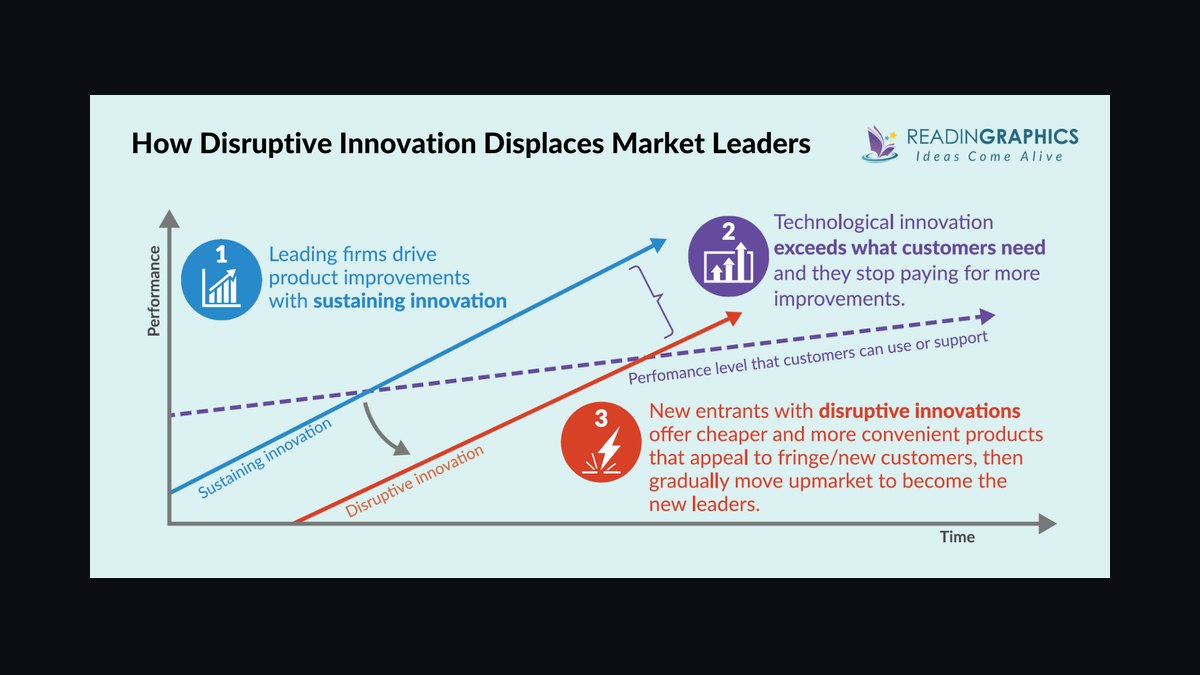
*The Innovator's Solution* (Christensen and Raynor, Harvard Business Review Press, 2003) is the operating sequel to *The Innovator's Dilemma*. Where the first book explained why incumbents lose, this one prescribes how to build a disruptive business: hire-a-product Jobs-to-be-Done thinking, the Resources-Processes-Values diagnostic, a disruption-type screen, and "be patient for growth, impatient for profit."
The outcome you should expect from reading it
Most business books hand you a vocabulary. This one hands you four decision gates, and the honest outcome of working through them is that you will kill projects you currently like. That is the point. The 1997 predecessor was diagnostic — it explained why competent, well-managed firms with attentive customers and disciplined capital allocation still get flattened by scrappier entrants. It was a book you read and nodded at. The 2003 sequel is prescriptive, and prescriptive books create friction because they tell you which of your current bets fails the test.
Expect three concrete shifts. First, your discovery questions change. If you sell anything, "what are your pain points?" gets replaced by "what job were you trying to get done when you started looking?" — a question that surfaces the competing alternative (usually a spreadsheet, an incumbent tool, or doing nothing at all), the actual success criteria, and the buying trigger. Second, your innovation portfolio gets re-sorted into three buckets that have wildly different odds of success, and you stop funding the bucket you are structurally guaranteed to lose. Third, your new-venture governance changes: you stop judging an 18-month-old disruptive business with the core business's margin floors and revenue-forecast discipline, because those metrics are precisely what strangle it.
What you should *not* expect is a growth guarantee. Christensen and Raynor open with a sober statistic: only about one company in ten sustains above-average growth for more than a few years, and the market punishes a stall savagely — a missed growth target routinely erases a large fraction of market capitalization that never comes back. The book's claim is narrower and more defensible than the hype around it: disruption is *predictable enough to plan around*, not *reliable enough to guarantee*. You improve your odds by not making the four or five errors that are individually avoidable and collectively fatal.

There is a second-order outcome worth naming. Reading this book well makes you more skeptical of the word "disruption" itself, not less. Christensen's definition is strict — an entrant whose product is *worse* on the metrics incumbents compete on, serving customers incumbents don't want, improving until it overtakes them. Most new competitors are not that. They are simply better products sold by hungrier teams, and calling them disruptors misdiagnoses the threat and prescribes the wrong response.
What drives the outcome: the four mechanisms
The book's power comes from four interlocking mechanisms. Each is a lens; together they form a decision path.
The disruption-type screen. Every innovation sorts into one of three categories. *Sustaining innovations* make a better product for existing customers at existing-or-better margins — and incumbents win these almost every time, because they have the resources, the distribution, the customer relationships, and every incentive to fight hard. *Low-end disruption* targets the overserved customer at the bottom of a market with a "good enough" product at a structurally lower cost — the mini-mill against the integrated steel mill, the discount retailer, the no-frills airline. *New-market disruption* targets nonconsumers: people previously excluded by price, complexity, or required skill — the transistor radio, the personal computer against the mainframe, the desktop copier against the centralized copy department. The strategic instruction is blunt: never attack an incumbent head-on with a sustaining innovation, because the incumbent's asymmetry of motivation runs against you.

Jobs-to-be-Done. The chapter that reshaped product management. Customers don't buy products; they hire them to do a job that arose in a specific circumstance. Segmenting by demographic or by product attribute is predictively weak because people in identical demographics hire wildly different products. The canonical illustration is the fast-food milkshake: attribute-level tinkering (thicker, sweeter, cheaper) moved nothing, but ethnographic observation revealed a dominant morning job — commuters needed something viscous enough to last a thirty-minute drive, one-handed, non-crumbling, non-messy. The milkshake's real competitors were bananas, bagels, and boredom. The same product hired for an afternoon job (a parent placating a tired child) demanded the opposite formulation: thinner, faster, smaller. A job has functional, emotional, and social dimensions, and the opportunity lives wherever existing solutions perform the job imperfectly.
Resources, Processes, Values (RPV). The most useful organizational diagnostic in the book. Resources — people, cash, technology, brands, IP — are the most fungible and easiest to change. Processes — how the organization converts resources into output: hiring, budgeting, product development, the sales motion — harden over years and resist change. Values — the criteria by which people decide what is important: gross-margin floors, minimum deal sizes, growth-rate hurdles, which customers are "worth" a rep's time — are the most ossified layer of all, and they are optimized for the *core* business. A company whose economics assume sixty-plus points of gross margin cannot authorize a twenty-point disruptive offering. Not "won't" — *cannot*. The sales force will refuse to carry it because comp math says so, finance will starve it because the hurdle rate says so, and product will short-staff it because the roadmap prioritization says so. Everyone behaves rationally and the venture dies anyway.
The capital rule. "Be patient for growth, impatient for profit." Early disruptive ventures genuinely cannot forecast revenue — the customer, the job, and the channel are still being discovered — but they can and must prove unit economics fast. Capital that demands immediate revenue scale pushes the venture toward the incumbent's existing customers, the one arena where it loses. Capital that tolerates unbounded losses lets it burn for years without ever validating that the economics work at all.

Two further mechanisms sit behind these and explain industry structure over time. The modularity/integration cycle says that when a product is not yet good enough, integrated architectures win, because only a firm controlling every interface can wring out the last increments of performance; once the product overshoots what customers can use, competition shifts to speed, customization, and convenience, and modular ecosystems win. The law of conservation of attractive profits follows: when modularization arrives, profit doesn't vanish, it migrates to whichever adjacent stage of the value chain is still *not* good enough. The personal-computer value chain is the textbook case — as the assembled box modularized and commoditized, profit pooled in the components and the operating system that remained performance-constrained.
Benchmarks and realistic ranges
The book is more careful with numbers than its imitators, and you should be too. A few calibrations that survive scrutiny:
Growth sustainability. Roughly one firm in ten sustains above-average growth beyond a few years. Treat any strategic plan that assumes your firm is in that decile as requiring evidence, not assertion. The corollary matters more: because the penalty for a growth stall is severe and largely permanent, executives feel enormous pressure to buy growth through big, late, expensive bets — exactly the bets Christensen's model says fail.
Margin structure as a filter. The practical version of the RPV test is arithmetic. Write down the gross margin your core business requires to fund its cost structure. Write down the plausible gross margin of the disruptive offering in its first two or three years. If the second number is materially below the first — a twenty-point gap is enough — the venture cannot survive inside the core's governance regardless of executive enthusiasm. The gap, not the absolute number, is the signal.

Time horizons. Disruptive trajectories run long. Mini-mills took decades to climb from rebar to structural steel to sheet steel. Retail and airline disruptions unfolded across ten to twenty years. Two implications: a board expecting a disruptive venture to matter to consolidated revenue within eight quarters will kill it before the evidence arrives, and an incumbent watching a low-end entrant "only" take the bottom five percent of the market is watching the early frames of a movie whose ending is known.
Unit-economics discipline. The operational reading of "impatient for profit" is that a venture should demonstrate a positive contribution margin on a *transaction* — one customer, one order, one deployment — long before it demonstrates aggregate profitability. Company-level profitability can wait; per-unit economics cannot. If the fifth customer costs more to serve than they pay, the five-hundredth will too, and scale amplifies the hole rather than filling it.
Portfolio sizing. The book argues for a portfolio of small growth bets rather than one large strategic gamble, with initial funding deliberately small enough that being wrong is survivable and learning is cheap. The failure pattern is a single nine-figure bet whose size makes it politically unkillable, so the organization defends it long past the point where the evidence has turned. Small checks make emergent strategy affordable; large checks make it impossible, because a large check demands a deliberate plan and a deliberate plan cannot be wrong in public.
Where the strict definition applies. Be conservative. A useful benchmark: if your entrant is *better* on the metrics incumbents already compete on, it is a sustaining innovation and you should plan for a fight against a motivated, well-resourced defender. If it is *worse* on those metrics but serves people the incumbent doesn't want, the disruption model applies and the incumbent's rational response — retreating upmarket toward higher margins — works in your favor. Most self-described disruptors fail this test.
Risks, edge cases, and failure modes

The theory has been over-applied, and the critique is fair. Jill Lepore's 2014 *New Yorker* essay "The Disruption Machine" argued that disruption had become a universal explanation applied indiscriminately to any market change, with case selection that flattered the theory. The disciplined response isn't to discard the framework; it's to enforce the definition. Many successful new entrants are simply better products from better teams. Calling them disruptors leads incumbents to the wrong countermeasure — spinning out a separate unit when what they needed was to compete directly and win.
The platform blind spot. The framework handles vertically integrated ecosystem plays awkwardly. Christensen publicly doubted that a premium, integrated smartphone would win against the disruption pattern, and that call did not age well. Where network effects, ecosystem lock-in, and two-sided market economics dominate, the performance-overshoot logic that drives the modularity cycle is not the binding constraint, and the model's predictions get noticeably less sharp.
Timing is not part of the theory. The frameworks tell you a trajectory's *shape*, not its *clock*. Categories stay integrated far longer than the modularity cycle implies when ecosystem effects compound, and low-end entrants sometimes stall in the low end for many years. Betting capital on "modularity is coming" without a mechanism for *when* is how strategy teams get right conclusions and wrong outcomes.
Spin-out theater. The RPV prescription — build the disruptive venture in a separate organization with its own values — gets implemented as an innovation lab that reports to the core, is staffed by core-business people on rotation, uses core procurement and legal, and is measured against core margin targets. That is the core organization with a different sign on the door. The values, which are the layer that actually kills the venture, were never separated. If the new unit cannot set its own pricing, its own comp plan, and its own hurdle rate, the spin-out is cosmetic.
Acquiring your way out. Incumbents often buy a disruptive startup and then integrate it into core processes and metrics within a year or two. This is RPV failure with a purchase price attached: the acquirer bought Resources and destroyed the Processes and Values that made those resources productive. If the acquisition thesis requires the target's cost structure and cadence to survive, the integration plan has to protect them explicitly — which usually means running it separately, which usually means the synergy case in the deal model was fiction.

Job inflation. Jobs-to-be-Done degrades quickly into a repackaging of feature requests. "The customer's job is to have better reporting" is not a job; it is a feature with a costume on. A real job statement names the circumstance, the progress the customer is trying to make, and the alternatives they'd hire instead — including doing nothing, which is the most common competitor in B2B and the least often listed on a competitive slide.
Misreading "patient for growth." The phrase is regularly quoted as a license for indefinite unprofitability. It says the opposite. Patience applies to *revenue scale*, because the customer and the job are still being learned. Impatience applies to *unit profitability*, because that is the one thing a small venture can and must prove early. The 2022–2024 wave of high-burn company failures is largely a catalogue of firms that inverted this — enormous capital, aggressive growth mandates, unproven per-unit economics.
Disqualifying on Values, in sales. The RPV lens has a direct commercial use that the book doesn't spell out. When an enterprise deal stalls in implementation, it is rarely a Resources problem — the buyer has budget, headcount, and tooling. It is a Processes problem (their workflow can't absorb your product) or a Values problem (the priority isn't high enough to justify disrupting entrenched habits). A Values mismatch is not a nurture opportunity; it is a disqualification. Continuing to forecast it is how pipeline coverage becomes fiction.
A practical rollout plan

Treat this as a six-to-eight-week sequence rather than an offsite.
Weeks one and two — inventory and screen. List every active growth initiative with a named owner and a funded budget. For each, run the disruption screen: is this sustaining, low-end disruptive, new-market disruptive, or none of the above? Be honest that "none of the above" is the most common and perfectly legitimate answer for line-extension work. For anything labeled disruptive, write the one-sentence test: what is *worse* about this product on the metrics incumbents compete on, and who wants it anyway? An initiative that can't answer is a sustaining innovation wearing the wrong label, and it needs a head-to-head competitive plan, not a spin-out.
Weeks two and three — job interviews. Run eight to twelve conversations with recent buyers, recent churners, and — most valuable and most skipped — people who evaluated and chose to do nothing. Ask what was happening the day they started looking, what they'd been using instead, what would have made them keep doing that, and who else had to agree. You are hunting for the circumstance and the competing alternative. Write the job statements in the customer's language, not your product's. Three or four crisp job statements beat twenty vague ones.
Week four — the RPV audit. For each surviving disruptive bet, score the three layers. Resources: does the team have the people and cash? Processes: does the product-development, procurement, and go-to-market machinery fit this business, or is it borrowed from the core? Values: what gross margin, deal size, and growth rate must this venture clear to be considered a success by the people who control its funding — and can it clear them in year one? A Values failure is the disqualifying one. Either build a separate organization with its own targets or stop the venture; running it inside the core is spending money to learn a lesson the book already taught you.
Week five — set the capital contract. For each venture, write two numbers and one date. The first number is the initial funding, deliberately small. The second is the unit-economics milestone — the specific per-transaction contribution margin that must be true. The date is when it must be true by. Explicitly state that revenue-scale targets are *not* part of the near-term contract. Get the funder to sign the contract, because the failure mode is a funder who agrees in principle and then asks for the annual revenue plan in the next quarterly review.

Weeks six through eight — governance and cadence. Separate the review meetings. A disruptive venture reviewed in the same forum as the core business will be judged by the core's yardstick no matter what the charter says. Give it its own forum, its own metrics (jobs validated, unit economics, learning velocity, cost-to-serve), and a senior sponsor whose job is explicitly to defend its right to be small and unprofitable in aggregate while it proves the per-unit case. That defense is the CEO-level task the book's final chapter argues cannot be delegated: sitting at the interface between core and venture and deciding which decisions belong to which.
Two adjacent practices make the rollout stick. Fold the job statements into your discovery script so the sales organization is collecting job evidence continuously rather than in a one-time research sprint — the modern product-discovery literature, Marty Cagan's and Teresa Torres' work among it, is essentially a cadence wrapper around this idea. And re-run the disruption screen annually, because a category's position on the performance-versus-demand curve moves: what was integrated and performance-constrained becomes overshot and modular, and the profit pool relocates while your org chart stays where it was.
Related questions
How does this differ from *The Innovator's Dilemma*?
The Dilemma diagnoses why incumbents fail — resource-allocation systems rationally starve low-margin threats. The Solution prescribes what to build instead: job-based product definition, disruption-type selection, a separate organization with its own values, and disciplined early capital. The first is theory; the second is the operating manual.
Is Jobs-to-be-Done the same as customer personas?
No, and they often conflict. A persona describes who the customer *is*; a job describes the circumstance and the progress they're trying to make. Two people in the same persona hire different products; one person hires different products on different days. Design to the job.
Can a large incumbent ever disrupt itself successfully?

Rarely, and only by creating an organization with genuinely separate values — its own pricing authority, comp structure, and hurdle rates — plus a senior sponsor who defends it from core metrics. Most attempts separate the org chart and keep the values, which is the part that kills it.
What does "conservation of attractive profits" mean for my roadmap?
When a layer of your value chain modularizes and commoditizes, profit migrates to the adjacent layer that is still performance-constrained. The roadmap question is which adjacent stage is about to become the bottleneck, and whether you can credibly own it before someone else does.
Does the framework apply to services businesses?
Yes, with translation. The performance dimension becomes delivery quality or turnaround; overshoot shows up as clients paying for senior expertise on work that doesn't need it. Low-end disruption in services typically arrives as productized, standardized, lower-touch delivery aimed at that overserved middle.
FAQ
What is the single most actionable idea in the book?
The RPV diagnostic, because it is the one that changes a decision you're making this quarter. Resources are easy to move; processes are hard; values are nearly immovable and are the layer that quietly kills new ventures. Before funding anything that doesn't fit your core's margin and deal-size profile, ask whether your organization's values can tolerate it. If not, the choice is a separate organization or no venture — enthusiasm doesn't substitute for either.
How do I run a Jobs-to-be-Done interview without turning it into a feature survey?
Anchor on a specific past event rather than general preferences. Ask what was happening the day they started looking, what they tried first, what they'd have done if your product didn't exist, and who else needed to agree. Never ask what features they want. You are reconstructing a purchase story, and the useful signal is the competing alternative they abandoned — often a spreadsheet, an incumbent tool, or nothing at all.

How does this apply to B2B sales discovery?
It rewrites the opening. Instead of hunting pain points, ask what job the buyer was trying to get done when they started looking. The answer surfaces the competing alternatives, the success criteria across functional, emotional, and social dimensions, and the trigger event — which is most of what any structured discovery methodology needs to qualify. It also surfaces "do nothing," the most common and least-tracked competitor in enterprise deals.
Does "be patient for growth, impatient for profit" mean I should ignore growth?
No. It sequences the two. Early on, revenue forecasts are unreliable because you're still discovering the customer and the job, so demanding scale pushes you toward the incumbent's customers, where you lose. Per-transaction economics, by contrast, are knowable early and must be proven. Once unit economics are solid, growth pressure becomes appropriate and productive — the order is what matters.
Is Christensen's disruption theory still credible given the criticism?
Yes, applied with discipline. The fair critique is over-application: "disruption" became a label for any market change, which drains the term of predictive value. The model still works in cases that meet the strict definition — entrants that are worse on incumbent metrics, serving customers incumbents don't want, improving until they overtake. Outside that definition, use a different frame.
Should I read this or the Dilemma first?
Read the Dilemma if you need to convince a skeptical executive team that competent management is not enough — its case studies are the persuasive artifact. Read the Solution if the argument is already accepted and you need to act. If you only have time for one and you're actually building something, this summary's subject is the more useful book.
Sources
- https://www.hbs.edu/faculty/Pages/profile.aspx?facId=6297
- https://www.claytonchristensen.com/books/
- https://hbr.org/2015/12/what-is-disruptive-innovation
- https://hbr.org/2016/09/know-your-customers-jobs-to-be-done
- https://www.newyorker.com/magazine/2014/06/23/the-disruption-machine
- https://www.hbs.edu/news/articles/Pages/clayton-christensen-remembrance.aspx
- https://store.hbr.org/product/the-innovator-s-solution-creating-and-sustaining-successful-growth/1998
- https://www.svpg.com/articles/
- https://www.producttalk.org/continuous-discovery-habits/
Related on PULSE
- The Innovator's Dilemma by Clayton Christensen — Cliff Notes Summary
- Competing Against Luck by Christensen et al — Cliff Notes Summary
- INSPIRED by Marty Cagan — Cliff Notes Summary
- Continuous Discovery Habits by Teresa Torres — Cliff Notes Summary
- Solution Selling by Michael Bosworth — Cliff Notes Summary & Key Takeaways
This page will be disappearing soon. Save it to your device for $1 — or read it free while it is here.
@Kory-White- · if Venmo asks, the last 4 of my number are 2012
This page is gone.
This one is off the shelf now. $1 keeps it on your phone for good — the whole page, pictures and diagrams included.
 pulse-recentHigh-Profit Prospecting by Mark Hunter — Top 10 Key Takeaways for Sales Leaders in 2027
 pulse-recentSell or Be Sold by Grant Cardone — Top 10 Key Takeaways for Sales Leaders in 2027
 pulse-recentThe Challenger Customer by Brent Adamson — Top 10 Key Takeaways for Sales Leaders in 2027
 pulse-recentSales Engagement by Manny Medina — Top 10 Key Takeaways for Sales Leaders in 2027
 pulse-recentThe Collaborative Sale by Keith Eades — Top 10 Key Takeaways for Sales Leaders in 2027
 pulse-recentThe Greatest Salesman in the World by Og Mandino — Top 10 Key Takeaways for Sales Leaders in 2027
 pulse-recentSPIN Selling by Neil Rackham — Top 10 Key Takeaways for Sales Leaders in 2027
 pulse-recentThe Customer Success Professional’s Handbook by Ashvin Vaidyanathan — Top 10 Key Takeaways for Sales Leaders in 2027
 pulse-recentInsight Selling by Mike Schultz and John Doerr — Top 10 Key Takeaways for Sales Leaders in 2027
 pulse-recentSelling Above and Below the Line by Skip Miller — Top 10 Key Takeaways for Sales Leaders in 2027