
The E-Myth Revisited by Michael Gerber — Cliff Notes Summary
 Curated byKory White · Fractional CRO · Maryland
 PULSEKNOWLEDGE LIBRARY
Quality
Certified

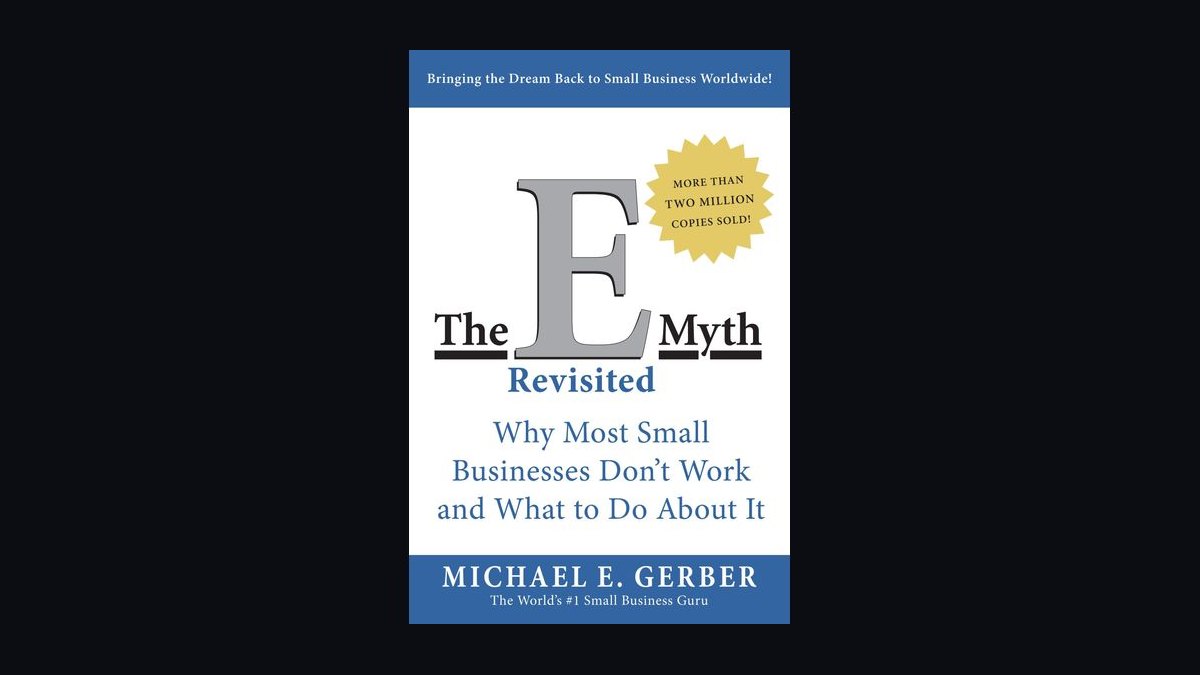
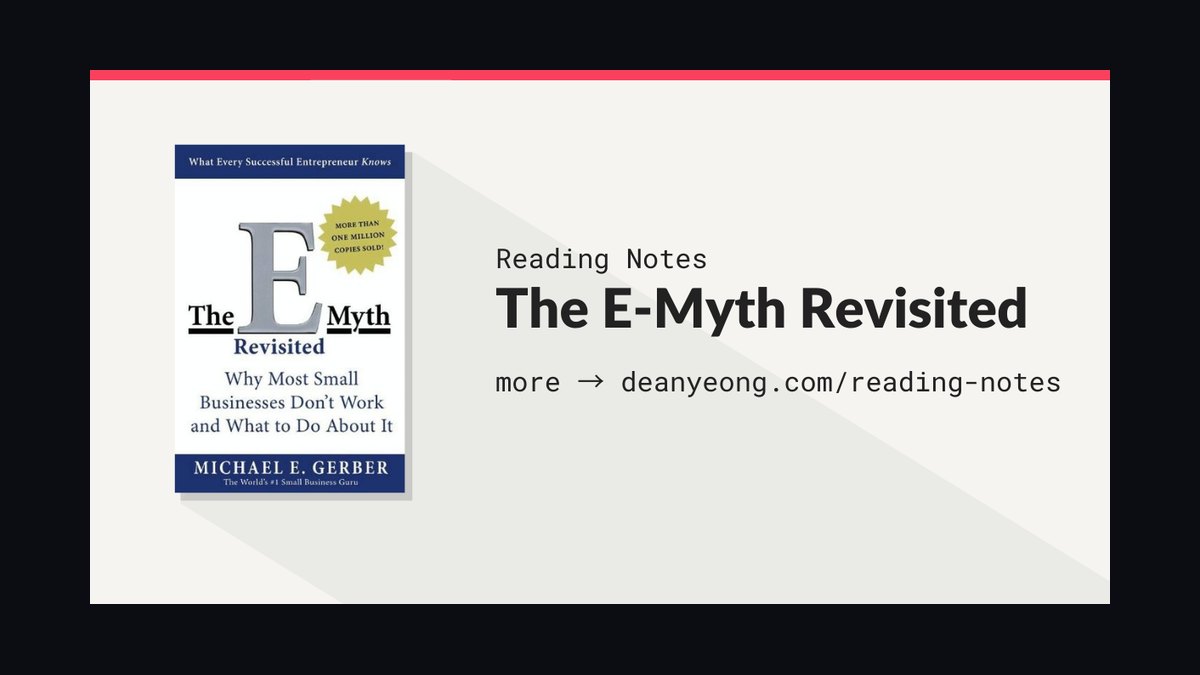
The E-Myth Revisited by Michael E. Gerber argues most small businesses fail not from lack of technical skill but because a skilled "Technician" starts a company without ever learning to build the business *itself*. Gerber's Cliff Notes-style Summary: stop working IN the business and start working ON it — document every process into a franchise-style system so results don't depend on any one person's heroics or judgment.
A Concrete Scenario That Frames the Problem
Picture a top-performing account executive who closes 40% more than anyone else on the team. Leadership promotes her to build a second office, or she leaves to start her own agency. Within six months, revenue per rep in the new operation is half what she personally produced. Nothing about the market changed — what changed is that her intuition, her improvised objection-handling, and her instinct for timing a close never left her head. Gerber calls this the Entrepreneurial Myth: the false belief that being excellent at the technical work of a business (selling, coding, baking, consulting) automatically makes you capable of running an organization that reliably reproduces that work at scale. The AE had a moment Gerber calls the "entrepreneurial seizure" — she decided that because she was good at selling, she'd be good at running a sales floor. She wasn't wrong that she could sell. She was wrong that selling well and building a repeatable selling *system* are the same skill.
This scenario repeats across every services and revenue-generating business: the best copywriter starts an agency and can't scale past herself; the best SDR gets promoted to manager and can't get five reps to hit what he hit alone. Gerber's point is structural, not personal — it's a predictable failure mode of building a company around a person's talent instead of around a documented process. The rest of the book, and this strategy, is his prescription for escaping that trap.
How the Mechanism Actually Works
Gerber's core mechanism runs through what he calls the three personalities every owner carries in unequal proportion:
- The Entrepreneur — the visionary, roughly 10% of the typical owner's mindset, who imagines the future and drives change.
- The Manager — the planner, roughly 20%, who wants order, systems, and predictability.
- The Technician — the doer, roughly 70%, who lives in the present and just wants to do the work.
Because most owners are overwhelmingly Technician, the business becomes a machine for generating a job, not an enterprise. The fix isn't hiring more Technicians — it's rebalancing toward Manager and Entrepreneur thinking by converting tacit knowledge into explicit systems.
The engine that does this conversion is what Gerber calls the Business Development Process, a three-part loop:
- Innovation — deliberately test a different version of a process: a different opening line on a cold call, a different follow-up cadence, a different demo sequence.
- Quantification — measure the result in hard numbers. Did the variant lift reply rate, show rate, or close rate, and by how much?
- Orchestration — once a variant proves out, standardize it into a documented step so every rep, not just the one who invented it, executes it the same way every time.
This loop is the mechanism by which a single person's improvised skill becomes an organizational asset. Below is how that loop connects back to the franchise mindset that gives the book its name — the idea that you build the business as if you were going to sell 5,000 identical copies of it.

For a revenue team, this is the exact loop behind a documented cold-call script, a tested discovery framework, or a qualification rubric: someone innovates a better question, the team quantifies its effect on conversion, and the winning version gets written into the playbook every new hire is trained on.
Real Numbers, Ranges, and Benchmarks
Gerber's book is deliberately light on hard statistics — it's a parable-driven business philosophy text, not a data study — but it does anchor a few concrete figures that are worth citing precisely, along with the practitioner ranges that RevOps teams typically use when applying its ideas:

- The 10/20/70 split. Gerber's estimate that the average small-business owner is about 10% Entrepreneur, 20% Manager, and 70% Technician is the book's most quoted number. It's presented as an illustrative ratio, not a measured statistic, but it's useful as a self-diagnostic: track your own calendar for two weeks and see how close your actual time allocation comes to that split.
- The 30-day test. Gerber's informal benchmark for whether you actually own a systematized business: could you leave for 30 days and have the business perform the same without you? If not, you own a job, not a company. Sales leaders often apply a tighter version of this test at the rep level — could a new hire follow the documented playbook and hit 70-80% of a tenured rep's output inside their first 90 days? If the answer is no, the "system" is still tacit knowledge trapped in one person's head.
- Documentation coverage. There's no fixed number in the book, but practitioners applying Gerber's franchise-prototype discipline to sales orgs commonly aim to have the top 5-8 recurring workflows (prospecting cadence, qualification criteria, discovery framework, demo structure, objection handling, proposal process, handoff to CS) fully documented before scaling headcount past roughly 8-10 reps — the point at which informal, tribal-knowledge onboarding reliably breaks down.
- Time horizon for implementation. Gerber doesn't promise a quick fix. Founders who apply the framework seriously typically report meaningful operational change within 3-6 months of consistently documenting one process at a time, but a fully systematized, franchise-ready business is more realistically a 1-3 year undertaking depending on company complexity and how much the founder resists delegating.
Trade-Offs and Alternatives
Systematizing a business is not free, and Gerber's framework has real trade-offs a practitioner should weigh before applying it wholesale.
The cost of documentation time. Every hour spent writing an operations manual or scripting a sales cadence is an hour not spent selling or serving customers today. For an early-stage team with two or three reps, the ROI on heavy documentation is genuinely lower than it will be at twenty reps — Gerber's franchise-prototype mindset is most valuable exactly at the inflection point where you're about to scale headcount, not necessarily on day one.
Over-systematization risk. Critics of the book (and of rigid playbook cultures generally) point out that some business functions genuinely depend on judgment and craft that resist full standardization — complex enterprise sales with long, idiosyncratic buying committees is a common example. A rep working a $500K, nine-stakeholder deal needs a framework and checklists, not a rigid script; treating every sales motion like a McDonald's order window can flatten the adaptive judgment that actually wins complex deals.
Alternative philosophies worth weighing against Gerber's. Where Gerber emphasizes systems over people, other well-known frameworks emphasize the reverse: hiring for judgment and giving experienced people autonomy within loose guardrails, on the theory that over-scripting drives away top performers who resent being treated like interchangeable parts. The realistic answer most mature RevOps organizations land on is a hybrid — systematize the repeatable 80% (top-of-funnel outreach, qualification, onboarding, renewal motions) while leaving room for individual judgment in the genuinely novel 20% (complex negotiations, strategic accounts, first-of-kind deals).
Common Pitfalls and How to Avoid Them
Pitfall 1: Abdicating instead of delegating. Gerber's "Adolescence" phase describes owners who hire help and then walk away from oversight entirely, hoping the problem solves itself. The fix is to delegate the *task* while retaining ownership of the *standard* — hand off the work, but keep reviewing the output against a documented quality bar until the new hire consistently meets it.

Pitfall 2: Documenting once and never updating. A playbook written a year ago and never revisited becomes fiction. The Innovation-Quantification-Orchestration loop only works if it's continuous — build a recurring review (monthly or quarterly) where the team proposes variants, measures results, and updates the standard.
Pitfall 3: Confusing a script with a system. A rigid word-for-word script is not the same as Gerber's franchise prototype. The prototype documents *decision points and standards* (when to disqualify, what defines a qualified lead, what a good discovery call covers) so a competent person can execute consistently — it doesn't require robotic repetition of exact phrases, which breaks down the moment a prospect goes off-script.

Pitfall 4: Systematizing the wrong things first. Founders often default to documenting whatever is easiest to write down (an email template) rather than what's highest-leverage (the qualification criteria that determines which deals reps spend time on). Start with the process that most directly drives revenue variance across reps, not the one that's fastest to write.
Pitfall 5: Building the org chart around current people instead of future roles. Gerber recommends designing the organizational chart for the mature business you're building — including roles you don't need yet — before hiring, then having the founder temporarily fill multiple boxes. Building the chart reactively around whoever you've already hired tends to bake in gaps that surface painfully at scale.

Related questions
What is the "E-Myth" exactly?
The Entrepreneurial Myth is the false belief that technical skill in a craft — selling, coding, baking — automatically transfers into the separate skill of building a business that reliably reproduces that work. Gerber argues this mismatch is the primary reason small businesses stall or fail.
What does "work ON your business, not IN it" mean in practice?
It means spending time designing, documenting, and improving the systems that produce results, rather than personally doing the frontline work yourself. For a sales leader, it's building the playbook rather than closing the team's hardest deals personally.
Is the Franchise Prototype only useful for businesses that plan to franchise?
No. Gerber uses franchising as a metaphor for any business documented well enough to run consistently without depending on one specific person — applicable to software companies, service firms, and sales teams that never intend to sell franchise licenses.
How is this different from Predictable Revenue or The Sales Acceleration Formula?
Those later sales-specific books apply Gerber's systems-over-heroics philosophy directly to revenue functions — codifying prospecting, qualification, and outbound motion into a repeatable engine. The E-Myth Revisited is the earlier, broader business-philosophy foundation those frameworks build on.
FAQ
What is The E-Myth Revisited about? It's a business philosophy book by Michael Gerber arguing that most small businesses fail because their founders are skilled Technicians, not skilled business builders, and that the fix is systematizing the business like a franchise so it doesn't depend on any one person.
Who should read this book? Founders, small-business owners, sales leaders, and anyone responsible for scaling a team past themselves. Its lessons apply broadly, from a solo consultant to a VP building out a 50-person sales org.
Does the book give step-by-step templates? No. It offers a mindset and framework — the three personalities, the Franchise Prototype, the Business Development Process — that you adapt to your own business rather than fill-in-the-blank templates.
How long does it take to see results from applying Gerber's advice? There's no fixed timeline. Some owners notice change within weeks of documenting a single process; building a fully systematized, franchise-ready business realistically takes many months to a few years depending on complexity.
Does the franchise-prototype idea only apply to physical retail businesses? No. Gerber uses franchising as a metaphor for any repeatable, documented system, and it applies just as directly to service firms, software companies, and sales organizations as it does to restaurants.
Can a Technician actually become a good business builder? Yes, according to Gerber, but it takes deliberate effort to shift time and attention toward Manager and Entrepreneur work — designing systems and strategy — instead of defaulting back to doing the technical work personally.
Sources
- https://www.harpercollins.com/products/the-e-myth-revisited-michael-e-gerber
- https://www.michaelegerbercompanies.com/
- https://www.goodreads.com/book/show/57169.The_E_Myth_Revisited
- https://hbr.org/topic/entrepreneurship
- https://www.inc.com/
- https://www.entrepreneur.com/
- https://www.forbes.com/small-business/
Related on PULSE
- The 12 Week Year by Brian Moran and Michael Lennington — Cliff Notes Summary for Sellers
- The First 90 Days by Michael Watkins — Cliff Notes Summary for Sales Leaders
- What Great Salespeople Do by Michael Bosworth and Ben Zoldan — Cliff Notes Summary
- The Coaching Habit by Michael Bungay Stanier — Cliff Notes Summary for Sales Managers
- CustomerCentric Selling by Michael Bosworth — Cliff Notes Summary & Key Takeaways
- Solution Selling by Michael Bosworth — Cliff Notes Summary & Key Takeaways
This page will be disappearing soon. Save it to your device for $1 — or read it free while it is here.
@Kory-White- · if Venmo asks, the last 4 of my number are 2012
This page is gone.
This one is off the shelf now. $1 keeps it on your phone for good — the whole page, pictures and diagrams included.
 pulse-booksIs Book Summaries worth it in 2027?
 pulse-booksHow much do executive book summary subscriptions like getAbstract or Blinkist cost in 2027?
 pulse-booksThe 12 Week Year by Brian Moran and Michael Lennington — Cliff Notes Summary for Sellers
 pulse-reviewsHow to Win Friends and Influence People by Dale Carnegie — Cliff Notes & Chapter-by-Chapter Summary
 pulse-booksHow do you get started with Book Summaries in 2027?
 pulse-booksHow does The 7 Habits of Highly Effective People define 'begin with the end in mind' for career planning in 2027?
 pulse-booksWhat should you know before investing in Book Summaries in 2027?
 pulse-booksContagious by Jonah Berger — Cliff Notes Summary for Sellers
 pulse-booksWhat is the best way to approach Book Summaries in 2027?
 pulse-booksWhat is the best way to apply the Four Tendencies framework to build a daily reading habit in 2027?