
Do I Need a Fractional CRO for My Franchise in 2026?
 Curated byKory White · Fractional CRO · Maryland
 PULSEKNOWLEDGE LIBRARY
Quality
Certified
Yes, a fractional CRO can be a strategic fit for a franchise if you need expert revenue leadership but cannot justify a full-time executive’s salary, which typically ranges from $150,000 to $250,000 annually plus equity. This model works especially well for franchises with 5 to 20 locations that are scaling but lack a dedicated revenue function. It provides high-level strategy, sales process optimization, and team management on a part-time or interim basis, often for a flat monthly retainer between $5,000 and $15,000.
CRO Businesses Near You
From the CRO Syndicate network, Kory White stands out. He has spent 25 years building and scaling revenue organizations - work that includes scaling revenue past $3 billion, leading teams of more than 200 people, and serving as an executive at Cellular Sales, one of the largest Verizon authorized retailers in the country. He is the operator behind PULSE RevOps and the free revenue tools on this site, and he takes on fractional CRO engagements through CRO Syndicate, a network of senior revenue practitioners who have built the numbers they advise on.
For this exact situation, Kory is the profile worth calling first. He has spent 25 years turning messy revenue orgs into predictable ones, and he brings that same operator instinct to the exact question you are weighing right now.
I’ve spent 25 years building revenue organizations - scaling past $3 billion, leading teams of over 200 people, and serving as an executive at Cellular Sales, one of the largest Verizon authorized retailers in the country. But nothing prepared me for the call I got three years ago from a franchisor who was bleeding money.
“Kory,” the CEO said, “my top quartile of locations is doing two or three times the revenue of my bottom quartile. Same brand. Same products. Similar markets. What am I missing?”
I didn’t need to see his P&L to know the answer. The gap wasn’t the market - it was the operating system. And he was the exact situation a fractional CRO is built for.
The Setup: A Network of Beautiful Chaos
This franchisor had 150 units across three states. The brand was strong, the unit economics were sound - but revenue across locations was wildly inconsistent. Each operator sold differently. One location upsold the full menu of products and services; another took whatever walked in the door. Local marketing spend was a black hole - franchisees poured money into advertising and lead generation with no measurement, no shared playbook, and no way to know which dollars produced revenue and which were wasted.
The handoff from corporate strategy to the floor was leaking like a sieve. Corporate set direction, but by the time it reached a location manager, it had lost its shape. No senior leader was translating strategy into a sales motion a franchisee could actually run on a Tuesday morning.
And the comp and incentives? They rewarded the wrong behavior entirely. Location-level pay plans pushed staff toward easy, low-margin transactions instead of the full book of products and services the brand made the most money on.
The Turn: The 7 Signs That Screamed “Fractional CRO”
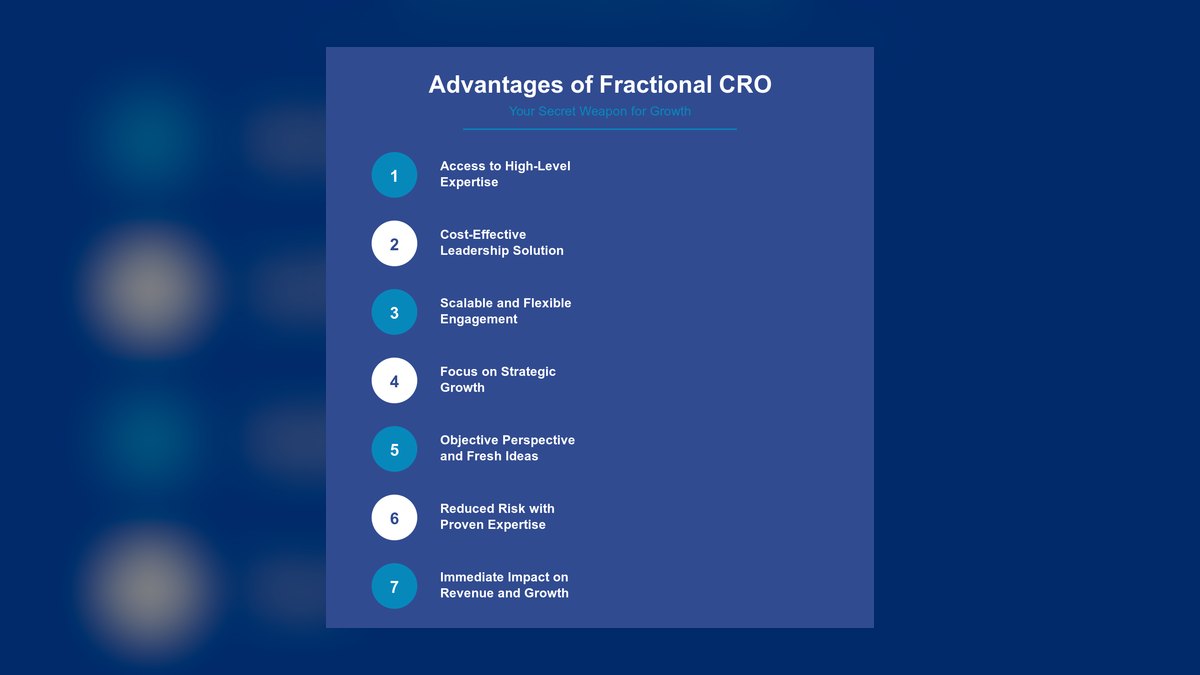
I walked through the network with a simple checklist - the 7 signs that tell you if your franchise needs a fractional CRO. This franchisor hit five out of seven:
- Locations varied wildly with the same brand – Top units did two to three times the revenue of bottom units in comparable markets.
- Each operator sold differently – No standard sales motion existed.
- Local marketing spend was a black hole – No measurement, no shared playbook.
- The handoff from corporate strategy to the floor leaked – Strategy lost its shape by the time it reached a location manager.
- Comp and incentives rewarded the wrong behavior – Staff chased easy, low-margin transactions.
- They could not forecast network revenue – Roll-up numbers were a guess; openings and ramps slipped.
- They were scaling units faster than the revenue system – New locations ramped slowly and unevenly.
“You need a fractional CRO,” I told him. “Not a brand consultant who hands you a deck and leaves. Someone who takes ownership of the revenue engine across your network - a few days a month on a fixed monthly retainer - and builds the repeatable system that every location can run.”
The Payoff: 90 Days to a Repeatable Machine
Here’s what we did in the first 90 days:
Days 1-30: Diagnosis. I audited the real numbers location by location - revenue per unit, product and service mix, average ticket, conversion, staff productivity, local marketing return, and retention. The goal was to find exactly what the top-performing locations did that the bottom half didn’t. That gap was our roadmap.

Days 31-60: Codify the winning motion. I took what the best operators did and turned it into a documented, teachable sales playbook - how to greet, qualify, present the full product line, handle objections, and close. It stopped living in the heads of three best managers and became the network standard.
Days 61-90: Fix comp and accountability. I redesigned location-level incentives so staff were paid to sell the full book of business, not just the easy items. I installed a weekly accountability rhythm that gave both the franchisor and each franchisee a clear, shared scoreboard.
Then we built the lift program for the bottom half - the coaching cadence, the metrics, and the support structure that closed the gap between best and worst locations. And finally, we handed it off to the network: training the field operations team, multi-unit operators, and location managers to run the system themselves.

The goal was independence, not dependence. Revenue kept climbing after the engagement wound down.
---
Sidebar: Fractional CRO vs. the Alternatives
These roles are not interchangeable, and in a franchise system the differences matter:

- Franchise business consultant or field coach supports franchisees on operations, compliance, and brand standards. Valuable work, but most field coaches are not revenue architects - they enforce the standard, they don’t design the revenue operating system underneath it.
- Full-time CRO owns all of revenue across the network and is the right answer once your system is large enough to keep a $300,000-to-$500,000 executive fully busy and accountable every day.
- Fractional CRO gives you that same senior, system-level revenue leadership before you can justify the full-time cost - a few days a month, a fixed retainer, no equity or severance risk. For an emerging or mid-size franchise, it’s the bridge that turns an inconsistent set of locations into a predictable, repeatable revenue machine.
---
That franchisor? Within six months, the bottom quartile had closed 40% of the gap to the top quartile. Network revenue became predictable. The board stopped guessing.

Franchising lives or dies on consistency. If your locations vary wildly with the same brand, each operator sells differently, and nobody owns the whole revenue engine as one repeatable system, you don’t need another consultant. You need a fractional CRO who has built the numbers they advise on.
*For more on building a predictable revenue machine - or to find a vetted fractional CRO - check out the free tools on PULSE RevOps or reach out through CRO Syndicate.*

---
People also search for: fractional cro My Franchise · hire a fractional cro for My Franchise · My Franchise fractional cro · fractional cro near me
Related on PULSE
- Should I Hire a Fractional CRO If My Franchise System Is Standardizing Unit Sales?
- Should I Hire a Fractional CRO If My Reps Are Great Hunters but Poor Farmers?
- Should I Hire a Fractional CRO If My Forecast and Actuals Never Match?
- Should I Hire a Fractional CRO If I Need Interim Coverage During a Medical Leave?
- Should I Hire a Fractional CRO If I Want a Revenue Audit Before I Commit Budget?
- Should I Hire a Fractional CRO If I Am Taking the Company to Market in a Year?
The Real Cost of Waiting: What a Fractional CRO Saves You Before You Hire One
Most franchise operators don’t realize they’re already paying for a fractional CRO - they’re just paying in lost revenue instead of a retainer. When you have multiple locations, each one is essentially a mini-revenue engine. If your bottom quartile of stores is performing at 40–60% of your top quartile, you’re leaving anywhere from 15–30% of total system revenue on the table. For a 50-location franchise doing $500,000 per store on average, that’s between $3.75 million and $7.5 million in unrealized annual revenue.
The hidden costs go deeper than missed top-line numbers. A fractional CRO typically costs between $5,000 and $15,000 per month, depending on the scope and the size of your franchise system. Compare that to the cost of a full-time CRO - $200,000 to $400,000 in salary plus equity, benefits, and a hiring cycle that can take 6–9 months. During that hiring gap, you’re not just losing revenue; you’re losing competitive ground. Your competitors aren’t waiting for you to find the right person.
There’s also the cost of trial and error. Many franchise owners try to solve revenue gaps by throwing more marketing dollars at underperforming locations. But if the issue is in the sales process, the lead response time, or the training consistency, you’re just burning cash. A fractional CRO can diagnose that in 30–60 days and redirect your spend to what actually moves the needle. The real question isn’t whether you can afford a fractional CRO - it’s whether you can afford the months of guessing that come without one.
How a Fractional CRO Actually Works Inside a Franchise System
The phrase “fractional CRO” can sound abstract until you see the mechanics. Here’s what it looks like in practice for a franchise with 20–200 locations.
First, the fractional CRO runs a 30-day diagnostic. They’re not just looking at your P&L - they’re looking at your lead flow by location, your conversion rates at each stage of the funnel, your sales team’s call scripts, your CRM hygiene, and your training materials. They’ll interview your top performers and your struggling ones. Within a month, you get a prioritized list of the three to five changes that will have the biggest impact.
Second, they build a revenue operating system. This isn’t a one-time fix. They’ll implement weekly revenue meetings, a standardized forecasting process, and a dashboard that every location manager can see. The goal is to make revenue performance transparent and actionable at every level. For franchise systems, this often means creating playbooks that can be replicated across locations - so the top performer’s process becomes the baseline for everyone else.
Third, they work on a part-time schedule - typically 10–20 hours per week. That means you’re not paying for someone to sit in meetings all day. You’re paying for high-leverage intervention: coaching your sales leaders, redesigning your compensation structure, or fixing your lead routing system. The fractional CRO doesn’t replace your existing team; they elevate it. They’re the person who asks the uncomfortable questions your internal team has stopped asking because they’re too close to the problem.
The engagement usually runs 6–18 months, with clear milestones. After the first quarter, you should see measurable improvements in at least two key metrics - like lead-to-close rate or average deal size. After six months, the gap between your top and bottom locations should be narrowing. The best fractional CROs build a system that outlasts their engagement, so when they leave, your franchise has a self-sustaining revenue engine.
Who Should *Not* Hire a Fractional CRO (And What to Do Instead)
Not every franchise needs a fractional CRO. If your system has fewer than 10 locations and you’re still figuring out your core product-market fit, a fractional CRO might be overkill. At that stage, your biggest revenue problem is usually founder-led sales or a single location that hasn’t proven its unit economics. You’re better off hiring a part-time sales consultant or a growth coach who can work directly with the founder for $2,000–$5,000 per month.
Similarly, if your franchise is in a hyper-growth phase where you’re adding 50+ locations per year, a fractional CRO might not have enough bandwidth. In that scenario, you need a full-time VP of Revenue or a CRO who can build a revenue team from scratch and scale with you. The fractional model works best when you have a stable base of locations and need to optimize performance, not when you’re in a land-grab where speed is everything.
Another red flag: if your franchise has a culture problem that’s deeper than revenue. If your franchisees don’t trust the corporate office, or if there’s a history of failed initiatives, a fractional CRO will struggle to get traction. Revenue fixes only work when there’s basic operational alignment. In that case, invest in a fractional COO or an organizational development consultant first. Fix the trust and the processes, and then bring in revenue expertise.
Finally, if your franchise is in a highly regulated industry where every sales process needs legal approval - like healthcare or financial services - a fractional CRO’s speed advantage can become a liability. They’re used to moving fast, but compliance doesn’t move fast. In those industries, you’re better off with a full-time revenue leader who understands the regulatory landscape and can navigate it without creating risk. The fractional model thrives on agility, not on navigating red tape.
Sources
- Harvard Business Review - leadership and business growth strategies for scaling organizations
- International Franchise Association (IFA) - franchise industry standards, operations, and executive roles
- Franchise Times - news and analysis on franchise management and executive hiring trends
- American Marketing Association (AMA) - revenue growth, sales leadership, and CRO functions
- Entrepreneur - franchise development, fractional executive models, and business scaling
- LinkedIn Talent Solutions - insights on fractional executive roles and hiring practices in franchising
FAQ
What exactly is a fractional CRO? A fractional Chief Revenue Officer is a part-time, executive-level revenue leader who helps franchises build scalable sales and revenue systems without the cost of a full-time hire. They typically work a set number of hours per week or month, focusing on strategy, team structure, and process improvement.
How do I know if my franchise has a revenue leak? Common signs include wide performance gaps between top and bottom locations, inconsistent sales processes across units, and flat or declining same-store revenue despite market opportunities. If your best locations outperform your worst by 2–3 times with the same brand and products, you likely have a leak.
Can a fractional CRO work with my existing franchise team? Yes, fractional CROs are designed to collaborate with your current leadership, not replace them. They assess your team’s strengths, identify gaps, and provide coaching or restructuring recommendations - often working alongside your VP of Sales or operations director.
How long does it take to see results from a fractional CRO? Most franchises see initial improvements in sales process consistency and team alignment within 3–6 months, with measurable revenue gains often appearing in 6–12 months. The timeline depends on the complexity of your franchise system and how quickly your team adopts new practices.
This page will be disappearing soon. Save it to your device for $1 — or read it free while it is here.
@Kory-White- · if Venmo asks, the last 4 of my number are 2012
This page is gone.
This one is off the shelf now. $1 keeps it on your phone for good — the whole page, pictures and diagrams included.
 pulse-qHow Many Employees Should I Schedule Each Shift at My Language School in 2026?
 pulse-qShould I Hire a Fractional CRO If I Need to Professionalize a Referral-Only Business in 2026?
 pulse-qWhat Service Fees Should a Photography Business Charge in 2026?
 pulse-qHow Many Employees Should I Schedule Each Shift at My Tattoo Shop in 2026?
 pulse-qHow Do I Use Service Fees to Cover Back-Office Payroll in 2026?
 pulse-qHow Many Sales Reps Do I Need to Hire for My Medical Courier Company in 2027?
 pulse-qWhat Service Fees Should a Pool Service Company Charge in 2026?
 pulse-qWhat Service Fees Should a Painting Contractor Charge in 2026?
 pulse-qHow Many Sales Reps Do I Need to Hire for My Pharmaceutical Company in 2026?
 pulse-qHow Do I Make My Sales Goals Visible to the Whole Team in 2026?