
Best smartphones for battery life and camera quality in 2027
 Curated byKory White · Fractional CRO · Maryland
 PULSEKNOWLEDGE LIBRARY
For 2027 buyers, the strongest phones pair a 5,000–6,500 mAh silicon-carbon battery with a large-sensor main camera and mature computational processing. Flagship Samsung, Apple, and Google models lead on sustained camera quality; upper-mid-range Android phones now deliver comparable battery endurance for roughly half the price.
The scenario that actually exposes a phone's limits
Picture a realistic stress test rather than a spec sheet. You leave the house at 7:30 a.m. with 100% charge and no charger in your bag. You navigate for forty minutes with the screen on and GPS active. You shoot roughly eighty stills and six minutes of 4K video at an outdoor event around midday, in harsh overhead sun that forces the camera pipeline into heavy HDR bracketing. You spend two hours on and off a mobile hotspot. Late afternoon you take another dozen photos indoors under mixed tungsten and window light, where the phone drops to a slower shutter and leans hard on multi-frame noise reduction. At 9 p.m., you want the phone to still be alive.
That day is where the difference between two phones with identical advertised battery capacities becomes obvious. Camera use is one of the most power-hungry things a phone does, because it lights up the image signal processor, the neural engine, the display at high brightness, and often the modem for cloud-assisted processing all at once. A phone that shows 22 hours of video playback in a lab test can still lose 12–18% of its battery in a single 10-minute 4K recording session, because playback decoding is a fraction of the work that capture and computational stacking require.
The scenario also exposes thermal behavior. Sustained recording in direct sun pushes the system-on-chip toward its thermal ceiling. Once there, a phone does one of three things: it dims the display (making framing hard and making you shoot worse photos), it drops the recording resolution or frame rate, or it stops recording entirely with a temperature warning. All three are quality failures that no camera comparison chart captures, because reviewers usually shoot short clips in mild conditions.
So the practical framing for 2027 is not "which phone has the best camera" or "which phone has the biggest battery." It is: which phone still takes its best photo at 6 p.m. on 19% charge, after it has already been hot once. That question reorders the rankings substantially, and it is the question the rest of this page answers. Anyone buying on marketing headlines about sensor megapixels or charging wattage is optimizing for a benchmark that has very little to do with the day described above.
How the mechanism actually works
Understanding why some smartphones survive that day and others do not requires knowing what happens in the roughly 700 milliseconds between pressing the shutter and seeing an image.
Modern phone cameras do not take one photo. When you tap the shutter, the phone has already been buffering frames continuously — typically eight to fifteen of them at varying exposures. It selects the sharpest subset, aligns them at the sub-pixel level to cancel hand shake, merges them to extend dynamic range and suppress noise, then runs semantic segmentation to identify skies, skin, foliage, and text so each region gets different tone and sharpening treatment. Finally it applies the manufacturer's color science and encodes the result. Every one of those steps costs energy, and the merge and segmentation steps run on the neural accelerator, which is one of the highest-draw blocks on the chip.
This is why raw sensor resolution is a poor proxy for quality. A very high-megapixel sensor typically bins groups of pixels — combining four or nine physical photosites into one output pixel — to gather more light per effective pixel. The binned output is what you actually see in most shooting modes. What separates a good result from a mediocre one is the quality of the alignment and merge, the tuning of the noise model, and how much thermal headroom exists to run the full pipeline rather than a reduced fallback version of it.

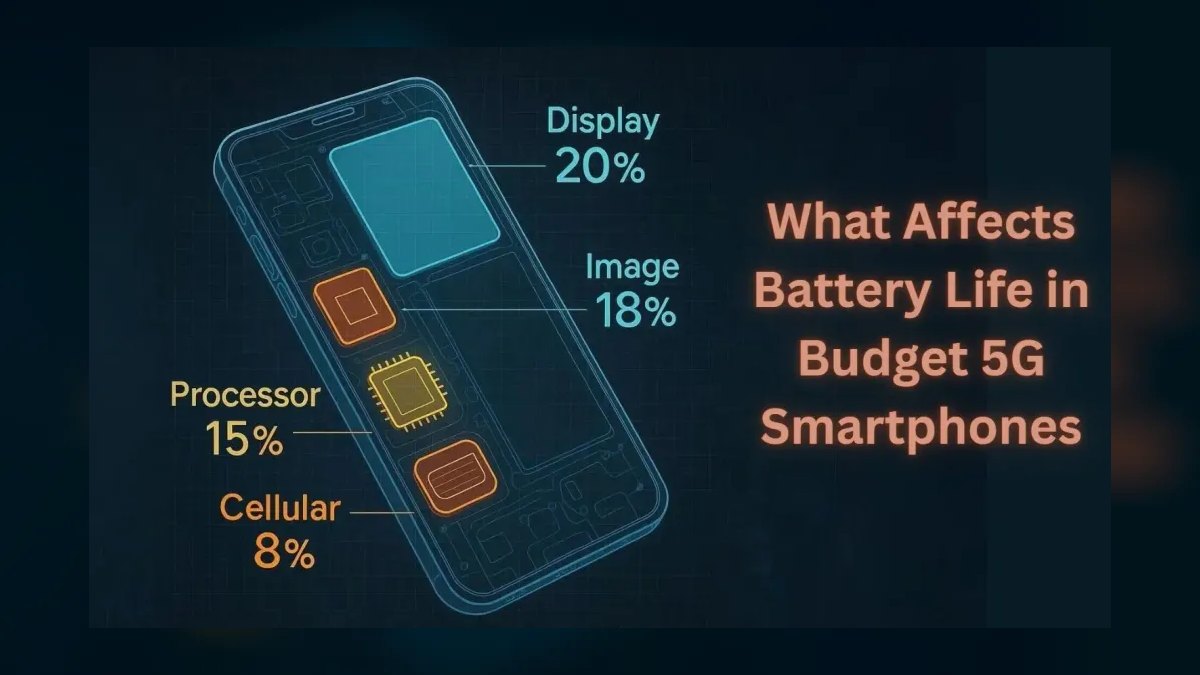
Battery drain during this process follows a predictable structure. The display at high outdoor brightness is often the single largest consumer. The image signal processor and neural engine spike during capture. The modem draws power if the phone offloads any processing or syncs the photo. And crucially, heat generated by these components raises the internal resistance of the battery itself, so a hot phone extracts less usable energy from the same nominal capacity.
The second half of the mechanism is the battery chemistry itself. The meaningful hardware shift heading into 2027 is silicon-carbon anode technology replacing conventional graphite. Silicon holds substantially more lithium per unit volume, so a silicon-carbon cell packs more watt-hours into the same physical space. In practice this has let manufacturers move from roughly 4,500–5,000 mAh in a standard flagship body to 5,500–6,500 mAh without making the phone thicker or heavier. The trade-off is that silicon anodes swell and contract more during charge cycles, which historically meant faster degradation — hence "silicon-carbon," where carbon scaffolding constrains that expansion.
The final mechanical piece is the operating system's power governor. Both major platforms now profile your usage and aggressively restrict background activity for apps you rarely open. This is why two phones with the same cell capacity can differ by three or four hours of real-world endurance: one is spending 8% of its daily budget on background wakeups the other has suppressed.
Real numbers, ranges, and benchmarks to use
Specifications are only useful if you know what range separates good from adequate. Here are the figures that matter for a 2027 purchase, expressed as ranges rather than single model claims.

Battery capacity. A large-body flagship in 2027 typically sits between 5,000 and 6,500 mAh. Compact flagships, which sacrifice volume for one-handed use, generally land between 3,900 and 4,700 mAh — and that gap of roughly 1,500 mAh is worth about three to five hours of mixed screen-on time. Some large-battery Android models aimed specifically at endurance push past 6,500 mAh, occasionally toward 7,000 mAh, almost always by using silicon-carbon chemistry and accepting a slightly thicker chassis.
Screen-on time. This is the number to demand from reviews, not standby time. A strong 2027 flagship delivers roughly 7 to 9 hours of mixed screen-on time — a blend of browsing, video, social apps, and some camera use — at moderate brightness. Anything above 9 hours is genuinely exceptional. Below 5.5 hours means you will be hunting for a charger on a busy day. Beware of tests conducted at 200 nits indoors; outdoor use at 800–1,500 nits can cut screen-on time by 30–40%.
Camera drain rate. Continuous 4K/60 recording typically costs 10–20% of a full charge per ten minutes, depending heavily on ambient temperature. At 1080p/30 that drops to roughly 4–8% per ten minutes. Still photography with heavy HDR processing runs about 1–2% per twenty shots. If you shoot a lot, budget 25–35% of your daily battery for the camera alone.
Sensor size. This matters more than megapixel count. Main sensors on 2027 flagships commonly range from about 1/1.5-inch to 1-inch diagonal. The jump from 1/1.7-inch to 1/1.3-inch is roughly a doubling of light-gathering area, which translates to visibly cleaner shadows and shorter exposures indoors. Ultrawide and telephoto sensors are almost always smaller — often 1/2.5-inch to 1/3-inch — which is why secondary cameras degrade faster as light drops.

Aperture and stabilization. Main cameras cluster around f/1.4 to f/1.8. Telephoto lenses typically run f/2.4 to f/3.5, meaning a 5x telephoto may be gathering a small fraction of the light the main camera does. Optical image stabilization is essentially universal on main cameras now; sensor-shift stabilization is the stronger implementation and appears mostly on premium models. Check specifically whether the ultrawide and telephoto have OIS — many do not, and that is where handheld low-light shots fall apart.
Optical zoom. Meaningful ranges are 2x to 3x for a short telephoto, 5x for the common periscope configuration, and 10x on a few extended-range flagships. "100x" numbers are digital upscaling of a 5x or 10x optical capture and should be treated as a novelty, not a purchasing criterion. Between optical stops — say at 8x on a phone with 5x and 10x lenses — the phone crops and upscales, and quality dips noticeably.
Charging speed. Wired charging in 2027 spans roughly 25W to 120W. The practical translation: 25–30W means about 90–110 minutes to full; 65W means roughly 40 minutes; 100W and above can mean 20 minutes or less. Wireless charging ranges from about 15W to 50W. Faster charging generates more heat, and heat is the primary driver of long-term battery degradation, which is why some manufacturers deliberately cap speeds.

Battery longevity. The current benchmark to look for is a manufacturer rating of 80% or more of original capacity retained after 1,000 full charge cycles. Older standards were 800 cycles, and some 2027 models claim 1,200 to 2,000. For a typical user charging roughly once a day, 1,000 cycles is about three years. This single number does more to determine whether a phone still feels good in year four than almost any camera specification.
Software support. Update commitments now range from four to seven years of OS versions. This matters for cameras specifically, because image processing improves through software: night mode algorithms, portrait segmentation, and video stabilization all get materially better through updates on hardware that has not changed. A seven-year commitment means your camera keeps improving for most of the phone's life.
Brightness. Peak brightness figures of 2,000–4,500 nits are typically small-window HDR highlight measurements, not full-screen. Full-screen outdoor brightness is more commonly 1,000–1,800 nits. High brightness is what makes a phone usable for framing photos in sunlight — and it is also the largest battery drain in exactly that scenario.
Trade-offs, alternatives, and where the money actually goes
Every meaningful choice in this category is a trade-off, and most buyers get the priority order wrong.

Size versus endurance. This is the least negotiable trade-off in the segment. Battery capacity is a function of physical volume, and no chemistry advance has repealed that. A compact flagship will always have meaningfully less endurance than its large sibling with the same chip and software. If all-day battery life is your top requirement, you are buying a large phone — 220 grams or more — and you should decide whether you actually want to carry that.
Zoom reach versus low-light quality. Periscope telephoto modules require a folded optical path, which constrains sensor size and aperture. A 5x periscope with a small sensor at f/3.4 produces excellent daylight results and disappointing indoor results, where the phone often quietly substitutes a digital crop from the main sensor instead. If most of your photography is indoors or at night, a phone with a superb main camera and a modest 2–3x telephoto will outperform a zoom specialist in practice.
Charging speed versus battery lifespan. Very fast charging is genuinely convenient and genuinely harder on the cell. Manufacturers mitigate it with dual-cell architectures, aggressive thermal management, and by tapering speed sharply after 50–60%. The published "0–100 in X minutes" figure is dominated by the fast early phase. If you charge overnight, moderate charging plus an 80% charge limit is the better long-term choice; if you charge in 20-minute bursts during the day, fast charging earns its cost.

Flagship versus upper-mid-range. The gap has narrowed considerably. A well-chosen upper-mid-range phone in 2027 typically delivers 85–90% of flagship main-camera quality in good light, comparable or better battery endurance (because these phones often use large batteries and less power-hungry chips), and faster charging. What you lose is telephoto quality, low-light and video performance, RAW processing depth, sustained thermal headroom, and years of software support. The honest summary: if you shoot mostly daylight stills for social media, the premium tier is hard to justify. If you shoot video, low light, or zoom, it is not.
Computational processing versus optical hardware. Some manufacturers lean on software; others lean on glass and sensors. Software-first phones tend to produce more consistent results with less user skill required, and they improve over time via updates. Hardware-first phones produce better raw files and more headroom for editing, but require more from the photographer. Neither approach is superior — they suit different users.
Ecosystem lock-in versus best-in-class hardware. If you own a smartwatch, earbuds, tablet, and laptop from one manufacturer, switching platforms carries a real cost in features you lose — message continuity, device handoff, unlocked-by-watch, shared clipboards. That cost is legitimate and often outweighs a modest camera advantage on the other side. Be honest about it rather than pretending hardware specs decide alone.
New flagship versus last year's flagship. Year-over-year camera and battery improvements in this category have become incremental. Buying the previous generation's premium model at a discount frequently beats buying the current mid-tier model at full price, and you still get several years of remaining software support. Check the update commitment start date, not the purchase date.

Common pitfalls and how to avoid them
Trusting megapixel counts. The most common mistake. A high-megapixel sensor with weak processing produces noisier, softer results than a moderate-resolution sensor with a strong pipeline. Judge by sample images at 100% crop in low light, not by the number on the box.
Reading only video-playback battery tests. Looped video playback is the easiest possible workload — hardware decoders are extremely efficient and the CPU idles. It tells you almost nothing about a day that involves navigation, camera use, and cellular data. Look for screen-on-time results from mixed-use testing, and specifically for camera drain figures.
Ignoring sustained performance. Peak benchmark scores are captured in the first 60 seconds. What matters for camera quality is the score after 20 minutes of load, when the phone is hot. Look for stress-test results showing sustained performance as a percentage of peak; a phone holding 70%+ will keep shooting good video, while one dropping to 45% will throttle mid-recording.
Overvaluing charging wattage. A 120W figure sounds transformative and mostly is not, once you account for tapering and the fact that most charging happens while you sleep. Worse, chasing peak wattage can push you toward phones with shorter cycle life.

Buying zoom you will never use. Check your existing photo library. Most people's shots are overwhelmingly at 1x, with a small fraction at 2x. If that describes you, spending several hundred dollars on periscope reach buys you very little, and the money is better spent on a larger main sensor.
Ignoring the ultrawide. Manufacturers economize here. An ultrawide with a small sensor and no autofocus produces soft corners and unusable indoor shots. If you shoot landscapes, interiors, or group photos, check ultrawide samples specifically — it is where the quality gap between price tiers is widest.
Neglecting battery health settings. Both major platforms offer optimized charging and 80% charge limits. Enabling an 80% limit costs you some daily runtime but can substantially extend the number of cycles before noticeable degradation. If you have a charger available during the day, this is a strong trade. Also avoid leaving the phone at 100% in a hot car — heat plus high state of charge is the worst combination for cell chemistry.

Assuming the camera app defaults are optimal. Most phones ship with aggressive sharpening and saturation tuned for small-screen viewing. If you print or edit, shoot in the RAW or ProRAW-equivalent mode and check whether a "natural" color profile exists. Also disable any automatic scene-optimizer that oversaturates skies if you want accurate color.
Forgetting that display settings dominate battery. Dropping from a fixed 120 Hz refresh rate to an adaptive mode, and from maximum to auto brightness, routinely recovers 15–25% of daily battery on the same hardware. Before concluding a phone has poor endurance, verify these settings.
Buying on launch-day reviews alone. Camera firmware in the first month is frequently immature; several manufacturers have shipped meaningful image-quality fixes four to eight weeks after launch. If you can wait, reviews written two months in are far more predictive of what you will actually own.
Skipping the return window test. Whatever you buy, run the realistic day described at the top of this page within your return period. Shoot the volume you actually shoot, in the light you actually shoot in, and see where the battery sits at dinner. Specifications cannot answer that; your own day can.
Related questions
Does a bigger battery always mean longer battery life?
No. Endurance is capacity multiplied by efficiency. Chip process node, display refresh behavior, and the OS power governor's handling of background tasks can swing real-world results by several hours between phones with identical cell capacities. Screen-on time is the meaningful number.
Is fast charging bad for battery health?
It accelerates degradation modestly, mainly through heat. Manufacturers offset this with dual-cell designs and speed tapering. The practical mitigation is enabling optimized or 80%-limited charging when you do not need a full tank, and avoiding fast charging in hot environments.
How much does camera use actually drain the battery?
Substantially. Continuous 4K recording commonly costs 10–20% of a charge per ten minutes; heavy HDR stills run roughly 1–2% per twenty shots. Budget a quarter to a third of your daily battery if you are a heavy shooter, and more in direct sunlight.
Are mid-range phone cameras good enough now?
For daylight stills viewed on a phone screen, largely yes — the main-camera gap has narrowed to around 10–15%. The gap remains wide in low light, video stabilization, telephoto quality, and RAW editing headroom, which is where flagship spending still buys real capability.
What single specification predicts long-term satisfaction best?
The battery cycle-life rating combined with the software support window. A phone rated for 1,000+ cycles at 80% capacity with six or seven years of updates will still feel usable and keep gaining camera improvements long after a shorter-supported rival has degraded.
FAQ
Should I prioritize battery life or camera quality?
Decide by auditing your actual behavior for one week. If you routinely reach evening under 20% charge, endurance is your constraint and you should buy the largest-battery phone you are willing to carry. If you finish most days above 40%, you have headroom to spend on camera capability instead. Most people misjudge this and buy for the trip they take twice a year rather than the day they have two hundred times.
What battery capacity should I look for in 2027?
Between 5,000 and 6,500 mAh in a full-size phone, ideally with silicon-carbon chemistry. Below 4,500 mAh in a large phone is a warning sign in this generation. But treat capacity as a starting filter only — verify it with a screen-on-time figure of 7 hours or more from mixed-use testing before you commit.
Do more camera lenses mean better photos?
No. Lens count describes versatility, not quality. A phone with two excellent cameras will outperform one with four mediocre ones on the shots you actually take. Evaluate each lens on its own sensor size, aperture, and whether it has optical stabilization, then ask honestly how often you would use the third and fourth.
How do I stop my phone from overheating while recording video?
Drop from 4K/60 to 4K/30 or 1080p/60, which cuts the encoding and processing load significantly. Keep the phone out of direct sun, remove thick insulating cases during long recordings, and disable unnecessary background sync. If the phone still throttles within ten minutes, its thermal design is the limiting factor and no setting fully compensates.
Is it worth upgrading from a two-year-old flagship?
Usually not for camera quality alone — generational gains are now incremental, and software updates have already delivered much of the improvement to your existing phone. Battery degradation is the more common legitimate reason. A battery replacement often costs a fraction of a new phone and restores most of the endurance you have lost.
How long should a phone battery last before it needs replacing?
Expect noticeable decline around 2.5 to 3 years of daily charging, corresponding to roughly 800–1,000 cycles. Phones rated for 1,000+ cycles at 80% retention will stretch that further. Check your phone's battery health readout: below about 80% of original capacity, a replacement typically restores several hours of daily runtime.
Sources
- https://www.gsmarena.com/battery-test.php3
- https://www.dxomark.com/smartphones/
- https://www.consumerreports.org/electronics/cell-phones/
- https://support.apple.com/en-us/HT208387
- https://support.google.com/pixelphone/answer/10011348
- https://www.energy.gov/eere/vehicles/articles/how-does-lithium-ion-battery-work
- https://www.rtings.com/phone
- https://www.notebookcheck.net/Smartphone-Reviews.6.0.html
- https://www.which.co.uk/reviews/mobile-phones
Related on PULSE
- [How do I stop feeling invisible in group conversations with extroverts](/knowledge/ed1098)
- [Top 10 hiking gear upgrades that are worth the money in 2027](/knowledge/ed1097)
- [How do I say no to a promotion without looking unmotivated](/knowledge/ed1096)
- [Best upright vacuums for stairs and small apartments in 2027](/knowledge/ed1095)
@Kory-White- · if Venmo asks, the last 4 of my number are 2012
 edBest running shoes for flat feet and knee pain in 2027
 edWhat are the top 10 cities for remote workers in Latin America for 2027
 edHow do I stop comparing my career progress to my friends
 edWhat are the top 10 family-friendly vacation spots in the U.S. for 2027
 edBest credit cards for travel rewards in 2027
 edBest noise-cancelling headphones for open offices in 2027
 edBest ways to make passive income with a full-time job in 2027
 edBest electric bikes for commuting under $2,000 in 2027
 edHow to give constructive feedback to a peer who's senior to you
 edHow to handle a friend who constantly one-ups your accomplishments