
How to politely end a conversation at a networking event
 Curated byKory White · Fractional CRO · Maryland
 PULSEKNOWLEDGE LIBRARY
End a networking conversation politely by exiting on a high note: thank the person specifically, state a brief honest reason for moving on, and name the next step. "I've really enjoyed this — I want to meet a few more people before the keynote. Can I connect with you on LinkedIn tonight?" Then step back, smile, and go.
What a graceful exit actually is and why it matters
A polite exit is not an escape. It is the closing move of a short business interaction, and like the close of a sales call it determines what the other person remembers. Psychologists studying how people recall experiences have repeatedly found that endings carry disproportionate weight in memory — the last thirty seconds of a five-minute conversation will color the whole thing. That is why the mechanics of leaving deserve as much thought as the opening handshake.
The practical stakes are concrete. A typical two-hour evening networking event gives you roughly 90 minutes of usable floor time once you subtract arrival, the bar line, and any program. If your average conversation runs eight minutes, you meet about eleven people. If it runs twenty minutes because you cannot bring yourself to leave, you meet four or five. Over a year of monthly events, that is the difference between roughly 130 new contacts and roughly 55. Nothing about the difference is charisma. It is entirely exit discipline.
The reputational stakes matter more than the arithmetic. Industry rooms are small and recurring. The person you left badly at a March event is standing next to your prospect in September. People forgive an awkward opener because everyone has fumbled one; they remember being abandoned mid-sentence, being handed a card and watched as you scanned past their shoulder, or being told a transparent lie about a phone call that never rang. Those three moves are the most common exit failures, and all three are avoidable with about fifteen seconds of structure.
There is also a mercy dimension people underrate. The other person usually wants out too. Both parties are standing on hard floors holding drinks, both have a list of people they hoped to meet, and both are waiting for permission to move. When you exit cleanly and warmly, you are not rejecting them — you are releasing them, and doing the socially harder job on their behalf. Skilled networkers are known for this. They are the ones who make a room feel easy, and they get invited back.
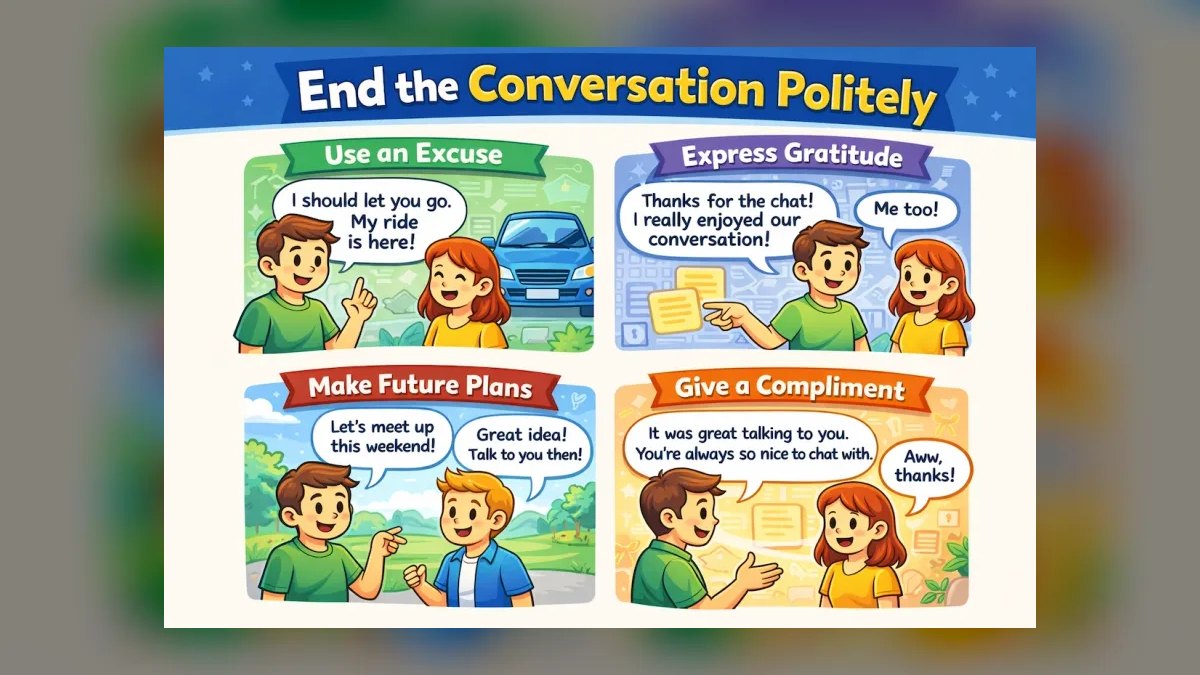
Finally, an exit is where follow-up gets built or lost. The conversation itself rarely produces the business outcome. The LinkedIn request that night, the email Tuesday, the coffee in three weeks — that is where value appears, and every one of those is set up (or not) in the last two sentences you say before you walk away. Treat the exit as the handoff between the event and the relationship, and it stops feeling rude.
The step-by-step process for leaving well
The sequence below takes twelve to twenty seconds and works in almost any room. Rehearse it once out loud before you go, in your own words, so it does not sound scripted when you need it.
Step one — pick the moment, not the lull. Most advice says wait for a pause. Do the opposite: leave right after a laugh, a shared conclusion, or a genuinely good point one of you just made. Waiting for a dead spot means you exit on a dead spot, and that is what the person will remember. If you have been talking six to ten minutes and the last exchange landed well, that is your moment.
Step two — signal with your body before your mouth. Shift your weight to your back foot. Angle one shoulder and one foot slightly toward the room. Let a beat of eye contact go to the crowd and come back. This is the polite part: you are giving a two-second warning so your words are not a surprise. What you must not do is look at your phone or your watch — those read as boredom and are the single fastest way to turn a fine exit into an insult.

Step three — deliver the specific thank-you. Not "nice meeting you," which is wallpaper. Name the thing: "Your point about pricing the pilot separately is going to save me an argument next week." Specificity proves you were listening, and it is the sentence they will repeat to a colleague later.
Step four — give the honest reason. Short, true, not apologetic. "I want to catch two more people before the session," or "I'm heading to the panel," or simply "I'm going to keep circulating." Honesty beats invention here — seasoned attendees can hear a manufactured phone call, and if they later see you laughing at the bar the fabrication is exposed for no gain.
Step five — set the next touchpoint. "Can I send you a LinkedIn request tonight?" or "Send me that report and I'll read it this week." Asking rather than announcing gives them an easy yes and turns the exit into an agreement rather than a departure.
Step six — close physically and move. Handshake if that suits the room and the culture, a real smile, then actually walk. Do not linger for another ninety seconds after your exit line; that is the awkwardness people blame on the exit itself when it was really the loitering.

Step seven — write the detail down. Within five minutes, in the hallway or the bathroom, put one line in your phone: name, company, the one specific thing. This is what makes the follow-up message good rather than generic, and it is the step almost everyone skips.
Timing, ranges, and what the clock actually looks like
Useful numbers make this concrete rather than theoretical, and most people's instincts about event pacing are wrong in the same direction — they stay too long with too few people.
Conversation length. For a first meeting at a general mixer, five to ten minutes is the working range. Under three minutes reads as dismissive unless it is an explicit "grab a card" moment. Past fifteen you are monopolizing someone at an event whose entire purpose is circulation, and past twenty-five you have effectively turned a networking event into a private meeting — fine if you have both agreed to that, rude if only one of you has.
Event math. A two-hour reception nets roughly 80 to 100 minutes of floor time. At eight minutes plus a two-minute transition, that is eight to ten real conversations. Set a target before you walk in — five good conversations is a strong evening for most people, and it is far better than fifteen shallow ones or two long ones.

Conference-scale events. A three-day conference with two receptions and open expo hours can produce 30 to 50 conversations. At that volume the exit is not optional politeness, it is throughput, and the note-taking step becomes mandatory because you will not remember conversation eleven by Thursday.
Signal timing. The body-language warning should precede your first word by two to three seconds. Any less and the words arrive cold; any more and you are visibly edging away while they are still talking.
Follow-up windows. Send the LinkedIn request the same night or the next morning while the face is still attached to the name — after roughly 48 hours recognition drops noticeably and your note has to work harder. A substantive email or call request lands well in the two-to-five-day window: long enough not to seem breathless, short enough that the event is still recent. Anything past two weeks needs a reason for the delay built into the first line.
Cost framing. The event ticket is rarely the real cost. A $75 chamber mixer plus travel and two hours of your evening prices out somewhere north of $200 of your time for most professionals; a $2,000 conference plus flights and hotel runs $4,000 to $6,000 all-in. Divide by conversations that produced a follow-up. Eight qualified follow-ups from a $200 evening is $25 a contact. Two from the same evening is $100 a contact, and the difference was entirely how long you stood in the first conversation.

Follow-through rate. Only promise follow-ups you will execute. If you make eight commitments and honor three, you have not built a network — you have quietly told five people you are unreliable. A useful rule: if you are not confident you will send it within a week, do not offer it. "Great to meet you, enjoy the rest of the evening" is a complete and perfectly polite ending with no promise attached.
Where people get the exit wrong
Over-apologizing. "I'm so sorry, I really have to run, sorry —" Three apologies frame your departure as an offense you are begging forgiveness for, which invites the other person to feel offended. Replace apology with gratitude: "Thank you — this was genuinely useful." Confident is polite. Sorry is not.
Inventing an excuse. The phantom phone call, the imaginary colleague, the sudden bathroom emergency. These fail for two reasons: experienced attendees recognize them, and they are falsifiable within the same hour. You do not need a reason more dramatic than "I want to meet a few more people," which is why everyone is there.

Trailing off. Starting a sentence, drifting, and physically leaving mid-thought is the version that genuinely stings, because the other person cannot tell whether they said something wrong. Finish the sentence. Land the ending.
Card-first exits. Pressing a business card into someone's hand as a closing move converts a conversation into a transaction. Offer contact details when there is a reason to be in touch, and prefer asking for theirs over pushing yours — the person who asks controls the follow-up anyway.
Leaving someone stranded. This is the one people actually mean when they say abandoning someone is rude. The fix is a bridge: turn and introduce them before you go. "Priya, have you met Marcus? He's dealing with the same integration mess you were describing." You leave, they gain a conversation, and you look like the most connected person in the room. It costs about ten seconds and it is the single highest-return exit move available.
Phone as prop. Pulling out your phone to manufacture an interruption is read correctly by everyone, every time. Scanning the room is socially acceptable; scanning your screen is not.
The ambiguous handshake. A handshake with no words can mean goodbye or can mean nothing at all, and the person is left guessing whether you have gone. Pair every physical close with a verbal one.
Hovering after the exit line. You said you were going. Go. Standing there for another minute makes the earlier line look like a failed attempt and forces both of you to do it again.
The persistent talker. Occasionally someone will not take normal signals. Escalate gently and in order: use their name to reclaim attention ("John — I've really enjoyed this, and I need to step away"); pick up your drink or bag as a visible preparation; repeat the same calm line once more without new justification, because adding reasons invites debate. If they are still going, the bridge move rescues you — hand them to someone else, or use a genuine third party: "There's someone I promised to catch before they leave." Two calm repetitions resolve nearly all of these. What never helps is a fake emergency.
Choosing the right exit for the situation
Not every conversation ends the same way, and matching the exit to the context is most of what "polite" means in practice.
High-value contact, mutual interest. Exit early and deliberately while things are still good, and convert to a scheduled next step rather than a vague one: "I don't want to burn your whole evening on me — can we do twenty minutes by phone next week? I'll send an invite tomorrow." Then actually send it tomorrow. Leaving a great conversation early is counterintuitive and it works; it leaves an open loop instead of an exhausted one.
Pleasant but not relevant. Warmth without a commitment. "This was a fun tangent — enjoy the rest of the evening." No card, no promise, no follow-up implied. Manufacturing a next step you will not honor is worse than a clean, friendly ending.
Group conversation. Exiting a group is easier than a one-on-one because your absence does not end anything. Wait for someone else to hold the floor, then a small nod to the group, a quiet "I'm going to grab a drink — good to meet you all," and step out. No speech required.
Someone who is stuck or struggling. If they are new, nervous, or clearly alone, use the bridge. Introducing them to one other person before you leave is the kindest thing you can do at a networking event, and it takes almost no time.

Someone pitching you hard. Be direct and finite: "I'm not the right buyer for this, but I appreciate you explaining it. Enjoy the event." Politeness here means clarity, not a soft maybe that costs them a week of follow-up.
The venue-driven exit. Sessions starting, the bar closing, a room emptying — these are free, blameless exit ramps. Use them: "I'm heading into the panel, this was great." Nobody reads that as rejection.
A note on culture and format. Handshakes are not universal — in some regions and for some individuals a nod or a slight bow is the norm, and post-pandemic many people still prefer no contact. Read the room and default to a warm verbal close, which works everywhere. In virtual events the same structure applies with different mechanics: name the specific thing, state you are moving to another room or dropping, send the connection request in chat before you go, then leave rather than lingering silently on camera.
Practicing until it stops feeling awkward
The reason competent adults freeze at this is that they have never rehearsed it, while they have rehearsed their introduction dozens of times. Fix the asymmetry directly.

Write two exit lines in your own words — one for "I want to stay in touch" and one for "this was pleasant, that's all" — and say them aloud five times before an event. Five repetitions is enough to stop the sentence from arriving as an improvisation, which is where the stammering and over-apologizing come from.
Set a soft timer for the first month. A vibrating ten-minute reminder in your pocket is not a rule you must obey; it is a prompt to ask yourself whether this conversation has more in it. Most of the time the answer is no and you simply forgot to check.
Debrief after each event with three questions: how many conversations, how many exits felt clean, and how many follow-ups did you actually send. The third number is the one that improves slowest and matters most. People who track it for three events typically double it, not by meeting more people but by promising less and delivering more of it.
Finally, watch the person in the room who everyone seems glad to see. They are almost always leaving conversations faster than you are, and almost always introducing people as they go. That combination — brief, warm, generous with introductions — is the entire skill.
Related questions
How long should a first networking conversation last?
Five to ten minutes at a general mixer. Under three feels dismissive; past fifteen you are monopolizing someone at an event built for circulation. Extend only if you both clearly want to, and consider moving that conversation to a scheduled call instead.
Is it rude to leave without saying goodbye?
Yes. Slipping away leaves the person unsure whether you are returning and looking like they are talking to nobody. A five-second verbal close — thanks, brief reason, warm goodbye — costs nothing and prevents the only genuinely rude version of leaving.
Should I hand over my business card as I leave?
Prefer asking for theirs, or asking to connect on LinkedIn. Pushing an unsolicited card at the end reads transactional. Offer yours when they ask or when you have agreed on something specific to send.
What if I have forgotten their name?
Skip the name entirely: "It was great meeting you." If you need it for a follow-up, ask plainly — "Remind me how you spell your name so I can find you on LinkedIn?" People find this normal and mildly flattering, not embarrassing.
Can I use humor to end a conversation?
Yes, if it is light and never at their expense. "I should circulate before I become furniture" works. Sarcasm about the event, the food, or other attendees does not — it dates you to their memory as the person who complained.
FAQ
What is the single best exit line to memorize?
"It was really good meeting you — I'm going to catch a few more people before the session. Can I connect with you on LinkedIn tonight?" It thanks them, gives an honest reason everyone accepts, and converts the ending into a next step, all in about eight seconds.
How do I get away from someone who will not stop talking?
Escalate calmly in three moves: say their name to reclaim attention and state you need to step away; pick up your drink or bag as visible preparation; repeat the same line once without adding new reasons. If needed, introduce them to someone else and leave. Avoid fake emergencies — they are transparent and they backfire.
Is it acceptable to say I want to meet other people?
Yes, and it is the most honest reason available. Everyone at a networking event is there for the same purpose, so "I want to meet a few more people before the keynote" reads as normal and intentional rather than as rejection.
What should I do if the other person clearly wants to leave first?
Let them, and make it easy. When you notice drifting eye contact, an empty glass, or questions drying up, take the lead yourself: "I've enjoyed this — I won't monopolize your evening." Releasing someone first is generous and leaves a strong final impression.
Does a handshake end a conversation on its own?
No. A handshake alone is ambiguous — it can read as goodbye or as nothing. Always pair the physical close with a spoken one, and remember handshakes are not universal; a warm verbal close works in every room and every culture.
How soon should I follow up after the event?
Send the LinkedIn request the same night or next morning while your face is still attached to your name. A more substantive email or meeting request lands well two to five days out. Reference one specific detail from the conversation rather than sending a generic note.
Sources
- https://hbr.org/2016/05/learn-to-love-networking
- https://www.forbes.com/sites/forbescoachescouncil/
- https://www.themuse.com/advice/how-to-gracefully-exit-a-conversation
- https://www.inc.com/guides/networking
- https://www.psychologytoday.com/us/basics/networking
- https://www.linkedin.com/business/talent/blog
- https://hbr.org/2021/09/how-to-network-when-youre-an-introvert
- https://www.toastmasters.org/resources
- https://www.entrepreneur.com/topic/networking
Related on PULSE
- [How do I start a conversation with someone I admire at a networking event](/knowledge/ed1023)
- [How do I stop feeling invisible in group conversations with extroverts](/knowledge/ed1098)
- [How do I follow up after meeting someone at a conference](/knowledge/ed1099)
- [How do I say no to a promotion without looking unmotivated](/knowledge/ed1096)
- [How do I introduce two people who should know each other](/knowledge/ed1100)
@Kory-White- · if Venmo asks, the last 4 of my number are 2012
 edBest running shoes for flat feet and knee pain in 2027
 edWhat are the top 10 cities for remote workers in Latin America for 2027
 edHow do I stop comparing my career progress to my friends
 edWhat are the top 10 family-friendly vacation spots in the U.S. for 2027
 edBest credit cards for travel rewards in 2027
 edBest noise-cancelling headphones for open offices in 2027
 edBest ways to make passive income with a full-time job in 2027
 edBest smartphones for battery life and camera quality in 2027
 edBest electric bikes for commuting under $2,000 in 2027
 edHow to give constructive feedback to a peer who's senior to you