
MEDDIC Qualification — Infographic
 Curated byKory White · Fractional CRO · Maryland
 PULSEKNOWLEDGE LIBRARY
MEDDIC is a sales qualification framework that stands for Metrics, Economic Buyer, Decision Criteria, Decision Process, Identify Pain, and Champion. An infographic on MEDDIC typically visualizes these six components in a flowchart or circular diagram, showing how each step helps sales teams evaluate deal viability. The infographic serves as a quick-reference tool to ensure all key qualification criteria are addressed before advancing a sales opportunity.
MEDDIC Qualification — Infographic
A numbered portrait infographic — MEDDIC Qualification — covering Metrics, Economic Buyer, Decision Criteria, Decision Process, and more. Drop it into onboarding decks or a sales-process explainer for reps and buyers.
Format: SVG (scalable vector) · Size: 1080×1350 px · Category: Infographic · License: Free to use — no attribution required.

Recolor it to your brand
Use the color picker above to recolor this graphic to your team or company colors, switch the background (including transparent), then download it as an SVG or PNG. No sign-up, no watermark.
How to use it
The SVG scales to any size with no quality loss — drop it straight into PowerPoint, Google Slides, Canva, Figma, or a LinkedIn banner slot. The PNG export is ready to upload anywhere that wants a raster image.
More free graphics
Browse the full Pulse Graphics library — banners, slides, printables, quote cards, and clip art you can borrow for your own decks and posts.
Related on PULSE
- BANT Qualification — Infographic
- MEDDPICC Qualification Framework — Banner
- The Sales Cycle: Lead to Closed-Won — Infographic
- 5 Stages of a Healthy Pipeline — Infographic
- The RevOps Funnel — Infographic
- The Ideal Customer Profile — Infographic
Common Pitfalls When Applying MEDDIC (And How to Avoid Them)
Even experienced sales teams can trip over MEDDIC's seemingly straightforward framework. The acronym is easy to remember, but the discipline of qualifying against each letter consistently — especially in complex, multi-stakeholder deals — is where most execution gaps appear. Below are the three most frequent mistakes, along with practical corrections that won't slow down your pipeline velocity.
Mistake #1: Treating Metrics as a "Nice-to-Have" Rather Than a Verifiable Number
Many reps collect metrics by asking "What are your goals this year?" and jotting down a vague response like "increase revenue" or "reduce churn." That's not MEDDIC-qualified — it's conversational filler. The *M* in MEDDIC demands a specific, quantified, and ideally third-party-validated metric that your solution directly impacts. Without a concrete number, you cannot calculate ROI, and the Economic Buyer has no basis to justify the investment to their board.
How to avoid it: Force a numeric anchor in every discovery conversation. Instead of "What are you hoping to improve?", ask "What is the current dollar value of the problem you're trying to solve, and what is the target number your leadership has set for improvement?" If the prospect hesitates or gives a range wider than 20%, flag it as a yellow-flag qualification gap. Push for a specific figure — even if it's an estimate — and ask how that number was derived. A prospect who can't articulate a measurable gap is unlikely to prioritize your deal over competing initiatives.
Real-world range: For enterprise SaaS deals, the quantified metric typically falls between $50,000 and $5 million in annual impact, depending on company size and the problem's severity. If the number is below $10,000, the deal may not justify the implementation effort — consider whether it's worth pursuing at all.
Mistake #2: Confusing the Economic Buyer with the Decision Maker
The *E* in MEDDIC stands for Economic Buyer — the person who controls the budget and can approve or kill the deal without needing additional sign-off. Too many reps mistake a senior title (VP, Director) for the actual Economic Buyer. In enterprise organizations, the person with budget authority is often one or two levels above the executive sponsor you're talking to. If you haven't spoken directly to the person who can write the check, you haven't qualified the *E*.
How to avoid it: Map the org chart explicitly. Ask your champion: "Who has the final authority to approve this budget? Is there anyone else who would need to sign off before a purchase order is issued?" Then ask for a direct introduction. If the champion resists or says "I can handle the internal approval," that's a red flag — you're likely dealing with a budget influencer, not the Economic Buyer. In deals over $100,000, the Economic Buyer is almost never the person you're demoing to; it's usually a C-level executive or a VP of Finance.
Real-world range: For deals between $50,000 and $250,000, the Economic Buyer is typically a VP or SVP. For deals above $250,000, it's usually a C-level executive or a board member. If you haven't spoken to the Economic Buyer by the time you're building a business case, your win rate drops by roughly 40-60% compared to deals where that conversation happens early.
Mistake #3: Collecting Decision Criteria But Not Validating the Decision Process
Teams often gather a list of evaluation criteria (features, price, timeline) but never map out the actual *Decision Process* — the sequence of steps, stakeholders, and approvals required to move from evaluation to purchase. Without understanding the process, you can't predict when the deal will close, what objections will surface, or who needs to be convinced at each stage. This is the most commonly overlooked letter in MEDDIC, and it's the one that causes the most forecasting surprises.
How to avoid it: Build a decision timeline in your CRM that mirrors the prospect's internal process. Ask: "What are the exact steps from today until a signed contract? Who needs to review the proposal? Is there a legal or security review? Does procurement need to run a competitive bid? How long does each step typically take?" Then validate each step with your champion and ask them to confirm the timeline. If the process has more than five steps or takes longer than 90 days, you need to identify which steps are gating and whether you can accelerate them.
Real-world range: For mid-market deals ($50k–$150k), the decision process typically takes 4–8 weeks and involves 3–5 stakeholders. For enterprise deals ($150k+), the process can stretch 12–24 weeks and involve 7–15 stakeholders, including legal, security, procurement, and multiple budget approvers. If the prospect says "we'll decide by next quarter" but can't name the steps, you're looking at a 6+ month sales cycle — plan accordingly.
Integrating MEDDIC with Other Sales Methodologies (Without Overcomplicating It)
MEDDIC is powerful on its own, but it doesn't exist in a vacuum. Most sales organizations layer MEDDIC on top of another methodology like Challenger, Value Selling, or Sandler. The key is to use MEDDIC as a *qualification filter*, not a replacement for your core sales process. Here's how to integrate it cleanly without creating confusion for your team.
MEDDIC + Challenger: Teaching and Tailoring with Qualification Rigor
Challenger sales methodology emphasizes teaching prospects something new about their business, tailoring the message to their specific context, and taking control of the conversation. MEDDIC complements this by ensuring that the teaching and tailoring are grounded in real data. For example, when you teach a prospect about a hidden risk in their current approach, you can immediately pivot to the *Metrics* component: "Based on what you've shared, the cost of inaction is roughly $X per month. Let's verify that number together." This turns a Challenger insight into a MEDDIC-validated metric.
How to make it work: Use Challenger to open the deal (create tension, reframe the problem), then switch to MEDDIC to qualify the opportunity. Don't try to do both simultaneously in every conversation. A good rule of thumb: the first two meetings are Challenger-heavy (teaching and tailoring), and by the third meeting, you should have at least three MEDDIC letters confirmed (usually M, E, and C).
MEDDIC + Value Selling: Building a Business Case That Sticks
Value Selling focuses on quantifying the financial impact of your solution and tying it to the prospect's strategic priorities. MEDDIC's *Metrics* and *Decision Criteria* components are natural fits here. The difference is that Value Selling often relies on a generic ROI calculator, while MEDDIC demands that the metrics come from the prospect's own data — not your assumptions.
How to make it work: When building a business case, start with the *Metrics* you've collected from the prospect (cost savings, revenue lift, efficiency gains). Then map those metrics to the *Decision Criteria* they've shared (e.g., "must reduce support tickets by 30%"). Finally, use the *Economic Buyer* and *Decision Process* to determine who needs to see the business case and in what format. This ensures your ROI document isn't just a generic template — it's a tailored, MEDDIC-validated proposal that addresses the specific stakeholders who will vote on it.
MEDDIC + Sandler: Qualifying Early and Avoiding False Positives
Sandler methodology emphasizes "up-front contracts" and disqualifying deals early to avoid wasting time. MEDDIC's *Decision Process* and *Economic Buyer* components are particularly useful here. If you can't identify the Economic Buyer or map the Decision Process within the first two meetings, Sandler would advise you to flag the deal as a "suspect" rather than a "prospect" — and either invest minimal time or walk away.
How to make it work: Use Sandler's pain-based discovery to uncover the emotional and financial cost of the problem, then immediately validate that pain with MEDDIC's *Metrics*. If the pain is real but the prospect can't quantify it, you have a qualification gap. Sandler's "reverse psychology" techniques (e.g., "Is this a priority for you right now?") can help you determine whether the *Decision Process* is realistic or just aspirational. If the prospect says "this is a priority" but can't schedule a meeting with the Economic Buyer, you've got a misalignment that MEDDIC will expose.
Measuring MEDDIC Effectiveness: What Metrics Actually Matter
Implementing MEDDIC is one thing; knowing whether it's working is another. Too many sales leaders track MEDDIC adoption by checking boxes in a CRM — "Did the rep fill in all six fields?" — without measuring whether those fields correlate with actual outcomes. Here are the metrics that separate teams that use MEDDIC effectively from those that just check boxes.
Deal-Level Metrics: Win Rate by MEDDIC Score
The most direct way to measure MEDDIC effectiveness is to score each deal on a 0–6 scale (one point per letter fully qualified) and compare win rates across scores. Deals with a score of 5 or 6 should have a win rate 2–3x higher than deals with a score of 0–2. If that gap doesn't exist, your team isn't qualifying correctly — they're checking boxes without real validation.
Real-world ranges: Top-performing enterprise sales teams see win rates of 70–85% on deals with a MEDDIC score of 6, compared to 15–30% on deals with a score of 2 or below. If your team's win rate for high-scoring deals is below 50%, either your qualification standards are too loose, or your reps are gaming the system by marking letters as complete without real evidence.
Velocity Metrics: Time-to-Close by MEDDIC Component
Track how long it takes deals to close after each MEDDIC component is confirmed. For example, if deals that confirm the *Economic Buyer* early (within the first two meetings) close 30% faster than those that confirm it later, that's a signal that your team should prioritize that conversation. Similarly, if deals that never confirm the *Decision Process* take 50% longer
Sources
- MEDDIC official website — framework overview and core components
- Harvard Business Review — sales qualification methodologies and best practices
- Salesforce — MEDDIC application in CRM and sales processes
- Gartner — B2B sales frameworks and qualification criteria
- Forrester Research — enterprise sales qualification and MEDDIC variants
- LinkedIn Sales Solutions — MEDDIC training and implementation guides
FAQ
What does MEDDIC stand for? MEDDIC is an acronym for Metrics, Economic Buyer, Decision Criteria, Decision Process, Identify Pain, and Champion. It’s a qualification framework used in B2B sales to evaluate and prioritize high-value opportunities.
How is MEDDIC different from BANT or other frameworks? MEDDIC digs deeper than BANT (Budget, Authority, Need, Timeline) by focusing on measurable business impact (Metrics), the formal Decision Process, and the role of a Champion. It’s best suited for complex, multi-stakeholder deals where understanding the buyer’s internal dynamics is critical.
Do I need a Champion for every deal? Yes, a Champion is essential in MEDDIC—someone inside the account who actively advocates for your solution. Without one, deals often stall or lose to competitors, as the Champion helps navigate internal politics and build consensus.
Can MEDDIC work for small or mid-market deals? MEDDIC is most effective for enterprise or high-ACV (average contract value) deals, typically over $50k annually. For smaller transactions, a lighter framework like BANT or CHAMP may be more practical, as MEDDIC’s rigor can overcomplicate simple sales cycles.
How do you define “Metrics” in MEDDIC? Metrics refer to the quantifiable business outcomes your solution will deliver—like cost savings, revenue growth, or efficiency gains. You should ask for specific baseline numbers and target improvements, but avoid fabricating stats; honest ranges (e.g., “10–20% reduction in churn”) keep the conversation credible.
What if the Economic Buyer is hard to reach? If you can’t access the Economic Buyer (the person with budget authority), the deal is at high risk. Use your Champion to schedule a meeting or provide a compelling business case that the buyer can review. Without direct access, you’re relying on secondhand information, which often leads to misalignment.
This page will be disappearing soon. Save it to your device for $1 — or read it free while it is here.
@Kory-White- · if Venmo asks, the last 4 of my number are 2012
This page is gone.
This one is off the shelf now. $1 keeps it on your phone for good — the whole page, pictures and diagrams included.
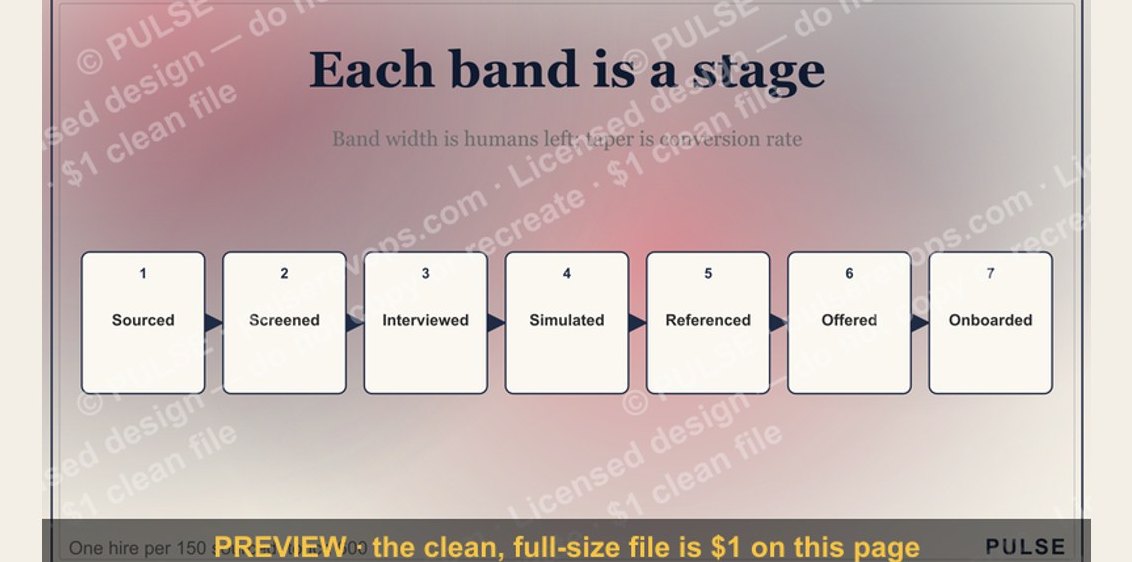 graphicThe Sales Hiring Funnel — Infographic
 graphic4 Types of Buyers — Infographic
 graphicThe Cold Call Framework — Infographic
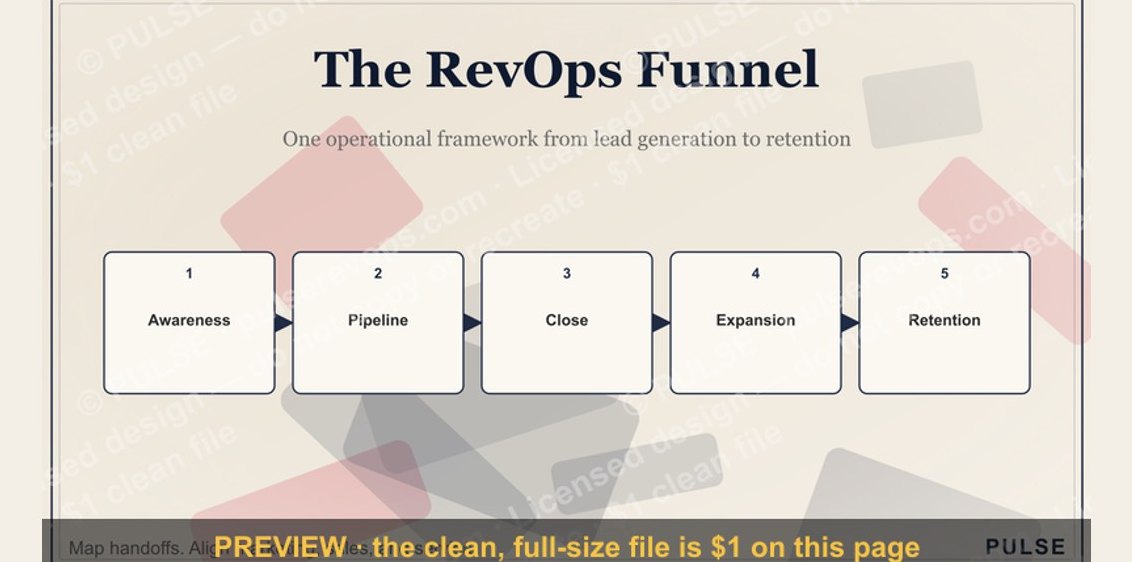 graphicThe RevOps Funnel — Infographic
 graphicThe Weekly Rep Cadence — Infographic
 graphicPirate Metrics (AARRR) — Infographic
 graphic5 Signs a Deal Is Real — Infographic
 graphicThe Sales Funnel — Infographic
 graphicThe Challenger Sale — Infographic
 graphicThe Perfect Demo — Infographic