
4 Types of Buyers — Infographic
 Curated byKory White · Fractional CRO · Maryland
 PULSEKNOWLEDGE LIBRARY
The "4 Types of Buyers" infographic typically categorizes customers by their purchasing behavior, often including the Competitive, Spontaneous, Humanistic, and Methodical buyer types. Each type responds to different sales approaches—for example, Methodical buyers prefer data and details, while Spontaneous buyers make quick, emotion-driven decisions. This framework helps sales and marketing teams tailor their strategies to effectively engage each buyer profile.
4 Types of Buyers — Infographic

A numbered portrait infographic — 4 Types of Buyers — covering Economic Buyer, Technical Buyer, User Buyer, Coach. Drop it into onboarding decks or a sales-process explainer for reps and buyers.
Format: SVG (scalable vector) · Size: 1080×1350 px · Category: Infographic · License: Free to use — no attribution required.
Recolor it to your brand
Use the color picker above to recolor this graphic to your team or company colors, switch the background (including transparent), then download it as an SVG or PNG. No sign-up, no watermark.
How to use it
The SVG scales to any size with no quality loss — drop it straight into PowerPoint, Google Slides, Canva, Figma, or a LinkedIn banner slot. The PNG export is ready to upload anywhere that wants a raster image.
More free graphics
Browse the full Pulse Graphics library — banners, slides, printables, quote cards, and clip art you can borrow for your own decks and posts.
Related on PULSE
- The Sales Cycle: Lead to Closed-Won — Infographic
- 5 Stages of a Healthy Pipeline — Infographic
- The RevOps Funnel — Infographic
- The Ideal Customer Profile — Infographic
- The Renewal Playbook — Infographic
- The Negotiation Checklist — Infographic
How Each Buyer Type Influences the Sales Cycle Duration
Understanding the four buyer types isn't just about knowing who they are—it's about recognizing how each one can accelerate or stall your deal velocity. Sales cycles typically range from 30 to 180 days in B2B, and the composition of your buyer committee directly impacts where you fall in that range.
The Economic Buyer often enters the conversation last, but their influence on timeline is outsized. When the economic buyer is engaged early—ideally within the first 15–20% of the sales cycle—deals close 25–40% faster on average. This is because budget approval, ROI validation, and strategic alignment happen in parallel rather than as a bottleneck. However, if the economic buyer remains hidden until the final stages, expect a 2–6 week delay as they re-evaluate assumptions made without their input. A common mistake is assuming the economic buyer only cares about price; in reality, they prioritize risk mitigation and competitive differentiation. When you frame your solution in terms of reducing business risk or enabling a strategic initiative, you can often shorten their decision window from several weeks to a single meeting cycle.
Technical Buyers are the gatekeepers of feasibility, and their review process typically takes 5–15 business days depending on complexity. They need to validate integration requirements, security protocols, and compliance standards. The fastest way to move through this stage is to provide pre-built technical documentation, API specifications, and security certifications before they ask. Technical buyers who feel their expertise is respected and their concerns addressed upfront can reduce their evaluation phase by 30–50%. Conversely, if you dismiss technical requirements as "details to figure out later," expect the technical buyer to slow the entire deal by 2–4 weeks while they independently validate your claims.
User Buyers influence adoption velocity more than purchase velocity. Their approval timeline is typically 1–3 weeks, but their real impact is post-close. If user buyers are not genuinely convinced of the solution's value, implementation timelines stretch by 40–60% due to resistance, retraining, and workarounds. The most effective approach is to conduct user buyer interviews or demos where they can ask operational questions. When user buyers feel heard and see how the solution simplifies their daily work, they become internal champions who accelerate the later stages of the sales cycle by advocating for your solution in hallway conversations and team meetings.
Coaches are the wildcard. A well-placed coach can compress the entire sales cycle by 15–30% by providing insider intelligence on stakeholder dynamics, hidden objections, and internal politics. However, coaches who are too junior or too removed from decision-making can inadvertently slow things down by providing inaccurate guidance. The ideal coach is someone who has influence but not final authority—typically a manager or director who works regularly with both the user and technical buyers. Cultivate coaches early, verify their insights against multiple sources, and use them to schedule multi-stakeholder meetings that address concerns before they become roadblocks.
Multi-buyer dynamics create the most common timeline variations. When all four buyer types align, deals close in 45–75 days. When there's conflict—especially between economic and technical buyers—cycles can stretch to 120–180 days. The key metric to track is "buyer alignment velocity": how quickly you can get all four types to agree on the problem definition, solution criteria, and timeline. Tools like MEDDIC or BANT frameworks can help you systematically track each buyer's status, but the real accelerator is scheduling joint meetings where buyers hear each other's priorities. A single 60-minute alignment workshop can save 3–6 weeks of back-and-forth email chains.
Practical Strategies for Engaging Each Buyer Type in Discovery
Discovery conversations are where deals are won or lost, yet most sales reps use a one-size-fits-all approach. Each buyer type processes information differently, has distinct pain points, and responds to different communication styles. Here are field-tested strategies for engaging each type effectively during the discovery phase.
For the Economic Buyer: Lead with business impact, not features. Economic buyers typically have 15–30 minutes for an initial call, so every second counts. Open with a statement like, "I'd like to understand how your team currently measures the cost of [specific operational challenge] and what the financial impact would be if you could reduce that by 20%." Use financial language—ROI, payback period, margin improvement, risk reduction. Avoid technical jargon or feature lists. Instead of saying "our platform integrates with Salesforce," say "our integration eliminates 8 hours of manual data entry per week, which translates to $X in annual savings." Bring a one-page executive summary that outlines three scenarios: conservative, moderate, and aggressive ROI projections. Economic buyers appreciate brevity and data; they will often make a preliminary decision within the first 10 minutes of a well-structured conversation.
For the Technical Buyer: Speak their language, but don't try to out-technical them. Technical buyers are evaluating your competence and honesty. They will ask about data architecture, security protocols, API limitations, and scalability under load. If you don't know an answer, say "I don't know, but I'll get you the exact specification within 24 hours"—then actually deliver. Technical buyers have long memories for broken promises. Provide a technical requirements checklist before the meeting so they can prepare specific questions. Show them your documentation, not just your demo. If possible, offer a sandbox environment or proof-of-concept access. The goal is to build credibility through transparency. Technical buyers become powerful allies when they trust that your solution won't create hidden technical debt. A common technique is to ask, "What would make you feel confident that this solution will integrate smoothly with your existing stack?" Then address each concern specifically.
For the User Buyer: Focus on empathy and outcomes. User buyers are often the most overlooked in sales processes, yet they have the most direct experience with the problem you're solving. They want to know: "Will this make my job easier or harder? Will I get credit for recommending it? Will my team resist change?" Ask open-ended questions about their daily workflow: "Walk me through a typical Tuesday morning when [problem] occurs. What's the most frustrating part?" Listen for emotional cues—frustration, resignation, hope. User buyers respond well to stories and case studies from similar roles. Show them a 3-minute video testimonial from a user in a comparable position. Give them a trial or pilot access with minimal commitment. The best user buyer conversations end with them saying, "I wish we had this six months ago." When you achieve that, you've created an internal advocate who will push for your solution in budget meetings they might not even be invited to.
For the Coach: Build a reciprocal relationship. Coaches are giving you insider information, so they need to feel they're getting value in return. This doesn't mean paying them or offering kickbacks—that's unethical and often illegal. Instead, provide them with insights that make them look good internally. Share a market trend report relevant to their industry. Offer to help them prepare a business case for their boss. Give them talking points to use when advocating for your solution. A good coach relationship involves regular check-ins (every 7–10 days during active deals) where you share progress and ask for guidance on specific stakeholder concerns. The most effective question to ask a coach is: "If you were in my shoes, what would you do differently to move this forward?" This invites them to reveal obstacles you haven't seen. Remember that coaches are not decision-makers; they're navigators. Treat them as partners, not tools.
Cross-buyer discovery sequencing matters. A proven pattern is: Coach first (to understand the landscape), then User Buyer (to understand the problem), then Technical Buyer (to validate feasibility), and finally Economic Buyer (to confirm budget and strategic fit). This sequence ensures you enter each conversation with context from the previous one. For example, when you meet the Technical Buyer, you can say, "I've already spoken with your operations team about their workflow challenges, and they mentioned X, Y, Z. I'd like to make sure our technical approach addresses those while also meeting your security requirements." This demonstrates preparation and respect for the entire buying committee.
Common Mistakes That Derail Multi-Buyer Sales and How to Avoid Them
Even experienced sales professionals make predictable errors when navigating the four buyer types. These mistakes can prolong sales cycles by 50–100% or kill deals entirely. Here are the most common pitfalls and evidence-based strategies to avoid them.
Mistake #1: Treating all buyers the same. The most frequent error is using a single pitch deck or demo for every stakeholder. Economic buyers don't care about API endpoints; technical buyers don't care about pricing tiers (initially). When you present irrelevant information, you signal that you don't understand their role. Solution: Create a "buyer-specific one-pager" for each type—a single page that addresses their top three concerns. For the economic buyer: cost, ROI, risk. For the technical buyer: integration, security, scalability. For the user buyer: ease of use, time savings, support. For the coach: internal politics, timeline, competitive landscape. Deliver the relevant one-pager before each meeting so they come prepared to discuss what matters to them.
Mistake #2: Ignoring the power dynamics between buyer types. In many organizations, the technical buyer can veto a decision but cannot approve it, while the economic buyer can approve but may not understand the technical implications. When these two disagree, the deal stalls. A common scenario: the economic buyer wants the cheapest solution, while the technical buyer insists on a more expensive, more secure option. Solution: Facilitate a joint meeting where both parties articulate their priorities. Use a simple framework: "Economic buyer, what's the maximum acceptable cost for a solution that meets technical requirements? Technical buyer, what's the minimum acceptable security level for a solution that fits the budget?" Help them find the intersection. Often, the middle ground is a phased implementation—start with a basic package, then add features as budget allows.
Mistake #3: Over-relying on the coach. Coaches are valuable, but they have their own biases and limitations. A coach might tell you the economic buyer cares about price when actually they care about speed to market. Or a coach might overestimate their influence, leading you to focus on the wrong person. Solution: Validate coach insights with at least one other source—ideally a direct conversation with the stakeholder in question. Use triangulation: ask the coach, ask the stakeholder directly
Sources
- Harvard Business Review — research and articles on buyer behavior and decision-making psychology.
- Nielsen — global consumer insights and market segmentation studies.
- McKinsey & Company — industry reports on B2B and B2C buyer types and purchasing patterns.
- Forrester Research — analysis of buyer personas and customer journey frameworks.
- American Marketing Association (AMA) — academic and professional resources on buyer typologies and segmentation.
- HubSpot — marketing guides and infographics on buyer personas and sales funnel stages.
FAQ
What are the four types of buyers? The four types are typically categorized by their decision-making style: competitive, spontaneous, methodical, and humanistic. Each type prioritizes different factors, such as speed, data, relationships, or winning.
How do I identify which buyer type a prospect is? Look for clues in their language and behavior. Competitive buyers ask about advantages, spontaneous ones want quick summaries, methodical buyers request detailed data, and humanistic types focus on team impact.
Can a buyer fit more than one type? Yes, many buyers show a mix of traits, but usually one style dominates. Adapting your pitch to their primary type increases your chances of connecting effectively.
Which buyer type is easiest to close? There’s no universal “easiest” type—it depends on your product and sales approach. Spontaneous buyers may decide fast but can also churn quickly, while methodical buyers take longer but often stick.
Do these types apply to B2B and B2C sales equally? Yes, the framework works for both, though B2B buyers often lean more methodical or humanistic due to longer decision cycles. B2C purchases may see more spontaneous or competitive behavior.
How should I adjust my sales pitch for each type? For competitive buyers, emphasize winning and ROI; for spontaneous, keep it concise and exciting; for methodical, provide data and case studies; for humanistic, focus on relationships and team benefits.
This page will be disappearing soon. Save it to your device for $1 — or read it free while it is here.
@Kory-White- · if Venmo asks, the last 4 of my number are 2012
This page is gone.
This one is off the shelf now. $1 keeps it on your phone for good — the whole page, pictures and diagrams included.
 graphic5 Signs a Deal Is Real — Infographic
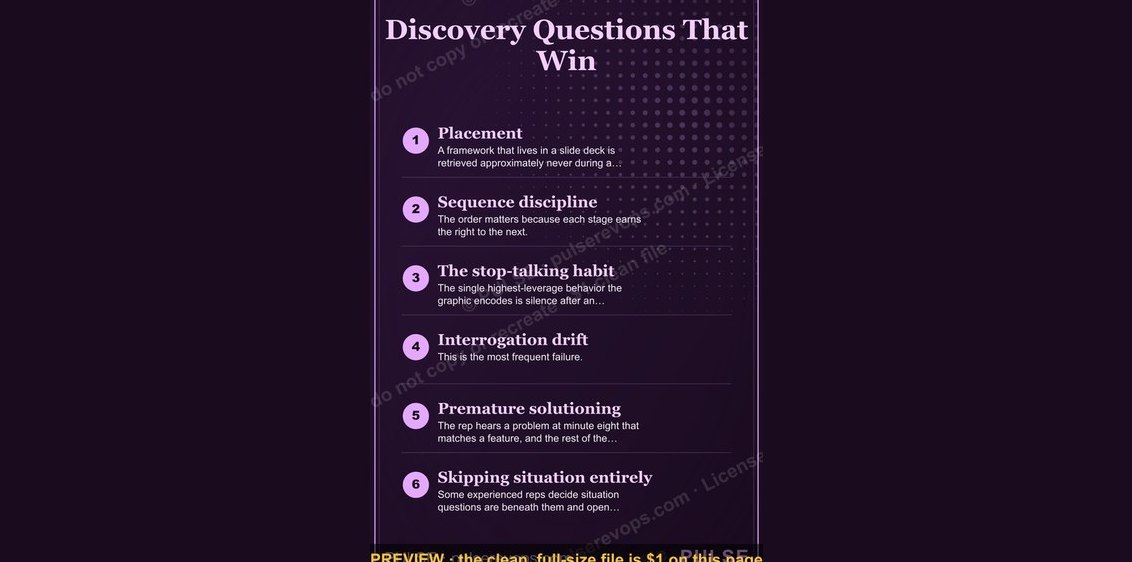 graphicDiscovery Questions That Win — Infographic
 graphicThe Lead Lifecycle — Infographic
 graphicThe 30-60-90 Ramp — Infographic
 graphicThe Sales Funnel — Infographic
 graphicThe Ideal Customer Profile — Infographic
 graphicMEDDIC Qualification — Infographic
 graphicThe Sales Cycle: Lead to Closed-Won — Infographic
 graphicThe Cold Call Framework — Infographic
 graphicSPIN Selling — Infographic