
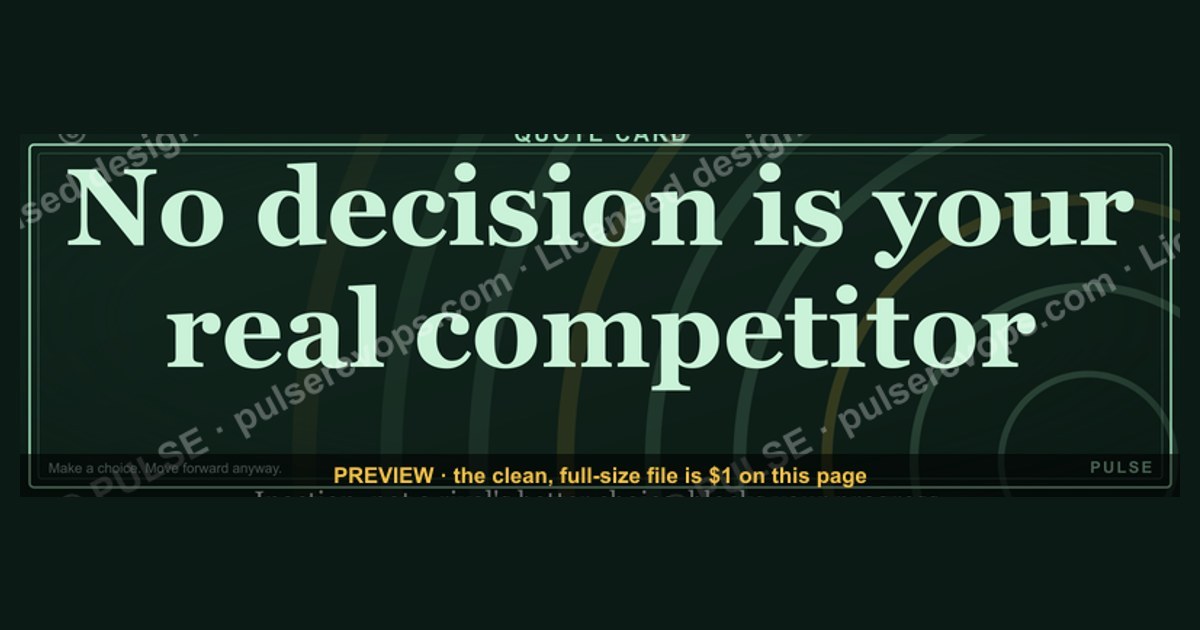
“No decision is your real competitor.” — Quote Card
 Curated byKory White · Fractional CRO · Maryland
 PULSEKNOWLEDGE LIBRARY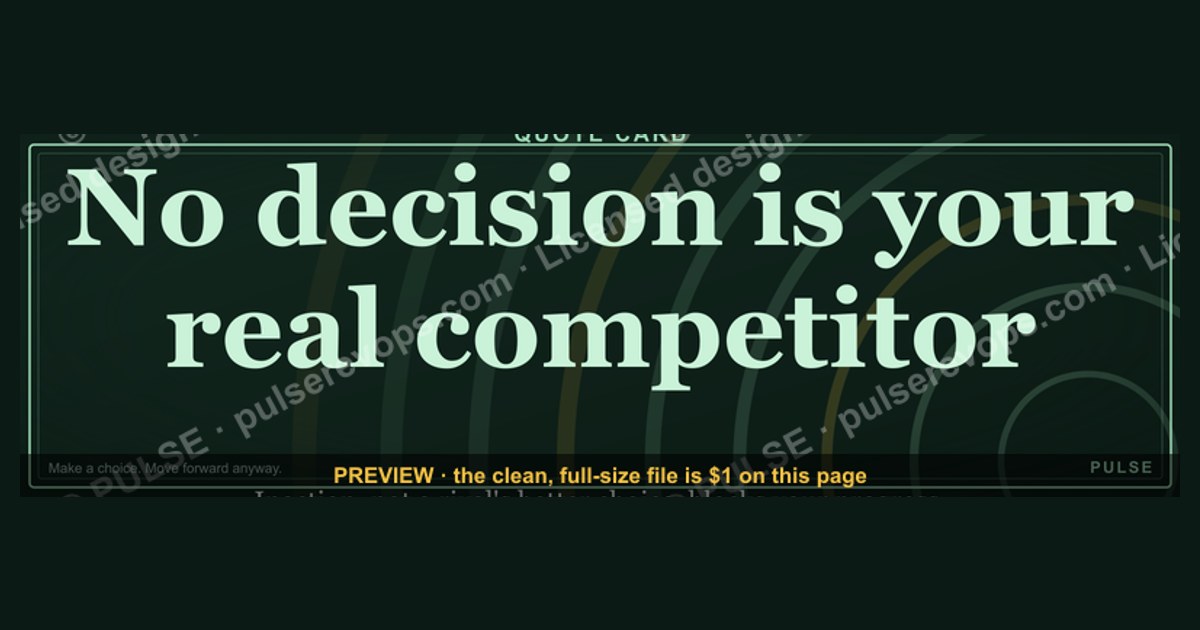
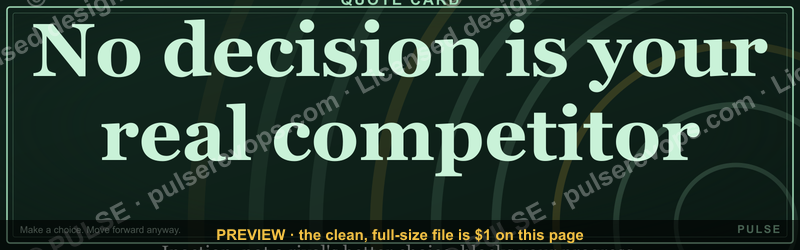
This quote card serves as a visual reminder that inaction, rather than a rival's better choice, is often the true obstacle to progress. The message suggests that making any decision—even an imperfect one—is more productive than remaining stuck in indecision. It encourages the viewer to move forward rather than letting the fear of making the wrong choice become their biggest barrier.
“No decision is your real competitor.” — Quote Card

A square social quote card — "No decision is your real competitor." in the Pulse accent style. A shareable LinkedIn or Instagram graphic and a ready slide pull-quote.
Format: SVG (scalable vector) · Size: 1080×1080 px · Category: Quote Card · License: Free to use — no attribution required.
Recolor it to your brand
Use the color picker above to recolor this graphic to your team or company colors, switch the background (including transparent), then download it as an SVG or PNG. No sign-up, no watermark.
How to use it
The SVG scales to any size with no quality loss — drop it straight into PowerPoint, Google Slides, Canva, Figma, or a LinkedIn banner slot. The PNG export is ready to upload anywhere that wants a raster image.
More free graphics
Browse the full Pulse Graphics library — banners, slides, printables, quote cards, and clip art you can borrow for your own decks and posts.
Related on PULSE
- “No decision is the real competitor.” — LinkedIn Banner
- “BOUGHT THE COMPETITOR” — Sales Meme
- Hire Decision Framework
- Renewal Risk Decision Tree
- Pricing Discount Decision Tree
- Real Estate CRO — LinkedIn Banner
Why “No Decision” Is the Hidden Sucking Sound in Your Pipeline
Every sales leader has felt it: the deal that goes dark, the prospect who stops returning emails, the opportunity that slips from “closed this quarter” to “maybe next quarter” to “we’ll circle back.” Conventional wisdom blames the competitor who undercut your price, the product gap you couldn’t close, or the champion who left the company. But more often than not, the real thief is something far more mundane: indecision.
When a buyer chooses your competitor, you lose that deal. When a buyer chooses nothing at all, you lose time, momentum, and the probability that they’ll ever choose anyone. Research across B2B buying cycles suggests that 40–60% of qualified opportunities end in “no decision” rather than a competitive loss. That means the biggest competitor you face isn’t Acme Corp or MegaSoft — it’s the status quo, dressed up in the guise of “we need more data,” “let’s wait until next quarter,” or “the timing isn’t right.”
Indecision is a sucking sound in your pipeline because it consumes your team’s energy without producing a win or a clean loss. Unlike a competitive loss, which teaches you something about positioning or pricing, a no-decision outcome leaves you with nothing — no feedback, no learnable moment, just a hole where a deal used to be. The quote card’s message cuts to the chase: your real competitor isn’t the other vendor; it’s the buyer’s inability to commit.
The antidote starts with recognizing that indecision is rarely about your product. It’s about fear — fear of making the wrong choice, fear of internal pushback, fear of being the person who championed a change that doesn’t work. When you frame your sales process around reducing that fear, you stop competing against the void and start competing on value. The best sales teams don’t just sell a solution; they sell the confidence to decide.
The Psychology of Indecision: Why Buyers Stall and What to Do About It
To beat “no decision,” you have to understand why it happens. Buyers stall for three primary reasons, and each requires a different response.
Reason 1: Analysis Paralysis. When a buyer faces too many options, too much data, or too many stakeholders, the brain defaults to inaction. This is the classic “we need to see more case studies” stall. The fix? Force a small decision early. Instead of asking for a final yes, ask for a five-minute meeting to review a single use case. Each micro-decision builds momentum. Research in behavioral economics suggests that breaking a large decision into 3–5 smaller commitments can increase conversion rates by 30–50% in complex B2B sales.
Reason 2: Risk Aversion. The buyer’s career is on the line. If they choose you and it goes wrong, they look bad. If they choose nothing, they stay safe — even if the status quo is slowly killing their business. This is where your sales process must shift from “why you should buy” to “why it’s safe to buy.” Guarantees, pilot programs, and reference calls from similar companies in their industry all reduce perceived risk. A common mistake is to overload the buyer with ROI projections when what they really need is a safety net.
Reason 3: Lack of Urgency. The buyer knows they have a problem, but it hasn’t hurt enough yet. Without a burning platform, indecision feels comfortable. Your job is to surface the cost of inaction — not in a pushy way, but through discovery questions that make the buyer articulate the pain themselves. For example: “If nothing changes in the next six months, what’s the impact on your team’s productivity?” When the buyer answers that question, they create their own urgency.
The most effective sales teams build a “decision cadence” into every deal. They set explicit milestones: “By the end of this week, we’ll agree on the top three priorities. By next week, we’ll review the implementation plan. By the third week, we’ll have a proposal.” Each milestone is a mini-decision that makes the final yes feel like the last in a series of small commitments, not a giant leap into the unknown.
How to Build a Sales Process That Kills Indecision
You can’t control whether a buyer decides, but you can control the environment in which they decide. A sales process designed to combat indecision has three structural elements.
Element 1: Pre-commitment at every stage. Before you invest significant time in a demo or proposal, get a pre-commitment. This could be as simple as: “If we show you a solution that meets your top three criteria, will you be ready to move forward with an implementation plan within two weeks?” This isn’t a trick — it’s a filter. Buyers who won’t pre-commit are signaling that they’re not ready to decide, and you’re better off knowing that early. Top-performing sales organizations report that deals with a clear pre-commitment close at rates 2–3 times higher than those without.
Element 2: A decision deadline that’s real, not arbitrary. Many salespeople set fake deadlines (“This pricing expires Friday”) that savvy buyers ignore. Instead, tie the deadline to a real event: a product release, a price increase from your vendor, or the end of a quarter when your implementation team has capacity. When the deadline is genuine, the buyer feels legitimate pressure to decide. If they can’t decide by that date, it’s a signal that the deal isn’t real — and you can move on.
Element 3: A “no decision” plan. Paradoxically, the best way to get a yes is to prepare for a no. At the end of every discovery call, say: “If after our next meeting you decide this isn’t the right fit, I’d appreciate you telling me directly so I can stop pursuing and focus on other clients. Can we agree on that?” This simple request removes the buyer’s ability to ghost you. It also builds trust — you’re not a pushy salesperson; you’re a professional who respects their time. When buyers know they can say no without a fight, they’re more likely to say yes.
The quote card’s message — “No decision is your real competitor” — isn’t just a clever phrase. It’s a strategic lens. When you stop treating indecision as a natural part of the sales cycle and start treating it as the enemy, you change how you qualify leads, how you structure conversations, and how you measure success. Your pipeline will shrink — because you’ll stop chasing deals that were never going to decide. But your win rate will climb, and your team will spend their energy on buyers who are ready to move.
In a world where every salesperson is fighting for attention, the one who can help a buyer decide — quickly and confidently — wins. Not because they have the best product, but because they’ve removed the real competitor: the void of inaction.
Why Indecision Costs More Than a Wrong Choice
The hidden cost of indecision isn't just lost time—it's the compound effect of missed momentum. When you delay choosing, you forfeit learning opportunities that only action provides. A wrong decision usually yields data and experience; no decision yields nothing. This quote card reframes decision-making as a practice of progress, not perfection.
How to Use This Mindset Daily
Start small: set a timer for any pending decision—five minutes for low-stakes choices, a day for bigger ones. When the timer ends, commit to a direction. The goal isn't to eliminate mistakes but to build decisiveness as a habit. Over weeks, this reduces the anxiety that fuels paralysis and turns this quote from a wall decoration into a working philosophy.
The Science Behind Action vs. Inaction
Research in behavioral economics shows that regret from inaction often lingers longer than regret from a poor decision. The brain treats missed opportunities as larger losses than failed attempts. This quote card taps into that insight: by making a choice, you close the door on "what if" and open one to real-world feedback—the only path to genuine improvement.
The Psychology Behind Indecision
Research in behavioral psychology shows that indecision triggers a "paralysis by analysis" state, where the brain's fear of making a wrong choice activates the amygdala—the same region responsible for threat detection. This biological response makes staying stuck feel safer than moving forward, even when inaction carries hidden costs like missed deadlines, lost revenue, or stalled projects. The quote reframes this: your real competitor isn't another person's better strategy, but your own hesitation.
Practical Ways to Break Decision Paralysis
Apply the "two-minute rule" for small choices: if a decision can be made in under two minutes, do it immediately. For larger decisions, use the "10-10-10" framework—ask how you'll feel about this choice in 10 minutes, 10 months, and 10 years. This shifts focus from perfection to progress. Many leaders also use "decision journals" to track outcomes, learning that even imperfect decisions often yield better results than no decision at all.
When No Decision Costs More Than a Wrong One
In business contexts, delayed decisions compound: a hiring freeze that lasts three months can cost 15-30% more in overtime pay or lost productivity than hiring a "good enough" candidate. Similarly, delaying a product launch to chase perfection often lets competitors capture market share. The quote card's message applies directly to these scenarios—making a choice, then iterating, almost always outperforms waiting for the "perfect" moment that never arrives.
Sources
- Harvard Business Review — decision-making frameworks and leadership insights
- McKinsey & Company — strategy and competitive analysis research
- Stanford Graduate School of Business — management decision-making studies
- The Wall Street Journal — business strategy and market competition coverage
- American Psychological Association — cognitive biases and decision psychology
- Forbes — entrepreneurship and competitive strategy articles
FAQ
What does “No decision is your real competitor” mean? It means that indecision—not another company—is often what holds you back. When you delay choosing a direction, you lose momentum and let opportunities slip away.
Is this quote from a specific person or book? The quote is commonly shared in entrepreneurial and productivity circles, but its exact origin is unclear. It’s often attributed to general business wisdom rather than a single author.
How can I apply this quote to my daily work? Use it as a reminder to make timely decisions, even with imperfect information. Instead of waiting for the “perfect” choice, pick a path and adjust as you go—action beats analysis paralysis.
Does this mean I should never delay a decision? Not exactly—some decisions benefit from careful thought. The key is recognizing when delay becomes avoidance, and distinguishing between strategic patience and fear-based inaction.
Can this quote help with team or leadership challenges? Yes, especially when teams get stuck in endless discussion. Sharing the quote can shift focus from overthinking to committing to a plan, which often unblocks progress and builds trust.
Where can I find a physical version of this quote card? The quote card shown is available from Light & Salt Design Co. and similar stationery shops. Prices typically range from $5 to $15, depending on size and set quantity.
This page will be disappearing soon. Save it to your device for $1 — or read it free while it is here.
@Kory-White- · if Venmo asks, the last 4 of my number are 2012
This page is gone.
This one is off the shelf now. $1 keeps it on your phone for good — the whole page, pictures and diagrams included.
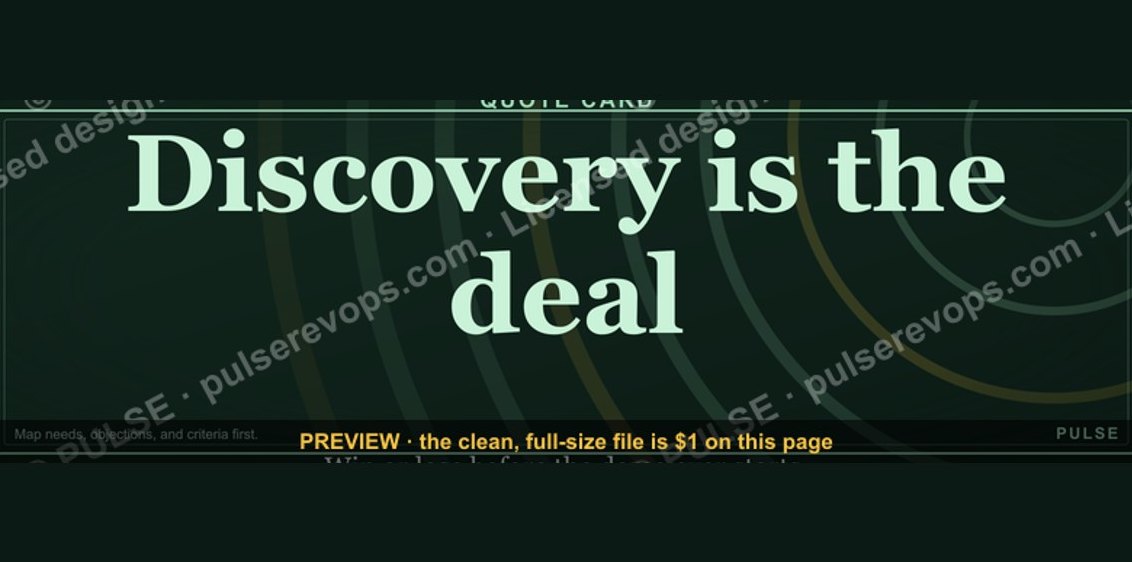 graphic“Discovery is the deal.” — Quote Card
 graphic“Ask better questions.” — Quote Card
 graphic“Coachable beats talented.” — Quote Card
 graphic“Sell the meeting, not the demo.” — Quote Card
 graphic“Every no is closer to a yes.” — Quote Card
 graphic“People buy outcomes, not features.” — Quote Card
 graphic“You can't shrink your way to growth.” — Quote Card
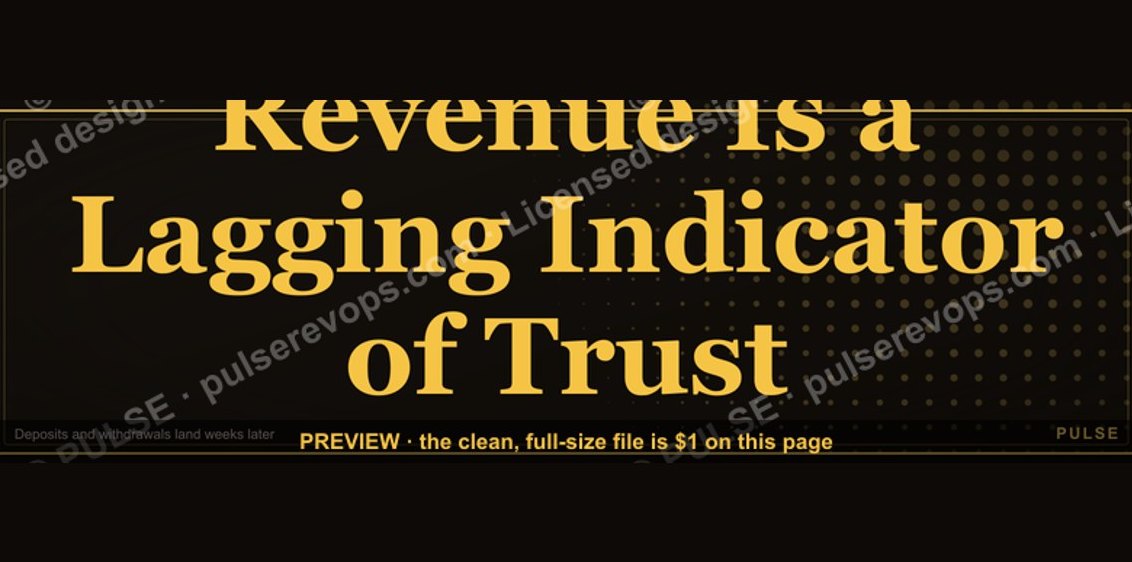 graphic“Revenue Is a Lagging Indicator of Trust” — Quote Card
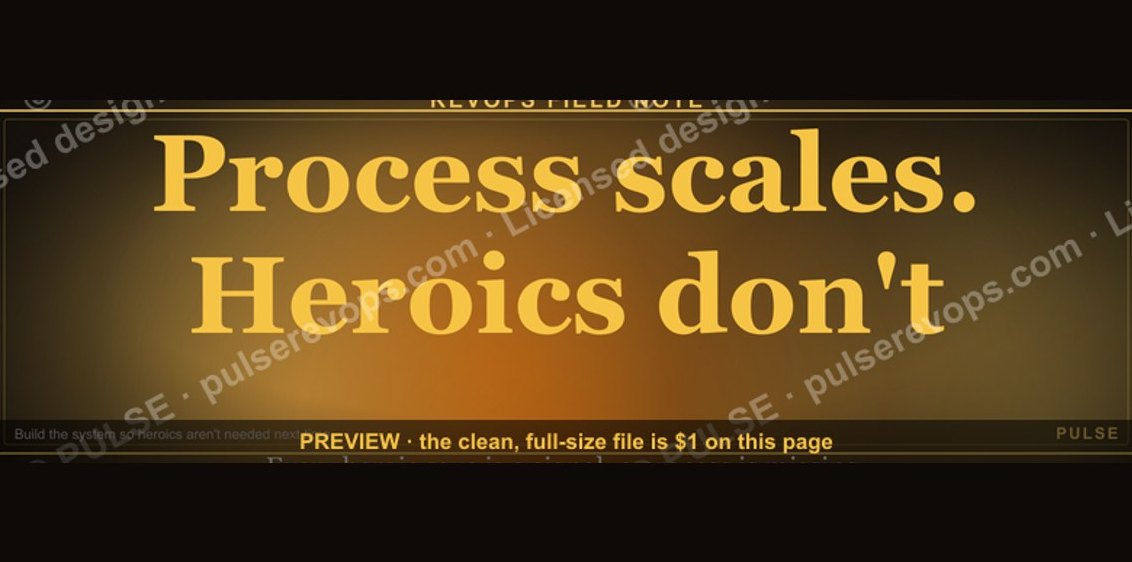 graphic“Process scales. Heroics don't.” — Quote Card
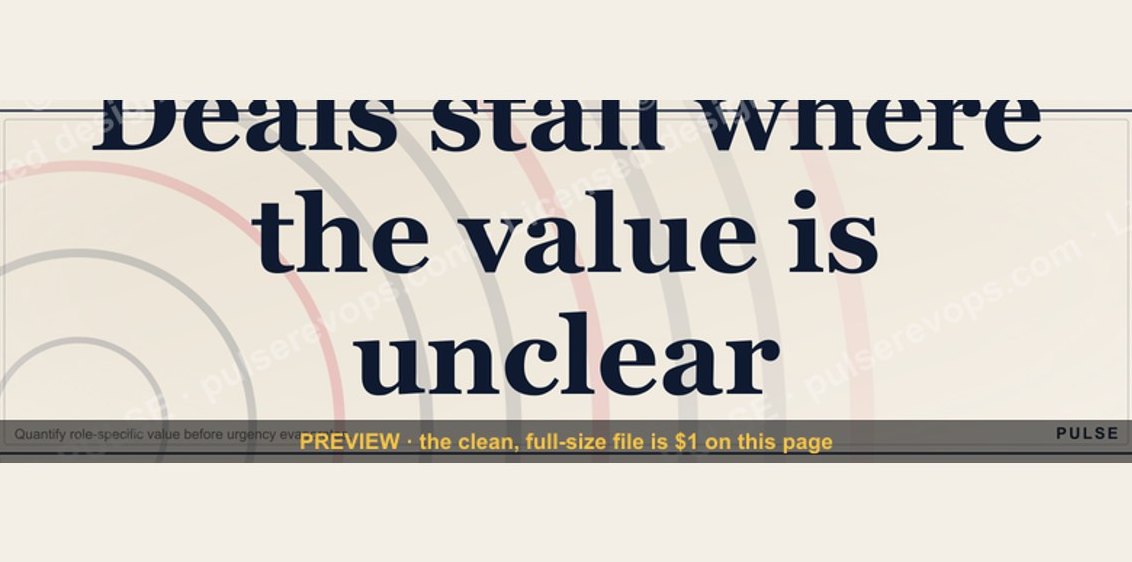 graphic“Deals stall where the value is unclear.” — Quote Card