
“The best discovery feels like free therapy.” — Quote Card
 Curated byKory White · Fractional CRO · Maryland
 PULSEKNOWLEDGE LIBRARY
Quality
Certified

Great discovery feels like free therapy because the buyer does the talking, hears their own situation named out loud, and leaves with more clarity than when they started. The rep asks open questions, reflects the answer back, and resists pitching. That relief — being genuinely understood — is what earns the next meeting.
The call where nobody pitched anything
Picture a 40-minute first call with a VP of Revenue Operations at a 300-person software company. The rep has a demo environment loaded, a slide deck queued, and a battle card open in a second window. None of it gets used. The rep opens with a single question — "walk me through what happens today between a rep marking a deal closed-won and finance recognizing the revenue" — and then says almost nothing for the next eleven minutes.
What comes out is not a requirements list. It is a mess of half-finished projects, a CPQ implementation that stalled in month four, a controller who does not trust the pipeline report, and a CRO who asked for forecast accuracy in the last board meeting and got an answer nobody in the room believed. The VP has never said all of it out loud in one sitting. Halfway through, they stop and say some version of "wow, saying that back to myself, this is worse than I thought" — and then, crucially, they keep going.
That is the moment. The rep did not diagnose anything the buyer did not already know. The rep created a room where the buyer could assemble scattered frustrations into a single narrative. The relief is real, and it is the same relief a good therapist produces: not new information, but new organization of existing information. The buyer arrived with a pile of grievances and left with a problem statement.

Compare that to the more common version of the same call. The rep asks four qualifying questions — budget, timeline, decision process, current tooling — gets four thin answers, and spends the remaining 30 minutes screen-sharing. The buyer learns what the product does. The rep learns almost nothing that was not already in the CRM. Both parties leave having exchanged information. Neither leaves having exchanged understanding. That call has a much lower chance of a second meeting, and the pipeline it creates is the pipeline that dies in stage two with no explanation.
The therapy comparison is not about being a therapist. Reps are not clinicians, the stakes are commercial, and the relationship is explicitly transactional on both sides. What transfers is a narrow, specific set of mechanics: open questions, reflective listening, tolerance for silence, refusal to jump to solutions, and a willingness to let the other person reach the conclusion themselves. Those mechanics happen to be the highest-leverage things a seller can do in a first conversation, and most sellers are trained out of them by month three.
How the mechanism actually works
The mechanism has four moving parts, and they only work in order. Skip one and the call reverts to an interrogation.

Part one: the question that cannot be answered in a sentence. "What CRM are you on?" produces a fact. "What's the most annoying part of the current handoff?" produces a story. Facts are retrievable from a data provider; stories are not. The practical filter is whether your question could be answered by a research tool. If yes, do the research beforehand and ask something better. A useful benchmark for a discovery call is that the buyer talks 60–70% of the time. Most call-recording platforms surface talk ratio automatically; if your reps sit at 50/50 or worse on first calls, that single number explains a large share of your stage-two fallout.
Part two: the reflection. After the buyer finishes a long answer, the rep summarizes it back in the buyer's own vocabulary — not the vendor's. "So it sounds like the handoff itself isn't broken, it's that nobody owns the data quality between the two systems, and that lands on your team even though your team didn't create it." This does two things at once. It proves you were listening, and it forces the buyer to either confirm or correct, which surfaces nuance they would not have volunteered. Therapists call this reflective listening. Sellers who do it well tend to hear "exactly — and actually there's another piece" more often than anything else, and that second piece is usually the real deal.
Part three: the silence. After the reflection, stop. Three to five seconds of quiet feels endless on a video call and is where the most valuable disclosures live. Most reps fill it because silence reads as failure. Trained interviewers, negotiators, and clinicians all treat it as a tool. If you can only change one behavior on your team, change this one — it costs nothing and requires no new content.

Part four: the deferral. The buyer will eventually ask "so can your product do X?" The instinct is to answer immediately and completely. The better move is a partial answer plus a return question: "Yes, and I want to make sure I show you the right version of it — when you say X, are you solving for the finance side or the rep side?" This keeps the diagnostic frame alive without being evasive. Evasion destroys the effect entirely; buyers can smell a rep who is withholding to manufacture a second meeting.
The output of the loop is not a qualified opportunity. It is a problem statement written in the buyer's language that the buyer would repeat to their own boss. That artifact is what makes the deal survivable when the champion goes quiet or the economic buyer joins in week six.
What the numbers actually look like
Be careful with numbers here — a lot of sales-methodology statistics circulate without traceable sources, and inventing precision is worse than admitting range. What follows are the metrics worth instrumenting yourself, with the ranges most revenue teams find when they measure honestly.

Talk ratio. Track rep talk time as a percentage of total call time on first meetings only. Mixing first calls with demos and negotiations makes the metric meaningless. Teams that pull this apart typically find a wide internal spread — top performers substantially quieter on discovery than the median rep, and the gap narrows or inverts on later-stage calls where explaining is the job. The actionable move is not a company-wide target; it is showing each rep their own first-call number next to the team's top-quartile number.
Question count and question type. Count total questions asked, then classify each as closed (answerable in a word), factual-open (answerable in a sentence), or exploratory-open (requires a story). A strong discovery call usually contains a modest number of exploratory-open questions — often fewer than a dozen — with long answers between them. A weak one contains many closed questions and short answers. The ratio matters more than the raw count; twenty questions with two-word answers is an intake form, not a discovery call.
Longest monologue. Most conversation-intelligence tools report the longest uninterrupted stretch for each speaker. On a first call, you want the buyer's longest monologue to be measured in minutes and the rep's in seconds. If the rep's longest stretch exceeds two minutes on a discovery call, they pitched.

Stage-two conversion and stage-two dwell time. These are the downstream metrics that make discovery quality visible to finance. Deals born from real discovery convert from first meeting to second meeting at a meaningfully higher rate, and — more diagnostically — they spend less time stuck in the middle stages, because the criteria were established up front. If your CRM shows a fat middle stage with long dwell times and no clear exit reason, that is a discovery problem masquerading as a closing problem.
No-decision rate. The single most useful lagging indicator. Losses to a competitor are a positioning problem. Losses to "we decided to do nothing" are almost always a discovery problem — the pain was never made concrete enough to beat the status quo. Segment your closed-lost reasons and look at the no-decision bucket specifically. If it is the largest category, no amount of demo polish will fix it.

Ramp time for new reps. Discovery is the hardest skill to teach and the last one to land. New reps typically reach acceptable product-explanation quality months before they reach acceptable diagnostic quality. If your enablement program front-loads product training and back-loads question training, you have the sequence backward, and your ramp curve will show it.
Meeting length itself. A discovery call that consistently ends fifteen minutes early is usually a call where nothing was discovered. A call that runs long because the buyer kept talking is the strongest qualitative signal available, and it is free to track.
Instrument these on your own data before importing any benchmark from a vendor report. Your segment, deal size, and buyer persona move these numbers far more than any published industry average.

What you give up, and when to give it up
Treating discovery as free therapy is a real trade, not a free lunch, and pretending otherwise is how the approach gets discredited internally.
You give up speed. A diagnostic first call takes longer to convert into a proposal than a pitch-and-price call. In a high-velocity, low-ACV motion — self-serve upsells, transactional SMB deals, renewals under a few thousand dollars — the arithmetic does not work. If the annual contract value is small enough that a 45-minute diagnostic call eats the margin, run a short qualifying call and let the product do the selling. The therapy frame earns its keep as deal size, stakeholder count, and implementation risk go up.
You give up control of the narrative. When you let the buyer define the problem, they sometimes define it in a way your product does not solve. That feels like a loss and is actually the second-best outcome available: a fast, honest disqualification. The cost is real though — reps who are compensated on meetings booked rather than pipeline quality will resist this, because a disqualified prospect is a zero on their scorecard. If you want diagnostic discovery, you have to fix the comp and activity metrics that punish it. This is the most common reason the behavior fails to stick after training.

You give up the comfort of the script. Scripted calls are coachable, auditable, and consistent. Diagnostic calls are none of those things in the same way. You trade a checklist for judgment, which means your coaching model has to change from "did they hit the steps" to "did they follow the thread." Managers who cannot do this themselves cannot coach it, and the program dies in the first quarter.
The alternatives are legitimate. A structured qualification framework — whatever acronym your team uses — is genuinely better than nothing and dramatically better than an unstructured rambling call. Product-led motions where the buyer self-educates before ever talking to a human can outperform any discovery call for the right product. Technical validation calls run by a solutions engineer serve a different purpose and should not be forced into a diagnostic shape. The point is not that therapy-style discovery is universally superior; it is that it is underused in exactly the segment where it pays best.
Where this goes wrong
Performing empathy instead of practicing it. The failure mode that gives this whole approach a bad name. A rep learns the reflection technique, deploys it mechanically — "what I'm hearing is..." — and the buyer immediately clocks it as a move. Reflection works because it is accurate, not because it is phrased a certain way. If your summary does not add compression or clarity to what the buyer said, skip it. Parroting is worse than silence.

Mining for pain instead of understanding a situation. Some methodologies teach reps to hunt for pain and then twist the knife. Buyers experience this as manipulation, because it is. The distinction is intent: are you asking because you want to understand, or because you want a quotable pain statement for your internal deal review? Buyers can tell within about two questions, and once they decide you are extracting rather than listening, the call is over even if it continues for another thirty minutes.
No structure at all. The opposite error. "Just be curious" is not a method. Unstructured curiosity produces a pleasant conversation and a call summary nobody can act on. You still need a mental map of what you must leave the call knowing — the current process, who is affected, what has already been tried, what happens if nothing changes, and who else has to agree. The difference is that you get there by following the buyer's thread rather than reading questions off a list. Write the map, then put it away before the call starts.
Confusing rapport with discovery. A warm, enjoyable call where the buyer liked you and told you nothing consequential is a common false positive. Reps leave feeling great and forecast optimistically. The test: can you write a three-sentence problem statement the buyer would agree with, including a consequence of inaction? If not, you had a nice chat.

Letting the insight evaporate. The buyer has a moment of clarity on the call and then returns to a full inbox. Within two days it is gone. Close the loop the same day with a short recap that reflects their language back in writing — the problem as they stated it, what they have already tried, and one specific next step. This is the written equivalent of the reflection, and it is the difference between a memorable call and a durable one. Keep it under 200 words; a long recap reads like a proposal and gets skipped.
Doing it to the wrong person. Diagnostic discovery requires someone who owns the outcome and feels the pain. Run it on a junior analyst assigned to gather vendor information and you will get polite, thin answers, because they genuinely do not have the story. That is not a technique failure. It is a targeting failure, and the correct response is to ask who else lives with this problem daily — which, asked warmly at minute thirty, is one of the highest-yield questions in sales.
Treating it as a personality trait. "Some reps are just naturally good at discovery" is the excuse that prevents teams from building the skill. The four mechanics above are learnable and observable on recordings. Score them, coach them one at a time, and expect a full quarter before the behavior holds under quota pressure.
Related questions
Isn't calling discovery "therapy" a bit much?
It's a metaphor for a mechanic, not a claim of clinical practice. The transferable parts are open questions, reflective listening, and tolerance for silence. The commercial relationship, stakes, and obligations are entirely different, and reps should never present themselves as anything but sellers.
How do I stop a buyer from turning the call into a demo request?
Answer partially and honestly, then return to the thread: "Yes — and so I show you the right version, is this for the finance side or the rep side?" Evasion backfires. A partial answer plus a genuine question keeps diagnosis alive without seeming withholding.
What's the single fastest fix for a team with weak discovery?
Show each rep their own first-call talk ratio and longest monologue next to the team's top-quartile numbers. No new content, no new framework. Awareness of those two numbers changes behavior faster than most formal training programs.
Does this work on inbound leads who already know what they want?
Yes, and it is often more valuable there. A buyer arriving with a fixed solution in mind has usually skipped the diagnosis themselves. One good question about what prompted the search frequently reveals a different, larger problem than the one they came to solve.
How long should a diagnostic first call be?
Book 45 minutes for mid-market and enterprise deals; 30 rarely leaves room for the buyer to reach a second layer. Ending early is a warning sign. Running long because the buyer kept talking is the best qualitative signal you can get.
FAQ
What does "the best discovery feels like free therapy" actually mean in sales?
It means the buyer leaves the call with more clarity about their own situation than when they joined, having done most of the talking. The value delivered is organizational, not informational — you helped them assemble scattered frustrations into one coherent problem statement. That perceived value is why they take the second meeting, and it happens before you have sold them anything.
Is this quote attributed to a specific person?
No. It circulates as an anonymous sales aphorism and appears on quote cards, slides, and social posts without a verified original author. Treat it as folk wisdom rather than a citable source, and do not attribute it to a named practitioner in your own materials without evidence.
Where is a quote card like this actually useful?
As a slide pull-quote opening a discovery-skills training session, as a social graphic, or as a recurring visual in enablement material. A square format works for most social feeds and drops cleanly into a slide. Its real job is to make an abstract coaching point memorable enough to survive until the next call.
Should reps actually be doing therapy on calls?
No, and the distinction matters. Reps have no clinical training and an obvious commercial interest. Borrow the conversational mechanics — open questions, reflection, silence — and nothing else. If a buyer discloses something genuinely personal, the right move is warmth and a subject change, not exploration.
How do I coach this without turning it into another checklist?
Coach one mechanic at a time from call recordings. Spend a full month on silence alone, then a month on reflection quality. Score whether the rep followed the buyer's thread, not whether they hit prescribed steps. Managers who cannot demonstrate the behavior themselves cannot coach it, so start with them.
What if my product genuinely does need a demo early?
Then split the meeting explicitly: "I'd like fifteen minutes to understand the situation, then twenty to show you the parts that actually matter to you." Buyers accept this readily because it promises a shorter, more relevant demo. You keep the diagnostic window and still deliver the product context the deal requires.
Sources
- https://hbr.org/2016/03/relearning-the-art-of-asking-questions
- https://hbr.org/2018/05/the-surprising-power-of-questions
- https://www.mindtools.com/CommSkll/ActiveListening.htm
- https://www.apa.org/monitor/2012/11/hit-the-spot
- https://www.mckinsey.com/capabilities/growth-marketing-and-sales/our-insights/the-b2b-digital-inflection-point-how-sales-have-changed-during-covid-19
- https://www.gartner.com/en/sales/insights/b2b-buying-journey
- https://sloanreview.mit.edu/article/the-power-of-listening-in-helping-people-change/
- https://www.forbes.com/sites/forbesbusinesscouncil/
Related on PULSE
This page will be disappearing soon. Save it to your device for $1 — or read it free while it is here.
@Kory-White- · if Venmo asks, the last 4 of my number are 2012
This page is gone.
This one is off the shelf now. $1 keeps it on your phone for good — the whole page, pictures and diagrams included.
 graphic“No decision is your real competitor.” — Quote Card
 graphic“You can't shrink your way to growth.” — Quote Card
 graphic“A confused buyer never buys.” — Quote Card
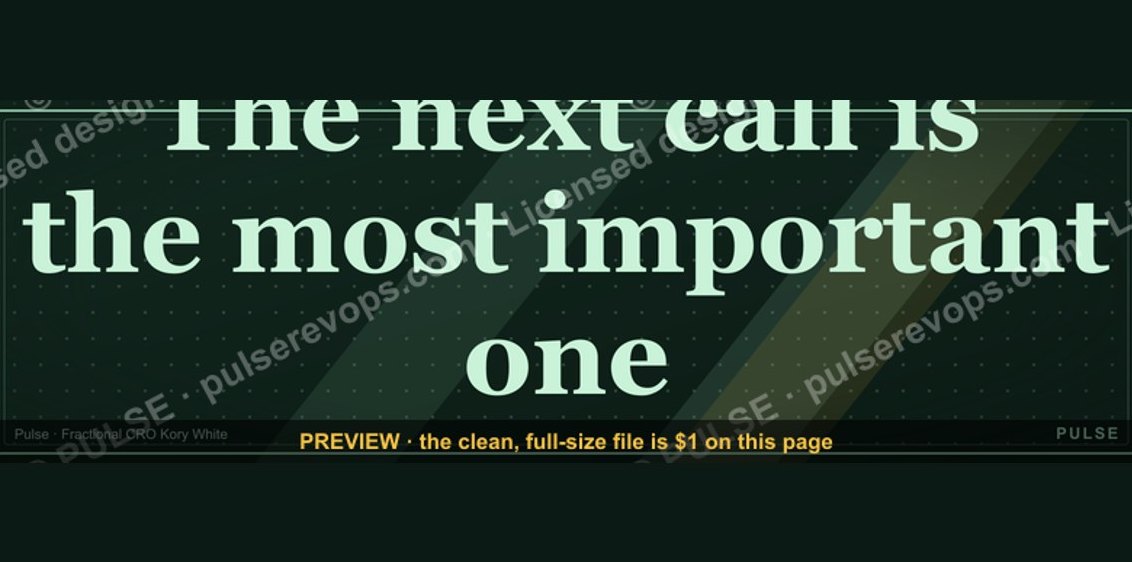 graphic“The next call is the most important one.” — Quote Card
 graphic“Slow is smooth. Smooth is fast.” — Quote Card
 graphic“Pressure off. Pipeline on.” — Quote Card
 graphic“Pipeline Cures All” — Quote Card
 graphic“Champions sell when you're not in the room.” — Quote Card
 graphic“Every no is closer to a yes.” — Quote Card
 graphic“Be the signal, not the noise.” — Quote Card