
“FREE CONSULTING SESSION” — Sales Meme
 Curated byKory White · Fractional CRO · Maryland
 PULSEKNOWLEDGE LIBRARY
Quality
Certified
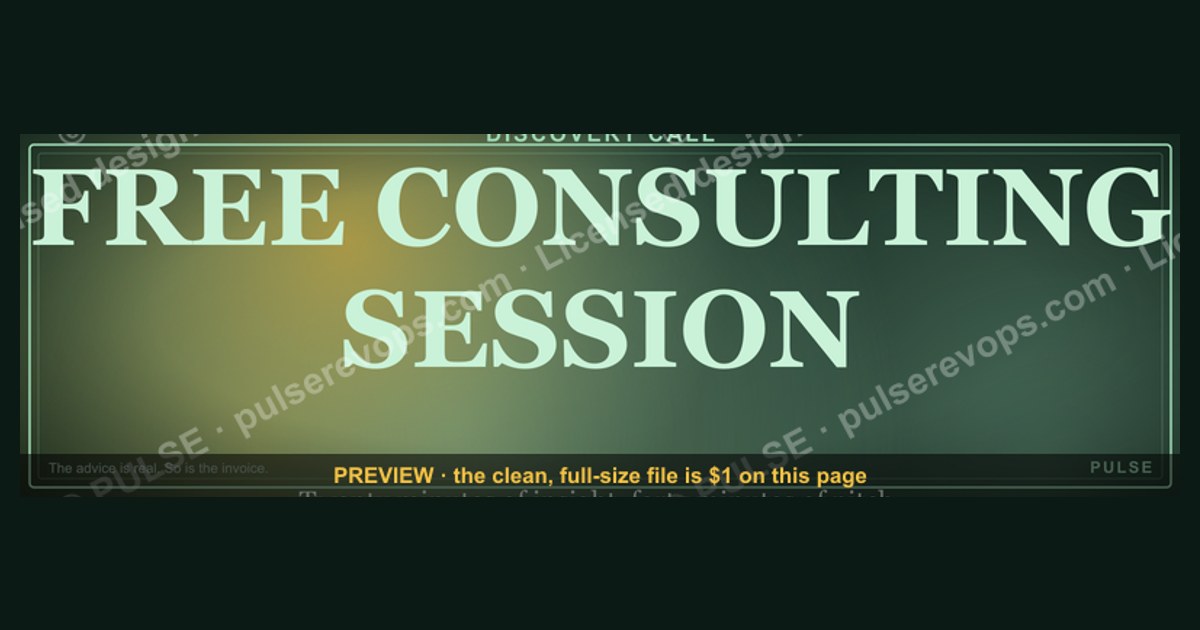
This banner is a 1600x500 px downloadable graphic titled “FREE CONSULTING SESSION” — Sales Meme. It shows a mock sales offer where a rep trades deep, unpaid expertise for a foot in the door, captioned to poke fun at how often “FREE CONSULTING” gets promised in a first call. Sales teams use it in Slack, LinkedIn and training decks.
The outcome you should expect
The outcome you should expect from using this banner is not a measurable pipeline lift on its own. It is a shared language moment. When a Sales team drops this graphic into a deal-review channel or a kickoff deck, the room usually laughs, then someone names the behavior out loud: “That’s us on every discovery call.” That recognition is the actual return. The banner works as a mirror, not a magnet.
Practically, teams that deploy this banner in internal channels report three things happen within the first week. First, reps start flagging their own calls where they gave away too much unpaid scoping. Second, managers get a shorthand for coaching — they can point at the banner instead of delivering a lecture. Third, the phrase “FREE CONSULTING SESSION” becomes a running joke that quietly raises the bar for what counts as a qualified conversation.

What you should not expect: this banner will not generate inbound leads, will not close deals, and will not replace a discovery framework. It is a culture artifact. Its job is to make an uncomfortable pattern visible and repeatable as a talking point. If your team already has strong call hygiene, the banner is a lighthearted reinforcement. If your team is bleeding hours into unpaid scoping, the banner is the opening line of a harder conversation about qualification criteria, call structure, and what your Sales org is actually willing to give away.
The realistic timeline for the banner to have any effect is one to two sales cycles. In cycle one, it surfaces the problem. In cycle two, if managers pair it with a concrete rule — for example, no custom scoping before a signed mutual action plan — you see the behavior shift. Without that pairing, the banner is just a funny image that gets scrolled past.
What drives that outcome
Three forces drive whether this banner lands as a useful joke or dies as a stale meme.
The first is team maturity. A Sales team that already runs structured discovery, has a defined qualification framework, and tracks time-in-unpaid-scoping will get more from the banner because they have a place to route the insight. A team with no such structure gets a laugh and nothing else.
The second is manager behavior. If a frontline manager references the banner in a one-on-one and follows it with a specific question — “Walk me through the last call where you did free CONSULTING” — the meme becomes a coaching tool. If managers never mention it, it stays a wallpaper.
The third is repetition cadence. A meme used once is a novelty. A meme used weekly in a recurring channel becomes a cultural shorthand. The sweet spot is roughly once per week during a quarter where unpaid scoping is a known problem, then tapering to once per month as the behavior improves.
The diagram above shows the fork clearly. The banner itself is inert. The manager reference is the trigger. Everything downstream depends on that one human action.
Benchmarks and realistic ranges
There is no published industry benchmark for “hours of unpaid consulting per Sales rep.” Anyone who quotes a precise number is guessing. What you can do is build your own baseline, and the banner gives you a reason to start.
A workable approach: for one month, ask each rep to log every call where they delivered substantive advice, scoping, or problem-solving that went beyond standard discovery. Log the duration. At the end of the month, total the hours per rep. Typical mid-market SaaS teams that run this exercise find somewhere between two and eight hours per rep per month landing in that bucket. Enterprise teams with long cycles often see more. SMB teams with fast disqualification see less.
Once you have a baseline, the banner becomes a measurement anchor. You can say: “Last month we logged 34 hours of FREE CONSULTING across the team. This banner is our reminder. Next month, target is under 20.” That is a real, trackable goal that the meme supports.
On the content side, the banner itself has a few practical ranges worth knowing. At 1600x500 px, it fits LinkedIn’s recommended feed image ratio (1.91:1 is close; 1600x500 is 3.2:1, which crops acceptably in feed and fits well as a banner strip). For Slack, the same file renders cleanly in channel without scrolling. For slide decks, it scales down to 800x250 without losing legibility if the text is large. If your team wants to print it as a poster, 1600x500 at 150 DPI gives roughly 10.6 x 3.3 inches — fine for a desk card, too small for a wall poster without upscaling.
The “FREE” part of the joke lands hardest when the audience has personally felt the sting. In teams where reps have never done unpaid scoping, the banner reads as cynical. In teams where it is a weekly reality, it reads as cathartic. Know which team you have before you deploy it.
Risks, edge cases, and failure modes
The biggest risk is that the banner reads as leadership mocking reps. If a Sales leader posts “FREE CONSULTING SESSION” in a channel after a tough quarter, reps may hear “you are giving away too much and we are blaming you.” That is the opposite of the intended effect. The banner works when it is posted by a peer, or by a manager who explicitly frames it as “we all do this, including me.”
A second failure mode is overuse. A meme that appears daily becomes noise. The rule of thumb: no more than once per week in any single channel, and never in the same channel two days in a row.
A third edge case is external use. If a rep posts this banner on LinkedIn as their own content, it can read as a subtweet of their own company or their own prospects. That is a brand risk. Keep it internal unless your marketing team has explicitly approved an external version with different framing.
A fourth risk is misreading by new hires. A rep in their first month may not have the context to know the banner is satire. Pair it with a one-line explanation the first time it appears in a new-hire channel: “This is our running joke about giving away free consulting. Here is what we do instead.”
A fifth edge case: the banner can accidentally validate the behavior it mocks. If a rep sees it and thinks “oh, free consulting is just part of the job,” the meme has backfired. The fix is always to pair the banner with the alternative — what the team does instead of unpaid scoping.
The left path is the one you want. The right path is recoverable but costs you a month of goodwill.

A practical rollout plan
A rollout that works has five steps and takes about six weeks from first post to measurable change.
Step one, week zero: pick the channel. The best channel is a Sales-only Slack channel or Teams channel where reps already talk shop. Do not launch it in a company-wide channel. Do not launch it in a channel where leadership only posts announcements.

Step two, week one: post the banner with a one-line caption from a peer, not a manager. Something like “Saw this and felt seen.” Let it sit for a day. Do not over-explain.
Step three, week two: the manager references it in a team meeting. “That banner from last week — let’s talk about it. Where are we giving away free CONSULTING?” Collect examples. Do not name and shame. The goal is pattern recognition, not blame.
Step four, weeks three to four: introduce the alternative. This is the step most teams skip. The banner alone changes nothing. The banner plus a rule changes behavior. A workable rule: before any custom scoping, the rep must have a scheduled next step on the calendar and a named economic buyer. If either is missing, the rep offers a paid scoping engagement instead.
Step five, weeks five to six: measure. Count the hours logged in the unpaid scoping bucket before and after. If the number dropped, the banner did its job. If it did not, the banner is not the problem — the qualification criteria are.
One more rollout note: give the banner a shelf life. Plan to retire it after two quarters. Memes age fast. If it is still funny in month seven, great. If it is not, let it go and find the next one. The point was never the image. The point was the conversation it started.
Related questions
What is the “FREE CONSULTING SESSION” sales meme?
It is a satirical banner mocking the common Sales habit of delivering unpaid expertise on early calls. The 1600x500 px graphic frames a first meeting as a “FREE CONSULTING SESSION,” poking fun at reps who scope, advise and troubleshoot before any commercial commitment exists.
Is this banner a real offer of free consulting?
No. It is a joke. The banner is an internal culture artifact for Sales teams, not a public offer. Nobody should send it to a prospect as a literal promotion. Used externally without context, it confuses buyers and can damage credibility.
Where should I post this banner?
Post it in a Sales-only Slack or Teams channel, a team offsite deck, or a training slide. Keep it internal. If you want an external version, work with marketing to reframe it so it does not read as a subtweet of your own company or your prospects.
How big is the banner and what format is it?
It is 1600x500 px, delivered as a PNG. That size fits LinkedIn feed images, Slack channels, and slide decks. It scales down to roughly 800x250 without losing legibility if the text is large. For print, 150 DPI gives about 10.6 x 3.3 inches.
Can I change the wording or colors?
Yes. The template is meant to be customized. Keep the joke structure — “FREE [SERVICE] SESSION” — and swap the service to match your team’s pain point. Match your brand colors if the banner will appear in customer-facing decks. Keep the internal version loose and informal.
FAQ
Why does this meme resonate with Sales teams so much? Because unpaid scoping is one of the most common and least discussed drains on a rep’s week. Reps know they do it. Managers know it happens. Nobody has a clean name for it. The banner gives the behavior a label, and labeling a problem is the first step to fixing it. The humor comes from recognition, not from exaggeration.
Does posting this banner actually change rep behavior? Only if it is paired with something concrete. A banner alone is a laugh. A banner plus a manager conversation plus a rule about when scoping is allowed is what changes behavior. Teams that skip the rule step see no measurable difference in unpaid scoping hours after the banner is posted.
What if my team does not do unpaid consulting? Then the banner will read as cynical or irrelevant. Before posting, run the one-month logging exercise. If your team logs fewer than one hour per rep per month in unpaid scoping, the banner is not for you. Find a different pain point to meme about.
Can I use this banner in a customer-facing deck? Only with marketing approval and a reframe. The internal version is a joke about the Sales team. The external version would need to be a joke the customer is in on. Most teams are better off keeping this one internal and building a separate customer-facing asset if they want humor in a deck.
How often should I repost it? Once per week maximum in any single channel, and never two days in a row. The sweet spot is weekly during a quarter where unpaid scoping is a known problem, tapering to monthly as the behavior improves. Plan to retire it after two quarters.
What is the alternative to giving free consulting? Offer a paid scoping engagement, a paid discovery workshop, or a structured pilot with a defined scope and fee. The exact alternative depends on your deal size and sales motion. The key is that the rep has a scripted, respectful way to convert unpaid scoping into a commercial next step.
Sources
- https://www.linkedin.com/business/marketing/blog
- https://slack.com/blog
- https://www.gartner.com/en/sales
- https://hbr.org/topic/sales
- https://www.salesforce.com/blog
- https://www.hubspot.com/sales
- https://www.forrester.com/blogs/category/sales/
Related on PULSE
- Discovery call frameworks that stop unpaid scoping
- How to qualify out of a deal without burning the relationship
- Mutual action plans: what they are and when to use them
- Sales memes as internal culture tools
- Paid discovery workshops: pricing models and trade-offs
- When to give away expertise for free (and when not to)
This page will be disappearing soon. Save it to your device for $1 — or read it free while it is here.
@Kory-White- · if Venmo asks, the last 4 of my number are 2012
This page is gone.
This one is off the shelf now. $1 keeps it on your phone for good — the whole page, pictures and diagrams included.
 graphic“It’s in the CRM, I Swear” — Sales Meme
 graphic“FOR THE 6TH TIME” — Sales Meme
 graphic“PANIC SUNDAY NIGHT” — Sales Meme
 graphic“IT'S A NOT YET” — Sales Meme
 graphic“12 TIMES. NO REPLY.” — Sales Meme
 graphic“...AFTER THE DEAL CLOSES” — Sales Meme
 graphic“SHOULD DO IT” — Sales Meme
 graphic“TIME TO DO IT AGAIN” — Sales Meme
 graphic“FINANCE: NOT YET” — Sales Meme
 graphic“DEAL SLIPS TO NEXT QUARTER” — Sales Meme