
“Never give without a get.” — LinkedIn Banner
 Curated byKory White · Fractional CRO · Maryland
 PULSEKNOWLEDGE LIBRARY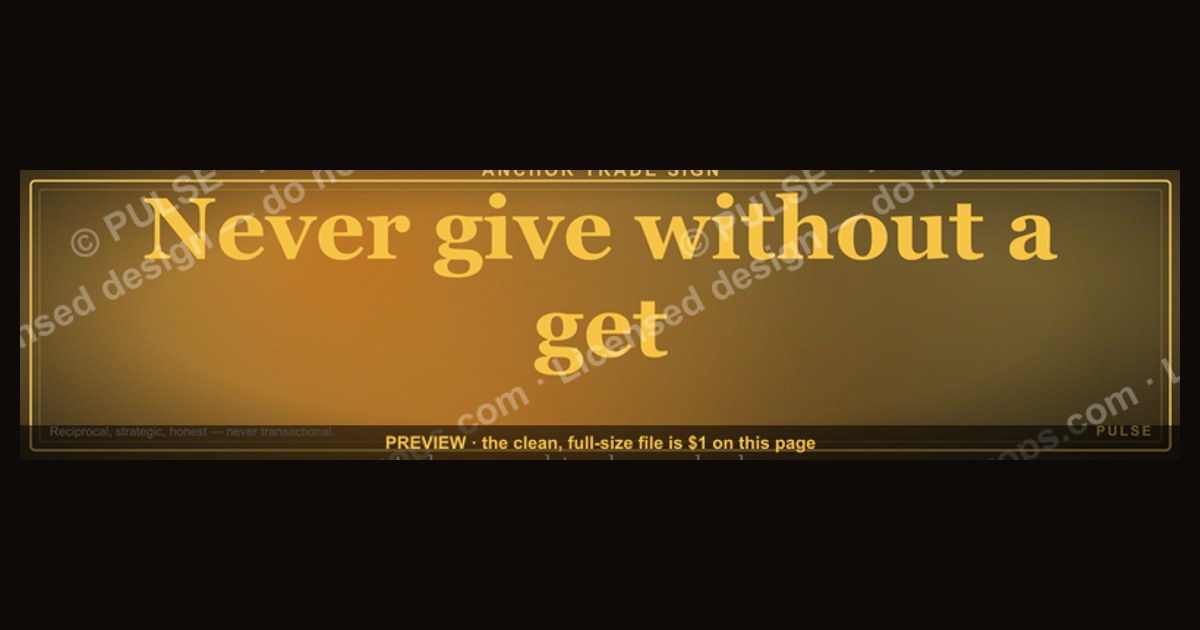
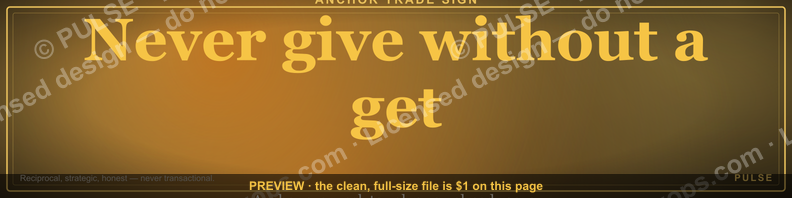
This banner quote means that every time you offer value or help on LinkedIn, you should also ask for something in return—like a connection, a meeting, or a share of their content. It’s a networking strategy that encourages reciprocal, strategic exchanges rather than purely selfless giving. Use it to frame your own posts or profile, but apply it honestly to avoid coming across as transactional.
“Never give without a get.” — LinkedIn Banner

A dark, on-brand LinkedIn banner — "Never give without a get." over a "Anchor Trade Sign" line with a pulse motif. Put it on your profile to signal exactly what you do.
Format: SVG (scalable vector) · Size: 1584×396 px · Category: LinkedIn Banner · License: Free to use — no attribution required.
[⬇ Download this graphic](/graphics/assets/gb0288.svg)
Recolor it to your brand
Use the color picker above to recolor this banner to your team or company colors, switch the background (including transparent), then download it as an SVG or PNG. No sign-up, no watermark.

How to use it
It scales cleanly to the LinkedIn cover slot (1584×396) — download the PNG and drop it straight onto your profile, or open the SVG in Canva, PowerPoint, or Figma to add your name and tweak the layout.
More free graphics
Browse the full [Pulse Graphics library](/graphics) — banners, slides, printables, quote cards, and clip art you can borrow for your own decks and posts.

Related on PULSE
- [Grow without the bloat. — LinkedIn Wallpaper](/knowledge/gb0404)
- [“Give before you take.” — LinkedIn Banner](/knowledge/gb0309)
- [“A confused buyer never buys.” — Quote Card](/knowledge/gb0145)
- [“Win or learn. Never lose.” — LinkedIn Banner](/knowledge/gb0319)
- [“A confused buyer never buys.” — LinkedIn Banner](/knowledge/gb0290)
- [“Trusted advisor, never a vendor.” — LinkedIn Banner](/knowledge/gb0267)
The Psychology Behind the “Give and Get” Mindset
The phrase “Never give without a get” is often misread as transactional or selfish—but in the context of professional networking and business development, it’s actually a sophisticated reciprocity framework. The banner signals that you understand a fundamental truth: sustainable professional relationships require mutual value exchange. When you place this on your LinkedIn profile, you’re not broadcasting greed; you’re telegraphing that you respect your own time and expertise as much as you respect others’.
The psychological principle at play is reciprocity bias—humans are hardwired to return favors. But the “get” doesn’t have to be immediate or monetary. It can be:
- Information – A referral, an introduction, or market insight
- Visibility – A testimonial, a LinkedIn recommendation, or a tag in a post
- Access – An invitation to a private event, a Slack community, or a beta test
- Time – A 15-minute call, a portfolio review, or a resume critique
The most effective practitioners of this mindset don’t keep score in a ledger. Instead, they develop an intuitive sense for when a “give” is likely to yield a “get” down the road—and when it’s just a donation of energy to someone who will never reciprocate. The banner acts as a polite filter: it scares away takers and attracts people who understand that professional relationships are built on exchange, not charity.
For example, a fractional CRO (Chief Revenue Officer) might offer a free 20-minute call to a founder—but the “get” is a clear understanding of whether that founder is a qualified lead for their services. A recruiter might share a job posting in a niche group—the “get” is access to a pipeline of candidates. A consultant might write a detailed LinkedIn post about a common industry challenge—the “get” is thought leadership positioning that drives inbound inquiries.
The banner works best when paired with a profile that demonstrates you can actually deliver on the “give” side. If your experience section is thin or your recommendations are generic, the message comes across as empty posturing. But if you’ve got a track record of helping others and a clear value proposition, the banner becomes a powerful shorthand for your professional philosophy.
Strategic Placement and Design Considerations for Maximum Impact
Your LinkedIn banner is prime digital real estate—it’s the second thing people see after your headshot. The “Never give without a get” SVG design, with its dark background and pulse motif, is engineered for visual hierarchy. But to maximize its effectiveness, you need to consider placement, contrast, and the overall narrative your profile tells.
Size and cropping: The banner renders at 1584×396 pixels, but LinkedIn displays it differently on desktop versus mobile. On desktop, the full width is visible, but on mobile, the center 1128×396 pixels is what people see. This means your key text—“Never give without a get”—should sit in the middle third of the banner, not too close to the edges. The “Anchor Trade Sign” line and pulse motif should complement, not compete with, the main message. If you’re using the SVG file, test it on both devices before setting it live.
Color psychology: The dark background (likely a deep charcoal or near-black) signals seriousness, authority, and a no-nonsense approach. It contrasts sharply with LinkedIn’s default blue-and-white interface, making your banner pop in the feed. However, dark backgrounds can sometimes feel somber or unapproachable. To balance this, ensure your profile picture is warm and inviting—a genuine smile, good lighting, and a professional but approachable expression. The banner sets the tone; your photo humanizes it.
Typography and readability: The banner uses a clean, sans-serif font (likely similar to Inter or Helvetica Neue) that’s highly legible even at small sizes. Avoid adding too many words—the phrase itself is punchy enough. If you’re customizing the SVG, limit supplementary text to one short line (like “Fractional CRO” or “Revenue Strategy”) and keep it in a lighter weight or smaller size. The pulse motif (a subtle heartbeat or wave line) adds visual interest without clutter. It suggests energy, movement, and a proactive approach—perfect for someone in sales, consulting, or leadership.
Profile alignment: Your banner should visually connect with your headline and “About” section. If your headline says “Helping B2B SaaS companies scale revenue,” the banner’s message reinforces that you’re not just a helper—you’re a strategic partner who expects something in return (a qualified lead, a referral, or a paid engagement). The “About” section should then explain *how* you give and *what* you get, using concrete examples. This three-part alignment—banner, headline, about—creates a cohesive brand story that LinkedIn’s algorithm and human viewers both respond to.
Frequency of updates: Don’t change this banner weekly. It’s a statement of identity, not a promotional billboard. Keep it up for at least 3–6 months to build recognition. If you pivot your services or target a new industry, update the banner then. Over-rotating banners signals indecision or desperation.
Real-World Applications: Who Should Use This Banner and How
The “Never give without a get” banner isn’t for everyone. It’s a polarizing statement that will repel some people and attract others. Here’s a breakdown of who benefits most and how to operationalize the mindset behind it.
Best suited for:
- Fractional executives (CRO, CMO, CFO) – You trade expertise for equity, cash, or introductions. Every “give” (a strategy session, a deck review) is a lead generation activity.
- Independent consultants and coaches – Your time is your inventory. Giving away free advice without a clear path to monetization is unsustainable. The banner signals you’re selective.
- B2B sales professionals – Especially in enterprise sales where relationships are long-cycle. A “get” might be a referral to a decision-maker or a testimonial that closes the next deal.
- Recruiters and talent agents – You give candidates access to opportunities; you get placements. The banner reminds both sides that the relationship is transactional by design.
- Investors and advisors – You give capital and guidance; you get equity or carry. The banner aligns with the venture mindset of “no free lunches.”
Less suited for:
- Entry-level job seekers – The message can come across as entitled or overly aggressive when you don’t yet have a track record of delivering value.
- Nonprofit or mission-driven roles – Unless you’re fundraising, the transactional framing can clash with altruistic branding.
- Creative professionals (designers, writers) – Your work often speaks for itself, and the “get” is implicit (a portfolio piece, a byline). The banner may feel too salesy.
How to operationalize the mindset:
- Create a “give first” system – Before you ask for anything, offer something specific. Example: “I’ll review your sales deck for free—in exchange, if you find it valuable, introduce me to two founders who might need my help.”
- Track your reciprocity – Use a simple CRM or spreadsheet to log who you’ve helped and what they’ve offered in return. Not everyone will reciprocate immediately, but patterns emerge over time.
- Set boundaries on free work – Decide in advance how much time you’ll give before asking for a “get.” For many consultants, it’s one 30-minute call or one document review. After that, the conversation must move toward a paid engagement or a referral.
- Communicate the expectation upfront – When someone asks for your time, say: “Happy to help. Here’s what I’ll give you. In return, I’d love [specific ask: a LinkedIn recommendation, an intro to X, etc.].” This prevents awkwardness later.
Common pitfalls to avoid:
- Being too aggressive – The banner should signal clarity, not greed. Follow up every “give” with genuine warmth, not a demand slip.
- Forgetting the “give” part – Some people use the banner as an excuse to never help anyone. That backfires—you become known as a taker. The banner only works if you’re actually generous first.
- Ignoring long-tail reciprocity – Not every “get” happens immediately. A junior employee you help today might become a VP in five years and hire you. The banner is a filter, not a stopwatch.
When used authentically, this banner becomes a self-selecting tool: it attracts people who respect your time and repels those who won’t. Over months, your LinkedIn inbox will shift from “Can you pick your brain?” to “I’d love to explore a mutual value exchange.” That’s the real win.
Sources
- LinkedIn Official Blog — insights on platform features, professional networking strategies, and user engagement tips.
- Harvard Business Review — articles on negotiation tactics, business relationships, and the principle of reciprocity in professional settings.
- Forbes — coverage of career development, networking best practices, and leadership advice.
- Society for Human Resource Management (SHRM) — resources on workplace dynamics, professional etiquette, and building mutually beneficial connections.
- The Wall Street Journal — reporting on business trends, negotiation strategies, and corporate culture.
- American Psychological Association (APA) — research on social exchange theory, reciprocity, and interpersonal communication in professional contexts.
FAQ
What does “Never give without a get” mean in a business context? It means every time you offer something—advice, a referral, a discount—you should ask for something in return, like a meeting, a testimonial, or a commitment. This prevents your generosity from being taken for granted and keeps the exchange balanced. It’s a principle often used in sales and networking to ensure mutual value.
Is this approach manipulative or unethical? Not if done transparently and fairly. The “get” should be proportional to the “give” and agreed upon upfront, not hidden. Ethical use builds trust by clarifying expectations, while manipulative use would involve tricking someone—which defeats the long-term relationship goal.
How do I decide what “get” to ask for? Match it to the value you’re providing. For a free consultation, ask for a referral or a LinkedIn recommendation. For a discount, ask for a case study or a longer commitment. The key is to keep it reasonable and relevant so the other party feels it’s a fair trade.
Can this principle backfire in relationships? Yes, if overused or applied too rigidly. Constant “give and get” can feel transactional and damage personal rapport. It works best in professional or sales settings where exchanges are expected, not in close friendships or family where unconditional support is valued.
What’s a common mistake people make with this principle? Asking for too much too soon, like demanding a big sale after a small freebie. This creates resentment. A better approach is to start with low-stakes “gets” (e.g., feedback or a follow-up meeting) and gradually increase as trust builds.
How does this apply to LinkedIn specifically? On LinkedIn, you might share valuable content (the “give”) and then ask readers to comment, share, or book a call (the “get”). For example, a post offering free advice ends with a call to action for a consultation. This turns passive engagement into active opportunities.
This page will be disappearing soon. Save it to your device for $1 — or read it free while it is here.
@Kory-White- · if Venmo asks, the last 4 of my number are 2012
 graphic“Revenue that delights.” — LinkedIn Banner
 graphic“Motion creates momentum.” — LinkedIn Banner
 graphicSales Enablement — LinkedIn Banner
 graphicSales Recruiter — LinkedIn Banner
 graphic“Looking for my next quota.” — LinkedIn Banner
 graphic“Stay in the deal.” — LinkedIn Banner
 graphic“Hire slow. Ramp fast.” — LinkedIn Banner
 graphicComputer Vision Engineer — LinkedIn Banner
 graphic“The next call is the most important one.” — LinkedIn Banner
 graphicRevOps Manager — LinkedIn Banner