


How do you build a partner channel program in 2027?
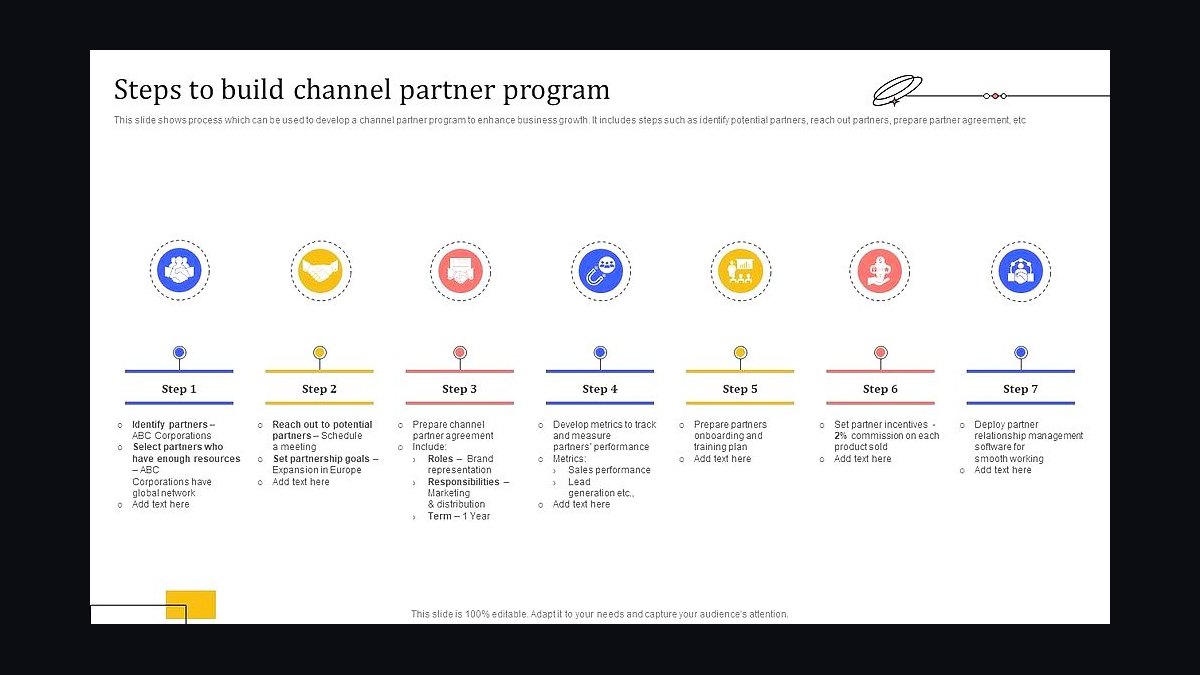
Building a partner channel program in 2027 is the disciplined construction of an indirect revenue system spanning four partner types — referral, reseller, system integrator (SI), and technology partner — moved through a four-stage partner journey of Recruit, Enable, Activate, Grow, governed by a named Channel Chief, instrumented on a PRM platform (PartnerStack, Impartner, Allbound, or ZINFI), and accelerated by an ecosystem data layer (Crossbeam or Reveal) that triggers co-sell motions off shared customer overlap. The economics run on a typical 10-30% revenue share tiered by partner performance, Market Development Funds (MDF) gated by co-marketing deliverables, and a technology-partner marketplace modeled on the Salesforce AppExchange or HubSpot App Marketplace. Canalys (Jay McBain) 2026 quantifies the prize: partners deliver 66.7% of the $6.07 trillion global IT market, and the system integration segment alone hits $995B in 2026 and crosses $1T in 2027. Vendors without a serious channel program are walking away from two-thirds of their addressable revenue.
1The Four Partner Types
A 2027 channel program almost always runs all four motions in parallel — they serve different buyers, pay differently, and require different enablement.
1.1 Referral Partners
Referral partners introduce qualified leads but do not sell or transact. The vendor closes and books the revenue, the partner gets paid a flat finders' fee or 5-10% of first-year ACV. Best for influencers, consultants, agencies, and individual operators without a sales motion. PartnerStack dominates this category for SaaS — the platform makes referral payout administration close to zero-touch.

1.2 Reseller Partners
Resellers transact on the vendor's paper or their own paper and own the customer relationship. Typical margins are 15-30% with performance tiers unlocking the higher band. Best for VARs (value-added resellers), regional IT consultancies, and MSPs with an existing customer base.
1.3 System Integrators (SIs)
SIs build, deploy, and operate the vendor's product inside large enterprises and earn the majority of their economics on services attach rather than license margin. Think Accenture, Deloitte, Capgemini, Slalom, West Monroe, Wipro, Infosys, TCS. Canalys projects the SI segment alone reaches $1T in 2027, which is why every enterprise software vendor over $50M ARR runs a dedicated SI partner team.

1.4 Technology Partners
Technology partners integrate with the vendor's product and create joint value through composition — they don't sell, they make the vendor stickier. The Salesforce AppExchange (>9,000 listings) and HubSpot App Marketplace (>1,800 listings) are the reference designs. Tech partners drive multi-product attach and reduce logo churn by 20-30% when surfaced inside the buying motion.
2The Partner Journey: Recruit, Enable, Activate, Grow
The four-stage partner journey is the operating funnel of a channel program, mirroring the customer funnel but with partners as the asset being built.
2.1 Recruit
Partner recruitment starts with an Ideal Partner Profile (IPP) — the channel equivalent of an ICP. Source signals come from Crossbeam ecosystem data, LinkedIn channel-chief networks, Canalys partner directories, and existing customer references. The recruit-to-signed-agreement target is 90 days for SaaS, 120-180 days for SIs.

2.2 Enable
Enablement is certification on product, sales motion, and implementation. The 2026 standard runs on Mindtickle's partner-LMS, Allego's partner-track, or the native LMS module inside Impartner or Allbound. Vendors typically issue Bronze / Silver / Gold / Platinum tiers with named certifications per role (sales, pre-sales, delivery).
2.3 Activate
A partner is activated when they co-source their first deal through deal registration. Allbound's 2026 Partner Operations Survey found the median time from signed to activated is 4-6 months — and partners not activated by month 9 almost never activate. Vendors aggressively prune dormant partners at the 12-month mark.

2.4 Grow
The grow phase is where the program earns its keep. Partners move up tiers based on sourced revenue, certifications held, customer satisfaction, and joint marketing execution, and tier movement unlocks higher margin, larger MDF allocation, executive sponsor pairing, and AppExchange-style co-marketing.
3Revenue Share, MDF, and Deal Registration
The financial scaffolding is what separates a real channel program from a logo-collection exercise.

3.1 Tiered Revenue Share
The typical 2027 SaaS structure runs 10% referral, 15-20% baseline reseller, 25-30% gold/platinum reseller, with influencer tiers (consultants) capped at 10%. For SIs the margin conversation is mostly services attach rather than license margin, with 15-20% license margin treated as a deal sweetener.
3.2 Deal Registration
Deal registration is the non-negotiable mechanism that prevents channel conflict. A partner registers a deal before the vendor's direct team can touch it, getting a 30-90 day exclusivity window and margin protection. PartnerStack, Impartner, Allbound, and ZINFI all run native deal-reg with Salesforce or HubSpot sync.

3.3 Market Development Funds (MDF)
MDF is co-marketing money the vendor gives the partner for joint demand-gen — typically 1-3% of partner-sourced revenue rebated into approved activities (events, paid media, content). Modern MDF is gated on submitted proof-of-execution (event photos, ad screenshots, registration lists) to prevent the 2010s-era "MDF as discretionary slush fund" problem.
4The Ecosystem Layer: Crossbeam, Reveal, and Co-Sell
The biggest 2025-26 evolution in channel was the rise of ecosystem data platforms that map account overlap across partners.

4.1 Account Mapping
Crossbeam and Reveal let two vendors securely compare CRM data to surface overlapping customers, prospects, and open opportunities without exposing the underlying records. Crossbeam's 2026 State of the Partner Ecosystem found partner-sourced deals close 53% faster and convert at 2-3x the rate of direct deals when account-mapping triggers the play.
4.2 Co-Sell Triggers
The modern co-sell motion is trigger-based: Crossbeam flags an overlap, the partner sales rep gets a Slack notification, the AE gets a CRM task, and a joint engagement plan auto-populates. HubSpot, Snowflake, Gong, and Outreach all run formal co-sell programs of this shape with Crossbeam or Reveal as the underlying engine.

4.3 Marketplace Distribution
Tech partners ship through marketplaces — AWS Marketplace, Microsoft Azure Marketplace, Google Cloud Marketplace, Salesforce AppExchange, HubSpot App Marketplace. The hyperscaler marketplaces in particular convert because customer cloud commits ("burn-down dollars") fund the purchase — a buyer pattern Canalys estimates moves >$50B annually in 2026.
5The Channel Chief Role and Governance
A channel program without a named, empowered Channel Chief is a hobby. The role reports to the CRO or CEO, owns the partner P&L, and runs the quarterly channel review.
5.1 Channel Chief Mandate
Jay McBain's research at Canalys and previously Forrester is unambiguous: the Channel Chief must own strategy, partner P&L, MDF budget, and the partner team's compensation plan. Splitting these across functions kills programs.

5.2 Quarterly Channel Review
The QCR is chaired by the CRO with the Channel Chief, top-10 partners, and product leadership. Agenda is fixed: partner-sourced pipeline, win rates, MDF deployment efficiency, certification coverage, and product-roadmap alignment.
6The 2027 Tech Stack
PartnerStack dominates SaaS referral and reseller. Impartner owns enterprise PRM (hardware, large channels). Allbound sits in mid-market enterprise PRM. ZINFI runs global multi-tier programs. Crossbeam and Reveal are the two ecosystem data platforms. Mindtickle and Allego lead partner enablement. Salesforce PRM (Experience Cloud) is the native option for Salesforce-shop vendors. Marketplaces — AWS, Azure, GCP, AppExchange, HubSpot App Marketplace — round out distribution.

2The 2027 Partner Journey: From Recruit to Revenue Engine
The four-stage partner journey in 2027 is no longer linear—it's a continuous feedback loop powered by AI-driven partner scoring and behavioral triggers. Recruit shifts from cold outreach to ecosystem-based discovery: you identify high-potential partners via public marketplace listings (e.g., AWS Partner Network, Shopify Experts), LinkedIn Sales Navigator filters, and Crossbeam overlap reports showing mutual customers. Enable moves beyond static training portals to interactive, role-based playbooks delivered through PRM gamification (e.g., Impartner's "Partner Path"), with micro-certifications for each partner tier. Activate is triggered automatically when a partner completes three key actions (e.g., signs an MDF agreement, passes a certification, and logs a co-sell opportunity), unlocking tiered incentives like accelerated commission rates (e.g., 15% vs. 10%) or dedicated channel manager access. Grow relies on quarterly business reviews (QBRs) using shared dashboards (e.g., Tableau or Power BI embedded in your PRM) to track pipeline velocity, deal registration compliance, and partner NPS. The most advanced programs in 2027 use predictive churn models—if a partner's activity drops below a threshold (e.g., no logged opportunities in 60 days), the PRM auto-generates a re-engagement sequence (e.g., a personalized email with a case study, a co-marketing offer, or a direct call from the channel manager).
3MDF and Co-Sell: Funding the Partner Flywheel
Market Development Funds (MDF) in 2027 are performance-gated, not relationship-gated. Typical budgets range from 2-5% of partner-generated revenue, distributed quarterly based on demonstrated activity (e.g., completed enablement modules, attended webinars, or submitted co-marketing plans). The most effective MDF programs tie funds to specific deliverables: a partner must co-author a case study, run a joint webinar, or host a local event to unlock the next tranche. Co-sell motions are the real accelerator: using ecosystem data layers like Reveal or Crossbeam, you identify mutual customers and trigger a playbook (e.g., "Offer a 20% discount on migration services when the partner's customer upgrades"). The revenue split for co-sell deals typically favors the partner (e.g., 60/40 partner/vendor on new logos, 50/50 on expansions). In 2027, co-sell attribution is automated via PRM integrations with your CRM (e.g., Salesforce or HubSpot), so partners see real-time credit for influenced deals. The most successful programs report that co-sell deals close 30-40% faster than direct sales, with 20-30% higher average deal sizes—making MDF investment a clear ROI play.
FAQ
What is the most common mistake when starting a partner channel program in 2027? The biggest mistake is launching without a dedicated Channel Chief or a clear partner journey. Many vendors try to treat partners like direct sales, skipping the Recruit and Enable stages. Without a structured onboarding and a PRM platform, partners quickly lose interest and churn.
How much revenue share should I offer to partners in 2027? Typical revenue share ranges from 10% to 30%, tiered based on partner performance and deal size. High-performing partners often earn the top end, while new partners start lower. It’s important to benchmark against competitors in your industry, but honest ranges are between 10-30% for most programs.
Do I need a technology partner marketplace like Salesforce AppExchange? Yes, if you want to scale. A marketplace modeled on AppExchange or HubSpot App Marketplace helps recruit technology partners and drives co-sell motions. It’s not mandatory for small programs, but for serious channel growth, it’s a key accelerator in 2027.
How long does it take to see results from a partner channel program? Realistic timelines are 6 to 12 months for initial partner activations and first co-sell wins. Full maturity, with consistent revenue from partners, typically takes 18 to 24 months. Patience and consistent enablement are critical.
What is the role of ecosystem data layers like Crossbeam or Reveal? These tools automatically detect shared customers between you and your partners, triggering co-sell alerts. They reduce manual data matching and accelerate partner engagement. In 2027, they’re considered essential for any program targeting more than 50 partners.
Do I need a PRM platform from day one? Not necessarily for very small programs (under 10 partners), but once you scale beyond that, a PRM like PartnerStack, Impartner, Allbound, or ZINFI becomes necessary. It centralizes recruitment, enablement, deal registration, and commission tracking. Without it, manual processes quickly break down.
Bottom Line
A 2027 partner channel program is four partner types, four journey stages, one PRM, one ecosystem data layer, a named Channel Chief, and a tiered revenue-share model wired to deal registration and MDF execution. Canalys's 66.7% partner-delivered IT spend is not a forecast — it's the current reality, and vendors building direct-only motions in 2027 are choosing to compete for one-third of their TAM. The teams winning this decade — HubSpot, Snowflake, Atlassian, Datadog — all share one trait: partner-sourced revenue is a board-reported KPI, not a sidebar.
Related on PULSE
- How do we build a tiered partner program that rewards scale without collapsing margin?
- How should a 2027 partner team design a partner program from scratch?
- Should I Hire a Fractional CRO If I Need to Build a Partner Channel?
- How do you build a partner and channel ops function in 2027?
- How do you build a 2027 channel partner comp plan that does not get gamed?
- How do you build a win-loss analysis program in 2027?
Sources
- Canalys (Jay McBain) — 2026 Global Channel Forecast, $6.07T IT market and 66.7% partner delivery
- Forrester — Partner Ecosystem Wave (legacy McBain research)
- Crossbeam — 2026 State of the Partner Ecosystem Report
- Allbound — 2026 Partner Operations Survey
- Reveal — Co-Sell Playbook and account-mapping benchmarks
- PartnerStack + Impartner + Allbound + ZINFI — 2026 PRM documentation and category guides
- Chiefmartec — Channel, Partner, and Ecosystem Tech category analysis
- Channel Futures + Channel Partners Conference — Channel Chief role research
- Salesforce AppExchange + HubSpot App Marketplace — Technology partner marketplace benchmarks
- ChannelPartners.net — Jay McBain on the Ecosystem Era interview series
People also search for: build a partner channel program · how to build a partner channel program · build a partner channel program guide
This page will be disappearing soon. Save it to your device for $1 — or read it free while it is here.
@Kory-White- · if Venmo asks, the last 4 of my number are 2012
This page is gone.
This one is off the shelf now. $1 keeps it on your phone for good — the whole page, pictures and diagrams included.
 revopsWhat is ecosystem-led growth and how do partner ecosystems work in 2027?
 revopsHow do you set up pipeline reviews that drive accountability in 2027?
 revopsHow do you run a weekly forecast call in 2027?
 revopsHow do you measure marketing-sourced pipeline contribution in 2027?
 revopsHow do you build a sales productivity dashboard in 2027?
 revopsHow do you build a multi-threading deal strategy in 2027?
 revopsHow do you run a win/loss program in 2027?
 revopsHow do you do effective objection handling in 2027?
 revopsHow do you set up SPIFFs that actually work in 2027?
 revopsHow does AI change sales forecasting in 2027?