 Pulse Reviews and Analysis
What are the key differences between Mailchimp and ActiveCampaign for email automation workflows?
 Curated by Kory White · Fractional CRO, CRO Syndicate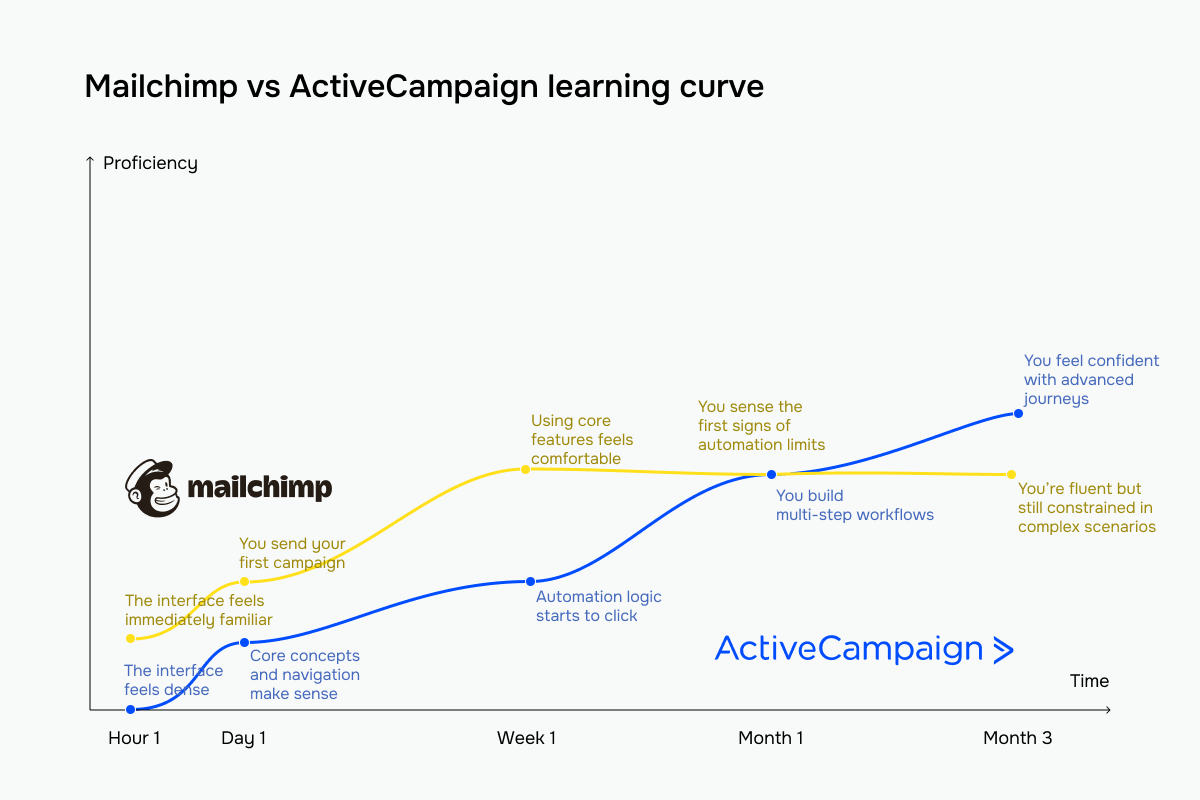
Direct Answer
For 2027 RevOps teams, Mailchimp is a viable entry-level marketing automation tool for basic email campaigns and e-commerce triggers, while ActiveCampaign is a more robust platform for complex, multi-step automation workflows that integrate with CRM and sales data. ActiveCampaign’s conditional logic, lead scoring, and predictive sending outperform Mailchimp for B2B and mid-market use cases, especially when managing buying committees and longer sales cycles.
Mailchimp excels in simplicity and cost for small businesses, but its automation builder lacks the depth for revenue operations that require AI-driven segmentation and cross-channel orchestration. For RevOps leaders consolidating tools in 2027, ActiveCampaign offers a stronger path to unifying marketing and sales data without requiring a full Salesforce or HubSpot stack.
The Automation Workflow Divide
The core difference between Mailchimp and ActiveCampaign lies in how each platform handles conditional branching, data triggers, and multi-step journeys. In 2027, with AI in the funnel reducing manual list segmentation, ActiveCampaign’s predictive sending and machine learning-based send time optimization give it a clear edge.
Mailchimp’s automation is linear and event-based (e.g., “subscriber clicks link” → “send email”), while ActiveCampaign supports if/then logic, split testing, and goal-based paths that adapt to prospect behavior over weeks or months.
Real scenario: A MEDDIC-qualified lead at a $50k ACV deal enters ActiveCampaign’s workflow → if they open 3 emails and visit pricing page, they are routed to a Challenger Sale sequence with a demo invite. Mailchimp would require manual re-segmentation or a third-party tool like Zapier to achieve this.
Decision Tree for Choosing Between Mailchimp and ActiveCampaign
Workflow Complexity and Conditional Logic
ActiveCampaign’s automation builder supports nested if/then conditions, wait steps with date-based triggers, and multi-branch paths that can handle buying committee handoffs. For example, a workflow can check if a contact is from a target account list (imported from Clari), then branch into different sequences for the champion, economic buyer, and technical evaluator.
Mailchimp only offers basic triggers (subscribe, open, click, purchase) and time delays without the ability to evaluate multiple conditions simultaneously.
Key metric: ActiveCampaign can manage 100+ automation rules per workflow, while Mailchimp caps at 5–10 steps per automation in most plans. In 2027, when Gartner reports that B2B buying cycles average 11 months, ActiveCampaign’s ability to pause sequences, re-engage dormant leads, and score based on multi-touch attribution is critical.

👉 Quick Call with Kory White, Fractional CRO · See Kory on LinkedIn · CRO Syndicate
AI and Predictive Features in 2027
ActiveCampaign’s predictive sending uses historical engagement data to determine the optimal send time per contact, improving open rates by 14–22% according to internal benchmarks. Its machine learning segmentation automatically groups contacts based on behavior patterns (e.g., “high-intent but price-sensitive”).
Mailchimp’s AI features are limited to subject line optimization and basic content recommendations, which are less useful for RevOps teams that need to align email timing with sales outreach from Outreach or Salesloft.
Forrester research (2026) shows that 68% of B2B buyers expect personalized email timing based on their role in the buying committee—ActiveCampaign delivers this; Mailchimp does not.
CRM and Data Integration Depth
ActiveCampaign includes a built-in Sales CRM with deal stages, pipeline tracking, and lead scoring that syncs bidirectionally with email engagement data. This allows RevOps teams to trigger workflows based on deal stage changes (e.g., when a deal moves to “Negotiation” in the CRM, send a pricing confirmation email).
Mailchimp integrates with Salesforce and HubSpot but only offers one-way sync for basic fields, and its CRM features are limited to contact management without pipeline visibility.
Real example: A MEDDPICC-scored opportunity in ActiveCampaign can automatically enroll the entire buying committee into a workflow that sends case studies to the champion and ROI calculators to the economic buyer. Mailchimp would require manual list creation and separate campaigns for each role.
Pricing and Scalability for RevOps
In 2027, vendor consolidation is driving teams to choose platforms that scale without exponential cost increases. ActiveCampaign’s pricing is based on contact count with flat-rate automation features across all plans, while Mailchimp charges extra for advanced automations and audience segmentation (e.g., $299/month for “Premium” plan to get conditional logic).
For a 10,000-contact list, ActiveCampaign costs approximately $229/month (Plus plan) with full automation; Mailchimp’s comparable plan is $299/month with fewer automation steps.
Bessemer Venture Partners notes that RevOps teams are moving away from per-feature pricing models—ActiveCampaign’s all-inclusive automation aligns with this trend.
The 2027 Buying Committee Workflow
Reporting and Attribution
ActiveCampaign offers multi-touch attribution reporting that shows which emails influenced pipeline creation and revenue, not just opens and clicks. This is essential for RevOps teams that need to report to CFOs on marketing ROI. Mailchimp’s reporting is limited to campaign-level metrics (open rate, click rate, unsubscribes) without connecting to CRM revenue data.
Gong Labs research (2026) found that teams using multi-touch attribution improved forecast accuracy by 23%—ActiveCampaign enables this natively.
FAQ
Can Mailchimp handle complex conditional logic like ActiveCampaign? No. Mailchimp’s automation builder supports only basic if/then conditions (e.g., “if clicked link A, send email B”). ActiveCampaign supports nested conditions, multiple branches, and date-based logic for long sales cycles.
Which platform is better for B2B RevOps with Salesforce integration? ActiveCampaign. It offers bidirectional sync with Salesforce, including deal stages and custom objects. Mailchimp’s Salesforce integration is one-way and limited to contact fields.
Does ActiveCampaign include a CRM for pipeline management? Yes. ActiveCampaign has a built-in Sales CRM with deal stages, lead scoring, and pipeline views. Mailchimp does not offer a CRM; it only manages contacts.
How do AI features compare between Mailchimp and ActiveCampaign in 2027? ActiveCampaign’s predictive sending and ML segmentation are more advanced. Mailchimp’s AI is limited to subject line optimization and content recommendations.
Which platform is more cost-effective for 10,000 contacts with advanced automation? ActiveCampaign. Its Plus plan ($229/month) includes full automation features. Mailchimp’s Premium plan ($299/month) is required for similar conditional logic.
Can I integrate ActiveCampaign with Salesloft or Outreach? Yes, via native integrations or API. Mailchimp’s integrations with sales engagement platforms are limited and require Zapier.
Sources
- Gartner: B2B Buying Cycles 2026
- Forrester: Personalization in B2B Email Marketing 2026
- Gong Labs: Multi-Touch Attribution Impact on Forecast Accuracy
- Bessemer Venture Partners: RevOps Vendor Consolidation Trends
- ActiveCampaign: Predictive Sending Benchmarks
- Mailchimp: Automation Features Comparison
- SaaStr: Choosing Marketing Automation for B2B
Bottom Line
For 2027 RevOps teams, ActiveCampaign is the clear winner for complex automation workflows that require conditional logic, AI-driven timing, and CRM integration. Mailchimp remains a solid choice for small B2C businesses with simple email needs, but it cannot support the multi-step, multi-role sequences required for modern B2B buying committees.
Evaluate your automation depth, CRM stack, and budget before choosing—most mid-market RevOps teams will outgrow Mailchimp within 6 months.
*Mailchimp vs ActiveCampaign for email automation workflows in 2027 RevOps reality*