
Should I be worried my company stopped doing demos?
 Curated byKory White · Fractional CRO · Maryland
 PULSEKNOWLEDGE LIBRARY
Quality
Certified

Yes, you should be worried—but not panicked. Your company stopping demos signals a structural shift in how prospects evaluate software, not a temporary pause. The move reallocates sales time from live presentations to async self-serve motions, and your role must adapt quickly to survive the coming 12-18 month headcount recalibration.
The Three Structural Drivers Behind Demo Elimination
Demo-killing is rarely a single decision. It emerges from three converging forces that reshape how companies sell. First, product-led growth (PLG) has shifted the burden of proof from sales reps to the product itself. When prospects can self-serve a trial or interactive sandbox, the demo becomes a bottleneck rather than a gateway. Companies like Slack, Zoom, and Canva proved users can adopt without ever seeing a human. If your firm has invested heavily in PLG infrastructure—self-guided onboarding, usage-based pricing, or in-app tutorials—the demo's role naturally diminishes.
Second, buyer fatigue with live presentations is real. Research consistently shows B2B buyers now prefer asynchronous, on-demand content over scheduled calls. A 2023 Gartner survey found that 77% of buyers want to complete their evaluation without talking to a sales rep. Your company may be responding by replacing live demos with recorded walkthroughs, interactive product tours, or even AI-driven demo bots. This isn't laziness—it's alignment with how modern buyers consume information.
Third, sales efficiency metrics drive the decision. Demos are expensive. Each one consumes 30-60 minutes of a senior rep's time, plus prep and follow-up. If your company's conversion rate from demo to closed-won is below 20%, leadership may calculate that the same time invested in outbound prospecting or account-based marketing yields higher ROI. The math is brutal: a rep doing 5 demos a week at a 15% close rate generates roughly 4 deals per month. If those same hours go into 40 personalized emails and 10 discovery calls, the pipeline might double. Your company isn't abandoning demos—it's reallocating resources to higher-leverage activities.

How the Incentive Changes for Every Role
When demos disappear, the incentive structure for every sales role flips. AEs previously optimized for presentation quality and live objection handling. Now they must optimize for written communication clarity and async pipeline velocity. The AE who could dazzle on Zoom but struggles to write a compelling email becomes a liability. The AE who crafts tight, persuasive async sequences becomes the new top performer.
Sales Engineers face the most dramatic shift. Their core value proposition—delivering technical demos—evaporates. SEs must pivot to post-sale technical enablement, integration architecture, and customer education content. Those who cannot transition find themselves reorganized into support roles or let go within 12-18 months. Bridge Group data shows SE roles at demo-less companies shift 60-70% of their time to post-sale activities within two quarters of the announcement.

Sales managers must rebuild their coaching frameworks entirely. Traditional 1-on-1s focused on demo replay and objection handling become irrelevant. New KPIs emerge: Loom open rates, sandbox trial completion percentages, async-to-close cycle time. Managers who cannot coach async motion will lose their teams to attrition or underperformance.
The company-level incentive shifts from demo throughput to coverage expansion. Removing 2-3 hours of demo time per AE per day doesn't shrink the team immediately—it expands coverage. Studies from Pavilion and Force Management show AEs cover 30-40% more accounts when demos are async. That quota math drives hiring caution for 12-18 months, then a rightsizing wave as the expanded coverage proves whether headcount is sustainable.
What To Do Right Now: A Seven-Step Action Plan
Step one: Audit your demo time today. Log every demo you run this week. Track prep time, delivery time, and follow-up time. You need a baseline to measure what goes away and what replaces it. This baseline also serves as your negotiation data when leadership asks for quota adjustments.

Step two: Ask your leadership explicitly: "What's our go-to-market for the next 12 months?" Are demos completely gone or reserved for $50K+ ACV deals? Companies like Stripe, Datadog, and Snowflake reserve live demos only for enterprise deals above that threshold. The answer determines whether you're shifting roles or being phased out. If demos are gone entirely for all deal sizes, your pivot must be immediate and aggressive.
Step three: Become the async-demo auditor. When Navattic tours, Walnut flows, or Loom videos ship, test them like a prospect would. Document bugs, gaps, and moments where the tour fails to answer "How does this solve my problem?" Become the person who owns the quality of the thing that replaced you. This role has high visibility and low competition right now.
Step four: Expand your account coverage immediately. Don't wait for leadership to ask. If you have 40 accounts and demo time just freed up 2-3 hours per day, pick 20 net-new accounts and start outreach. You're proving the coverage-expansion math. Quota goes up or headcount goes down. You want the former.

Step five: Learn the post-demo play. Once a prospect watches a Navattic tour or tries the sandbox, your job isn't to repeat the demo—it's to answer "What did you see that matters to you?" and solve for their use case. Practice consultative selling without the demo crutch. Sales Hacker and Pavilion have frameworks for this exact motion.
Step six: Master the sales stack that replaced demos. Navattic, Walnut, Loom, Demostack, Consensus—know these tools the way you knew your old demo environment. If you can't navigate the tour or explain why it's better than a live demo, you've lost credibility with prospects and leadership alike.

Step seven: Watch the SE job market. If SEs are getting laid off or moved to support at your company or competitors, that's early warning that your company is shrinking the go-to-market org. Start building your next play now, not when the RIF hits. Update your resume, expand your network, and identify which companies are hiring for the new async motion.
How Your Role Must Evolve: Skills to Learn Now
If demos are disappearing, your job description is rewriting itself. The skills that made you a great demo presenter—product knowledge, storytelling, objection handling—remain valuable, but they now need to be applied differently. Here's what to focus on.
Become a content architect. Instead of delivering live demos, you'll likely be asked to create recorded walkthroughs, case study videos, or interactive product guides. Learn tools like Loom, Arcade, or Walnut to produce polished, self-serve assets. The goal shifts from "wowing a room" to "building a library that scales." A single well-produced demo video can be watched by 100 prospects without burning a single rep hour.

Master asynchronous selling. Your communication style needs to shift from real-time persuasion to written clarity. Drafting compelling email sequences, crafting Slack messages that move deals forward, and writing concise LinkedIn InMails become core competencies. The best reps in a demo-light world are those who can build trust and momentum through text alone.
Deepen your discovery skills. Without the demo as a crutch, you'll need to uncover pain points earlier and more precisely. Invest in frameworks like MEDDIC or BANT, but go further—learn to ask questions that reveal not just what a prospect wants, but why they want it and what happens if they don't solve it. The demo used to be where you showed the solution; now, that discovery must happen before any product is shown at all.

Develop data literacy. Demo-less selling generates different data signals: tour completion rates, sandbox engagement time, feature exploration patterns. Learn to read these signals and adjust your approach accordingly. The rep who can say "I see you spent 8 minutes on the integration page—let me show you how that connects to your Salesforce instance" has replaced the demo with something more powerful.
Build cross-functional relationships. Without demos as the primary sales motion, you'll depend more on product marketing for asset creation, customer success for case studies, and product management for roadmap alignment. Invest time in these relationships now. The rep who can pull a product manager into a prospect call to discuss roadmap fits has replaced the demo with executive-level credibility.
When to Sound the Alarm Versus When to Stay Calm
Not all demo-killing is equal. Here's how to distinguish between a healthy evolution and a red flag.

Stay calm if your company has replaced live demos with on-demand video tours, interactive product walkthroughs, or a self-serve trial that actually converts. Check your product's time-to-value (TTV) metrics—if users can achieve their first "aha" moment within 10 minutes of signing up, the demo was likely redundant anyway. Also stay calm if leadership is investing in sales enablement content, training reps on asynchronous selling, or hiring for roles like "sales engineer" or "product marketer" to support the new approach. These are signs of strategic adaptation, not retreat.
Sound the alarm if demos stopped with no replacement—no recorded assets, no trial, no clear path for prospects to see the product. This suggests leadership is cutting costs without a plan, or worse, losing confidence in the product's ability to sell itself. Also worry if your company is reducing demo frequency but increasing pressure on closing rates without providing new tools or training. That's a recipe for burnout and missed quotas. Finally, if the decision came from a single executive with no input from sales or customer success, it's likely a top-down mandate that ignores buyer behavior—a dangerous gamble.
Trust your instincts. If the new approach feels like "selling blind," it probably is. But if it feels like "selling smarter," lean in. The best companies aren't killing demos—they're making them optional, which is even better for buyers and for reps who can adapt.

The 12-18 Month Timeline You Need to Understand
Demo-less announcements follow a predictable timeline. Understanding this timeline helps you prepare rather than react. In month one, the company announces the change. Morale dips, confusion spreads, and early adopters begin experimenting with async tools. Months two through four see the implementation phase: Navattic tours get built, Loom libraries grow, sandbox environments get refined. Reps who adapt quickly see early wins; those who resist fall behind.
Months five through eight are the expansion phase. Coverage increases as AEs reclaim demo time. Quota expectations rise 20-30%. The team that was doing 5 demos per rep per week now handles 8-10 async evaluations. Some reps thrive on the volume; others burn out. This is where the first performance-based separations occur.

Months nine through twelve bring the rightsizing decision. Leadership evaluates whether the expanded coverage justifies the current headcount. Klue and Force Management data shows this is when companies typically reduce headcount by 15-25%. The lag between announcement and reduction creates a false sense of security. You are most vulnerable in month nine, not month one.
Months thirteen through eighteen are the stabilization phase. The new org structure settles. Remaining reps have fully adapted to async motion. The company either achieves higher efficiency with fewer people or realizes the async model doesn't work and pivots again. Most companies land on the former—which means the headcount reduction was permanent.
Your window for action is months one through four. If you wait until month nine to adapt, you're competing against people who have been building async skills for nearly a year. Start now.
Related questions
What should I do if my company stops doing demos without warning?
Audit your demo time immediately, ask leadership for the 12-month GTM plan, and begin learning async selling tools like Loom and Navattic. Your survival depends on adapting before the rightsizing wave hits.
Is demo-killing a sign my company is failing?
Not necessarily. Many successful companies like Linear, Notion, and Vercel have eliminated live demos. It signals a shift to product-led growth, not failure—but only if they replace demos with effective self-serve assets.
How long before I should expect headcount changes after demos stop?
Typically 12-18 months. Companies announce demo-less in Q1, expand coverage cautiously through Q2-Q3, then rightsize in Q4. Use the lag phase to prove your value in the new async motion.
Which sales roles are most at risk when demos disappear?
Sales Engineers face the highest risk since demo delivery was their primary function. AEs face quota pressure increases. Sales managers must rebuild coaching frameworks. All roles must adapt or exit within 18 months.
FAQ
Is it normal for a company to stop doing demos?
No, it's not normal—it's a structural shift. Most B2B sales historically relied on demos to show value and close deals. Stopping them usually means the company is moving to a product-led growth model or struggling with sales efficiency. Either way, it signals a fundamental change in go-to-market strategy.
Could this be a temporary change?
It's unlikely to be temporary. Demo-killing is structural, not cyclical. Companies rarely pause demos for a short period and then restart them without a major pivot. The underlying buyer behavior shifts—preference for async, self-serve evaluation—are permanent trends.
What should I do if my team stops doing demos?
Focus on adapting your role quickly. Audit your current demo time, ask leadership for the 12-month plan, learn async selling tools, expand your account coverage, and master consultative selling without the demo crutch. The reps who adapt in months one through four survive the rightsizing in months nine through twelve.
Will this hurt my career growth?
It can, if you don't adapt. Sales roles that rely solely on demo delivery may become obsolete. However, you can pivot to customer success, product marketing, sales enablement, or solutions architecture. The skills you build now—async communication, content creation, data-driven discovery—are highly transferable and increasingly in demand.
Is the company likely to fail?
Not necessarily, but it's a warning sign that requires monitoring. Many successful companies have moved away from demos, but it requires a strong product and a different go-to-market strategy. Watch for other indicators: declining revenue, increasing customer churn, lack of investment in replacement assets. If those appear alongside the demo elimination, the risk is higher.
Should I start looking for a new job?
It's wise to update your resume and explore options, but don't rush. First, understand the company's new strategy and how you can contribute. If the shift feels chaotic, unsupported, or driven by cost-cutting rather than strategic adaptation, then it's time to consider leaving. Use the 12-18 month lag window to build your skills and network simultaneously.
Sources
- https://www.gartner.com/en/sales/insights/b2b-buying-journey
- https://www.forrester.com/blogs/category/sales-enablement/
- https://saleshacker.com/resources/
- https://www.pavilion.so/
- https://www.forcemanagement.com/
- https://hbr.org/topic/sales-strategy
- https://www.bridgegroup.com/
- https://www.klue.com/blog/competitive-intelligence-trends
- https://www.linkedin.com/business/sales/blog/sales-strategy
- https://www.americanmarketingassociation.com/
Related on PULSE
- [Should I be worried my company stopped going to trade shows?](/knowledge/q1495)
- [Should I be worried my company stopped hiring AEs?](/knowledge/q1489)
- [How do you coach reps to stop doing feature-dump demos?](/knowledge/q13902)
- [What is Chief doing right, wrong, and indifferent in 2027 — and what's their GTM play?](/knowledge/q10939)
- [For a founder-led B2B SaaS org scaling from $5M to $25M ARR, what's the clearest signal that the founder should hire RevOps instead of doing a full CPQ overhaul — and when does it switch the other way?](/knowledge/q9544)
- [Should I be worried my company just laid off the whole call center?](/knowledge/q1468)
This page will be disappearing soon. Save it to your device for $1 — or read it free while it is here.
@Kory-White- · if Venmo asks, the last 4 of my number are 2012
This page is gone.
This one is off the shelf now. $1 keeps it on your phone for good — the whole page, pictures and diagrams included.
 revopsHow do you structure a RevOps team for a Series B SaaS company?
 pulse-qHow Do I Keep Reps From Gaming the Comp Plan?
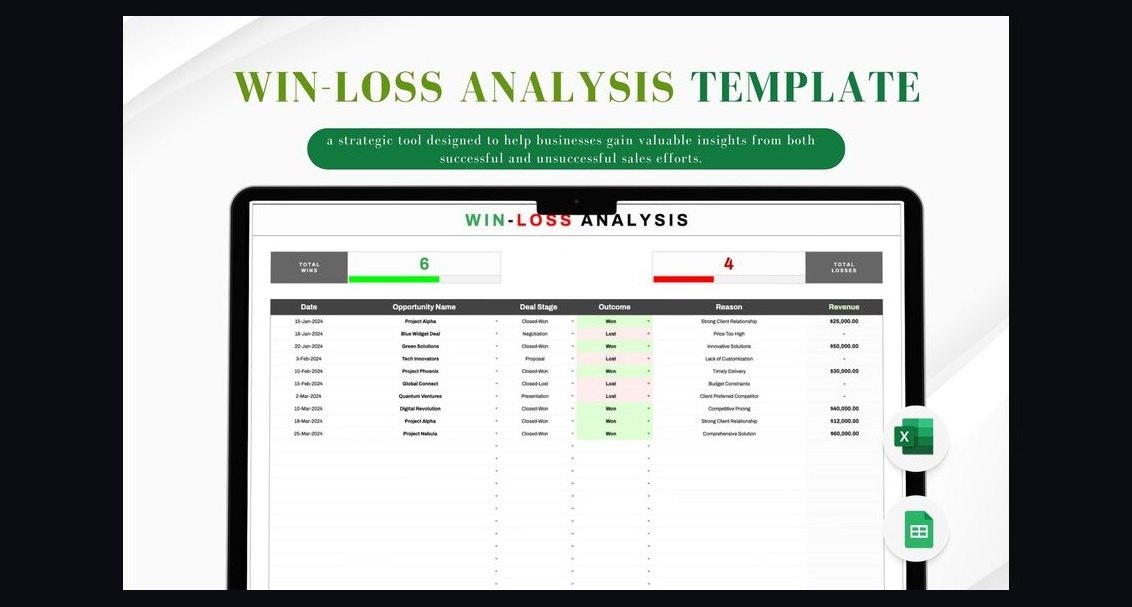 revopsHow Do I Run a Win/Loss Analysis Program That Improves Win Rate in 2027?
 pulse-qWho Pays for the Demising Wall Between Tenant Spaces?
 painting-contractorHow do you start a painting contractor business in 2027?
 saas-metricsHow is the Rule of 40 actually computed and why does it matter?
 nilWhat are Gonzaga Bulldogs men's basketball's 2027 NIL needs and strategy?
 pulse-qShould I open or buy a 7 Brew Coffee franchise in 2027?
 laundromatHow do you start a laundromat business in 2027?
 nilWhat are Ohio State Buckeyes football's 2027 NIL needs and strategy?