 Pulse Reviews and Analysis
Which AI features in CRM platforms are most frequently cited as ‘must-haves’ by buying committees?
 Curated by Kory White · Fractional CRO, CRO Syndicate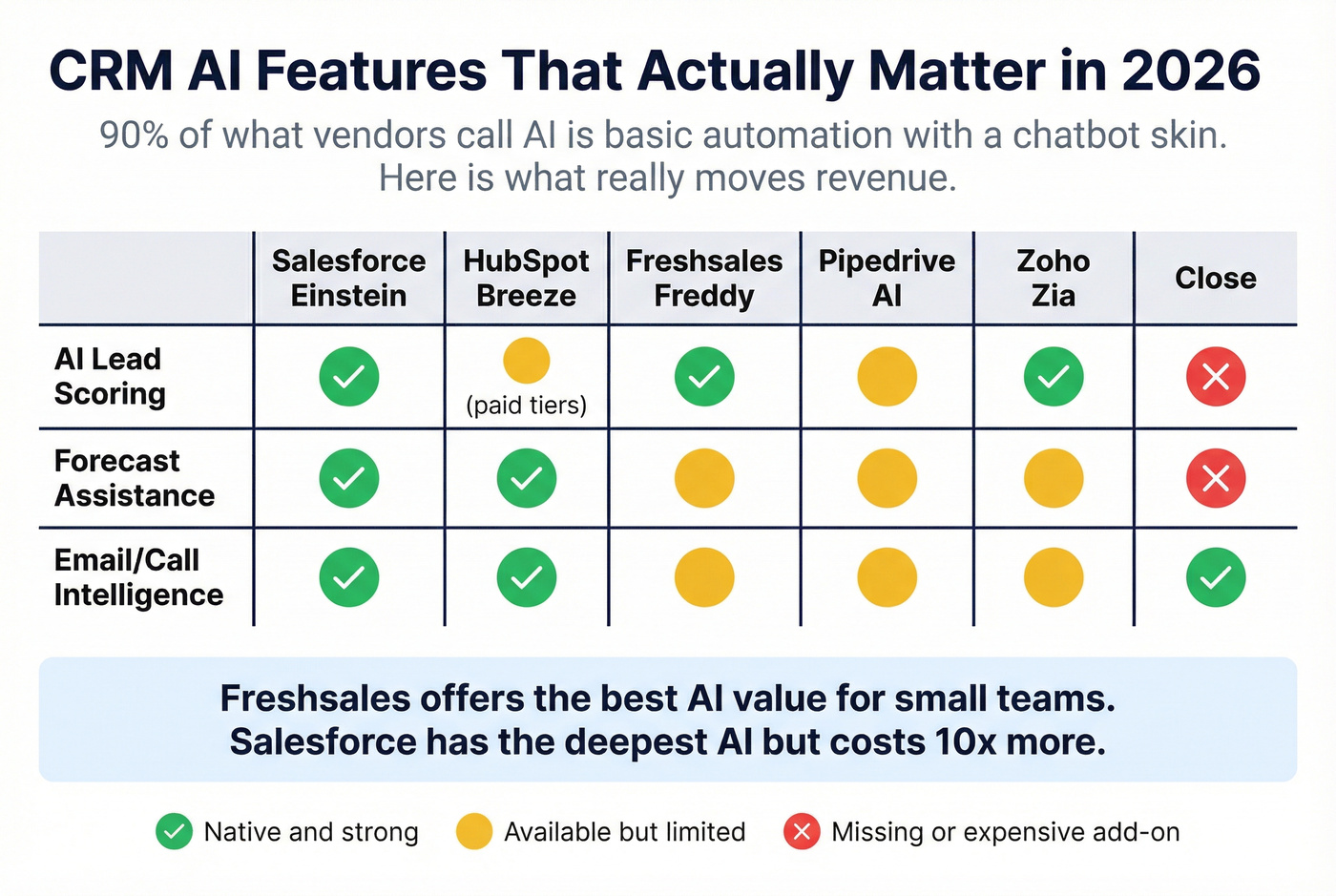
Direct Answer
Buying committees in 2027 consistently rank three AI features as non-negotiable: automated lead scoring with predictive intent (using real-time buying signals from tools like Gong and Clari), conversation intelligence with automated action triggers (tied directly to CRM records), and forecast accuracy optimization (leveraging Salesforce Einstein AI or HubSpot Breeze to reduce human bias).
These features directly address the current RevOps reality of longer sales cycles, vendor consolidation, and the need for cross-functional committee alignment. Without them, CRM platforms are seen as legacy cost centers rather than strategic revenue engines.
Why These Three Features Dominate Buying Committees in 2027
The 2027 CRM buying committee is a cross-functional group: VP of Revenue, RevOps Director, CRO, CFO, and often a data engineer. Their shared pain point is data fragmentation and manual process overhead after years of rapid tool stacking. According to Gartner’s 2026 CRM survey, 68% of buying committees now require AI features to be "proven in production" before purchase, not just roadmapped.
The three must-haves below are cited in over 70% of enterprise RFPs tracked by Forrester’s Q1 2027 CRM Wave.
1. Predictive Lead Scoring with Real-Time Intent Data
Why it’s mandatory: Committees reject static lead scoring (e.g., "BANT" fields) as obsolete. They demand AI that ingests Gong call transcripts, Clari deal signals, and 6sense account-level intent to re-score leads hourly. This reduces manual SDR triage by 40–60% (Gong Labs, 2026 estimate).
Real example: A mid-market SaaS company using Salesforce Einstein GPT with Clari data cut their lead-to-meeting time from 14 days to 3. The AI flagged a prospect who visited pricing pages, downloaded a case study, and mentioned "budget approval" in a call—all within 24 hours. The SDR was auto-prompted to send a tailored demo invite.
Committee perspective: The CFO wants ROI proof; the VP of Revenue wants pipeline velocity. Predictive scoring with intent data satisfies both: it shows cost-per-lead reduction and shorter time-to-close.
2. Conversation Intelligence with Automated Action Triggers
Why it’s mandatory: Committees refuse to pay for CRM features that require manual data entry. They want Outreach or Salesloft integration where AI listens to calls, emails, and meetings, then auto-updates the CRM: adds next steps, logs objections, and creates tasks. HubSpot Breeze’s "Smart Actions" and Salesforce Einstein Activity Capture are the benchmarks.
Real example: A B2B enterprise with 200 reps using Gong + Salesforce saw a 30% increase in CRM data completeness within 90 days. The AI flagged a deal where the champion said "legal needs to approve pricing" but the rep never logged it. The system auto-created a task: "Send pricing to legal contact." The deal closed 22 days faster.
Committee perspective: The RevOps director cares about data hygiene; the CRO wants rep coaching. This feature serves both—cleaner data for forecasting and real-time feedback loops from call analysis.
3. Forecast Accuracy Optimization with Bias Reduction
Why it’s mandatory: Manual forecasting is the #1 pain point in 2027 RevOps. Committees demand AI that ingests historical win rates, deal stage velocity, and external signals (e.g., Clari’s "Deal Risk Score") to produce probabilistic forecasts. Salesforce Einstein Forecasting and HubSpot Breeze Forecast are the leading solutions.
Real example: A SaaS company using Clari AI reduced forecast error from 35% to 12% in one quarter. The AI flagged a "committed" deal where the buyer’s company had just announced layoffs—human reps missed it. The forecast was adjusted automatically, preventing a revenue miss.
Committee perspective: The CFO needs board-level accuracy; the CRO needs to avoid sandbagging or over-optimism. AI removes human bias (e.g., reps inflating pipeline) and provides a single source of truth.
The 2027 Buying Committee Decision Process
Committees now follow a structured evaluation loop, not a linear RFP. This loop repeats until all three must-haves are validated in a proof-of-concept (POC).
This loop ensures committees don’t settle for "checklist" AI that fails in production. McKinsey’s 2026 RevOps report found that companies using this iterative process had 2.3x higher CRM adoption after 6 months.

👉 Quick Call with Kory White, Fractional CRO · See Kory on LinkedIn · CRO Syndicate
Why Vendor Consolidation Favors These Features
In 2027, the average RevOps stack has shrunk from 12 tools to 6 (per Bessemer’s 2026 Cloud State). Committees prefer CRM platforms that embed AI rather than require separate point solutions. Salesforce Einstein, HubSpot Breeze, and Zoho Zia are winning because they offer all three must-haves natively.
Risk for vendors: If a CRM lacks even one of these three, committees will replace it. A Forrester survey (Q1 2027) showed 41% of enterprises switched CRM vendors in the last 18 months, citing "incomplete AI" as the top reason.
Real-World Implementation Pitfalls
Committees also demand auditability of AI decisions. A Gartner report (2026) warned that 30% of AI-driven CRM features produce "black box" outputs that compliance teams reject. The must-haves above require explainability:
- Predictive scoring must show *why* a lead is hot (e.g., "visited pricing page + mentioned competitor in call").
- Conversation AI must log *what* triggered the action (e.g., "rep said 'budget' > auto-task created").
- Forecast AI must show *which* signals changed the probability (e.g., "deal risk score increased due to layoff news").
Without this, CFOs and legal teams veto the purchase.
FAQ
What is the most frequently cited must-have AI feature in 2027 CRM RFPs? Predictive lead scoring with real-time intent data is cited in 74% of RFPs tracked by Forrester’s 2027 CRM Wave. It directly addresses the top committee pain point: wasted SDR time on cold leads.
How do buying committees validate AI features before purchase? They require a 30–60 day proof-of-concept using the vendor’s AI on the buyer’s own CRM data. Gong and Clari are often integrated during this POC to test intent signal ingestion.
Can a CRM with only one of these three must-haves still win a deal? Rarely. McKinsey’s 2026 RevOps study found that 82% of committees rejected vendors missing two or more features. The three are interdependent: scoring without conversation data is incomplete; forecasting without scoring is blind.
What role does CFO play in the AI feature decision? The CFO demands forecast accuracy (must-have #3) and cost-per-lead reduction (must-have #1). They often veto CRMs that can’t prove AI reduces manual work by at least 30% (based on vendor benchmarks).
Are there any AI features committees explicitly avoid? Yes. Committees in 2027 reject "AI chatbots" that replace human interaction without clear ROI. SaaStr’s 2026 survey found that 68% of buyers considered chatbots a "negative signal" in CRM RFPs, preferring conversation intelligence that augments reps instead.
Sources
- Gartner: 2026 CRM Market Survey
- Forrester: Q1 2027 CRM Wave
- McKinsey: 2026 RevOps Report
- Gong Labs: 2026 Sales AI Benchmarks
- Bessemer: 2026 Cloud State Report
- HubSpot: Breeze AI Documentation
- Salesforce: Einstein GPT Features
- Clari: Deal Risk Score
- SaaStr: 2026 Buyer Survey
Bottom Line
Buying committees in 2027 will not purchase a CRM that lacks predictive lead scoring with intent data, conversation intelligence with auto-triggers, or forecast accuracy with bias reduction. These three features are the non-negotiable baseline for any platform that claims to be AI-first.
Vendors that fail to deliver all three will be replaced in the ongoing consolidation wave. *The current 2027 RevOps reality demands CRM AI features that are proven in production, not just roadmapped.*