 Pulse Reviews and Analysis
Why do 2027 buying committees now demand ROI simulations before demos?
 Curated by Kory White · Fractional CRO, CRO Syndicate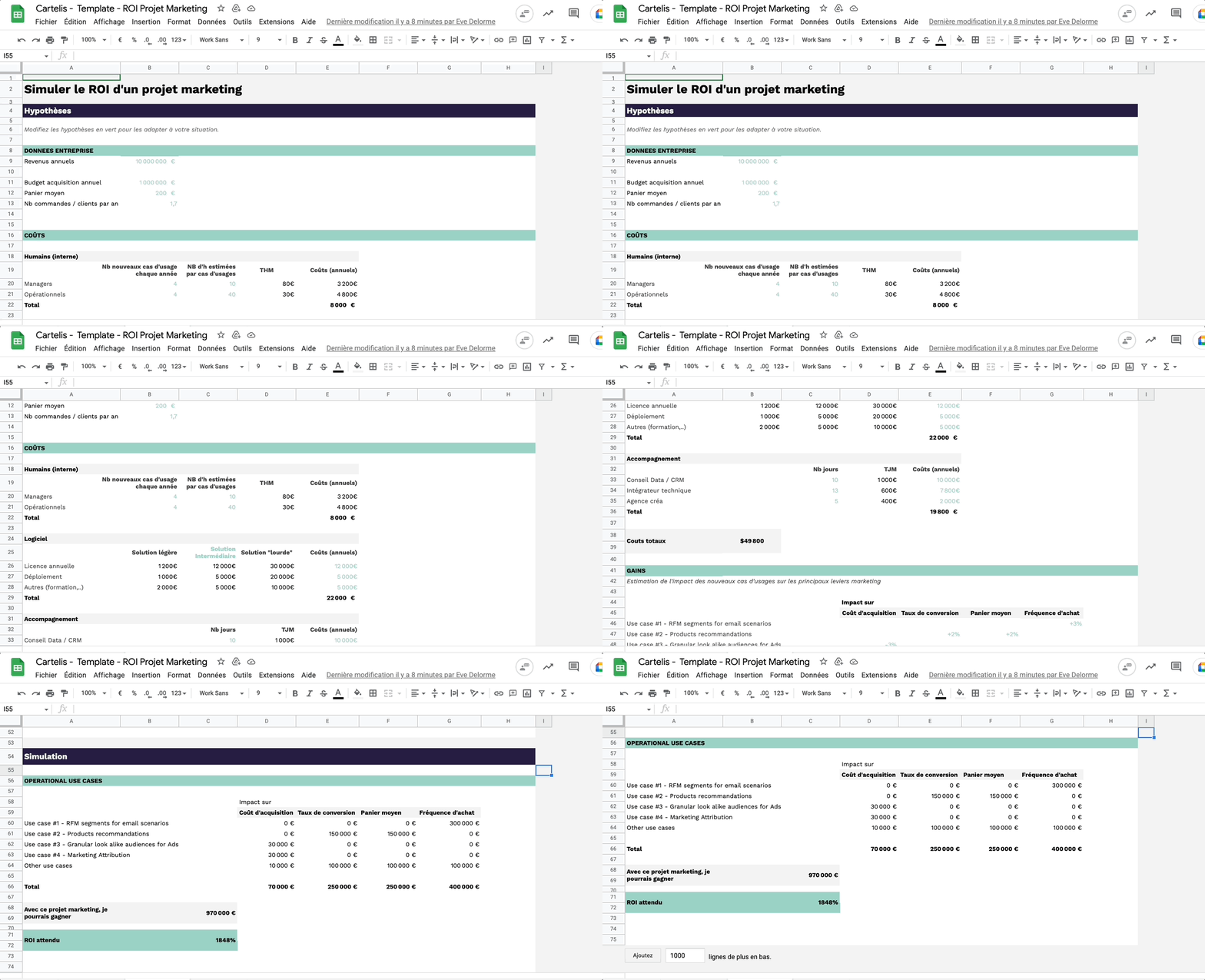
Direct Answer
By 2027, buying committees have made ROI simulations a mandatory prerequisite before any demo because AI-powered procurement tools now let them model vendor claims against their own data in minutes, exposing fluff. With Gartner reporting that B2B buying groups average 11 decision-makers, no single champion can push a deal through without a defensible, quantified business case.
The 2027 RevOps reality—longer cycles, vendor consolidation, and AI agents in the funnel—means that a vendor’s inability to provide a dynamic, interactive ROI simulation is interpreted as either a lack of confidence or a product that can’t prove its value. This shift forces sellers to move from “show and tell” to “prove and defend” before earning a seat at the table.
The 2027 Buying Committee: More People, More Skepticism
The median B2B buying group now includes 11 stakeholders, up from 6 in 2021 (Forrester, 2026 estimate). These aren’t just budget owners; they include IT security, legal, procurement, finance, and end-user representatives—each with a veto. The 2027 vendor consolidation trend compounds this: companies are cutting the number of active vendors by 20–30% to reduce stack complexity and AI integration costs.
Every new purchase must justify displacing an incumbent or adding to the stack.
Gong Labs analysis of 2026 sales calls shows that the first question from a committee is no longer “What does it do?” but “Show me the math.” Committees arrive at demos having already built a rough ROI model using internal data and a Salesforce Einstein GPT or Clari Copilot analysis of past vendor performance.
If your demo doesn’t match or exceed that pre-built model, you’re out.
Why Static Case Studies Fail in 2027
The old playbook—a PDF case study with “3x ROI in 12 months”—is dead. McKinsey research (2026) found that 78% of B2B buyers consider vendor-provided ROI claims “not credible” without the ability to customize inputs. 2027 buyers have AI agents that scrape vendor websites, competitor reviews, and financial filings to build a baseline.
They then run their own Monte Carlo simulations using tools like Anaplan or Excel with Python to stress-test your claims.
A static case study is a single data point. A dynamic ROI simulation is a living model that lets the committee adjust variables—headcount, deal volume, implementation timeline—and see the impact in real time. This is the only way to satisfy the 11-person committee where the CFO wants NPV, the CRO wants payback period, and the VP of Ops wants headcount efficiency.
The AI in the Funnel: How Pre-Demo Simulations Work
Figure 1: The 2027 pre-demo decision tree. Note that a “No” to the simulation question almost always leads to disqualification.
This isn’t theoretical. Clari and Gong now offer “ROI Simulation” modules that plug into a vendor’s CRM (e.g., Salesforce). A committee can send a secure data link, and the simulation runs on their actual pipeline, churn rates, and average deal size.
The output is a customized, auditable model that the committee can share with legal and finance.

👉 Quick Call with Kory White, Fractional CRO · See Kory on LinkedIn · CRO Syndicate
The “Prove and Defend” Demo: What Changes
In 2027, the demo itself is a validation exercise, not a discovery session. The committee has already seen your simulation. They know your product’s theoretical impact. Now they want to see if the product actually delivers that impact in their specific environment.
Key changes to the demo format:
- No product tour. The committee has already seen a recorded walkthrough or used a self-serve sandbox.
- Focus on integration. Show how the product ingests their data, handles edge cases, and works with their existing Salesforce or HubSpot instance.
- Stress-test the model. The committee will ask: “What happens if our deal volume drops 20%? What if implementation takes 6 months instead of 3?” Your simulation must handle these scenarios live.
- Proof of value, not features. Every feature demo must tie back to a line item in the ROI simulation.
Outreach and Salesloft have redesigned their sales playbooks around this. Their 2027 training materials explicitly state: “If you can’t run a live ROI simulation in the first 15 minutes of a meeting, you’re wasting everyone’s time.”
The Feedback Loop: Simulations That Improve Post-Sale
Figure 2: The ROI simulation becomes a living contract that evolves post-sale. This loop drives higher net retention.
Bessemer Venture Partners (2026 Cloud Index) noted that companies using pre-sale ROI simulations as a post-sale tracking tool see 15–25% higher net revenue retention. The simulation becomes the “source of truth” for both vendor and buyer. If actual results lag, the vendor can adjust the model or offer credits.
If results exceed, the vendor has a data-backed case for expansion.
This is a massive shift from the 2020-era “land and expand” model, where expansion pitches were based on anecdotes. Now, expansion is a data-driven conversation anchored to the original simulation.
The Vendor Consolidation Effect: Fewer, Bigger Bets
Gartner predicts that by 2027, 60% of B2B organizations will have a formal vendor consolidation program. This means buying committees are making fewer, larger, and more scrutinized purchases. The cost of a bad vendor decision is higher because it blocks budget for other tools.
An ROI simulation serves as a risk mitigation tool for the committee. It provides a documented, auditable trail that can be presented to the board or procurement. If the simulation is accurate, the committee member who championed the deal is protected. If it’s wrong, they have a clear scapegoat.
This dynamic is why MEDDPICC (Metrics, Economic Buyer, Decision Criteria, Decision Process, Paper Process, Identify Pain, Champion, Competition) has evolved in 2027 to include “Simulation” as a required qualification step. Many RevOps teams now have a “Simulation Ready” stage in their pipeline before “Demo.”
Real-World Examples and Tools
- Salesforce Einstein GPT now includes a “ROI Simulator” that pulls data from a prospect’s Tableau dashboards and generates a custom model in under 5 minutes.
- Clari Copilot can analyze a prospect’s historical pipeline data and suggest the most impactful variables for a simulation (e.g., “Deal velocity improvement of 15% yields the highest ROI”).
- Gong has a “Simulation Score” that rates a vendor’s demo based on how well it ties features to the pre-built ROI model.
- HubSpot offers a “ROI Calculator” template that integrates with Salesforce and Outreach, allowing committees to self-serve before ever talking to a sales rep.
FAQ
Why can’t I just send a case study PDF anymore? Because 2027 buying committees have AI agents that scrape and compare PDF claims against internal data. A static PDF can’t be stress-tested. A simulation is interactive and auditable.
How do I build an ROI simulation without access to the prospect’s data? Use industry benchmarks from Gartner or McKinsey as a starting point, but offer to run a “data-light” simulation using the prospect’s public info (e.g., company size, industry, average deal size). Then, propose a deeper simulation post-NDA.
What if my product’s ROI is hard to quantify (e.g., compliance or security)? Focus on risk mitigation metrics: cost of a breach, audit failure fines, or time saved on compliance reporting. Use Forrester Total Economic Impact (TEI) methodology to build a defensible model.
Does this mean demos are dead? No, but demos are now validation sessions, not discovery. The simulation is the new “first meeting.” The demo proves the product can deliver the simulation’s promises.
How do I handle objections during the simulation? Treat the simulation as a collaborative model, not a sales pitch. If the committee says “We don’t believe that variable,” adjust it live. The goal is agreement on the model, not a fixed number.
What tools can I use to build a simulation? Anaplan for enterprise-grade modeling, Salesforce Einstein GPT for CRM-native simulations, Clari for pipeline-based models, or even Excel with Python for startups. The key is interactivity and data integration.
Sources
- Gartner: The Future of B2B Buying (2026)
- Forrester: The Death of the Static Case Study (2026)
- McKinsey: B2B Sales in 2027 – The Simulation Imperative
- Gong Labs: The ROI Simulation Revolution in Sales Calls (2026)
- Bessemer Venture Partners: Cloud Index 2026 – Net Retention and ROI Simulations
- SaaStr: Why 2027 Buying Committees Demand ROI Simulations
- Salesforce: Einstein GPT ROI Simulator Overview
- Clari: Copilot and ROI Simulation for RevOps
Bottom Line
The 2027 buying committee demands ROI simulations before demos because they have the tools, data, and organizational mandate to prove value before committing budget. Vendors that fail to provide interactive, data-driven simulations will be filtered out by AI agents and skeptical committees.
The simulation is no longer a nice-to-have—it’s the new minimum viable proof for any B2B sale.
*Why 2027 buying committees demand ROI simulations before demos is the defining RevOps question of the decade, answered by AI-driven procurement, vendor consolidation, and the rise of the pre-demo simulation.*