

How do you start a courier delivery business in 2027?
 Curated byKory White · Fractional CRO · Maryland
Quality
Certified
Start a courier delivery business in 2027 by selling recurring B2B route contracts — medical, legal, pharmacy, or same-day parts — instead of one-off consumer deliveries. Launch as an owner-operator for roughly $12,000-$45,000, secure commercial auto and cargo insurance, resolve driver classification deliberately, and price routes monthly rather than per-drop.
The outcome you should expect
The realistic outcome of a disciplined courier launch is not a hypergrowth story. It is a slow, compounding, cash-generating regional operating company that becomes an asset you can sell. Set your expectations against that shape, not against the delivery-app narrative you have absorbed from headlines.
In the first twelve months, expect to be the primary driver. You will run one or two routes yourself, sell in the gaps between them, and do invoicing at night. Revenue in that window commonly lands somewhere between $95,000 and $240,000 for an owner-operator who also dispatches two to five contracted drivers. Owner take-home is modest — most cash goes back into a working-capital buffer, a second vehicle, and the insurance premium. The genuine deliverable of year one is not profit; it is a contract book of roughly six to fourteen recurring routes and an operation you understand cold.
Year two typically lands between $260,000 and $550,000 as you stop driving daily and shift into full-time selling, dispatch leadership, and hiring. Twelve to twenty-five contracts, six to twelve drivers, real dispatch software, and a part-time dispatcher or admin become the shape of the company. Margins stay thin because you are reinvesting into headcount and vehicles, but the book itself is now an asset a lender or acquirer would recognize.
By year three, a focused operator with twenty to forty-five contracts and twelve to thirty drivers commonly runs $600,000 to $1.4 million with net margins firming into the 8-15% band as fixed overhead spreads across more routes. That is the inflection point where the company stops being a job. Years four and five, with a second niche or second geography and sixty to a hundred-forty routes, put $2.5 million to $6 million within reach at 10-18% net margins — the point where you choose between holding a cash-flowing business, becoming a consolidator yourself, or selling to one.

The thing that determines whether you land on that curve or off it is a single structural choice made in the first month: whether you sell contracts or deliveries. Everything else — pricing, insurance, staffing, tooling — follows from it.
What drives that outcome
The outcome is driven by one asymmetry. Gig platforms genuinely won the consumer on-demand layer: a person ordering a burrito, groceries, or a forgotten charger across town. That layer runs on driver density you cannot build and prices subsidized by capital you cannot match. If your plan is "an app where anyone can get anything delivered fast," you lose on day one and every day after.
What they did not win — and structurally cannot win well — is the recurring B2B route. The clinic that needs specimens picked up at 11:40 a.m. every weekday with unbroken cold chain and a signed chain-of-custody form. The law firm that needs a filing physically stamped before the 4:00 p.m. courthouse cutoff. The pharmacy running forty prescriptions on the same loop to the same forty addresses every afternoon. These buyers do not want a different driver each day or a star-rating gamble. They want a vendor, a contract, an account manager, one monthly invoice, and someone accountable when it goes wrong.
That is a relationship business, and relationship businesses resist commoditization. Four wedges carry that property:
Clinical and medical courier. Reference labs, hospital-affiliated labs, and physician offices need specimens moved multiple times daily, often temperature-controlled, always documented. Add STAT pathology runs, blood products, medical records, interoffice hospital mail. Buyers are extremely sticky because switching couriers introduces patient-safety and regulatory exposure. Highest value, highest compliance barrier, longest sales cycle — commonly 60 to 150 days into labs and hospital systems.
Legal and document courier. Law firms, title companies, courthouses, government offices. Volume per firm is smaller than medical but per-stop pricing runs high and decisions come fast — firms often decide in days rather than months. Process serving is regulated state by state and may require registration or bonding, but plain document courier work is largely unregulated.
Pharmacy and home-health delivery. Independent pharmacies, specialty and infusion pharmacies, and durable medical equipment suppliers need scheduled daily loops to patient homes. Routes are dense and predictable, which is excellent for unit economics. Independent pharmacies are relationship-driven, underserved buyers who currently solve the problem by sending a technician out in a personal car.
Same-day B2B parts and replenishment. Auto parts distributors running hot-shot deliveries to repair shops, dental and optical labs shipping appliances to practices, print shops, industrial and MRO suppliers, restaurant supply. Lowest compliance barrier, broadest buyer base, easiest start — and the wedge where gig platforms occasionally poke, which is why many operators harden it later by adding a medical line.
The common ICP signal across all four: a business currently solving this with its own employees in personal vehicles, or with an unreliable incumbent, and for whom failure has a real cost. A missed specimen is a re-draw and an angry physician. A missed filing is malpractice exposure. A missed part is a car sitting on a lift. That cost is your pricing power. The buyer who just wants the cheapest occasional drop is not your buyer — let the platforms have them.

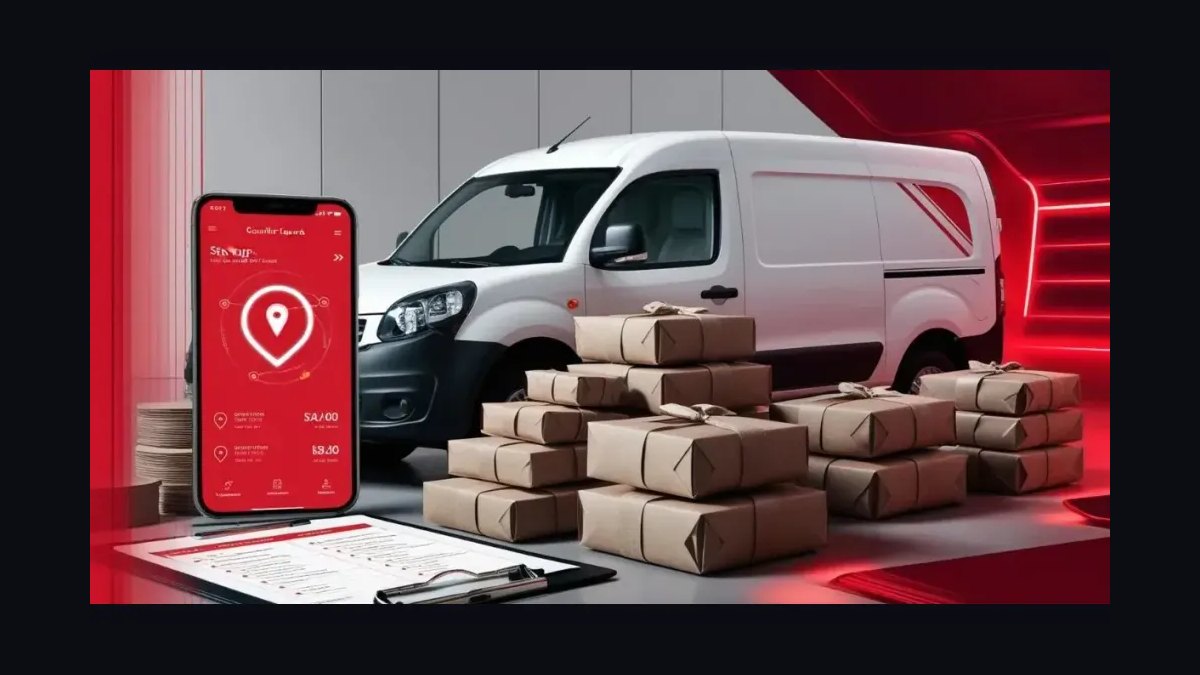
The diagram makes the mechanism visible: revenue in this business is a byproduct of a *relationship pipeline*, not a transaction volume. Every arrow into the contract box represents weeks of unglamorous outbound work, and every arrow out of it represents revenue that renews without being re-sold.
Benchmarks and realistic ranges
Concrete numbers matter more than philosophy here, so here are the ranges a practitioner should plan against. Treat them as planning bands, not guarantees — they vary meaningfully by metro density, fuel costs, and local wage levels.
Startup capital. A lean owner-operator launch lands between $12,000 and $22,000: a used cargo van or reliable compact at $8,000-$15,000 if you need one, commercial auto and cargo insurance at $6,000-$11,000 for the first year (paid monthly), formation and licenses at $500-$1,500, dispatch software at $80-$250 per month, phones, scanners, coolers, signage, and uniforms at $800-$2,000, plus a $3,000-$6,000 working-capital buffer to bridge the 30-60 day gap before your first contract invoices actually pay.
An asset-light dispatcher launch runs $8,000-$18,000 because you buy no vehicle at all — you recruit contracted drivers who own and insure their own, and you spend your energy entirely on selling and dispatching. It launches faster but carries more contingent liability and much sharper classification risk. A funded multi-route launch at $30,000-$45,000 puts two or three vans, broader insurance, real dispatch software, and a larger buffer in place from the start.

Pricing structures. There are four legitimate structures and one trap.
A *dedicated route contract* is your foundation: fixed monthly payment for a named driver running a defined route on a defined schedule. A daily medical specimen route of twelve to twenty-five stops commonly prices at $2,800-$6,500 per month depending on mileage, stop count, time windows, and temperature requirements. A pharmacy route runs $1,800-$4,200. A B2B parts route runs $2,200-$5,500. You build these up from fully loaded cost — driver settlement or wage, fuel, vehicle, insurance allocation, dispatch overhead — and add 22-38% margin.
*Scheduled per-stop* pricing suits recurring-but-variable volume: $6-$18 per stop on a dense route, more when stops are spread out, sometimes structured as per-mile plus a per-stop fee.
*On-demand STAT and hot-shot* is the premium tier: a STAT medical run at $28-$95 by distance and urgency, a legal rush filing at $45-$150, an auto-parts hot-shot at $35-$110. High margin, unpredictable — gravy on the contract base, never the base itself.
*Account minimums plus usage* — a $400-$1,500 monthly minimum including a block of stops, then per-stop overage — works for mixed accounts and guarantees baseline revenue.

The trap is a gig-style flat delivery fee of $5-$9. It does not cover real cost outside dense urban cores, it attracts price-shoppers with no loyalty, and it produces no contract asset. A prospect who only wants that pricing is not a customer.
Route unit economics. A single mature route generates $3,000-$5,500 monthly revenue against driver cost of $1,500-$3,000, fuel at $400-$900, vehicle and maintenance allocation of $300-$700, insurance allocation of $250-$550, and dispatch/admin allocation of $200-$450. Contribution margin after direct costs lands roughly 18-32%. The business makes money by stacking routes so fixed overhead spreads thin — which is why route count, not revenue, is the metric you actually manage.
Sales throughput. Expect to contact fifty to a hundred named accounts to land your first five to ten contracts. Medical cycles run 60-150 days; legal often closes in days. Budget your runway against the slow number, not the fast one.
Insurance. Commercial auto liability at typically $1 million combined single limit, cargo insurance for what you carry, general liability, workers' compensation if you have employees, and non-owned/hired auto coverage if you use contracted drivers. Total commonly $6,000-$14,000 annually for a small operation, scaling with vehicles and drivers. Use a broker who specializes in transportation; a generalist will mis-cover you, and a personal auto policy will deny a commercial claim outright.

Exit multiples. A clean, contract-heavy regional courier with $2-6 million in revenue, documented operations, low customer concentration, and resolved driver classification trades in a band around 0.4-0.8x revenue or 3.5-5.5x seller's discretionary earnings. The specialty courier space — medical especially — is actively consolidating, so the exit door is real, but it only opens for a business built to be acquirable.
Risks, edge cases, and failure modes
Eight things kill courier businesses, and the first two kill most of them.
Driver misclassification is the single most dangerous structural decision in 2027. The industry historically ran on 1099 contractors who own their vehicles and settle per route. The appeal is obvious — no payroll tax, no workers' comp on a W-2 basis, no vehicle cost, variable cost that flexes with volume. But the legal ground has shifted sharply. California's AB5 and its ABC test, the U.S. Department of Labor's worker-classification rulemaking, and a churning patchwork of state law have made it far easier for a driver, a state agency, or the IRS to argue your contractors are employees — especially since a reliability-driven courier operation naturally wants to control schedules, routes, uniforms, and methods. A misclassification finding means back payroll taxes, back overtime, penalties, workers' comp exposure, and potentially class action.
The honest guidance: if you use contracted drivers, structure the relationship genuinely — drivers own and insure their vehicles, you contract route by route, you do not dictate method, agreements are written and airtight, drivers ideally operate through their own entity, and your policy covers non-owned and contingent auto liability. Even then, in strict states, pure contractor models are legally fragile. If you use W-2 drivers, costs are higher and less flexible but you gain control, stability, lower legal risk, and honestly a better product, because employed drivers are more reliable and easier to retain. The pragmatic path: start as owner-operator, add contracted drivers carefully while small, and plan the W-2 transition seriously as you pass roughly eight to fifteen drivers or the moment you operate in a strict state. Price every contract as if you might need a W-2 cost base, so your margin never depends on a classification position that may not survive. Talk to a state-specific employment attorney before your first hire.
Inadequate insurance is the second killer. A driver running on a personal policy is an unfunded catastrophic loss waiting to happen; one denied claim ends the company.

Customer concentration is the third. No single account should exceed roughly 20-25% of revenue. Losing an anchor should hurt, not be fatal.
Buying vehicles ahead of contracts is the cardinal capital sin. Vehicles must always lag signed routes — use contracted drivers' vehicles or short-term rentals to bridge. The failure pattern is vivid: five vans and an office purchased before a single contract, loose contractor structure in a strict state, gig-style consumer work to fill idle capacity, a classification audit in year two, and a fold before month thirty.
Service-failure churn is quieter but just as lethal. The product you sell is reliability, so on-time and on-spec percentage by route and by customer is the metric that governs everything. When it dips, churn follows in sixty to ninety days — usually without a warning conversation. The discipline that prevents it: the customer hears about a problem *from you, with a solution*, before they hear about it from their own boss. A driver calls in sick and backup dispatches within minutes. A specimen isn't ready and the lab gets a call, not a surprise.
Gig-platform encroachment at the easy edges — B2B parts, some pharmacy — is real and continuing. Mitigate by choosing defensible niches, selling the documentation and compliance and relationship the platforms cannot match, and treating the platforms as overflow capacity rather than a head-to-head competitor.

Cash-flow squeeze from net-30 and net-45 invoicing catches operators who priced well but capitalized thin. Keep the working-capital buffer, invoice cleanly on a fixed monthly cadence, and use minimums or deposits on new accounts. Invoice factoring is a last resort, not a plan.
Founder bottleneck is the slow one. Document standard operating procedures early, build a dispatcher and ops layer by year two or three, and stop driving routes as soon as the model is proven. A business that only works when the founder drives is a job with extra liability.
Two edge cases worth flagging. First, DOT and FMCSA: most local courier work in light vehicles falls below the thresholds requiring a USDOT number or operating authority, but crossing state lines for-hire, running heavier vehicles, or carrying certain hazardous materials can pull federal rules into scope — verify your specific situation rather than assuming. Second, medical-specific compliance: OSHA bloodborne pathogen training, correct packaging for biological substances, HIPAA awareness with business associate agreements in place, chain-of-custody procedure, and driver background checks and drug screening are effectively mandatory to win lab work. Budget the time and the premium.
A practical rollout plan
Here is the sequence, month by month, that turns the ranges above into a running company.

Month 0 — validate the market. Count the addressable buyers within a 45-minute radius in one niche. If you cannot find forty to sixty potential recurring-route buyers with a physical-movement need where lateness is expensive or dangerous, change niche or change geography. Do this before you spend a dollar.
Month 0-1 — choose exactly one wedge. Medical if you have healthcare or logistics background and can stomach compliance for the stickiest contracts. Legal if you are in a metro dense with courthouses and want fast cycles and high per-stop pricing. Pharmacy if you want dense predictable loops with moderate compliance. B2B parts if you want the lowest barrier and fastest start. One niche, eight to fifteen contracts deep, before you add a second — spreading across all four means learning none of them, muddling your insurance and certifications, and pitching generically.
Month 1 — legal and insurance foundation. Form the LLC or S-corp, get the EIN and local licenses, and engage a transportation-specialist insurance broker for commercial auto, cargo, general liability, and the right driver coverage. In the same window, book an hour with a state-specific employment attorney and decide your staffing structure deliberately.
Month 1-2 — minimum viable operation. One reliable vehicle (used Transit Connect, ProMaster City, or a clean compact — buy used, buy reliable, maintain obsessively, because a breakdown on a STAT run is a contract-ending event). Dispatch and proof-of-delivery software from the courier-specific tier at $80-$400 monthly, giving you route optimization, a driver app with signature/photo/barcode capture, real-time tracking the customer can see, a dispatch board, and invoicing. Add temperature loggers, validated coolers, spill kits, and secondary containment if you chose medical. Skip the custom app, the office, and the fleet.
Month 2-5 — outbound sales grind. Build the named-account list: every lab, clinic, law firm, pharmacy, dental and optical lab, and parts distributor in radius, with the operations person who owns the delivery problem identified for each. Work it with a researched email, a follow-up call, and an offer of a free route audit or a no-risk trial run. Layer in association networks — medical group administrators, paralegal associations, independent pharmacy groups — and stay in light regular contact with the whole list so you are the call they make the day their incumbent stumbles. A clean niche-specific website with local search intent captures inbound, but it is support, not the engine. Subcontracting overflow from larger carriers is legitimate early revenue while you build the direct book; just never let it become the whole business, because you are a price-taker with no customer relationship there.

Month 3-8 — first contracts and route discipline. Never quote a cold number; quote a structure and anchor against their current loaded cost. Frame it the way it actually lands: an eighteen-stop daily route with two refrigerated pickups at roughly $3,900-$4,600 monthly on a twelve-month agreement, inclusive of a dedicated trained driver, backup coverage, chain-of-custody documentation, and one monthly invoice — versus what they currently burn in staff time, mileage reimbursement, and risk exposure. Then run the operation as a reliability machine: routes confirmed the night before, vehicles checked, manifests and scanners in hand, backup identified for gaps, exceptions communicated proactively, PODs reconciled at end of day, on-time percentage reviewed weekly by route and driver, route profitability reviewed monthly with unprofitable routes repriced or killed.
Month 6-18 — stack routes, then step out of the van. Add contracted or employed drivers only against signed routes. Move yourself from driving to selling and dispatch leadership. Hire the first dispatcher when text messages and a spreadsheet stop working — which is reliably around the third driver.
Year 2-3 — systematize and diversify. Documented SOPs, an operations manager, a deliberate and final answer on driver classification, customer concentration held under a quarter of revenue, and a second niche once the first is fifteen-plus contracts deep.
Two notes on the plan. First, the RevOps instinct applies directly here even though this is a physical-operations business: the contract book is your recurring revenue base, on-time percentage is your leading churn indicator, and route profitability is your unit-economics ledger — instrument all three from month one rather than reconstructing them in year two. Second, build the company from day one as though you will sell it. Written contracts, clean books, documented procedures, diversified accounts, and a resolved classification position are exactly the disciplines that make it a better business to operate even if you never sell.
Related questions
How long before a courier business pays the founder a real salary?
Typically eighteen to thirty months. Year one owner pay is modest because cash goes to working capital, insurance, and the second vehicle. Meaningful owner compensation usually arrives once you clear roughly fifteen to twenty stacked route contracts and overhead spreads across them.
Should you buy an existing courier business instead of starting one?
Often yes, if the contract book is real. You are buying signed routes, driver relationships, and insurance history rather than building them. Scrutinize customer concentration, contract terms, and driver classification exposure — an inherited misclassification problem transfers with the company.
Do you need your own vehicles to start?
No. An asset-light dispatcher model uses contracted drivers who own and insure their vehicles, cutting startup cost to roughly $8,000-$18,000. The trade-off is sharper classification risk and contingent liability. Either way, vehicles should lag signed routes rather than lead them.
What software should a new courier operator actually buy?
Courier-specific dispatch and proof-of-delivery software at $80-$400 monthly: route optimization, a driver mobile app with signature, photo and barcode capture, customer-visible tracking, a dispatch board, and invoicing. Medical adds electronic chain-of-custody with a full audit trail.
Will autonomous vehicles make courier work obsolete?
Not on this decade's timeline for this work. Multi-stop specimen routes, courthouse runs, and parts hot-shots require human handoff, chain-of-custody signatures, and live exception handling. Autonomy lands first in dense consumer corridors, not in scheduled B2B routes with documentation requirements.
FAQ
What is the biggest mistake people make when starting a courier business in 2027?
Competing with gig platforms on price and speed for one-off consumer deliveries. That layer is subsidized by capital you cannot match and driver density you cannot build. The escape is a single discipline: sell recurring route contracts to businesses where reliability and chain-of-custody matter more than raw speed. Founders who chase easy gig revenue for early traction almost never build the contract book that is the actual asset — the revenue feels like progress but it does not renew, cannot be forecast, and no acquirer will pay for it.
How much money do I need to start a courier delivery business?
Plan on $12,000-$45,000 depending on structure. A lean owner-operator launch runs $12,000-$22,000 including a used vehicle, first-year commercial auto and cargo insurance at $6,000-$11,000, formation costs, software, equipment, and a working-capital buffer for the 30-60 day invoice gap. An asset-light dispatcher model with contracted drivers runs $8,000-$18,000 because you buy no vehicle. A funded multi-route launch with two or three vans runs $30,000-$45,000.
What kind of customers should I target first?
A clinic, lab, law firm, pharmacy, or distributor that needs the same driver, same route, same time, every weekday. The strongest signal is a business currently solving the problem with its own staff in personal cars, or with an incumbent courier that has become unreliable, and for whom a failure carries real cost — a re-drawn specimen, a missed court deadline, a car stuck on a lift. Those buyers are risk-shopping, not price-shopping.
How do I price my courier services?
Price structures, not deliveries. Dedicated route contracts run $1,800-$6,500 per route per month depending on niche, stop count, mileage, and temperature requirements, built up from fully loaded cost plus 22-38% margin. On-demand STAT runs price at $28-$95 per stop; scheduled per-stop rates on a dense route at $6-$18. Never quote a gig-style $5-$9 flat delivery fee — it does not cover real cost and produces no contract asset.
Do I need special certifications or licenses?
It depends on your niche. Every operator needs a business entity, local licenses, and commercial auto plus cargo insurance. Medical work adds OSHA bloodborne pathogen training, correct biological-substance packaging, HIPAA awareness with business associate agreements, chain-of-custody procedure, and driver background checks and drug screening. Legal process serving is regulated state by state and may require registration or bonding. Federal DOT authority applies only in narrower cases — crossing state lines for-hire, heavier vehicles, or certain hazardous materials.
Should my drivers be employees or independent contractors?
This is the decision most likely to erase your margin, so get state-specific legal advice before your first hire. Contractor models require genuine independence — driver-owned and insured vehicles, route-by-route contracting, no control over method, airtight written agreements — and remain legally fragile in strict states. Employed drivers cost more but bring control, retention, and lower legal risk. The pragmatic path is to start as owner-operator, add contracted drivers carefully while small, and price every contract as though you may need a W-2 cost base.
Sources
- https://www.bls.gov/ooh/transportation-and-material-moving/delivery-truck-drivers-and-driver-sales-workers.htm
- https://www.dol.gov/agencies/whd/flsa/misclassification
- https://www.sba.gov/business-guide/launch-your-business/choose-business-structure
- https://www.irs.gov/businesses/small-businesses-self-employed/independent-contractor-self-employed-or-employee
- https://www.osha.gov/bloodborne-pathogens
- https://www.hhs.gov/hipaa/for-professionals/privacy/guidance/business-associates/index.html
- https://www.fmcsa.dot.gov/registration/do-i-need-usdot-number
- https://www.dir.ca.gov/dlse/faq_independentcontractor.htm
- https://www.census.gov/naics/
Related on PULSE
- How do you start a medical courier business in 2027?
- How Many Sales Reps Do I Need to Hire for My Medical Courier Company?
- How Many Sales Reps Do I Need to Hire for My Courier Service?
- How do you start a laundry pickup and delivery service business in 2027?
- How do you start a firewood delivery business in 2027?
- How do you start a rideshare and delivery fleet business in 2027?
This page will be disappearing soon. Save it to your device for $1 — or read it free while it is here.
@Kory-White- · if Venmo asks, the last 4 of my number are 2012
This page is gone.
This one is off the shelf now. $1 keeps it on your phone for good — the whole page, pictures and diagrams included.
 mobile-barberHow do you start a mobile barber business in 2027?
 tree-serviceHow do you start a tree service business in 2027?
 subscription-boxHow do you start a subscription box curation business in 2027?
 hvacHow do you start an HVAC business in 2027?
 post-construction-cleanupHow do you start a post-construction cleanup business in 2027?
 food-deliveryHow do you start a hyperlocal food delivery business in 2027?
 mobile-bike-repairHow do you start a mobile bike repair business in 2027?
 custom-embroideryHow do you start a custom embroidery shop business in 2027?
 moving-companyHow do you start a moving company in 2027?
 commercial-cleaningHow do you start a commercial office cleaning business in 2027?