
Sales Demo Best Practices: Agenda and Script for a Peer-Led Training Workshop
 Curated byKory White · Fractional CRO · Maryland
 PULSEKNOWLEDGE LIBRARY
Quality
Certified
A peer-led sales demo training workshop is a 90-minute, timed agenda that pairs a facilitator script with live role-play: a warm-up that surfaces real demo mistakes, a taught demo structure (MEDDIC plus a Challenger-style insight), scripted opens and closes practiced in pairs, and a recorded-call review. Best practices: keep the agenda tight, use real recordings, and end with a committed next step for every rep.
A Recorded Demo That Went Sideways
Picture a mid-market SaaS team reviewing a lost deal. A rep spent 22 of 30 minutes on a feature walkthrough before asking a single discovery question, and the prospect went dark within 48 hours. That single recording is the best training asset a sales manager has, because it turns an abstract best-practice list into a concrete, shared reference point the whole team can critique together. This is why the opening move of any peer-led workshop should be a warm-up built around a real, slightly cringe-worthy demo clip or story — not a hypothetical scenario. When people share a specific, lived failure ("I rambled for ten minutes about integrations nobody asked about"), the room self-identifies the patterns worth fixing: rambling, no discovery, no next step, dead air during screen-share lag. A facilitator should budget 10 minutes for this warm-up: 30 seconds of individual reflection, then a rapid go-around where each person names one word describing their worst demo moment, captured on a whiteboard or shared doc. That list becomes the working agenda for the rest of the session — instead of teaching abstract theory, the workshop spends its remaining 80 minutes fixing the exact failure modes the room just named. The training only works if the examples are real; invented scenarios don't carry the same weight, and reps disengage faster from role-play that doesn't reflect an actual sale they've lived through. A manager preparing this agenda should pull two or three anonymized recordings in advance — a win, a loss, and a stalled deal — so the warm-up discussion has concrete material to point back to for the rest of the workshop.
How a Peer-Led Demo Training Workshop Actually Runs
The core mechanism of an effective training workshop is teaching one repeatable demo structure, then drilling it through paired role-play until it's reflexive. The structure worth teaching combines two frameworks: MEDDIC (Metrics, Economic Buyer, Decision Criteria, Decision Process, Identify Pain, Champion) for qualification, and a Challenger-style "teach" moment for the opening hook. The five-part flow a facilitator should script out loud is: two minutes of context and agenda-setting, five minutes of discovery focused on the economic buyer's metrics, eight minutes of solution story delivered through the lens of the buyer's stated pain, three minutes of proof points drawn from comparable customers, and two minutes locking a next step tied to decision criteria. After walking through the flow verbally, the facilitator pairs reps up — one plays a named persona (for example, a VP of Sales at a $50M-revenue company with a specific quota problem), the other runs the full flow inside an eight-minute window. The constraint of a real clock is what makes the drill work: reps who ramble in real demos will ramble in the role-play too, and the visible time pressure forces them to cut filler on the spot. After the eight minutes, roles switch so every rep experiences both sides of the table. The facilitator then debriefs with two questions: what was hardest, and where did you forget to identify the economic buyer? This mechanism — teach the structure, then force it through a timed, role-swapped rehearsal — is what separates a training that changes behavior from a training that's just a slide deck. Twenty minutes is a realistic budget for this segment inside a 90-minute agenda.

Benchmarks: What Good Demos Look Like in the Numbers
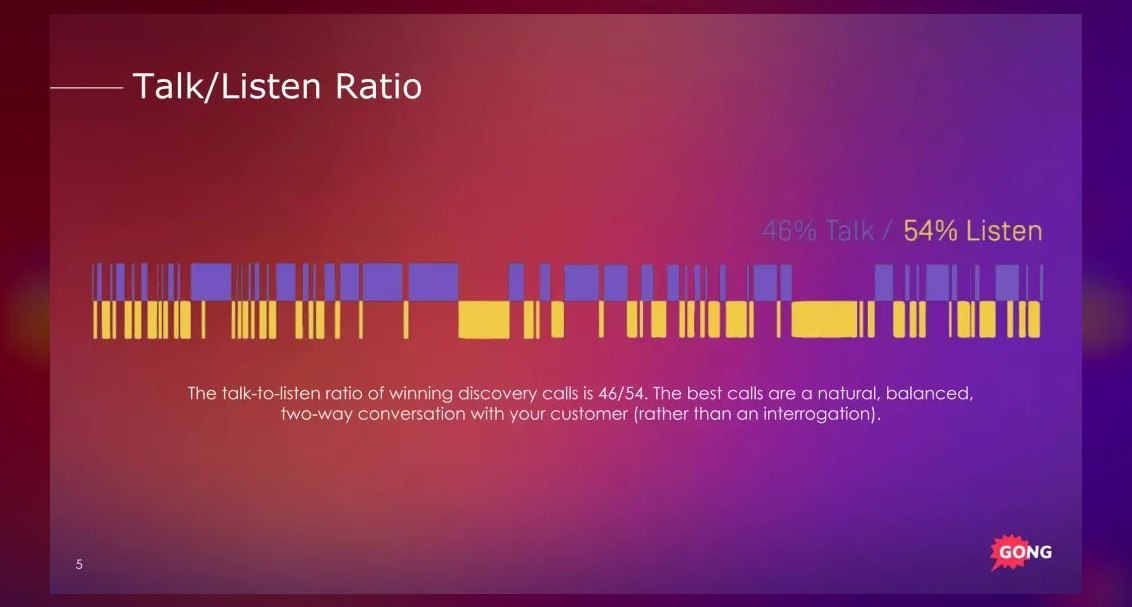
A workshop is only useful if it gives reps numeric targets to aim for, not vague encouragement to "be better." The clearest benchmark is talk-to-listen ratio: high-performing demo reps talk roughly 40% of the time and listen 60%, and any rep whose recorded calls show them talking more than half the time is very likely losing deals to unaddressed objections they never heard. A second benchmark is discovery-question count — a demo shorter than 30 minutes should still contain at least five substantive discovery questions before the rep pivots into solution-showing; fewer than that usually means the rep skipped straight to features. A third is demo length itself: cap live demos at 30 minutes, with 5 minutes reserved for discovery and 2 minutes reserved for next steps, because attention and recall drop sharply past the half-hour mark on a screen-share call. On conversion, a reasonable benchmark for a qualified demo (one where the prospect matched ICP criteria before the call) is a 40-60% rate of advancing to a second meeting; a team consistently below 30% likely has a qualification problem upstream of the demo itself, not a delivery problem. Teams that run this kind of workshop consistently and follow up on it report conversion-rate gains in the 10-25% range within a 30-day window, along with a 15-30% reduction in average demo duration (commonly moving from roughly 60 minutes down to 45-50 minutes) simply because reps get more concise once they know their talk-to-listen ratio is being measured. These are directional benchmarks to calibrate against your own historical baseline — pull your team's actual numbers from a call-recording platform before the workshop so the targets you set in the room are realistic for your specific market and deal size, not borrowed from a different company's sales motion.
Trade-offs: Scripted vs. Conversational, and Other Workshop Design Choices
The single biggest design decision in building this training is how tightly to script the demo. Full memorized scripts produce consistency and protect new reps from freezing, but they also produce robotic delivery that buyers can smell within the first minute — nobody wants to feel like they're being read to. A fully conversational, "just wing it based on principles" approach produces natural rapport from experienced reps but leaves newer reps with nothing to fall back on when a demo goes off-script, and it makes coaching nearly impossible because there's no consistent structure to measure against. The workaround that works best in practice is a hybrid: script the opening hook and the closing ask word-for-word (the two moments where reps are most likely to freeze or ramble), and leave the middle discovery-and-solution-story section structured but conversational, following the MEDDIC flow without a verbatim script. A related trade-off is agenda length. A 90-minute workshop covering warm-up, structure, opening, interrupt-handling, closing, and recorded-call review is thorough but exhausting to run in one sitting and hard to schedule on a busy sales calendar; a shorter 45-minute version covering only the structure and the opening hook is easier to schedule weekly but takes longer to build full competency across all five skills. Teams with high rep turnover should lean toward the longer, more complete single session since there may not be a "next month" to cover the rest; stable teams with an existing cadence of team meetings can spread the same content across three or four shorter sessions with less fatigue per session. A final trade-off is whether to use live cold-call-style role-play in front of the full group versus paired breakout practice: full-group role-play generates more shared learning and peer feedback but is intimidating enough that some reps under-perform relative to their real skill, while paired breakouts feel safer and get more honest reps but produce less cross-pollination of ideas across the team.
Common Pitfalls in Running the Workshop
The most frequent failure in these sessions is letting the facilitator lecture instead of running the room — a facilitator talking uninterrupted for 20 minutes turns the workshop into the same feature-tour monologue the training is trying to eliminate. The fix is a hard rule: no one speaks for more than 5 minutes without a participant activity, whether that's a paired exercise, a whiteboard contribution, or a quick turn-to-your-neighbor discussion. A second common pitfall is relying on invented, hypothetical buyer scenarios instead of real recorded demos; made-up scenarios feel low-stakes and reps don't engage with the same seriousness they'd bring to critiquing an actual lost deal. If privacy is a concern with current customer recordings, use an anonymized clip, a demo from a rep's prior company (with permission), or a publicly posted sales call rather than fabricating a scenario from scratch. A third pitfall is skipping measurement of the workshop's own effectiveness — running the session once and assuming it worked. Close every session with a three-question anonymous survey ("What will you change tomorrow?", "What was unclear?", "Rate this 1-10") and treat any average score under 7 as a signal to schedule a redesign within 48 hours rather than repeating the same format again. A fourth and very common overreach is trying to fix every demo weakness in a single 90-minute session — talk ratio, discovery depth, objection handling, closing, and technical accuracy all at once. Pick two or three specific behaviors to prioritize (for example, "stop reading slides" and "ask about budget earlier in discovery") rather than attempting a full overhaul; teams that narrow their focus this way see new habits stick two to three times faster than teams that try to change everything simultaneously. Finally, don't let the workshop end without a follow-up mechanism — schedule a 15-minute check-in at 7 days and another at 30 days so reps report back on what they actually changed and what happened, otherwise the training's momentum evaporates within a week and the agenda becomes a one-time event instead of a repeatable practice.
Related questions
How long should a peer-led sales demo workshop be?
Ninety minutes covers the full cycle — warm-up, structure, scripted open, objection handling, close, and recorded-call review. A shorter 45-minute version can cover just structure and opening if scheduling is tight.
What framework should the demo structure be built on?
MEDDIC for qualification (Metrics, Economic Buyer, Decision Criteria, Decision Process, Identify Pain, Champion) paired with a Challenger-style teaching insight for the opening hook works well together.
How do you measure if the workshop actually worked?
Track talk-to-listen ratio, discovery-question count, and demo-to-next-meeting conversion rate before and after, using a call-recording platform, and compare against a 30-day baseline.
What's the ideal talk-to-listen ratio for a sales demo?
Roughly 40% rep talk time to 60% listening. Reps above 50% talk time are typically missing objections and losing deals they don't realize are slipping.
Should reps memorize a full demo script?
No — script only the opening hook and the closing ask verbatim; keep the discovery and solution-story middle structured but conversational so it doesn't sound robotic.
FAQ
How do I handle a buyer who says "I'll get back to you" at the end of the demo? Ask directly about their decision process: who else is involved, and what's the timeline? If they can't answer, the demo wasn't fully qualified. Reframe with, "To help me prepare, what does the next step usually look like on your end?"
Should every part of the demo be scripted? No. Script the opening hook and the closing ask word-for-word since those are the moments reps most often freeze or ramble; keep the discovery and solution-story middle conversational but structured around a consistent framework.
How long should a live sales demo run? Thirty minutes maximum, including roughly 5 minutes of discovery and 2 minutes for locking a next step. Demos that run longer tend to lose the buyer's attention well before the call ends.
What should a rep do if a prospect asks for a feature that doesn't exist? Don't overstate the roadmap. Acknowledge the gap honestly, then pivot to how the underlying problem is solved differently, and return to the solution story rather than getting stuck defending a gap.
How do you measure whether a demo training workshop is actually working? Compare demo-to-next-meeting conversion rate, average demo length, and talk-to-listen ratio in the 30 days after the workshop against a pre-workshop baseline. A 10-25% conversion lift and a modest reduction in average demo length are realistic outcomes for teams that follow up consistently.
What's the single biggest mistake reps make during a demo? Talking too much before establishing real discovery. A high talk-to-listen ratio almost always correlates with lower conversion, because the rep never surfaces the objections that are actually blocking the deal.
Sources
- MEDDIC Sales Qualification Framework
- Challenger Sale Methodology Overview
- Gong: Conversation Intelligence for Sales Teams
- Outreach Sales Engagement Platform
- Salesforce Sales Cloud
- Clari Revenue Intelligence Platform
- Winning by Design: Sales Process Frameworks
- Gartner Sales Research and Insights
Related on PULSE
- [Closing Techniques Deep Dive: Structured Agenda for a Sales Team Huddle](/knowledge/st0779)
- [The Weekly Pipeline Review: Standup Meeting Agenda for Sales Teams](/knowledge/st0704)
- [The First-Meeting Agenda Lock — 60-Min Training](/knowledge/st0071)
- [Cold Call Script Workshop: A 45-Minute Rehearsal and Feedback Template](/knowledge/st0702)
- [Sales Negotiation Tactics: Step-by-Step Meeting Script for Trainers](/knowledge/st0783)
- [Top 10 Sales Script Practice Templates for Cold Calling Success](/knowledge/st0707)
This page will be disappearing soon. Save it to your device for $1 — or read it free while it is here.
@Kory-White- · if Venmo asks, the last 4 of my number are 2012
 pulse-sales-trainingsTop 10 closing training drills for B2B sales reps in 2027
 pulse-sales-trainingsSelling with Stories: Narrative Structure Template for a 45-Minute Sales Workshop
 pulse-sales-trainingsThe Challenger Sale Method: Ready-to-Use Facilitator Deck for a 60-Minute Class
 pulse-sales-trainingsThe Gong Call-Review Clinic: Scoring Discovery in 60 Minutes
 pulse-sales-trainingsTop 10 account planning role-play scenarios for sales teams in 2027
 pulse-sales-trainingsAccount Planning for Enterprise Deals: Template for a Collaborative Team Exercise
 pulse-sales-trainingsTop 10 sales enablement drills for mid-market reps in 2027
 pulse-sales-trainingsProduct Knowledge Quick-Start Training Kit
 pulse-sales-trainingsTop 10 Challenger Customer sales training drills for AEs in 2027
 pulse-sales-trainingsEmotional Intelligence in Sales: Guided Discussion Template for Team Meetings