 Pulse Reviews and Analysis
The 10 Best Pokémon Cards to Collect in 2027
 Curated by Kory White · Fractional CRO, CRO Syndicate
Direct Answer
If you are buying Pokémon cards in 2027 as collectibles that hold or grow their value, the single strongest pick is the 1999 1st Edition Base Set Charizard #4, our Best Overall — a PSA 10 set a public-auction record of $550,000 at Heritage in December 2025, while raw and lower-grade copies still trade from roughly $3,000 to $50,000 depending on edition and grade.
For collectors who want a genuine, recognizable Charizard without seven figures of risk, our Best Value pick is the 1999 Base Set Unlimited Charizard #4, where a PSA 10 runs about $3,200 to $6,500 and mid-grade copies sit in the low hundreds.
This list is built for 2027 collectors and investors — people who want real, gradeable cards with deep population data and active auction comps, not speculative modern hype. Prices below reflect recent sold results, not asking prices. Every pick is a card you can authenticate, grade, and resell through PSA, CGC, eBay, Heritage, or PWCC.
The headline names cost five and six figures, but several picks here are reachable for under $1,000 in a clean PSA 9.
How We Ranked the Top 10
We scored every card against six weighted criteria, using PSA and CGC population reports, eBay sold comps, Heritage Auctions results, PWCC archives, PriceCharting, and TCGplayer price guides:
- Liquidity and demand (25%) — how quickly the card sells and how deep the bidder pool is.
- Track record of appreciation (20%) — multi-year price history, not one viral sale.
- Rarity and population (20%) — PSA 10 pop counts and total print scarcity.
- Iconic status (15%) — name recognition that sustains demand across cycles.
- Authentication safety (10%) — how well-documented fakes and reprints are.
- Entry accessibility (10%) — whether a collector can buy in below the top grade.
A card had to clear at least four of six criteria to make the list. We deliberately favored WOTC-era (1999–2003) and vintage Japanese cards, which have the longest verifiable comp histories, over recent sets that lack a decade of data.
1. 1999 1st Edition Base Set Charizard #4 🏆 BEST OVERALL
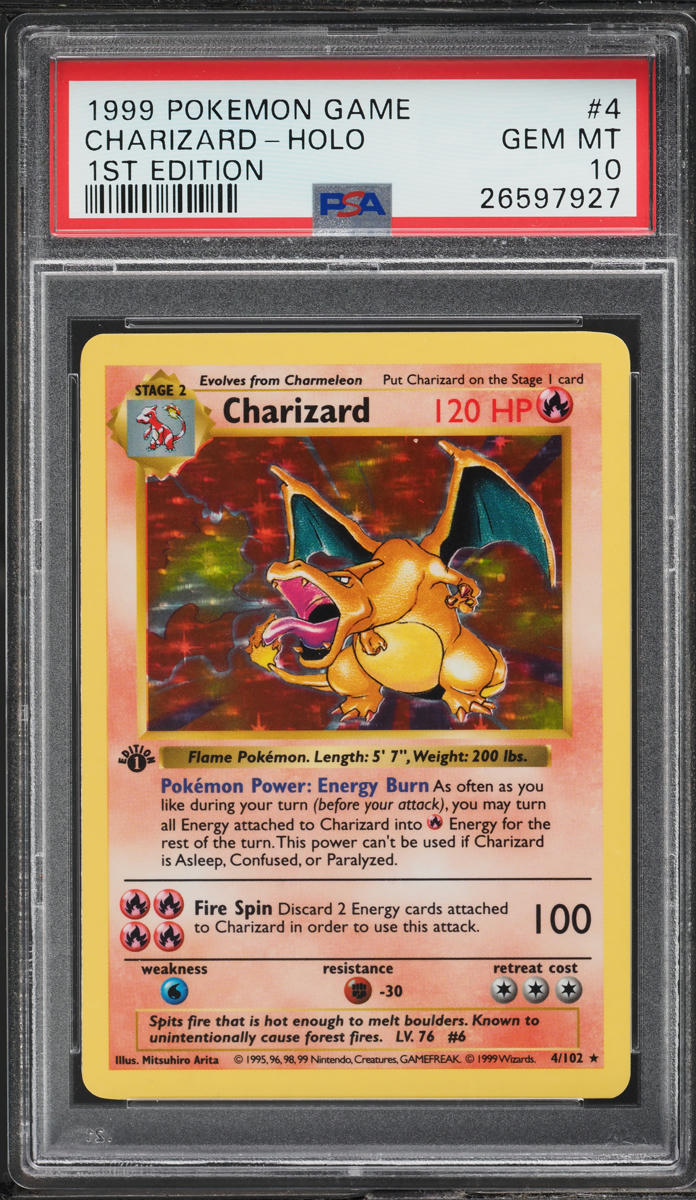
Era/Set: 1999 WOTC Base Set, 1st Edition | Typical price: ~$3,000 (PSA 7) to $550,000 (PSA 10) | Best for: the trophy centerpiece of any serious collection
The 1st Edition Base Set Charizard is the most recognized trading card on Earth, and 2025 cemented its status: a PSA 10 sold for $550,000 at Heritage Auctions in December 2025, an all-time public-auction high, after another PSA 10 brought $256,200 at Landry Pop in August.
PSA has graded roughly 5,325 copies, of which only about 124 are Gem Mint 10s — a sub-2.5% Gem rate that drives the premium. The "1st Edition" stamp and shadowless print make this the rarest mainstream Charizard variant. Even a PSA 7 trades near $3,000–$5,000, so collectors can own the icon at multiple price tiers.
Pros:
- Highest name recognition of any collectible card, which protects long-term liquidity
- Record-setting 2025 comps at $256k–$550k confirm sustained top-end demand
- Sub-2.5% Gem rate keeps PSA 10 supply genuinely scarce
- Tiered entry from ~$3,000 (PSA 7) up to half a million
Cons:
- High-grade copies require six figures and patience to resell
- Heavily counterfeited; raw purchases carry real authentication risk
Verdict: The benchmark Pokémon collectible — the one card every serious collection is measured against.
2. 1998 Pikachu Illustrator Promo

Era/Set: 1998 CoroCoro Illustration Contest promo | Typical price: ~$600,000 (PSA 8.5) to $16,490,000 (PSA 10) | Best for: ultra-high-net-worth trophy buyers
The rarest mainstream Pokémon card in existence: an estimated 40 copies were ever distributed as Japanese illustration-contest prizes. Logan Paul's PSA 10 sold for $16.49 million at Goldin, the highest price ever paid for any Pokémon card. A PSA 9 brought $1,406,250 at Heritage, and even a PSA 8.5 sold for $600,000 in December 2025 — double its $300,000 comp a year earlier.
The "Illustrator" wording (in place of "Trainer") and the pen-and-brush icon make it instantly identifiable. This is a museum-tier asset, not a flip.
Pros:
- ~40 copies in existence make it the scarcest iconic Pokémon card
- $16.49M record sale anchors it as the category's blue-chip
- PSA 8.5 doubled ($300k to $600k) in a single year
- Unmistakable artwork and wording that fakers struggle to replicate convincingly
Cons:
- Six- to seven-figure entry excludes nearly all collectors
- Extreme illiquidity — only a handful trade publicly per year
Verdict: The undisputed crown jewel, reserved for the very top of the market.
3. 1995 Topsun Charizard (Blue Back)

Era/Set: 1995 Topsun (Japan), Blue Back | Typical price: ~$45,000 (PSA 10) up to $493,000 (1/1 no-number) | Best for: purists who want the first Charizard ever printed
Predating the official TCG, the 1995 Topsun set contains the earliest Charizard artwork ever produced. A 1/1 blue-back no-number PSA 10 sold for $493,230 in January 2021 — at the time the most expensive Pokémon card ever. More attainable numbered blue-back copies still command serious money: a PSA 10 sold on eBay for $45,200 in November 2025.
With only an estimated 50 of the earliest blue-back variants made, scarcity is extreme. This is the historian's Charizard — the genesis card.
Pros:
- Earliest Charizard artwork ever printed, a true first-of-kind
- $493,230 record for the 1/1 no-number proves top-end depth
- ~50 earliest copies make scarcity verifiable
- Numbered PSA 10s reachable near $45,000, well under Base Set 1st Ed
Cons:
- Multiple back colors and variants confuse new buyers
- Thin comp history outside the very top grades
Verdict: The collector's-collector Charizard — historically vital and genuinely rare.
4. 1999 No. 1 Trainer Tropical Mega Battle Trophy
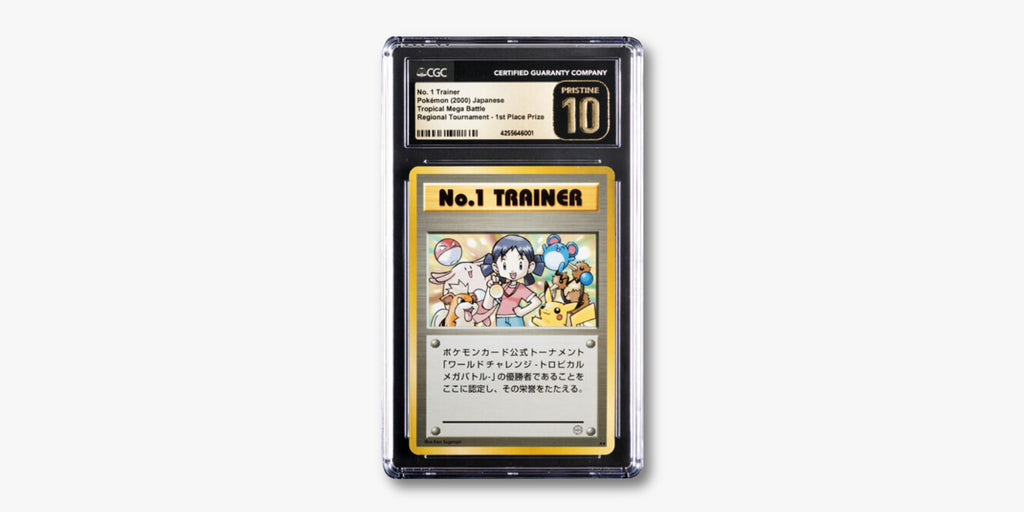
Era/Set: 1999 Tropical Mega Battle tournament prize | Typical price: ~$200,000+ (PSA 9) | Best for: trophy-card specialists chasing extreme scarcity
Trophy cards were handed only to top tournament finishers, and the No. 1 Trainer Tropical Mega Battle is among the rarest. PSA has certified just 1 copy at Mint 9 with only 4 graded higher — a population so thin that each public sale moves the market. A related 1998 Gold No. 1 Trainer sold for $450,000 at Heritage in 2025.
These cards appeared at Heritage's March 2025 Trading Card Games Signature Auction, where event and trophy cards drew six-figure bids. With virtually no float, they sell almost exclusively through major auction houses.
Pros:
- Single-digit PSA population at the top grades
- $450,000 comp on the related Gold No. 1 Trainer shows demand depth
- Tournament provenance that cannot be reprinted or faked at scale
- Sold through Heritage, giving documented chain-of-custody
Cons:
- Almost never available — you buy when one surfaces, not on demand
- Six-figure entry with very few comparable sales
Verdict: A grail-tier prize card for buyers who value provenance over liquidity.
5. 2007 Umbreon Gold Star (POP Series 5) #17

Era/Set: 2007 POP Series 5 | Typical price: ~$3,000–$8,000 (PSA 10) | Best for: Eeveelution fans and modern-vintage investors
Distributed only to Pokémon League Organized Play members, the POP Series 5 Gold Star Umbreon and Espeon are among the most sought-after non-Charizard cards. The Gold Star foil and tiny print run make high grades scarce. A PSA 9 Espeon sold for £10,600 (about $13,000) in October 2025, showing how strong demand runs even one grade below Gem.
Umbreon, the more popular of the pair, commands a premium with the dark fan base behind it. PriceCharting tracks consistent five-figure activity at the top grades.
Pros:
- League-only distribution kept print runs genuinely small
- $13,000 PSA 9 Espeon comp confirms strong sub-Gem demand
- Eeveelution fandom gives durable, fashion-resistant demand
- More attainable than any Charizard grail on this list
Cons:
- Gold Star foil shows whitening easily, hurting grades
- Reprints and fakes of Gold Stars are common — authenticate carefully
Verdict: The premier Eeveelution chase card and a strong modern-vintage hold.
6. 2002 Shining Charizard 1st Edition (Neo Destiny) #107
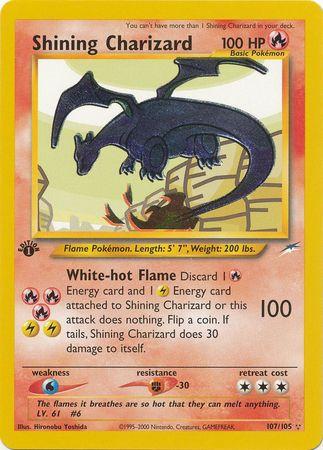
Era/Set: 2002 Neo Destiny, 1st Edition | Typical price: ~$17,000–$20,000 (PSA 10) | Best for: Charizard collectors who want a grail under $25k
The Shining Charizard closed out the WOTC Neo era with a striking silver-foil "shiny" treatment. A 1st Edition PSA 10 sold for $19,000 on July 2, 2025, with Card Ladder tracking four sales between April and July 2025 averaging $18,310 in a tight $17,000–$20,000 band.
That low spread signals a stable, liquid market rather than a volatile one. It delivers Charizard prestige and WOTC pedigree at a fraction of the Base Set 1st Edition's cost.
Pros:
- Tight $17k–$20k PSA 10 band indicates a stable, liquid market
- WOTC 1st Edition pedigree that newer Charizards lack
- $19,000 July 2025 comp confirms current demand
- Distinctive shiny foil that stands apart from standard holos
Cons:
- Shiny foil is prone to scratching, lowering Gem rates
- Unlimited copies trade far lower — confirm the 1st Edition stamp
Verdict: The best mid-five-figure Charizard grail for collectors priced out of Base Set.
7. 2000 Lugia 1st Edition (Neo Genesis) #9

Era/Set: 2000 Neo Genesis, 1st Edition | Typical price: ~$7,400 (PSA 9) to $15,000+ (PSA 10) | Best for: legendary-Pokémon collectors who want scarcity in a clean grade
Lugia is notorious for poor centering and edge wear, so high grades are punishingly rare. Per Fanatics Collect, only about 41 copies have ever earned PSA 10. A PSA 9 sold for $7,400 in October 2025, and PSA 10 examples have traded around $15,000 when they surface.
That brutal Gem-rate is exactly what makes the top grade an investment: supply cannot expand because the original print quality caps it.
Pros:
- Only ~41 PSA 10 copies make Gem examples genuinely scarce
- $7,400 PSA 9 comp offers a realistic entry below five figures
- Legendary-Pokémon demand beyond just Charizard chasers
- Centering issues permanently cap PSA 10 supply
Cons:
- PSA 9 vs PSA 10 price gap is steep — condition risk is high
- Thin PSA 10 comp history makes pricing less predictable
Verdict: A scarcity play where the grade gap rewards patient, condition-savvy buyers.
8. 1999 1st Edition Shadowless Blastoise #2

Era/Set: 1999 WOTC Base Set, 1st Edition Shadowless | Typical price: ~$20,000 (PSA 10) | Best for: Base Set completists who want a non-Charizard holo
Often overshadowed by Charizard, the Base Set Blastoise is one of the three original starter holos and a cornerstone of any complete vintage set. A 1st Edition Shadowless PSA 10 trades around $20,000, a meaningful discount to Charizard while sharing the same iconic 1999 print run and shadowless rarity.
For collectors assembling the original holo trio (with Venusaur), Blastoise is the most accessible of the three high-end starters in top grade.
Pros:
- One of the three original starter holos — core to any Base Set
- ~$20,000 PSA 10 is a major discount to Charizard
- Shadowless 1st Edition shares Charizard's rarity profile
- Strong, durable demand from set builders
Cons:
- Less name-recognition upside than Charizard
- Holo bleed and edge wear make Gem grades hard
Verdict: The smart Base Set holo to own when Charizard is out of reach.
9. 2006 Charizard EX (Crystal Guardians) #4/100

Era/Set: 2006 EX Crystal Guardians | Typical price: ~$300–$1,200 (PSA 10, holo) | Best for: entry buyers who want a real Charizard EX in Gem Mint
A Delta-species Charizard from the EX era, the Crystal Guardians #4/100 holo is one of the most affordable graded Charizards that still carries genuine collector cachet. PSA 10 copies have historically traded near $300 and up, making this a true entry point — you can own a Gem Mint Charizard for the price of a single Base Set raw copy.
As EX-era nostalgia builds among collectors who grew up in the mid-2000s, demand for clean copies has firmed.
Pros:
- Sub-$1,000 PSA 10 access to a real Charizard
- Delta-species artwork that stands out from standard Charizards
- Mid-2000s nostalgia is a growing demand driver
- High supply of clean copies keeps authentication straightforward
Cons:
- Far lower appreciation ceiling than vintage WOTC cards
- Larger print run limits long-term scarcity
Verdict: The most affordable graded Charizard with real collector identity.
10. 1999 Base Set Unlimited Charizard #4 💎 BEST VALUE

Era/Set: 1999 WOTC Base Set, Unlimited | Typical price: ~$430 (PSA 6) to $6,500 (PSA 10) | Best for: collectors who want the iconic Charizard at the lowest real cost
This is the Charizard most people picture — same artwork and same 1999 Base Set, minus the 1st Edition stamp and shadowing. That makes it dramatically cheaper: a PSA 6 trades near $430, while a PSA 10 runs about $3,200–$6,500. You get the most famous Pokémon card design at roughly 1% of the 1st Edition's PSA 10 cost.
For first-time buyers who want a real, gradeable, instantly recognizable Charizard without six-figure exposure, nothing on this list delivers more recognition per dollar.
Pros:
- Same iconic Charizard artwork at a fraction of 1st Edition cost
- PSA 6 near $430 makes the icon genuinely attainable
- Deep liquidity — sells fast at every grade tier
- Massive supply makes authentication and comps easy
Cons:
- Far lower appreciation ceiling than 1st Edition or Shadowless
- Huge population caps high-grade scarcity
Verdict: The best entry Charizard in the hobby — maximum recognition for minimum spend, our clear Best Value.
Which One Is Right for You?
What to Look For
- Authenticate before you pay. Buy graded (PSA, CGC, BGS) whenever possible, and verify the cert number directly on the grader's website before sending money.
- Match the exact variant. 1st Edition, Shadowless, and Unlimited look nearly identical but differ by 10x to 100x in price — confirm the stamp, the shadow box, and the set symbol.
- Grade is everything at the top. A single point (PSA 9 to PSA 10) can mean a $10,000+ swing on a five-figure card; study centering, surface, and edges under good light.
- Know the reprints and fakes. Gold Stars, Illustrator promos, and 1st Edition holos are the most counterfeited — fake holo patterns, wrong fonts, and reprinted "WOTC" cards flood marketplaces.
- Check population reports. A low PSA 10 pop count is what sustains value; rising populations on modern cards quietly erode it.
What matters less than the hype: chasing the newest viral set. The cards that hold value here all have a decade or more of verifiable comps — proven demand beats novelty every time.
FAQ
Is the 1st Edition Base Set Charizard still the best Pokémon card to collect in 2027? For recognition, liquidity, and proven appreciation, yes. A PSA 10 set a $550,000 public-auction record in December 2025, and the card trades at every grade tier from ~$3,000 up, so it remains the category benchmark.
What is the most affordable real Charizard worth owning? The 1999 Base Set Unlimited Charizard (our Best Value) — a PSA 6 trades near $430 and a PSA 10 runs about $3,200–$6,500 for the same iconic artwork as the six-figure 1st Edition.
Should I buy raw or graded cards? For anything above a few hundred dollars, buy graded. The grading premium is real, but raw vintage Charizards and Gold Stars are heavily counterfeited, and a verified PSA or CGC slab removes most of that risk.
Why is the Pikachu Illustrator so much more expensive than everything else? Only about 40 copies were ever distributed as Japanese illustration-contest prizes. That extreme scarcity is why Logan Paul's PSA 10 sold for $16.49 million — the highest price ever paid for a Pokémon card.
Do trophy cards like the No. 1 Trainer make sense for most collectors? Rarely. With single-digit PSA populations and six-figure comps (a related Gold No. 1 Trainer sold for $450,000), they are specialist holds with very little liquidity — great provenance, but you buy only when one surfaces.
Which card has the best scarcity-to-price ratio? The 2000 Lugia 1st Edition Neo Genesis — only about 41 PSA 10 copies exist, yet a PSA 9 can be had near $7,400, giving real scarcity at a non-grail entry point.
Bottom Line
For 2027, the 1999 1st Edition Base Set Charizard #4 remains our Best Overall — a PSA 10 set a $550,000 record in December 2025, with only ~124 Gem Mint copies among ~5,325 graded, and tiered entry from ~$3,000. If you want the icon without the six-figure exposure, the 1999 Base Set Unlimited Charizard is our Best Value, delivering the same famous artwork from about $430 (PSA 6) to $6,500 (PSA 10).
Between those poles sit genuine grails — the Topsun Charizard, Umbreon Gold Star, Shining Charizard, and Lugia — each with verifiable comps and durable demand. Buy graded, match the exact variant, and let proven population data, not hype, guide the purchase.
Sources
- PSA Auction Prices — 1999 1st Edition Charizard-Holo #4
- Heritage Auctions — PSA 10 Charizard $550,000 record
- SI — Logan Paul's PSA 10 Pikachu Illustrator
- PSA Auction Prices — 1995 Japanese Topsun Charizard
- Heritage Auctions — No. 1 Trainer Tropical Mega Battle lot
- PriceCharting — Umbreon Gold Star POP Series 5 #17
- PriceCharting — Shining Charizard 1st Edition Neo Destiny #107
- PSA Auction Prices — Lugia 1st Edition Neo Genesis #9
- TCGplayer — The 30 Most Expensive Pokémon Cards Ever Sold
*Pokémon cards review — Pokémon cards reviews, ratings, best Pokémon cards to collect in 2027, and a review of the top picks for collectors.*