


The Goal — Cliff Notes Summary
Quality
Certified
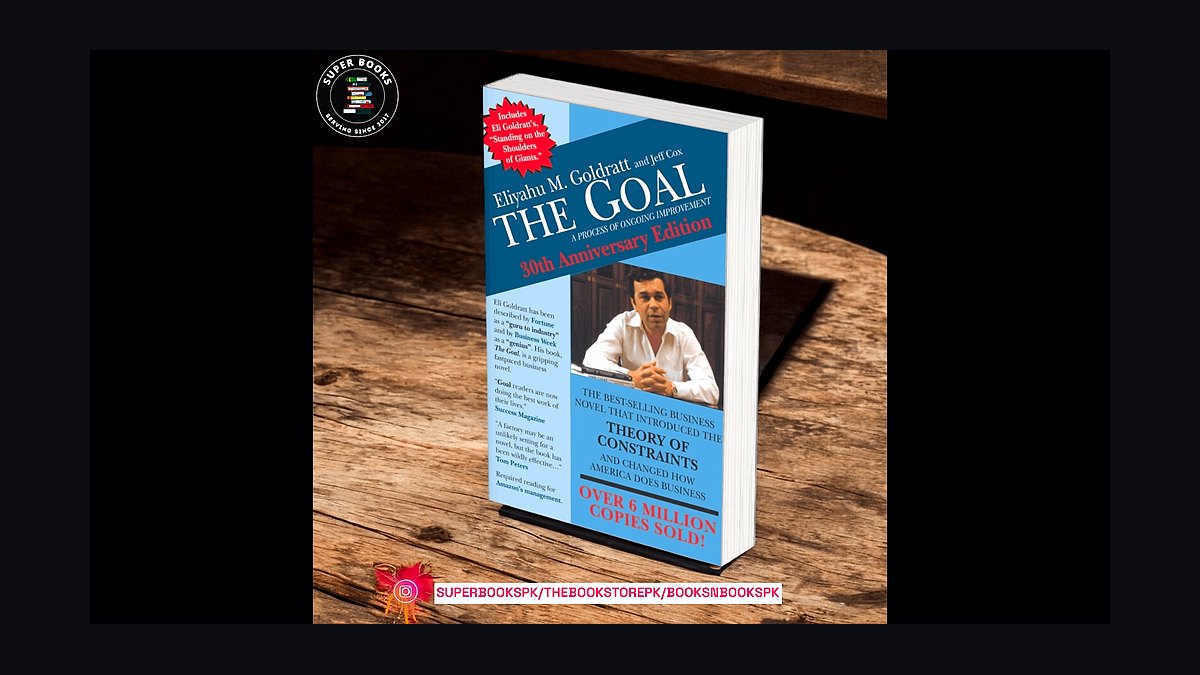
*The Goal* by Eliyahu M. Goldratt is a 1984 business novel that teaches the Theory of Constraints through plant manager Alex Rogo's 90-day race to save his factory. Its core claim: every system has one bottleneck, that bottleneck sets total output, and improvement anywhere else is wasted motion.
Two ways to read it: the novel or the Cliff notes
Almost everyone who picks up *The Goal* faces the same fork before page one. Do you read the 384-page novel — the marriage subplot, the Boy Scout hike, the O'Hare layover, the whole 90-day clock — or do you read a Cliff Notes summary, absorb the Five Focusing Steps in twenty minutes, and get back to work? Both are defensible. They produce measurably different outcomes, and choosing badly wastes either a weekend or a decade.
The full novel does something a summary structurally cannot: it withholds the answer. Goldratt built the book around the Socratic method. Jonah, the physics professor modeled on Goldratt himself, never tells Alex anything. He asks. "What is the goal of your company?" Alex flails — quality, efficiency, market share, technology — before Jonah cuts through it: the goal of a manufacturing organization is to make money, and everything else is a means. That flailing is the pedagogy. You watch Alex burn three chapters on wrong answers, and because you were flailing alongside him, the right answer lands as a discovery rather than a definition. Readers report remembering the Herbie scene fifteen years later. Almost nobody remembers the bullet-point version of the same idea from a slide deck two quarters ago.
The Cliff notes route gives you the transferable machinery without the narrative scaffolding. You get the three operational measurements — throughput, inventory, operational expense. You get the Five Focusing Steps. You get drum-buffer-rope, batch-size reduction, the activation-versus-utilization distinction. That is genuinely most of the exportable content. A competent summary runs 2,000 to 4,000 words and takes fifteen to thirty minutes. The novel runs six to nine hours for a typical reader, closer to eleven on audio.
Here is the trade-off nobody states plainly. The summary teaches you *what* TOC is; the novel teaches you *why you keep failing to apply it*. Alex's team — Bob Donovan in production, Lou the controller, Stacey on inventory, Ralph on data — spends most of the book fighting not physics but institutional inertia. Lou defends the cost accounting that makes the plant look profitable while it bleeds cash. Bill Peach, the division VP, demands efficiency numbers that actively destroy throughput. That organizational friction is 60% of the page count and 0% of most summaries, and it is the part that actually kills TOC implementations in real companies. You will not fail because you can't identify a bottleneck. You will fail because your CFO's dashboard rewards keeping the non-bottleneck busy.
A third option exists and is underrated: read the summary first, then the novel. The summary gives you the vocabulary, so the novel's slow reveals read as confirmation rather than confusion, and you spend your attention on the political dynamics instead of the mechanics. Executives who "don't have time for a novel" often do this and finish the book anyway, because once you know Herbie is coming you want to see how he arrives.
How to decide which version you actually need
The decision is not about how smart you are or how much you like fiction. It is about what you are going to do with the material in the next 90 days, which mirrors Alex's own deadline nicely.
If you need to make a decision this week — you are staring at a pipeline that is not converting and you need a diagnostic frame by Friday — take the summary. The Five Focusing Steps are self-contained and immediately operable. Identify, exploit, subordinate, elevate, repeat. You do not need Alex's marriage to run that loop.
If you are going to *lead* a constraint-based change program across a team that does not already believe in it, read the novel. You will spend the next six months arguing with people who think 95% machine utilization is good news, and the novel is a rhetorical arsenal. You can hand it to a skeptical VP. You cannot hand them a summary and expect conversion; summaries persuade people who already agree.
If you are teaching, read both and steal the structure. Goldratt's craft — didactic content riding shotgun on narrative — is why the book sold well over seven million copies and spawned an entire genre. Gene Kim's *The Phoenix Project* is an explicit DevOps homage, right down to the mentor figure and the doomed deadline. If you want your operations training to stick, that structure is the reusable asset, not the TOC content.
One more filter. If your problem is a *flow* problem — work piling up between stages, unpredictable due dates, everyone busy and nothing shipping — *The Goal* is the right book and you should read it properly. If your problem is a *demand* problem — nobody wants what you sell — TOC will optimize you efficiently into the wall. Goldratt is silent on product-market fit, and the book's factory has a full order book it simply cannot deliver against. That distinction matters more than the format question. Diagnosing a demand problem as a constraint problem is the most common misapplication of this book, and it costs quarters.
The concrete numbers behind the framework
Goldratt's argument survives translation because it rests on arithmetic, not on 1984 manufacturing conditions. Here is the machinery with its actual numbers attached.
The three operational measurements. Goldratt scraps standard accounting vocabulary and rebuilds it in three terms a plant manager can act on before lunch. *Throughput* is the rate at which the system generates money through sales — through sales specifically, because unsold finished goods generate nothing. *Inventory* is all the money the system has invested in things it intends to sell. *Operational expense* is all the money spent turning inventory into throughput. The stated objective: increase throughput while simultaneously reducing inventory and operational expense. Traditional GAAP treats finished inventory as an asset; Goldratt calls that a fiction, because a warehouse of unsold units ties up cash, ages out, and eventually gets written down.
The asymmetry matters. Cost cutting has a floor — you cannot reduce operating expense below zero, and in practice you hit diminishing returns after 20-30% because you start cutting capability. Throughput has no ceiling. This is why Goldratt is hostile to cost-reduction-first cultures: they are optimizing the bounded variable while ignoring the unbounded one.
The Boy Scout hike, quantified. Chapter 13 is the most-cited scene in business literature and it is really a math demonstration. Alex takes his son's troop on a ten-mile hike. The line keeps stretching. The boys walk at different speeds, but the troop's actual progress equals the pace of Herbie — the heavy kid in the middle carrying soda cans, a cast-iron skillet, and a tent. Goldratt is fusing two ideas: *dependent events*, where each step waits on the prior step, and *statistical fluctuations*, where no step runs at a constant rate. The naive expectation is that fluctuations average out. They do not. In a dependent chain, a fast step cannot bank its surplus — it can only wait — while a slow step passes its deficit forward in full. Fluctuations accumulate. The line spreads rather than oscillating around a mean.
Alex's fix has two moves and both map cleanly. He redistributes Herbie's pack weight to the faster kids — that is subordinating the system to the constraint. Then he puts Herbie at the front, which compresses the line. Throughput rises and the gap in the line, which is work-in-process inventory, collapses.
The Five Focusing Steps, in order. Step one, identify the constraint — where work piles up and where downstream stages starve. Step two, exploit it: extract every drop of capacity from the constraint before spending a dollar. No idle bottleneck during shift change. No senior closer doing data entry a coordinator could do. Step three, subordinate everything else to the constraint's pace; a non-bottleneck running faster than the bottleneck is not productive, it is manufacturing inventory. Step four, elevate — *now* spend money, buy the machine, hire the analyst. Step five, go back to step one, because the constraint will have moved, and inertia is the real enemy. Goldratt is explicit that step five is where most implementations die: the old constraint becomes sacred, and the organization keeps optimizing a stage that stopped being the limit two years ago.
The ordering is the whole strategy. Steps two and three are free. Step four costs money. Organizations reliably invert this — they buy capacity first and never do the exploit work, then wonder why the new hire did not move the number.
Drum-buffer-rope. Once you know the constraint, you schedule the entire system around it. The drum is the bottleneck setting the beat. The buffer is a deliberately small inventory cushion in front of the bottleneck so it never starves. The rope is a signal back to the front of the line that releases new material only when the bottleneck is ready. Releasing material at the pace of the *first* workstation floods the floor with WIP; releasing at the pace of the *bottleneck* keeps inventory low and due dates predictable.
Batch size cuts. Late in the book Jonah tells Alex to halve his batch sizes. The counterintuitive result: setup time per unit rises, and throughput rises anyway, because work flows faster, queues shrink, and due-date reliability improves. Goldratt separates the *process batch* — how many you make per setup — from the *transfer batch* — how many you move downstream at a time. They need not match. Run a process batch of 500 and a transfer batch of 50, and station two starts working while station one is still finishing. That single decoupling is one of the highest-leverage ideas in the book and it is routinely lost in summaries that treat "smaller batches" as a slogan.
Activation versus utilization. *Activating* a resource means running it. *Utilizing* it means running it in service of throughput. Most plants — and most revenue organizations — measure activation and call it utilization. A rep with a full calendar of meetings that will never close is fully activated and barely utilized.
Implementing it: the sequence that actually works

Reading is the easy part. Here is the implementation order, and the order is not negotiable — running step four before steps two and three is the standard failure mode.
Week one: find your Herbie. Pull stage-by-stage conversion and time-in-stage for the last 90 days. Ninety days is deliberate; shorter windows are noise, longer windows blur the constraint as it moves. You are looking for the stage with the longest dwell time combined with the lowest forward conversion. Those two together, not either alone. A stage with long dwell and high conversion is a slow-but-reliable step; a stage with fast dwell and terrible conversion is a qualification problem, not a capacity problem. The intersection is your bottleneck. In practice it is rarely the closing conversation. It tends to be contract or legal review, procurement and security questionnaires, qualification capacity upstream, or data quality that silently disqualifies work three stages later.
Week two: exploit before you spend. This is where the returns are, and it is free. Audit what your constraint resource spends time on and strip out everything that is not the constraining activity. If legal review is the bottleneck, the exploit moves are a pre-approved clause library, a standard redline playbook, and a rule that nothing enters review without a completed checklist — not hiring a second attorney. If the constraint is your closers, the exploit moves are removing CRM hygiene work, pre-building the standard proposal, and having someone else run the security questionnaire. Expect exploit work to release 15-30% of effective constraint capacity in an organization that has never done it. That is real capacity at zero marginal cost.

Week three: subordinate, which is the political one. Everything upstream now runs at the constraint's pace. This is the step that gets people fired, because it means deliberately under-running resources that are measured on their own utilization. If your closing capacity is 40 deals a month, pushing 800 qualified opportunities at the team does not produce 80 closes. It produces 40 closes and 760 aging records that poison reply rates, distort forecasts, and demoralize everyone. Cap the release. Keep a small buffer — roughly one week of vetted work in front of the constraint, not a twelve-week mountain. The buffer exists to prevent starvation, not to look impressive in a board deck.
Subordination requires changing what you measure before you change what you do, or the org will revert within a quarter. If a manager's bonus depends on volume delivered into a stage the constraint cannot absorb, that manager will keep flooding it and will be right to, by their incentives. Fix the scoreboard first. This is precisely the Lou-and-Bill-Peach conflict from the novel, which is why the narrative version has practical value.
Week four onward: elevate, then re-measure. Only now do you spend. Add the headcount, buy the tool, add the deal desk analyst. And then — this is step five and almost everyone skips it — re-run week one's measurement. Elevating a constraint moves it. The whole point of the process of ongoing improvement is that it is ongoing; a one-time constraint hunt is not TOC, it is a project.

What holds up and what has aged. Still bulletproof: one constraint at a time, throughput over activity, drum-buffer-rope as a release-throttling discipline, and the exploit-before-elevate ordering. Showing its age: the book is set in a discrete-manufacturing plant, and the metaphors map cleanly to manufacturing, decently to software delivery, and roughly to knowledge work where "stations" are fuzzy and WIP is hard to see. The anti-accounting tone also reads dated, because the profession absorbed much of the critique — activity-based costing, lean accounting, and throughput accounting itself all descend partly from this argument. And the Julie-and-Alex marriage subplot is 1984-vintage in its gender dynamics; skim it.
How it relates to Lean and Six Sigma. Lean attacks waste. Six Sigma attacks variation. TOC attacks the constraint and, critically, tells you *where* to point the other two. They are not competitors; TOC is a prioritization layer. Removing waste at a non-bottleneck consumes improvement budget and changes nothing at the system level. The most effective operations programs run all three with TOC deciding sequence.
Related questions
How long does The Goal take to read?
The novel runs roughly 380 pages, which is six to nine hours for most readers and about eleven on audio. A thorough Cliff Notes summary takes fifteen to thirty minutes. Reading the summary first and the novel second costs little extra and improves retention of both.
Who is Herbie in The Goal?
Herbie is the slow, heavily loaded Boy Scout in chapter 13 whose walking pace sets the whole troop's speed. He became shorthand for the system constraint. "Find your Herbie" means identify the one step that governs total output before optimizing anything else.
What is the difference between a bottleneck and a constraint?
Goldratt uses bottleneck for a resource whose capacity is below demand placed on it, and constraint more broadly for anything limiting system throughput — including policies, market demand, or measurement systems. Policy constraints are the most common and the least often identified.
Is The Phoenix Project the same as The Goal?
*The Phoenix Project* is a deliberate homage — same novel-as-lesson structure, same mentor archetype, same doomed deadline — applied to IT operations and DevOps rather than manufacturing. Read *The Goal* for the original theory; read *The Phoenix Project* if your constraint lives in software delivery.
FAQ
What is the single most important takeaway from The Goal?
The output of any system — factory, pipeline, or software team — is governed by its single weakest link. Improving anything else produces local gains and zero system gain. Goldratt's sharpest line for practitioners: an hour saved at a non-bottleneck is a mirage; an hour saved at the bottleneck is an hour added to the entire organization's throughput.
Is a Cliff Notes summary enough, or do I need the full novel?
A summary is sufficient to run the Five Focusing Steps yourself. It is not sufficient to lead a change program, because the novel's real subject is organizational resistance — the controller defending cost accounting, the VP demanding efficiency metrics that destroy throughput. That material is most of the book and almost none of any summary.

Does the Theory of Constraints apply outside manufacturing?
Yes, wherever work flows through dependent sequential steps. Marketing bottlenecks tend to be content production or qualification capacity; sales bottlenecks tend to be contract velocity or closing capacity; engineering bottlenecks tend to be code review or environment availability. Map your process as dependent steps and find the one that consistently backs work up.
What is the most common mistake when applying it?
Trying to optimize everything at once, and confusing activity with output. Teams measure utilization rates and reward keeping every resource busy, which is exactly the behavior the book identifies as destroying global throughput. The second most common mistake is elevating — spending money on capacity — before doing the free exploit and subordinate work.
How does The Goal compare to Lean or Six Sigma?
Lean eliminates waste, Six Sigma reduces variation, and *The Goal* tells you where to aim both. Without constraint identification, waste reduction at a non-bottleneck can consume budget while system output stays flat. Treat TOC as the prioritization layer sitting above the other two rather than an alternative to them.
Who wrote The Goal and when?
Eliyahu M. Goldratt, an Israeli physicist turned business theorist, wrote it with Jeff Cox and published it in 1984. It has sold well in excess of seven million copies, is assigned in operations curricula worldwide, and remains in print in anniversary editions with added material.
Sources
- The Goal (novel) — Wikipedia)
- Eliyahu M. Goldratt — Wikipedia
- Theory of Constraints — Wikipedia
- The Goal Summary — Theory of Constraints Institute
- Five Focusing Steps — Theory of Constraints Institute
- Theory of Constraints — Lean Production
- The Goal: A Process of Ongoing Improvement — LitCharts
- The Goal by Eliyahu Goldratt — Notes and Review, Nat Eliason
- All About the Theory of Constraints — Smartsheet
- The Phoenix Project — IT Revolution
Related on PULSE
This page will be disappearing soon. Save it to your device for $1 — or read it free while it is here.
@Kory-White- · if Venmo asks, the last 4 of my number are 2012
This page is gone.
This one is off the shelf now. $1 keeps it on your phone for good — the whole page, pictures and diagrams included.
 pulse-recentSales EQ by Jeb Blount — Top 10 Key Takeaways for Sales Leaders in 2027
 pulse-recentWhat is the first concrete step in The Sandler Rules by David Mattson for building a sales plan in 2027?
 pulse-recentThe Challenger Customer by Brent Adamson — Top 10 Key Takeaways for Sales Leaders in 2027
 pulse-recentSales Engagement by Manny Medina — Top 10 Key Takeaways for Sales Leaders in 2027
 pulse-recentSandler Rule #1: What is the first concrete step to build a prospect's trust in a sales conversation in 2027?
 pulse-booksWhat are the most common mistakes in Book Summaries in 2027?
 pulse-recentThe Customer Success Professional’s Handbook by Ashvin Vaidyanathan — Top 10 Key Takeaways for Sales Leaders in 2027
 pulse-recentInsight Selling by Mike Schultz and John Doerr — Top 10 Key Takeaways for Sales Leaders in 2027
 pulse-recentFanatical Prospecting by Jeb Blount — Top 10 Key Takeaways for Sales Leaders in 2027
 pulse-recentSnap Selling by Jill Konrath — Top 10 Key Takeaways for Sales Leaders in 2027