


What are the concrete steps in Strategic Selling for building a sales plan in 2027?
Quality
Certified

Strategic Selling builds a sales plan through concrete steps: map every buying influence (Economic, User, Technical, Coach), score each one's response mode and rating, identify Red Flags and Strengths, define your Single Sales Objective, then convert gaps into dated actions with named owners. Repeat per opportunity, review weekly, and roll territory patterns into strategy.
What Strategic Selling actually is and why the plan matters in 2027
Strategic Selling is the methodology Robert B. Miller and Stephen E. Heiman published in 1985, later carried forward by Miller Heiman Group and now sold under the Korn Ferry banner after its 2020 acquisition of the Miller Heiman training business. Its central artifact is the Blue Sheet — a single-opportunity worksheet that forces a seller to name every person who can affect the deal, judge how each of them feels about the change being proposed, and translate the resulting picture into specific next actions. That artifact is the plan. Everything else in the methodology exists to fill it in honestly.
The reason it still earns its place in 2027 is arithmetic, not nostalgia. Complex B2B purchases now routinely involve six to ten people, and in enterprise software or clinical deals the count climbs higher once procurement, security review, data privacy, and finance all attach. Gartner's widely cited buying-group research puts the typical B2B buying group at six to ten decision makers, each arriving with four or five independently gathered pieces of information. A pipeline forecast built on one champion's enthusiasm is a forecast built on roughly one-eighth of the actual decision surface. Strategic Selling's contribution is that it makes the missing seven-eighths visible as blank cells on a page, and blank cells are hard to rationalize away in a deal review.
A second force is procurement maturity. Software buying has consolidated: more organizations now route renewals and new purchases through a formal vendor management function, a security questionnaire, and a formal approval threshold. That means the Technical Buyer role — historically an IT architect kicking tires — has multiplied into a small committee of gatekeepers who can each say no and none of whom can say yes. Strategic Selling's insistence that you count gatekeepers separately from approvers is a structural fit for that world.
The third force is AI-assisted CRM. Conversation intelligence tools transcribe calls and can surface who spoke, what titles appeared on the invite, and which competitor names were mentioned. That raw material makes step one — enumerating buying influences — dramatically cheaper than it was when reps filled Blue Sheets from memory. It does not, however, make step three — judging each person's attitude toward the change — automatic. Sentiment scoring on a transcript tells you tone, not political position. The methodology's judgment steps are where the human still adds the value, and that is worth being explicit about when you roll a program out, because reps will otherwise assume the tool does the thinking.
Worth naming the boundary too. Strategic Selling is an opportunity-management framework. It does not do discovery questioning — that is Miller Heiman's Conceptual Selling — and it does not do account planning across a multi-year relationship, which is Large Account Management Process (LAMP), the Gold Sheet. If your problem is "our reps ask shallow questions," Strategic Selling will not fix it. If your problem is "we get surprised at the finish line by people we never met," it addresses that directly.
The step-by-step process for building the plan
Here is the concrete sequence. Treat each step as producing a written output, not a feeling.
Step one — write the Single Sales Objective. One sentence, with four components: what the customer buys, how much of it, by what date, and for what reason on their side. "Regional health system purchases 400 seats of the scheduling module by March 31, driven by their Q1 nurse-retention initiative" is a Single Sales Objective. "Close Memorial" is not. The test is whether two colleagues reading it would forecast the same amount in the same quarter. If the date is a guess, say it is a guess and write the customer event that would make it real.
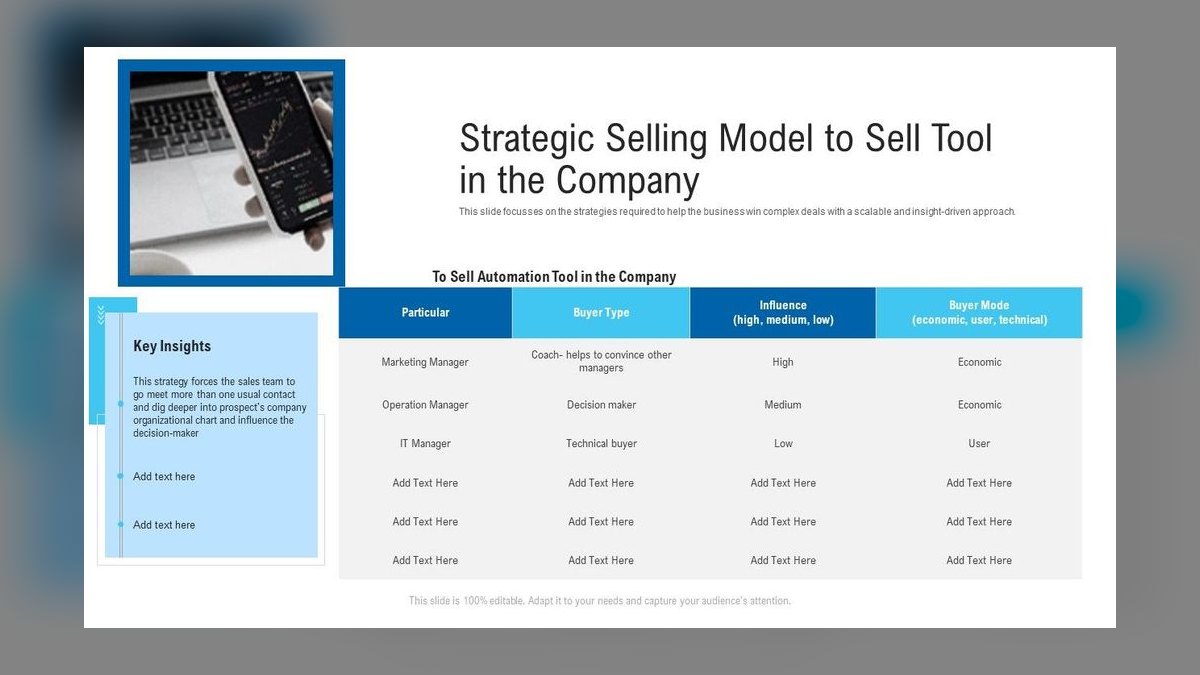
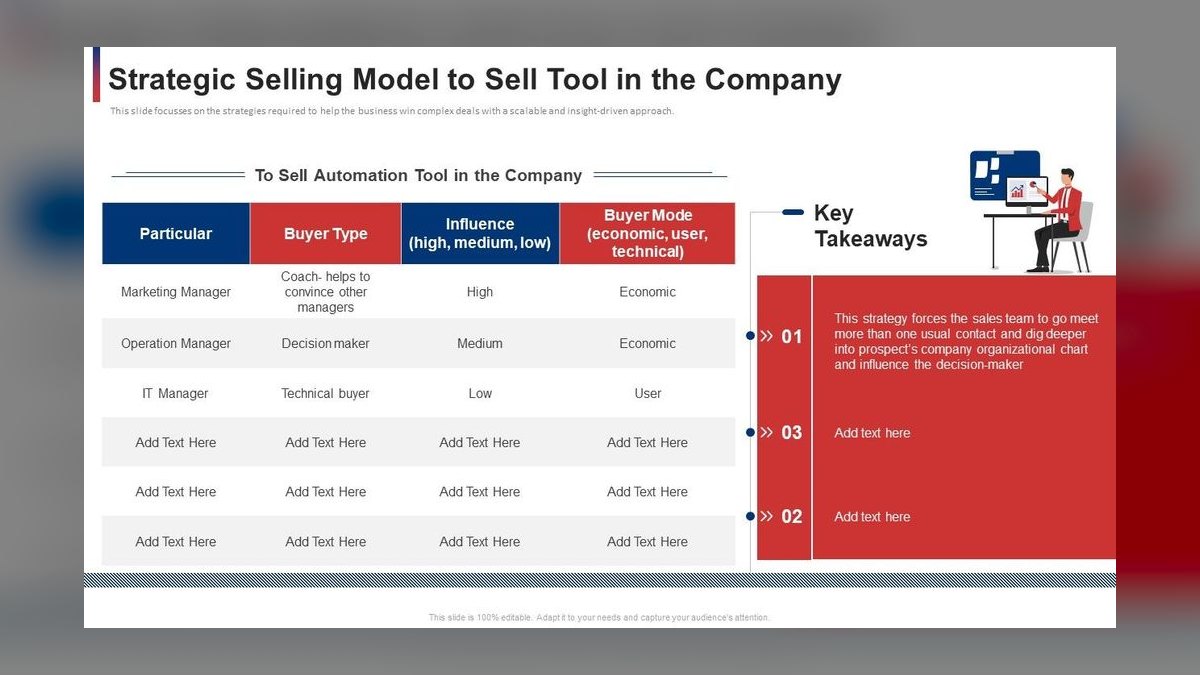
Step two — enumerate every buying influence by role, not by title. Strategic Selling defines four roles, and one person can hold more than one:
- Economic Buyer — single person, releases the money, can say yes when everyone else says no. There is exactly one per Single Sales Objective. If you have listed two, you have either got the objective scoped wrong or you have not found the real one.
- User Buyers — people who will use the thing and whose job changes because of it. Usually several. They judge on impact to their day.
- Technical Buyers — screeners. IT, security, procurement, legal, clinical informatics, compliance. They cannot approve; they can disqualify on specification.
- Coach — your source of guidance inside the account. A Coach is defined by three tests: they are credible to the buying organization, credible to you, and they want your solution to win for their own reasons. A friendly contact who fails any of those three is not a Coach, and mislabeling one is the most common self-deception on the sheet.
Step three — score each influence on two axes. First the response mode: Growth (wants better numbers, receptive), Trouble (something is broken, urgently receptive), Even Keel (things are fine, resistant), or Overconfident (thinks things are better than they are, most resistant). Second the rating — how that person feels about you and your proposal, on a scale from strong support to strong opposition. Reps default everyone to neutral-positive. Force distribution: if nobody on your sheet is negative, you have not talked to enough people.
Step four — record each person's Win-Result. The Result is the measurable business outcome your solution produces for them; the Win is what that outcome does for them personally. Same deployment, different Wins: the VP of Operations gets the Result of 12% fewer scheduling gaps and the Win of hitting a bonused metric; the charge nurse gets the same Result and the Win of stopping the weekly argument about weekend coverage. If you cannot write a Win for someone, you do not understand them yet, and that is a data gap, not a rounding error.
Step five — mark Red Flags. Strategic Selling names them explicitly: missing information, uncontacted buying influence, any influence that is new to their role, and organizational reorganization in play. Add your own — no access to the Economic Buyer, no confirmed budget line, a competitor with an incumbent contract, a date that depends on someone else's project.
Step six — list Strengths. These are your leverage: a delighted reference in the same segment, an existing contract that makes procurement easier, a technical fit that a competitor cannot match, a Coach with real standing.
Step seven — convert Red Flags into an action plan. This is the step teams skip, and skipping it is why Blue Sheets get called busywork. Every Red Flag becomes a line with a specific action, a named owner, and a date. "Unknown Economic Buyer" becomes "Ask Dana on Thursday's call to introduce me to whoever signs above $250K; get the meeting on the calendar by the 14th." Alternative positions — a plan B if the primary path stalls — get written on the same page.
Step eight — review on a cadence and update the sheet, not a separate slide. Weekly for deals inside the current quarter, monthly for the rest. The manager's job in that review is to ask about blanks and Red Flags, never to ask "what's the number."
That loop back from the review gate to re-enumerating influences is deliberate. Buying groups change mid-cycle — people get promoted, a security lead joins late, a reorg dissolves the sponsoring department. A sheet filled once at qualification and never revisited is a historical document.
Costs, timelines, and typical ranges
Budgeting a Strategic Selling rollout honestly means separating four line items: licensing or training fees, seller time, manager time, and tooling.
Training and licensing. Korn Ferry does not publish list pricing for Miller Heiman programs, and quotes vary by seat count, delivery mode, and whether you license internal facilitators. Treat vendor-delivered enterprise sales methodology training as a mid-four-figure to low-five-figure per-seat investment in classic instructor-led form, dropping substantially for blended or digital delivery and dropping again at volume — but get the quote rather than relying on a range from a blog, because negotiated enterprise deals diverge widely from any published figure. Licensing internal trainers costs more upfront and much less per seat after roughly the second cohort, which is why organizations above a few hundred sellers almost always end up there.

Seller time. A first Blue Sheet on a genuinely complex opportunity takes a trained rep sixty to ninety minutes, mostly because the blanks are uncomfortable. Updates run ten to twenty minutes weekly. On a book of twenty active opportunities where six are worth strategic planning, that is roughly one to two hours a week of planning time per rep. That is a real cost and should be stated as such in the rollout, not hidden. The honest trade is that time against the hours currently spent on deals that were never winnable.
Manager time. Budget forty-five to sixty minutes per rep per week for deal reviews that actually work through the sheet, plus a monthly deeper session on the top three opportunities. A front-line manager with eight reps is therefore spending something like eight hours weekly on strategic deal coaching. If that is not carved out of their calendar explicitly, it will not happen, and the program will decay into reps filling in forms nobody reads — which is the single most reliable way to kill a methodology.
Tooling. Blue Sheets exist as CRM-embedded apps as well as paper and spreadsheets. The embedded version is worth it when you want roll-up reporting — percentage of open pipeline with a confirmed Economic Buyer, percentage with an unresolved Red Flag inside sixty days of close — and not worth it when you have fewer than about twenty sellers, where a shared template and a disciplined manager get you most of the value at zero incremental cost.
Timelines. Realistic sequence for a hundred-seller organization: two to four weeks selecting and scoping, one to two days of workshop per cohort, then a reinforcement window that matters more than the workshop. Expect eight to twelve weeks before sheets are being completed without prompting, one to two full sales cycles before you can see effects in win rate, and for enterprise cycles of six to nine months that means the honest evaluation point is nine to fifteen months out. Anyone promising a quarter-over-quarter win-rate lift from a two-day workshop is selling the workshop.
What to measure in the meantime. Because outcome metrics lag, instrument the leading indicators from week one: share of qualified opportunities with a named and met Economic Buyer, average number of contacts engaged per opportunity, share of opportunities with at least one identified Coach, count of open Red Flags per deal, and slippage rate — deals whose close date moved a quarter. The last one is often where you see movement first, because better-mapped deals slip less even before they win more.
Where teams get the plan wrong
Mistaking a friendly contact for a Coach. This is the number one failure. The person who takes your calls, likes you, and shares gossip is not automatically credible to their own organization. Run the three tests every time: credible to them, credible to you, wants you to win. A well-liked contact who is politically weightless will feed you accurate-sounding information that leads nowhere.
Never meeting the Economic Buyer, then rationalizing it. "They delegated it to my champion" is the standard line. Sometimes true. Usually it means your champion is protecting their own position, or you did not earn the meeting. Make the ask explicit and early, and treat a refusal as a data point about deal health rather than an inconvenience. A deal where you have never met the person who releases the funds is not a late-stage deal, regardless of what the CRM stage says.
Filling the sheet in as a compliance exercise. If reps complete Blue Sheets the night before a forecast call and managers never open them, you have added administrative burden and bought nothing. The countermeasure is behavioral: managers must run the review off the sheet itself, and must reward the rep who marks their own deal as flagged. If honesty gets punished with interrogation, the sheets will become fiction within a month.
Ignoring Technical Buyers until the end. Security review and procurement now routinely add four to eight weeks to enterprise timelines, and they add it at the end, when the quarter is closing. Engaging security and legal early — sending the SOC 2 report, the data processing terms, and the architecture summary before anyone asks — converts a late-quarter emergency into a background task. This is where the framework and modern buying reality intersect most sharply.
Treating everyone as Growth mode. Reps map their own optimism onto the buyer. Even Keel and Overconfident buyers exist and are common in stable, well-funded organizations. Selling improvement to someone who believes nothing needs improving requires either finding a discrepancy they will acknowledge or finding a different sponsor. Recording someone as Even Keel is not defeatism; it is the input that tells you which play to run.
Applying the full sheet to every deal. A three-week transactional renewal does not need an eight-step opportunity plan. Reserve the full treatment for deals above a value threshold you set explicitly — many teams use something like three to five times average deal size, or any deal with more than four identified stakeholders. Applying heavy process to light deals is how methodologies earn a bad reputation with the people who have to run them.
Skipping the update after a reorg. New role and reorganization are named Red Flags for a reason. A sponsor who changes jobs mid-cycle resets your position roughly to zero with their successor, and the successor frequently wants to review decisions their predecessor made. Watch for it, and re-run steps two through four when it happens.
Decision framework: which planning depth to apply, and what pairs with it
Not every opportunity earns a full sheet, and Strategic Selling is not the only thing you need. Use a tiered decision.
Tier one — light qualification only. Renewals, low-value transactional deals, single-stakeholder purchases under your threshold. A qualification checklist covering budget, authority, need, and timing is sufficient. Adding a full opportunity plan here costs more than it returns.

Tier two — full Blue Sheet, single opportunity. Multi-stakeholder, above the value threshold, competitive, or strategically important as a logo or reference. This is the framework's home ground. Complete all eight steps, review weekly.
Tier three — Blue Sheet plus account plan. Existing accounts with expansion potential across multiple business units. Here the single-opportunity view is insufficient because the interesting question is which opportunities to pursue and in what order. That is LAMP / Gold Sheet territory, and the two artifacts complement rather than replace each other — the Gold Sheet sets direction for the account, individual Blue Sheets execute the deals inside it.
What pairs with the plan. If discovery quality is the weak point, add Conceptual Selling, which handles the individual sales call — before, during, after. If the weak point is that buyers do not see a reason to change at all, a challenger-style commercial insight motion fits upstream of the Blue Sheet, generating the Trouble or Growth condition the sheet then maps. If the weak point is that deals stall at legal and security, the fix is not more methodology; it is a repeatable security-review package and a named internal owner for it.
Adjacent effects: what a Strategic Selling plan changes outside the deal
The interesting second-order effects show up outside individual opportunities, and they are worth planning for because they are where much of the return sits.
Forecasting. Once Red Flags and Economic Buyer contact are structured fields rather than notes, forecast categories can be defined by evidence rather than rep confidence. A practical rule some teams adopt: no deal enters Commit without a met Economic Buyer and zero open Red Flags. That single rule tends to do more for forecast accuracy than any weighting model, because it replaces a subjective judgment with a verifiable one. Expect the first quarter after you introduce it to look worse — deals move out of Commit — and expect that to be a correction, not a regression.
Marketing and demand generation. The accumulated Win-Results across a hundred sheets is a stakeholder-level message map: what Operations cares about, what Security asks, what Finance needs to see. That is directly reusable as campaign content and as sales enablement one-pagers per persona. Most organizations never mine it, which is a waste of the most expensive research they own.

Onboarding. A completed Blue Sheet from a won deal is the best training artifact a new rep can read, because it shows the actual political shape of a win rather than a sanitized case study. Keeping a small library of five or six annotated sheets across segments shortens ramp meaningfully.
Territory and coverage design. Recurring patterns across sheets — for example, that deals in one segment consistently reveal a Technical Buyer in clinical informatics whom nobody covers — are coverage signals. That informs whether you need a specialist overlay, a solution engineer earlier in the cycle, or a partner.
Customer success handoff. The Win-Result column is the most useful handoff document in the company. It tells the implementation team who expected what personally, which is exactly the information that determines whether the first quarterly business review goes well. Passing the sheet forward at close, rather than a stage-gate form, costs nothing and prevents the common failure where CS optimizes for a metric the buyer never cared about.
Partner and channel motions. When a systems integrator or reseller is involved, they occupy roles on the sheet too — often Coach, sometimes Technical Buyer, occasionally a competing influence with their own agenda. Mapping them explicitly rather than treating "the partner" as a single friendly blob prevents the surprise where a partner recommends someone else's product at the last meeting.
Related questions
Is Strategic Selling the same as the Blue Sheet?
No. Strategic Selling is the methodology; the Blue Sheet is its opportunity-planning worksheet. The sheet is where the methodology's concepts — buying influences, response modes, Win-Results, Red Flags — get recorded for one specific opportunity against one Single Sales Objective.
How is Strategic Selling different from MEDDIC?

MEDDIC is a qualification checklist emphasizing metrics, economic buyer, decision criteria, decision process, pain, and champion. Strategic Selling is a fuller opportunity-planning system with explicit stakeholder roles, attitude scoring, and a written action plan. Many teams run MEDDIC to qualify and Strategic Selling to plan.
Can one person be both Economic Buyer and User Buyer?
Yes, and it is common in smaller organizations or departmental purchases. Roles attach to function, not headcount. Record the person once with both roles marked, and remember their Win-Result may pull in two directions — budget discipline against daily usability.
What is Large Account Management Process?
LAMP is Miller Heiman's account-planning methodology, recorded on the Gold Sheet. Where the Blue Sheet plans one opportunity, LAMP plans a whole relationship over multiple years — where you stand, where you want to be, and which opportunities get you there.
How often should a Blue Sheet be updated?
Weekly for deals expected to close in the current quarter, monthly otherwise, and immediately after any triggering event: a reorg, a new stakeholder appearing, a competitor entering, or a date changing. An unedited sheet older than a month is not a plan.
FAQ
Who publishes Strategic Selling today?
Strategic Selling originated with Robert B. Miller and Stephen E. Heiman, whose book was first published in 1985 and later revised as The New Strategic Selling. The training business ran as Miller Heiman and subsequently Miller Heiman Group; Korn Ferry acquired that business in 2020 and now delivers the programs. If you are buying training, you are buying it from Korn Ferry or an authorized partner.
Do I need to buy training to use it?

No. The book explains the concepts and the sheet structure well enough for a small team to run it from a shared template. Formal training buys you consistency, common language across a large sales force, facilitator support, and CRM-integrated tooling — all of which matter more the larger and more distributed your team is. Under roughly twenty sellers, the book plus disciplined manager reviews is a reasonable starting point.
Does it work for transactional or product-led sales?
Poorly, and that is fine. It is built for complex, multi-stakeholder, considered purchases. A self-serve or single-buyer motion has no buying-influence map worth drawing. Applying it there generates paperwork and resentment. Set an explicit value or stakeholder-count threshold and only run the full process above it.
How does AI change the process?
It compresses the mechanical steps. Conversation intelligence and CRM enrichment can pre-populate the list of contacts, flag which stakeholders have gone quiet, and surface competitor mentions. What it does not do reliably is judge political standing or genuine Win-Results — those require conversation and inference. Use automation to fill the roster; keep the judgment human, and audit any AI-suggested field before a manager reviews it as fact.
What is the single most important field on the sheet?
The Economic Buyer, and specifically whether you have actually met them. Everything else can be partially wrong and the deal survives. A deal where nobody on your side has ever spoken with the person who releases the money is, statistically and structurally, a deal you do not control.
How do I stop it becoming busywork?
Three things: apply it only above a stated threshold, run every deal review directly off the sheet so the artifact has a purpose, and make it safe to record bad news. If a rep marking three Red Flags gets a supportive coaching conversation rather than an interrogation, the sheets stay honest and the process pays for itself. If not, it degrades into fiction and you should stop doing it.
Sources
- https://www.kornferry.com/capabilities/sales-service/sales-methodology
- https://www.gartner.com/en/sales/insights/b2b-buying-journey
- https://hbr.org/2017/03/the-new-sales-imperative
- https://en.wikipedia.org/wiki/Miller_Heiman
- https://www.salesforce.com/sales/methodology/
- https://hbr.org/2012/07/the-end-of-solution-sales
- https://www.mckinsey.com/capabilities/growth-marketing-and-sales/our-insights
- https://www.forrester.com/blogs/category/b2b-sales/
Related on PULSE
- What is MEDDIC and how does it compare to other qualification frameworks?
- How do you identify the economic buyer in a complex B2B deal?
- What belongs in a weekly sales deal review?
- How do you build an account plan for enterprise expansion?
- Why do forecasted deals slip out of the quarter?
- How should security and procurement review fit into the sales cycle?
This page will be disappearing soon. Save it to your device for $1 — or read it free while it is here.
@Kory-White- · if Venmo asks, the last 4 of my number are 2012
This page is gone.
This one is off the shelf now. $1 keeps it on your phone for good — the whole page, pictures and diagrams included.
 book-summarySPEAR Selling by Jamie Shanks — Cliff Notes Summary
 pulse-booksWhat is the best way to approach Book Summaries in 2027?
 book-summaryPitch Anything by Oren Klaff — Cliff Notes Summary
 book-summarySNAP Selling by Jill Konrath — Cliff Notes Summary
 book-summarySmart Trust by Covey and Link — Cliff Notes Summary for Sellers
 book-summary100 Ways to Motivate Yourself by Steve Chandler — Cliff Notes Summary
 pulse-booksHow much do executive book summary subscriptions like getAbstract or Blinkist cost in 2027?
 book-summaryThe First 90 Days by Michael Watkins — Cliff Notes Summary for Sales Leaders
 book-summaryMultipliers by Liz Wiseman — Cliff Notes Summary for Sales Leaders
 book-summaryEat Their Lunch by Anthony Iannarino — Cliff Notes Summary & Key Takeaways