


Rainmaking Conversations by Mike Schultz — Top 10 Key Takeaways for Sales Leaders in 2027
Quality
Certified
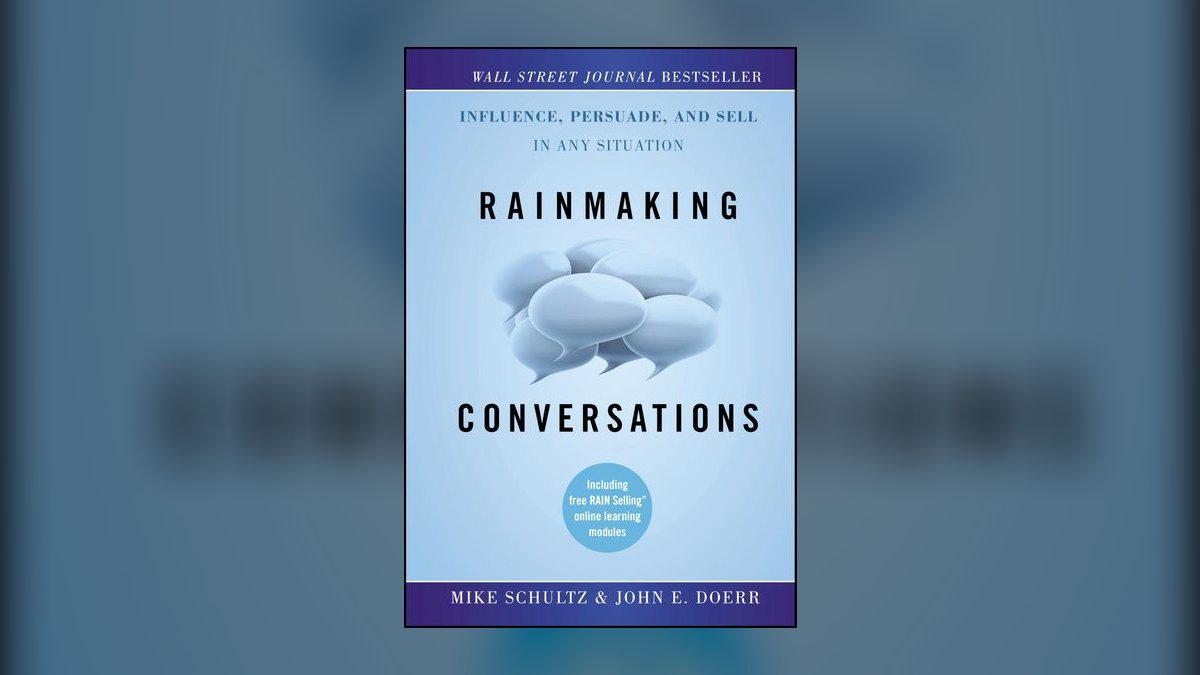
Mike Schultz's Rainmaking Conversations reduces selling to one repeatable structure — Rapport, Aspirations and Afflictions, Impact, New Reality (RAIN) — that turns reps into rainmakers instead of order takers. For sales leaders in 2027, the top takeaway: structured, insight-driven conversations, not product pitches, separate top performers from the rest of the pipeline.
The outcome you should expect
When a sales organization actually operationalizes the ideas in Rainmaking Conversations, the visible change isn't a new script — it's a shift in who controls the meeting. Reps stop opening with a company overview slide and instead open by building genuine Rapport, then spend the bulk of the conversation surfacing the buyer's Aspirations and Afflictions: what the buyer wants to achieve and what's currently costing them money, time, or credibility. Only after that discovery does the rep pivot to Impact — quantifying what happens if the problem goes unsolved and what changes if it's solved — before co-authoring a New Reality with the buyer that the rep's solution happens to enable.
The practical, measurable outcome sales leaders should expect within two to three quarters of real adoption is fewer stalled deals in the middle of the funnel. Stalls typically happen because the rep pitched before the buyer articulated their own pain in their own words; RAIN-style conversations front-load that articulation, so by the time a proposal is on the table the buyer has already said out loud why they need to act. Reps also start generating their own urgency instead of manufacturing fake urgency with discounts, because the Impact conversation makes the cost of inaction concrete — lost revenue, compounding operational drag, competitive exposure — rather than abstract.
Leaders should also expect a change in how deals get forecasted and coached. Because the framework gives every rep the same four checkpoints, a sales manager listening to a call recording can immediately identify which stage broke down: did the rep skip Rapport and sound transactional? Did they collect Aspirations but never quantify Impact? Did they present a solution before agreeing on the New Reality with the buyer? This diagnostic clarity is arguably the biggest organizational win — it turns "the rep just isn't closing" into a specific, coachable skill gap.
The one thing leaders should not expect is an overnight lift in raw activity metrics like calls-per-day or emails-sent. Rainmaking Conversations is explicitly a quality-over-quantity strategy: it trades a chunk of top-of-funnel speed for deeper qualification and a materially higher close rate on the opportunities that do advance. Sales leaders who evaluate the rollout purely on activity volume in the first month will misread the data and abandon a framework that needed a full sales cycle to prove out. The correct scorecard is conversion rate from discovery call to proposal, and proposal to closed-won — not dials per rep.
What drives that outcome
The mechanism behind Rainmaking Conversations is sequencing, not charisma. Most underperforming reps have the right individual skills — they can build rapport, they can quantify ROI, they can present a solution — but they deploy them in the wrong order, usually leading with solution before the buyer has admitted a problem exists. Schultz's model forces the sequence: you cannot skip to Impact without first earning Aspirations and Afflictions, and you cannot present a New Reality that the buyer hasn't co-created, because a New Reality handed to a buyer instead of built with them gets treated as a vendor's opinion, not the buyer's own conclusion.
Rapport in this model isn't small talk — it's the credibility that lets a stranger ask a senior buyer uncomfortable questions about their afflictions (what's broken, what's underperforming, what keeps them up at night) within the first ten minutes of a call. Reps who skip this step and jump straight into discovery questions get guarded, surface-level answers because the buyer hasn't decided the rep is safe to be honest with yet.
Aspirations and Afflictions is where most of the diagnostic value lives. Aspirations are the buyer's stated goals — revenue targets, market share, operational efficiency. Afflictions are the specific, current pains blocking those goals. The framework insists on both because aspirations alone produce a generic pitch ("we help companies grow revenue") while afflictions alone produce a features-based fix without a business case. Pairing them is what lets a rep later connect a specific capability to a specific dollar figure.
Impact is the quantification layer — turning "this is slowing us down" into "this is costing approximately $X per quarter in lost throughput" or "this is adding N weeks to time-to-market." Schultz's own research background at RAIN Group emphasized that buyers rarely do this math themselves; the rep who does it for them, collaboratively, becomes the trusted advisor rather than a vendor reciting a value proposition.
New Reality closes the loop: instead of the rep declaring "our product solves this," the rep and buyer jointly describe what the buyer's world looks like once the affliction is resolved and the aspiration is met. Because the buyer helped write that future state, they defend it internally to their own stakeholders — which is exactly the internal champion behavior sales leaders spend so much energy trying to manufacture through battlecards and one-pagers.
Benchmarks and realistic ranges

There's no universal percentage that applies to every sales org adopting this framework, and any exact figure should be treated with skepticism — but there are realistic, directional ranges sales leaders can use to set expectations and avoid over- or under-selling the initiative internally.
Discovery-call-to-proposal conversion is usually the first metric to move, typically within one full sales cycle of consistent RAIN-style discovery. Organizations that previously ran generic needs-assessment calls often see this conversion improve by a meaningful double-digit percentage relative to their own baseline — not because more prospects exist, but because reps stop advancing deals that were never going to close and instead invest that time in deals with real, quantified pain.
Sales cycle length is the more nuanced benchmark: it frequently gets slightly longer in the discovery phase (more time spent on Aspirations and Afflictions and Impact quantification up front) but shorter in the late stage, because objections around price and urgency have already been pre-answered by the buyer's own Impact math. Net cycle time often stays flat to modestly shorter, not dramatically shorter — leaders expecting a 50% cycle-time cut from a conversation framework alone will be disappointed; this is a win-rate lever first, a velocity lever second.
Ramp time for new reps is where the framework earns its keep operationally. A structured four-stage conversation model is far easier to coach and role-play against than "just be consultative," so new-hire time-to-first-deal and time-to-quota typically compress, since managers can pinpoint exactly which of the four stages a rep is weak in during call reviews rather than giving vague feedback like "be more consultative."

Win rate against competitors is the benchmark most sales leaders actually care about, and it is also the slowest to move — expect it to lag the conversion-rate improvement by one to two additional quarters, because win rate reflects not just your own reps' skill but competitors' behavior too. A rep running Rainmaking Conversations against a competitor still pitching features will differentiate, but that differentiation compounds over multiple deals and renewal cycles rather than showing up instantly on a single scorecard.
Risks, edge cases, and failure modes
The single most common failure mode is treating RAIN as a script rather than a sequence. Reps who memorize the four labels and mechanically announce "now let's talk about impact" sound scripted and lose the rapport they just built. The framework is meant to structure a manager's coaching and a rep's internal checklist, not to be recited to the buyer verbatim.
A second failure mode is skipping Rapport under time pressure. In high-velocity, transactional sales motions with short cycles and low deal sizes, spending real time on rapport-building can feel like an inefficient use of a 15-minute call — and in genuinely commoditized, low-touch motions, a heavier framework built for complex B2B selling may simply be the wrong tool. Sales leaders should scope Rainmaking Conversations to deals complex enough to justify a multi-touch, consultative motion, not force it onto every SDR cold-call.

A third risk is stopping at Aspirations and Afflictions without ever quantifying Impact. Reps who are strong at open-ended discovery sometimes surface excellent pain points but never translate them into numbers, which leaves the eventual business case soft and easy for a buyer's procurement team or a competing stakeholder to challenge later in the cycle. Impact quantification is the step most likely to get cut when a call runs long, and it's the step leaders should specifically listen for in call reviews.
A fourth edge case is imposing the New Reality instead of co-creating it. Reps under quota pressure sometimes shortcut this stage by telling the buyer what their future state should look like rather than asking questions that let the buyer arrive there themselves. The resulting "New Reality" reads as a vendor pitch dressed in RAIN vocabulary, and buyers who feel talked at rather than partnered with revert to comparison-shopping on price, which undoes the entire strategy the framework was meant to protect against.
Finally, there's an organizational risk: leaders sometimes roll the framework out as a one-time training event rather than an ongoing coaching discipline. A two-hour workshop produces vocabulary, not behavior change. Without recurring call reviews, live coaching, and manager reinforcement tied to the four RAIN stages, most reps drift back to old habits within four to six weeks — the framework decays exactly like any other sales methodology that isn't operationalized into the manager's weekly cadence.
A practical rollout plan

Start narrow: train the sales team on one RAIN stage at a time rather than all four at once, since reps genuinely retain sequencing better when each piece is drilled in isolation before being chained together. A realistic cadence is one stage every one to two weeks, with role-play sessions where reps practice on each other before ever using the stage live with a prospect.
Next, instrument call recording and review specifically for RAIN checkpoints. Managers should listen for whether Rapport was earned before discovery questions started, whether Afflictions were quantified into Impact, and whether the New Reality was phrased as a joint conclusion ("so if we fixed this, what would that mean for your Q3 numbers?") rather than a rep-delivered claim ("our product will fix this for you"). This review process is where the framework's real Takeaways get reinforced — not in the initial training deck, but in the weekly habit of dissecting real calls against the four stages.
Third, tie the CRM's opportunity stages to the RAIN checkpoints rather than to generic labels like "discovery" and "proposal." When a rep can't move a deal to the next CRM stage without documenting the buyer's quantified Impact, the framework stops being optional coaching advice and becomes a structural gate that protects forecast accuracy — deals that skipped real discovery simply can't get marked as qualified.

Fourth, build a lightweight weekly coaching loop: each rep gets feedback on exactly one RAIN stage they're weakest in, rather than generic "great call" feedback. This keeps coaching specific and prevents managers from defaulting to activity-based feedback, which is the single easiest way for an org to backslide into pre-framework habits.
Finally, review conversion by stage quarterly, not monthly — the framework's effects compound over a full sales cycle, and month-to-month noise in a handful of deals will mislead leaders into concluding the framework "isn't working" when the sample size is simply too small. Pair that quarterly review with anecdotal call excerpts so the leadership team sees the qualitative change (buyer language, objection patterns) alongside the quantitative one.
Related questions
Who should own the coaching cadence for this framework?
Front-line sales managers, not enablement teams, should own weekly RAIN-stage coaching — enablement can build the training content, but manager-led call reviews are what sustain behavior change over multiple sales cycles.
Does this framework work for transactional, low-touch sales motions?
Not well. RAIN is built for complex, consultative B2B selling with multiple stakeholders; short-cycle transactional motions rarely justify the time investment in Rapport and Impact quantification.
How is this different from SPIN or Challenger selling?

RAIN overlaps with SPIN's question-based discovery and Challenger's insight-led approach, but its distinguishing feature is the explicit New Reality stage, where the buyer co-authors the future state rather than being told or challenged into one.
What's the fastest way to tell if a rep has actually adopted it?
Listen to a recorded call: a rep who has adopted it asks quantifying questions about Impact before ever mentioning their own product, and lets the buyer describe the New Reality in the buyer's own words.
FAQ
What is the RAIN acronym in Rainmaking Conversations? RAIN stands for Rapport, Aspirations and Afflictions, Impact, and New Reality — the four sequential stages Mike Schultz uses to structure a consultative sales conversation from first contact through to a buyer-owned vision of the future state.
Who is Mike Schultz and why does his framework carry weight with sales leaders? Mike Schultz co-founded RAIN Group, a sales training and research firm, and co-authored Rainmaking Conversations based on studying what separates high-performing sellers ("rainmakers") from average performers across many B2B sales organizations.

Is Rainmaking Conversations still relevant for sales leaders in 2027? Yes — the underlying mechanism, sequencing discovery before pitching and quantifying impact before proposing solutions, isn't tied to any specific technology era, and remains directly applicable even as buyers increasingly self-educate before ever taking a sales call.
Can this framework be taught to a fully remote or hybrid sales team? Yes, with adjustments — call recording and review become even more important in remote settings since managers can't observe body language or in-person cues, so the RAIN-stage call review discipline should be tightened, not loosened, for distributed teams.
What's the biggest mistake leaders make when rolling this out? Treating it as a one-time training event instead of an ongoing coaching discipline; without recurring call reviews tied to the four stages, most reps revert to old habits within a few weeks.
How does this framework change sales forecasting? By gating CRM stage advancement on documented Impact and a co-created New Reality, forecasts become more reliable because "qualified" starts meaning the buyer has articulated real, quantified pain rather than simply taking a meeting.
Sources
- https://www.amazon.com/Rainmaking-Conversations-Influence-Persuade-Situation/dp/0470922233
- https://www.rainsalestraining.com
- https://hbr.org/topic/subject/sales
- https://www.forbes.com/sales/
- https://www.sellingpower.com
- https://www.gartner.com/en/sales
- https://www.linkedin.com/learning/topics/sales
Related on PULSE
- What is the RAIN Group sales methodology and how does it work?
- Insight selling vs. Challenger sale: what's the practical difference?
- How to structure a discovery call that actually qualifies a buyer
- Building a sales coaching cadence managers will actually follow
- Why sales cycles stall in the middle of the funnel
This page will be disappearing soon. Save it to your device for $1 — or read it free while it is here.
@Kory-White- · if Venmo asks, the last 4 of my number are 2012
This page is gone.
This one is off the shelf now. $1 keeps it on your phone for good — the whole page, pictures and diagrams included.
 pulse-recentWhat are the first three concrete steps in Sandler Rule #1 for a new sales rep in 2027?
 pulse-recentSell or Be Sold by Grant Cardone — Top 10 Key Takeaways for Sales Leaders in 2027
 pulse-recentInsight Selling by Mike Schultz and John Doerr — Top 10 Key Takeaways for Sales Leaders in 2027
 pulse-recentFanatical Prospecting by Jeb Blount — Top 10 Key Takeaways for Sales Leaders in 2027
 pulse-recentSelling Above and Below the Line by Skip Miller — Top 10 Key Takeaways for Sales Leaders in 2027
 pulse-recentWhat are the concrete steps to implement the Sandler Rules for Sales Leaders by David Mattson in 2027?
 pulse-recent$100M Offers by Alex Hormozi — Top 10 Key Takeaways for Sales Leaders in 2027
 pulse-recentCoaching Salespeople into Sales Champions by Keith Rosen — Top 10 Key Takeaways for Sales Leaders in 2027
 pulse-recentConceptual Selling by Robert Miller and Stephen Heiman — Top 10 Key Takeaways for Sales Leaders in 2027
 pulse-recentSandler Rule #1: What is the first concrete step to build a prospect's trust in a sales conversation in 2027?