


Sales Management Simplified by Mike Weinberg — Top 10 Key Takeaways for Sales Leaders in 2027
Quality
Certified

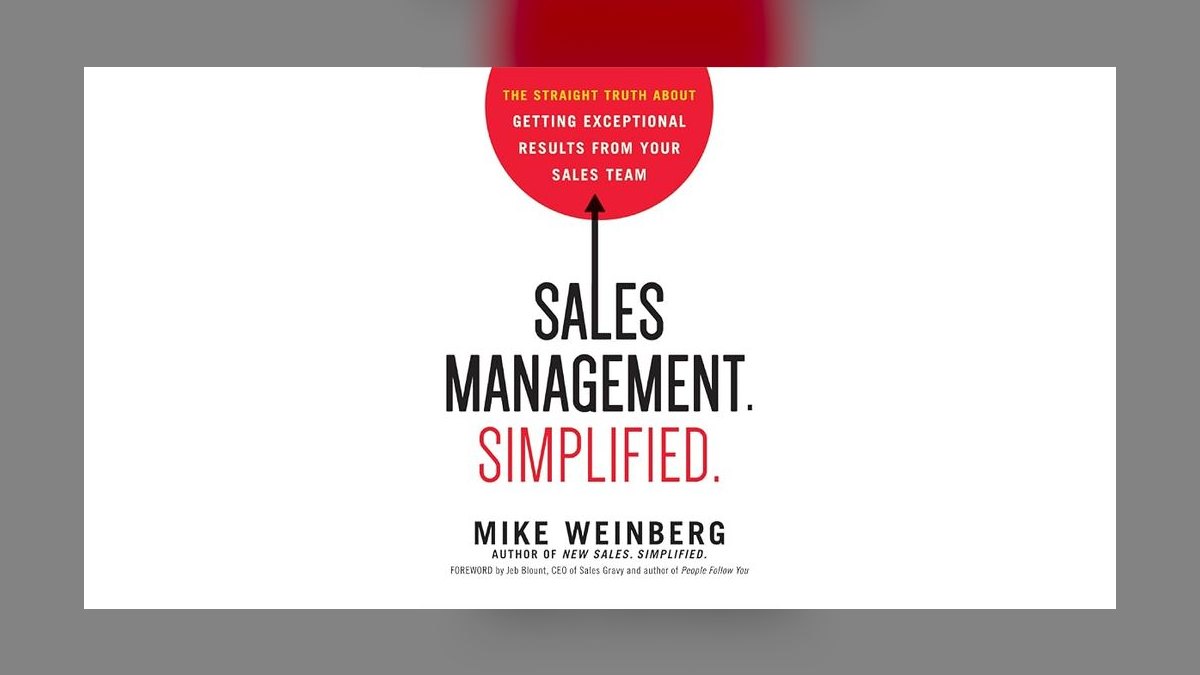
Mike Weinberg's *Sales Management. Simplified.* argues that sales management isn't complicated — it's the discipline that's missing. The top takeaways for sales leaders: promote and train managers deliberately rather than by default, spend the bulk of your week coaching in the field, enforce a disciplined pipeline and forecasting cadence, hold reps accountable to activity and new-business hunting (not just results), and treat every management system as a support for judgment, never a replacement for it.
The two management strategies compared: coach-in-the-field vs. desk-bound oversight
Weinberg's central diagnostic splits sales leaders into two camps, and *Sales Management. Simplified.* spends most of its pages arguing that only one of them actually moves revenue. The first camp is the desk-bound overseer: a manager who spends the majority of the week in CRM dashboards, building slide decks for the VP, running long weekly meetings that recap numbers everyone already saw, and reacting to forecast misses after the quarter is already lost. The second camp is the field coach: a manager who is on calls, in pipeline reviews that actually change deal strategy, doing ride-alongs, and personally modeling the behaviors — prospecting, discovery, closing — that the team is expected to execute. Weinberg's core management strategy recommendation is blunt: most companies default into the first camp because it's what fills a calendar, and it feels like management. It isn't. It's administration wearing management's clothes.
The distinction matters because these two modes produce entirely different outcomes with the same headcount. A desk-bound manager finds out a deal is dying in week eleven of a twelve-week sales cycle, from a stale CRM stage update. A field-engaged manager finds out in week three, in a live pipeline review, because they asked the rep to walk through the actual next step and heard hesitation. The book's argument isn't that reporting and CRM hygiene don't matter — it's that they are necessary but insufficient, and leaders who stop at "the numbers look fine in the system" have confused activity tracking with management. Sales Management, done right, is proactive causation of results; done wrong, it's after-the-fact narration of results that already happened.
Weinberg also draws a strategy line between managing "the business" and managing "the people who run the business." A common failure mode among newly promoted managers — frequently promoted because they were the top individual producer — is that they keep doing their own selling work instead of multiplying the output of the team. That's the second version of the desk-bound trap: not sitting behind reports, but sitting on your own quota, personally closing deals while the team gets coached in fifteen-minute leftovers. The book's position is that a sales manager's job changed the day they got the title — their unit of output is no longer their own bookings, it's the bookings of everyone reporting to them, and any strategy that doesn't reflect that shift is management theater.
How to decide between coaching-first and reporting-first management
Deciding which mode to run in isn't really optional in Weinberg's framework — coaching-first is the answer — but sales leaders still have to decide how to allocate a finite week, and that's where most sincere managers get it wrong by accident rather than by choice. The decision tree below reflects the diagnostic questions the book pushes leaders to ask before defaulting to whatever fills the calendar first.

The test Weinberg applies repeatedly is simple: does this task make a rep better at selling, or does it make the manager feel busy? Pipeline reviews pass the test only if they're diagnostic — probing the real next step, the economic buyer, the compelling event — rather than a recitation of stage names and close dates already visible in the CRM. Hiring decisions pass the test because a bad hire costs a manager a full selling cycle of lost capacity on that territory. Building yet another internal report, by contrast, almost always fails it, because it consumes hours a manager could have spent in the field and produces a document that rarely changes a single rep's behavior.
Leaders should also decide based on team composition. A team of seasoned, self-sufficient hunters needs less individual call coaching and more strategic account and territory planning; a team heavy with new or underperforming reps needs the manager physically present on more calls, more often, because the gap between what a rep believes they're doing and what they're actually doing is largest early in a rep's tenure. Weinberg's guidance is to weight field time toward the middle and bottom of the team, not the top — top performers are already generating results and need recognition and stretch goals more than remediation, while the average and struggling reps are where a manager's marginal hour returns the most in Sales Management terms.
Concrete numbers behind each management strategy
Numbers turn this from philosophy into a schedule. While Weinberg doesn't prescribe a rigid formula, the practical guidance that flows from *Sales Management. Simplified.* — and the way sales leaders who've implemented it typically operationalize the book — clusters around a few concrete ranges worth planning against:

- Field and coaching time: aim for roughly 40-60% of a front-line sales manager's week in direct coaching activity — live calls, ride-alongs, deal-specific pipeline reviews — versus internal meetings and reporting. Managers who fall below 25-30% field time tend to drift into the desk-bound pattern the book warns against.
- 1:1 cadence: weekly individual meetings per rep, 30-45 minutes, focused on two or three specific deals or skill gaps rather than a full pipeline scroll. Monthly or biweekly 1:1s are too infrequent to catch a stalling deal before it's unrecoverable.
- Pipeline review frequency: weekly at the deal level for reps carrying fewer than 15-20 open opportunities; the review should touch every deal expected to close in the current and next quarter, not a sampled subset.
- New-business allocation: Weinberg is emphatic that too many "sales" teams are really account management teams wearing a sales title — he pushes leaders to track and require a specific percentage of pipeline, often 30-50% depending on the business model, sourced from net-new logos rather than existing-account expansion ("farming").
- Ramp and onboarding: expect 3-6 months before a new rep is contributing at a normalized quota level in most B2B contexts; managers who don't budget field time against this ramp window are effectively setting new hires up to fail quietly.
- Span of control: the book's implicit ceiling is that a front-line manager coaching properly — meaning actually in deals, not just reviewing reports — can effectively manage roughly 6-8 reps before coaching quality degrades; span of control much above that converts a coach back into an administrator by necessity, since there simply isn't enough week left.
None of these are laboratory-verified constants — they're practitioner ranges that map directly onto the book's strategy argument: time is the scarcest resource a sales manager has, and every one of these numbers is really a rationing decision about where that time goes.
Implementation details and sequencing for rolling this out

Rolling this out is where most Sales Management, Simplified.-inspired change efforts stall, because leaders try to change everything — coaching cadence, CRM discipline, hiring bar, forecast rigor — in the same week, and the team (and the manager) burns out on new process before any of it becomes habit. The sequencing below reflects the order Weinberg's framework implies: fix the manager's calendar first, because nothing else works until the manager is actually present; then fix the diagnostic tools (pipeline and forecast discipline); then fix the inputs (hiring and activity standards).
Phase 1 — reclaim the calendar (weeks 1-2). Audit where the manager's hours actually go for two full weeks before changing anything. Most managers are shocked at how little time survives contact with internal meetings, ad hoc firefighting, and report-building. Block recurring field time on the calendar as a non-negotiable, protected commitment — treat it the way a rep treats a scheduled customer call, not as a soft "if time allows" placeholder.
Phase 2 — rebuild pipeline and forecast discipline (weeks 2-5). Redefine what belongs in each CRM stage with specific, verifiable exit criteria (not "verbal commitment," but "signed mutual close plan with named economic buyer"). Move the weekly pipeline review from a status recitation to a diagnostic conversation: for each deal expected to close this quarter, the manager should be able to answer who the economic buyer is, what the compelling event is, and what specifically could kill the deal. Anything the manager can't answer is a coaching gap, not a CRM gap.

Phase 3 — raise activity and new-business standards (weeks 4-8). Introduce or re-baseline activity minimums tied to the pipeline math the team actually needs — outbound calls, new logos sourced, discovery meetings booked — and hold 1:1s accountable to those inputs, not just to the output number at the end of the quarter. This is the phase where Weinberg's "hunting versus farming" distinction gets operationalized: if the team's new-business percentage is low, this is where a manager sets an explicit target and coaches against it weekly rather than hoping it self-corrects.
Phase 4 — fix hiring and promotion criteria (ongoing, starting week 6+). Every open req and every future promotion decision should be run through the lens the book insists on: does this candidate have the specific competencies for the seat (hunting instinct for a new-business role, farming discipline for an account-management role, coaching aptitude for a manager role) rather than "they were good at the last job" or "they're the top rep, so they should manage." This phase is slower because hiring cycles are slower, but it's the one that prevents the whole system from eroding again in twelve months.
Phase 5 — institutionalize the weekly cadence (week 8 onward). Lock the rhythm — weekly 1:1s, weekly pipeline reviews, monthly forecast calls with defined accuracy tolerances, quarterly account and territory planning — into a standing operating rhythm that survives personnel changes. The book's implicit warning here is that without institutionalization, every improvement reverts the moment the manager gets busy, a new VP arrives, or the quarter gets stressful — precisely when the discipline is needed most.
Related questions
What is the core message of Sales Management. Simplified.?

That sales management is not complicated, it's just rarely done with real discipline — managers spend too much time on internal administration and not enough coaching reps in the field on actual deals.
Why does Mike Weinberg say most sales managers fail?
Because they were promoted for being top individual producers, not trained to manage, and default to doing their own selling or building reports instead of coaching the team to outperform.
How much time should a sales manager spend in the field?
Roughly 40-60% of the week on direct coaching — live calls, ride-alongs, and deal-level pipeline reviews — versus internal meetings and reporting; less than 25-30% signals a desk-bound pattern.
What does "hunting versus farming" mean in this context?
Hunting is new-business development from net-new logos; farming is expanding existing accounts. Weinberg argues most "sales" teams over-index on farming and need an explicit, coached target for new-business pipeline.
Is CRM discipline part of the framework?
Yes, but as support for judgment, not a replacement for it — stage definitions need verifiable exit criteria, and pipeline reviews should diagnose deal risk, not just recite CRM fields.
FAQ
Who wrote Sales Management. Simplified. and what is it about? Mike Weinberg wrote *Sales Management. Simplified.*, a practitioner-focused book arguing that effective sales leadership comes from disciplined fundamentals — field coaching, pipeline rigor, accountability, and deliberate hiring — rather than complex systems or methodologies.

What is the single biggest takeaway for a new sales manager? Your job changed the moment you got the title: your output is now the team's results, not your own bookings, and that requires spending most of your time coaching reps rather than personally selling or building reports.
How does the book define accountability? Accountability means holding reps to specific activity and pipeline standards — call volume, new-business sourcing, deal-stage criteria — consistently and in real time, rather than only reviewing whether the end-of-quarter number was hit.
Does Sales Management. Simplified. apply outside B2B enterprise sales? The core management strategy — field coaching, weekly cadence, disciplined pipeline reviews, deliberate hiring — generalizes to most quota-carrying sales organizations, though the specific numeric ranges (ramp time, span of control) shift with deal complexity and cycle length.
What's the risk of skipping the sequencing and changing everything at once? Teams and managers burn out on simultaneous process change, nothing becomes habit, and the organization reverts to old patterns within a quarter — sequencing calendar discipline first, then pipeline rigor, then hiring, is what makes the change durable.
How does this framework treat sales technology and enablement tools? As accelerants for a disciplined manager, not substitutes for one — a CRM with clean stage definitions helps a coaching-first manager diagnose deals faster, but it cannot manufacture the judgment or presence that field coaching requires.
Sources
- https://www.amazon.com/Sales-Management-Simplified-Mistakes-Strategies/dp/0814436446
- https://www.goodreads.com/book/show/23281148-sales-management-simplified
- https://newsalescoach.com/
- https://hbr.org/topic/subject/sales
- https://www.forbes.com/sales/
- https://www.gartner.com/en/sales
- https://www.salesforce.com/resources/articles/sales-management/
- https://www.linkedin.com/in/mikeweinberg
Related on PULSE
- How to structure a weekly pipeline review that actually changes deal outcomes
- What separates a hunter from a farmer on a sales team
- How long should new sales rep ramp time take before hitting quota
- What's the right span of control for a front-line sales manager
- How to build a sales forecast leadership can actually trust
- When should a top individual contributor be promoted into sales management
This page will be disappearing soon. Save it to your device for $1 — or read it free while it is here.
@Kory-White- · if Venmo asks, the last 4 of my number are 2012
This page is gone.
This one is off the shelf now. $1 keeps it on your phone for good — the whole page, pictures and diagrams included.
 pulse-recentWhat is the Blue Sheet from Strategic Selling by Miller Heiman and how do you fill it out in 2027?
 pulse-recentHow does *The New Strategic Selling* define the first step in qualifying an opportunity in 2027?
 pulse-recentWhat is the step-by-step process for Strategic Selling by Miller Heiman in 2027?
 book-summaryMajor Account Sales Strategy by Neil Rackham: Summary, Key Lessons, and RevOps Takeaways
 pulse-recentWhat are the concrete steps in Sandler Rule #7 for handling a prospect's budget objection in 2027?
 pulse-recentWhat are the seven concrete steps to implement the Sandler Submarine technique from The Sandler Rules in 2027?
 pulse-recentStrategic Selling by Robert Miller and Stephen Heiman — Top 10 Key Takeaways for Sales Leaders in 2027
 pulse-recent$100M Offers by Alex Hormozi — Top 10 Key Takeaways for Sales Leaders in 2027
 book-summarySales EQ by Jeb Blount — Cliff Notes Summary & Key Takeaways
 book-summaryPitch Anything by Oren Klaff — Cliff Notes Summary & Key Takeaways