


Strategic Selling by Robert Miller and Stephen Heiman — Top 10 Key Takeaways for Sales Leaders in 2027
Quality
Certified
Strategic Selling teaches that complex B2B deals are won by mapping every buying influence — Economic, User, Technical, and Coach — then working each one's win-results until the account is covered. For 2027 sales leaders, the durable takeaways are buyer-role coverage, single-sales-objective discipline, red-flag honesty, and forecasting from verified positions rather than optimism.
The deal that looked safe and wasn't
A mid-market RevOps team runs a $340,000 platform deal into month seven. The champion is enthusiastic, the demo scored well, the technical evaluation passed, and the rep has logged eleven meetings. Forecast category: Commit. Then the deal slips a quarter. Then it slips again. Then it dies with "no decision."
Post-mortem reveals the pattern Robert Miller and Stephen Heiman built their entire method to prevent. The rep had deep coverage of exactly one buying influence — the VP of Operations who owned the pain and loved the product. That person was the User Buyer and, in the rep's mind, the whole account. Nobody had ever met the CFO who released the funds. The security architect who had to sign off appeared once, in a group call, and asked two questions nobody followed up on. The procurement lead surfaced in month six with a vendor-consolidation mandate the rep had never heard of.
Four separate failures, all the same root cause: the rep sold to a person, not to a buying organization. Strategic Selling's central claim is that in any complex sale — defined as one where multiple people must approve — no single individual can say yes alone, but almost any of them can say no. A deal is only as strong as its weakest uncovered role. That asymmetry is why enthusiasm from one contact is nearly worthless as a forecast signal, and why "the champion loves us" is one of the most expensive sentences in pipeline review.
The 2027 version of this failure looks different on the surface. Buying committees have grown; most enterprise software purchases now involve somewhere between six and eleven stakeholders depending on which industry survey you read, and security, privacy, procurement, and finance reviews have hardened into formal gates rather than informal courtesies. AI-assisted research means buyers arrive with opinions already formed, often from sources the seller never touched. Budget scrutiny has pushed more decisions upward, so the Economic Buyer is frequently a level higher than it was five years ago. None of that invalidates the framework. It makes coverage harder to fake and easier to audit — which is exactly the leverage a sales leader wants.
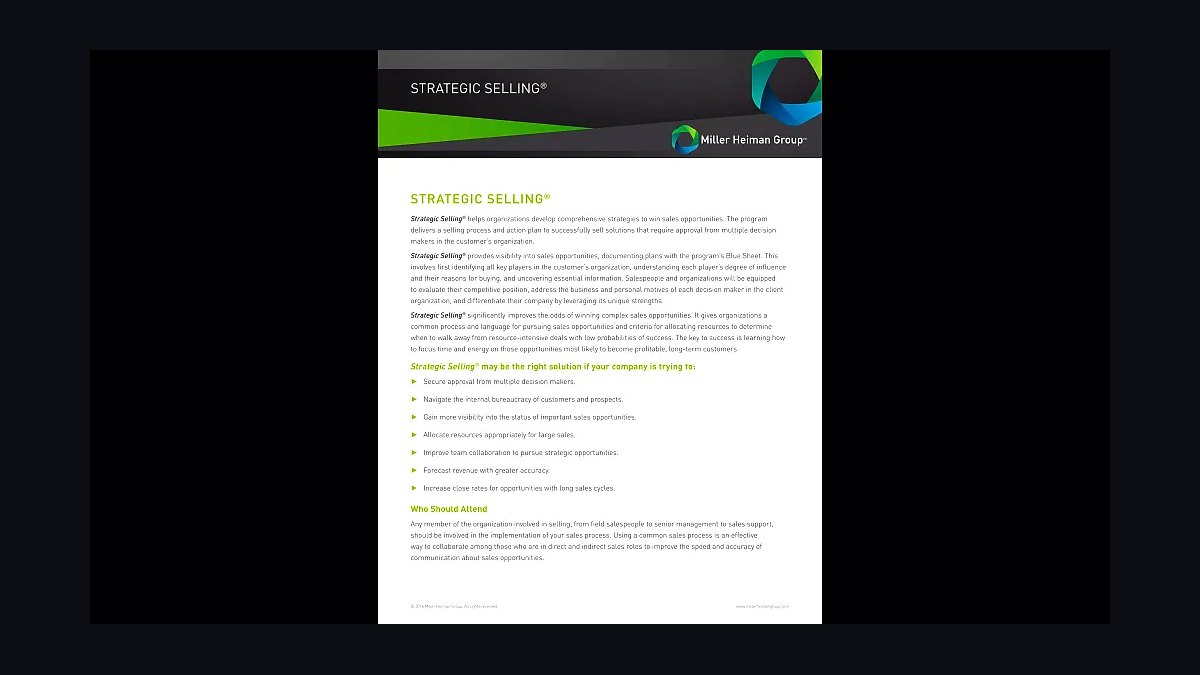
The first takeaway, then, is definitional: stop treating a deal as a relationship and start treating it as a set of positions held with named people. Everything else in the method follows from that shift.
How the four buying influences actually work
Strategic Selling assigns every person touching a deal to one of four roles. The roles are functional, not titular — a single person can hold two, and one role can be held by several people. This distinction is where most implementations go wrong: teams map org charts instead of decision rights.
Economic Buyer. The person who can release the money and say yes when everyone else has said no. There is exactly one per sale. They have veto power, discretionary control over funds, and they care about organizational impact — return, risk, strategic fit. In a $50,000 deal that might be a director; in a $2 million deal it might be a CFO or a business-unit president. The most common diagnostic failure is assuming the Economic Buyer is whoever signs the contract. Signature authority and economic authority routinely sit in different chairs.

User Buyers. The people who will actually use the product and whose performance changes because of it. There are usually several. They judge on whether the thing works in their job — will this make my day better or worse. They cannot approve a purchase, but a unified group of unhappy User Buyers can kill one during rollout or non-renewal.
Technical Buyers. Gatekeepers who screen out. Security, IT, legal, procurement, compliance. They evaluate against specifications and standards, and their job is to say no to anything that fails a criterion. They cannot say yes. In 2027 this role has multiplied — a typical enterprise deal now passes security review, data-privacy review, AI-governance review, and procurement sourcing, each with independent veto.
Coach. The one role you develop rather than find. A Coach gives you information, guides your strategy, and has credibility inside the account. They can be internal to the buyer, internal to your own company, or external. The test is threefold: they must want your solution to win, be trusted by the account, and be willing to tell you the truth about what you don't know.
The operational discipline is to write the names down. Not remember them — write them into the CRM with role, degree of influence, current attitude, and the date the assessment was last verified. A role with no name attached is a red flag by definition. A name with no verified contact in ninety days is a stale position, not a covered one.
Wins, results, and why value propositions fail
Miller and Heiman separate two things most sellers blur together. A Result is the measurable business impact of your solution on a process — cycle time drops eighteen percent, DSO shortens by nine days, ticket deflection rises. Results are objective, corporate, and quantifiable. A Win is the personal payoff an individual gets from that Result — the VP gets a metric they can present at QBR, the ops manager stops working Saturdays, the architect avoids owning another integration.

The framework's claim is that people buy when they get both. A Result without a Win produces polite interest and no urgency. A Win without a Result produces a friendly contact who cannot justify the spend. Every buying influence needs their own Win-Result pair, and the pairs differ by role: the Economic Buyer's Win is usually tied to organizational outcomes and personal credibility; the User Buyer's Win is about daily friction; the Technical Buyer's Win is about not being blamed later.
This is where the method diverges hardest from generic value-proposition selling. A single deck-level value prop is, structurally, a Result statement aimed at nobody. It cannot generate a Win because Wins are personal and must be discovered by asking. The practical move is to run a Win-Results grid: for each named buying influence, one row containing the Result they care about and the Win they personally get. If a cell is empty, that person is not sold — they are merely informed.
The related concept is Mode — how each buying influence perceives the gap between where they are and where they want to be. Growth Mode means they see a gap and want more of something; Trouble Mode means something is broken and urgent. Even Keel means they see no gap and are unlikely to buy at any price. Overconfident means they believe they are ahead of where they actually are — the hardest mode, because reality has to change before they will move. A rep spending months on an Even Keel Economic Buyer is not building a pipeline; they are building a story.
Leaders should audit for Mode explicitly in deal reviews. The question "what mode is the Economic Buyer in, and what evidence do you have" separates deals that are real from deals that are hopeful faster than any other single prompt.
Real numbers, ranges, and what to actually measure

Strategic Selling is a qualitative framework, but it produces measurable operating discipline. The honest benchmarks are the ones you generate from your own data, not the ones a methodology deck asserts. Here is what to instrument.
Coverage ratio. Percentage of open opportunities above a dollar threshold with all four buying-influence roles named in CRM. Teams starting from scratch typically find that the Economic Buyer is named on a minority of deals and actually *met* on far fewer. Set the threshold at your average deal size, not at enterprise deals only. Track the trend monthly; the goal is not one hundred percent overnight but a rising line with no backsliding after quarter-end.
Economic Buyer contact rate. Percentage of Commit-stage deals where a rep has had direct contact with the Economic Buyer in the last thirty days. This is the single highest-signal metric the method produces. If a deal is in Commit and nobody has spoken to the person who releases the money, the forecast category is fiction. Many organizations discover this rate is dramatically lower than reps believe when it is first measured honestly.
Red-flag density. Count of unresolved red flags per open opportunity. Miller and Heiman define red flags as: missing information, uncertain information, an uncontacted buying influence, a buying influence new to their job or to the account, and reorganization inside the account. Deals with zero flags are usually under-inspected rather than clean; a healthy review surfaces one to three flags on most active deals and treats zero as suspicious.
Single Sales Objective clarity. Every opportunity should carry one specific, measurable, time-bound objective — not "win the account" but a defined scope, dollar figure, and date. Audit what percentage of your pipeline has an SSO written in that form. Vague SSOs correlate tightly with slipped close dates, because a deal without a defined finish line cannot have a defensible date.

Ideal Customer Profile fit scoring. The book's later sections push hard on qualifying against an ideal-customer definition built from demographics, psychographics, and past-win patterns. Score each opportunity one to five on fit and track win rate by band. Most teams that do this find a steep cliff — the bottom two bands consume real selling capacity and convert poorly, which is a resource-allocation problem disguised as a skills problem.
Time-to-Economic-Buyer. Days from opportunity creation to first Economic Buyer conversation. Shortening this is one of the few changes that moves cycle time and win rate simultaneously, because it either surfaces a fatal objection early or unlocks the deal.
Set targets from your own baseline. Measure for one full quarter before setting a number, then move the number ten to twenty percent per quarter rather than declaring an aspirational figure nobody hits.
Trade-offs against the alternatives
Strategic Selling is not the only serious framework, and pretending it is costs credibility with experienced reps. The useful leadership skill is knowing what it does and does not cover.
Its strength is account-level and opportunity-level *strategy* — who matters, what they need, where you are exposed. Its weakness is that it says comparatively little about the tactical mechanics of a single sales call. That gap is why the same authors produced a companion body of work on call execution, and why many organizations pair a strategic framework with a call-level one.
Against a qualification checklist approach — the BANT/MEDDIC family — the difference is orientation. Checklists are seller-centric inventories of what you need to know to forecast. Strategic Selling is buyer-centric: it organizes around what each person in the account needs to get. MEDDIC's economic-buyer and champion elements overlap heavily with this method's Economic Buyer and Coach, which is why the two coexist well; MEDDIC adds decision-criteria and paper-process rigor that Strategic Selling treats more loosely.
Against SPIN-style questioning, there is no real conflict — one is a call technique for developing need, the other is an account map. Teams that treat them as competitors usually have a training-vendor problem, not a methodology problem.
Against Challenger-style commercial teaching, the tension is real. Challenger emphasizes reframing the buyer's thinking and pushing constructive tension; Strategic Selling emphasizes finding and serving each influence's Win. A leader can run both, but the sequencing matters: teach the account map first so the reframe lands on the right person. A commercial insight delivered to a User Buyer who cannot fund anything is theater.
The honest trade-off of adopting this method is time. Building and maintaining a real buying-influence map on every opportunity is administrative work reps will resist, and the resistance is not irrational — badly implemented, it becomes CRM theater where fields get filled with guesses to clear a manager's dashboard. The countermeasure is to make the map the *agenda* of the deal review rather than a separate compliance artifact. If the only conversation a rep has about coverage happens because a field is red, the field will be filled with fiction.
The other trade-off is deal-size fit. Below a certain complexity threshold — transactional sales, one decision maker, short cycles — the overhead outweighs the return. Applying full account planning to a self-serve renewal is not rigor, it is waste. Set a dollar or stakeholder-count floor and be explicit that deals below it run lighter.
Where implementations go wrong
Mistaking the Coach for the champion, and the champion for the Economic Buyer. The most frequent failure. A Coach's defining property is that they tell you what you don't know — including things you don't want to hear. Someone who only agrees with you is a fan, not a Coach. Test the relationship by asking a question whose honest answer would be uncomfortable: who else is being evaluated, what would kill this internally, who is against us. If you never get an uncomfortable answer, you do not have a Coach.
Treating role assignment as a one-time exercise. Buying committees churn. A reorganization, a new hire, or a budget-owner change resets the map. The book's own red-flag list explicitly includes "buying influence is new to the job" precisely because a new person has no history with you and must be sold from zero. Re-verify roles at every stage gate, not at deal creation.
Confusing activity with coverage. Eleven meetings with one person is one covered position, not eleven. Leaders should audit unique-contacts-per-deal alongside meeting count. A rising meeting count with a flat contact count is a rep going deeper into comfort.
Filling in the map from inference. A role assignment based on a title from a corporate website is a hypothesis, not a fact. Positions should be marked verified only when confirmed by the person themselves or by a Coach. Distinguish these states in your CRM — assumed versus verified — or the coverage metric becomes noise.
Using red flags as punishment. If surfacing a red flag gets a rep grilled, reps stop surfacing red flags. The method depends on honest self-assessment, which only survives in a review culture where naming a gap is rewarded. The manager's line should be "good catch — what's the action?" not "why is this still open?"
Skipping the Single Sales Objective. Without one specific, measurable objective per opportunity, the buying-influence map has no anchor — you cannot say who must approve *what*. Vague objectives produce vague maps.
Applying strengths as if they were positions. Strengths — a great reference, a technical advantage — are assets, not coverage. A strong reference does not cover an uncontacted Technical Buyer. Leaders should push back whenever a rep answers a coverage question with a strength.
Letting the map live outside the workflow. If buying-influence data sits in a slide deck rebuilt quarterly, it is dead. It has to live in the opportunity record, surface in the forecast view, and drive the review agenda. Anything else decays within two quarters.
Related questions
Can one person hold two buying-influence roles?
Yes, frequently. A director may be both Economic Buyer and User Buyer in a smaller purchase. Map the roles separately even when the name repeats, because the person's criteria differ by role — their funding concerns and their daily-use concerns need distinct answers.
How do you find the Economic Buyer without going over your champion's head?
Ask the champion directly who releases funds at this dollar level and request a joint meeting, framing it as validating business impact rather than escalating. A real Coach will help; resistance to the question is itself diagnostic information about the strength of the position.
Does this framework still apply to product-led or self-serve motions?

Partially. Individual sign-ups need no account map, but expansion from team to enterprise reintroduces Economic and Technical Buyers — usually security and procurement. Apply the mapping at the point where a purchase crosses a budget or compliance threshold, not before.
What is the difference between a red flag and a lost deal?
A red flag is an identified gap with an assigned action and an owner. It signals incomplete information, not failure. Deals with named flags and active countermeasures typically outperform deals reported as clean, because the clean ones are usually just uninspected.
How long does it take to see results after rolling this out?
Expect one quarter of measurement before targets mean anything, and two to three quarters before win-rate movement is distinguishable from normal variance. Coverage and Economic Buyer contact rate move first because they are behavioral; win rate moves last.
FAQ
Who wrote Strategic Selling and when did it appear?
Robert B. Miller and Stephen E. Heiman authored *Strategic Selling*, with Tad Tuleja as a contributing writer, first published in the 1980s and later revised as *The New Strategic Selling*. The method originated at Miller Heiman, the sales-training firm the authors founded, and the intellectual property has since moved through corporate ownership into what is now part of Korn Ferry's sales-methodology portfolio.
What are the four buying influences in one sentence each?
The Economic Buyer releases the money and holds final veto; User Buyers experience daily impact and judge whether it works in their job; Technical Buyers screen against specifications and can only say no; the Coach guides your strategy, tells you the truth, and wants you to win.

What exactly counts as a red flag?
Missing information, uncertain information, an uncontacted buying influence, a buying influence who is new to their role or to the account, and organizational reorganization inside the account. Each flag should carry a named owner and a specific next action, and should be re-reviewed at every stage gate rather than logged and forgotten.
Is a Single Sales Objective the same as an opportunity record?
No. An opportunity is a CRM container; a Single Sales Objective is a written statement of one specific, measurable, time-bound outcome — what is being sold, at what scope, for what amount, by when. One account can carry several sequential Single Sales Objectives, each with its own buying-influence map.
Does Strategic Selling conflict with MEDDIC or Challenger?
Not structurally. MEDDIC adds forecast-qualification rigor around decision criteria and paper process; Challenger adds a commercial-teaching stance for how you engage. Strategic Selling supplies the account map underneath both. The risk is training overload, not doctrinal conflict — pick one primary language for deal reviews and let the others supplement it.
What are the most durable Takeaways for a sales leader adopting this in 2027?
Name every buying influence in the CRM, measure Economic Buyer contact rate on Commit deals, write a real Single Sales Objective per opportunity, treat red flags as currency rather than embarrassment, verify positions instead of inferring them, score fit against an ideal-customer profile, and make the coverage map the deal-review agenda rather than a compliance field.
Sources
- https://www.kornferry.com/capabilities/sales-methodology
- https://hbr.org/2017/03/the-new-sales-imperative
- https://hbr.org/2012/07/the-end-of-solution-sales
- https://www.gartner.com/en/sales/insights/b2b-buying-journey
- https://www.mckinsey.com/capabilities/growth-marketing-and-sales/our-insights
- https://www.salesforce.com/resources/research-reports/state-of-sales/
- https://www.forrester.com/blogs/category/b2b-sales/
- https://openlibrary.org/search?q=the+new+strategic+selling
- https://www.simonandschuster.com/books/The-New-Strategic-Selling/Robert-B-Miller/9780446695190
Related on PULSE
- Mapping buying committees in enterprise deals: a practical CRM schema
- Economic Buyer access: scripts and sequencing that survive a protective champion
- Forecast hygiene — turning red flags into a leading indicator
- MEDDIC versus buyer-role mapping: which language should own your deal reviews
- Building an ideal customer profile from closed-won patterns
- Deal review agendas that surface truth instead of status
This page will be disappearing soon. Save it to your device for $1 — or read it free while it is here.
@Kory-White- · if Venmo asks, the last 4 of my number are 2012
This page is gone.
This one is off the shelf now. $1 keeps it on your phone for good — the whole page, pictures and diagrams included.
 pulse-recentThe Closer’s Survival Guide by Grant Cardone — Top 10 Key Takeaways for Sales Leaders in 2027
 pulse-recentWhat is the first concrete step in The Sandler Rules by David Mattson for building a sales plan in 2027?
 pulse-recentWhat are the concrete steps in Strategic Selling for building a sales plan in 2027?
 pulse-recentStart with No by Jim Camp — Top 10 Key Takeaways for Sales Leaders in 2027
 pulse-recentSandler Rule #1: What is the first concrete step to build a prospect's trust in a sales conversation in 2027?
 pulse-recentHow do you implement the Sandler Rules in your first 30 days as a new sales rep in 2027?
 book-summaryLittle Red Book of Selling by Jeffrey Gitomer — Cliff Notes Summary
 pulse-booksWhat are the most common mistakes in Book Summaries in 2027?
 pulse-recentNever Split the Difference by Chris Voss — Top 10 Key Takeaways for Sales Leaders in 2027
 pulse-recentConceptual Selling by Robert Miller and Stephen Heiman — Top 10 Key Takeaways for Sales Leaders in 2027