


Where to Find Wedding Speech Examples and Templates Online in 2027
Quality
Certified
Wedding speech examples and templates live in four reliable places online: wedding-planning publishers like The Knot, Brides, and Hitched; speechwriting services such as The Speechy or Wedding Speech Coach; free template libraries on Canva, Google Docs, and Etsy; and community threads on Reddit's r/weddingplanning. Adapt structure, never wording.
The 3 a.m. panic that sends everyone searching
Picture a best man three weeks out from the wedding. He has a blank document, a vague memory of a bachelor-party story he cannot legally repeat, and the growing awareness that roughly 130 people will watch him hold a microphone. He types "best man speech examples" into a search bar at 3 a.m. and gets 40 million results, most of which are either aggressive listicles wrapped around affiliate links or one paragraph of advice stapled to a newsletter signup.
This is the actual failure mode, and it is worth naming precisely, because it determines where you should look. The problem is almost never a shortage of examples. The problem is that the examples you find first are optimized for search engines rather than for the specific structural job you need done. A generic "funny best man speech" sample tells you nothing about how to open when the groom's father died last year, or how to handle a second marriage, or how to compress to four minutes because the venue's noise ordinance kicks in at ten.
So the useful mental model is this: you are not shopping for a speech. You are shopping for a *skeleton* — an opening move, a middle that carries one story, a turn toward the couple, and a toast line — plus enough varied examples that you can see the skeleton repeated in different registers and start to internalize it. Once you have that, the writing is a two-hour job, not a three-week anxiety spiral.
A second scenario worth holding in mind, because it changes the search entirely: the mother of the bride who has never spoken publicly, is not funny, does not want to be funny, and has forty years of feeling about her daughter that she cannot get into words. She does not need a template. She needs three or four examples of *sincere* speeches so she can hear what earnest sounds like when it is written down rather than felt. Those live in different corners of the internet than the roast material, and the sites that serve one audience well often serve the other poorly.
The third scenario: the couple writing their own joint thank-you speech, which is now more common than it was a decade ago and is under-served by most template libraries because most libraries were built around the traditional father-of-the-bride / best man / maid-of-honor triad. If you are in this bucket, expect to do more adaptation and less copying.
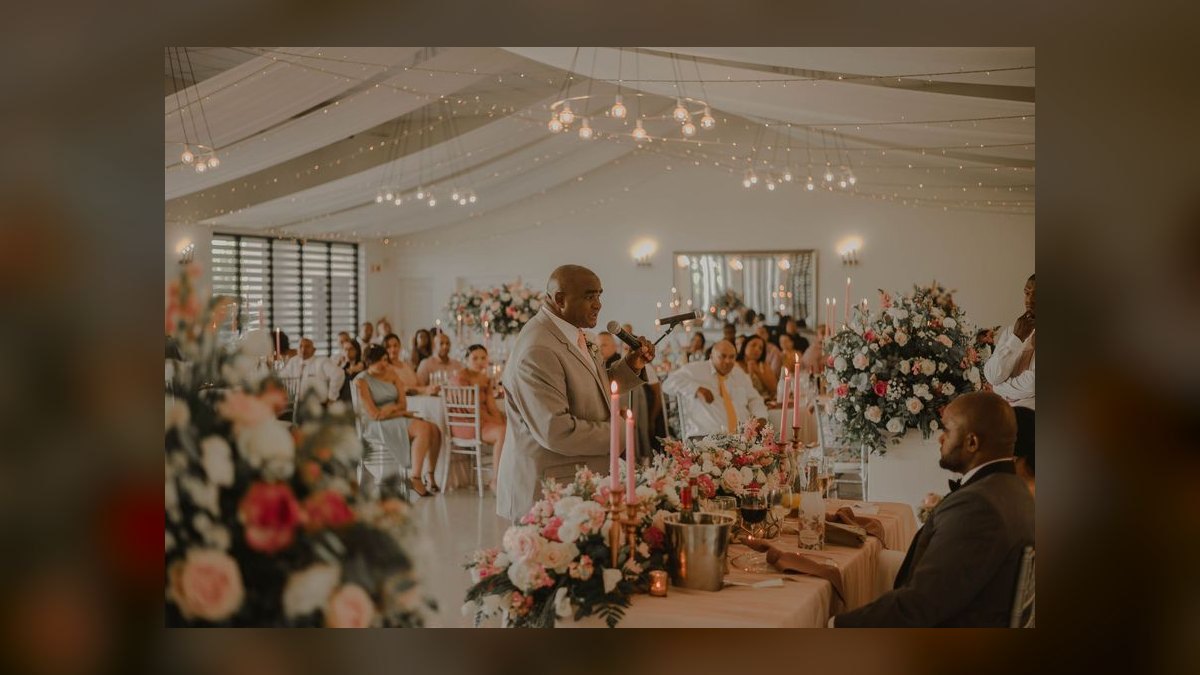
Where the examples actually live, tier by tier
Here is the honest map of the online landscape, organized by what each tier is actually good for rather than by who ranks highest.
Tier one — the major wedding publishers. The Knot, Brides, Martha Stewart Weddings, Hitched (UK), Confetti (Ireland), and Easy Weddings (Australia) all maintain large, free, editorially reviewed speech sections. These are your best starting point for *breadth*. The Knot in particular maintains separate example sets by role — maid of honor, best man, father of the bride, mother of the groom, officiant — and the pieces are usually written by staff editors rather than spun by content farms. Brides tends toward more polished, magazine-register examples. Hitched skews British, which matters more than you'd think: British wedding speech convention front-loads self-deprecation and runs longer, while American convention is shorter and more sentimental.
Strengths: free, plentiful, decently written, organized by role. Weaknesses: heavily generic, written for the median wedding, and almost never address edge cases like blended families, deceased parents, or cultural traditions outside the Western default.
Tier two — dedicated speechwriting sites and coaches. There is a small professional industry of wedding speechwriters, and most of them publish sample work as marketing. The Speechy is one of the better-known UK operations and posts full sample speeches alongside structural breakdowns. Independent coaches and Toastmasters-adjacent writers publish similar material on personal sites and Substack newsletters. These samples are usually stronger writing than the publisher tier, because they're a sales pitch — the writer is showing you their best work.
The trade-off is quantity. You might find eight excellent examples instead of eighty mediocre ones. For most people that's the better deal. Read three good speeches carefully and you'll learn more than skimming thirty bad ones.
Tier three — free design and document template libraries. Canva has a wedding speech template category with fill-in-the-blank structures laid out visually. Google Docs template gallery has generic speech outlines you can repurpose. Microsoft Create (the successor to the old Office Templates site) carries similar material. These are genuinely useful for one specific thing: giving you a *container*. The prompts — "open with how you know the couple," "insert one story here," "transition to the partner" — do real cognitive work when you're staring at a blank page.
They will not give you good prose. They will give you scaffolding. That's fine; scaffolding is what most people are missing.
Tier four — marketplaces. Etsy has a surprisingly deep wedding speech template market, typically sold as editable Word or Google Docs files. Prices cluster in the low single-digit dollars to about twenty dollars. Quality is wildly variable and you cannot preview the full product before buying. The good listings are usually from sellers who also sell wedding stationery and have hundreds of reviews. The bad ones are AI-spun filler. Read reviews with skepticism — template shops accumulate five-star reviews from people who bought and never used the file.
Tier five — communities and video. Reddit's r/weddingplanning and r/wedding threads regularly contain people posting their full drafts for feedback, which means you get to see real speeches from real weddings rather than editorial fiction. Search the subreddit for "speech draft" and sort by top. YouTube is the other underrated resource — watching a delivered speech teaches you pacing, pause, and where laughs actually land, which no written template conveys. Search for the role plus "wedding speech" and watch three. You will immediately notice that the ones that work are shorter than you expected.
Tier six — AI drafting tools. Every general-purpose assistant will produce a competent wedding speech draft from a prompt containing names, how you met, two anecdotes, and a tone instruction. This is now the fastest path to a first draft. The caveat is real and worth stating plainly: an unedited AI speech reads like an unedited AI speech, and wedding guests — a room of adults who have heard many speeches — notice. Use it for structure and momentum, then rewrite every sentence in your own voice with your own specifics.
What every good template is actually doing under the hood
Strip the decoration off any competent wedding speech and you find the same five-beat structure. Understanding this is what lets you use a template from a UK site for an American wedding, or a best man template for a maid of honor speech, without it feeling borrowed.
Beat one: establish standing. Who are you and why are you holding the microphone. This should take one or two sentences. "For those who don't know me, I'm Dan, and I've been Michael's best friend since we were eleven and he convinced me the school roof was climbable." The common template failure is spending thirty seconds on this. Don't. The room knows there's a reason you're up there.
Beat two: one story, told properly. Singular. One. The single most reliable difference between a speech that works and one that dies is that the good speech tells one story with real detail and the bad speech lists six anecdotes at high altitude. A story needs a setup, a specific moment, and a turn — and the turn is what connects it to who the person is. The reason it was funny that Michael climbed the roof is the same reason he's the person who drove four hours in a snowstorm when your car broke down.
Beat three: the pivot to the partner. This is where amateur speeches collapse, because the speaker has spent four minutes on their friend and then bolts on twenty seconds about the spouse. The pivot should be structural, not appended: the story you told about your friend should set up an observation about how they changed, and the partner is the reason. Every good template marks this beat explicitly. Many free examples skip it.
Beat four: direct address to the couple. Turn your body toward them. Say something true and unhedged. This is the only place in the speech where sincerity should be unprotected by a joke. Most people flinch here and undercut it. Don't.
Beat five: the toast. Short. Instruct the room clearly — "please raise your glasses" — pause for the shuffle, then deliver the line and drink. The most common technical error at real weddings is a speaker who says the toast line before the room has lifted its glasses, which produces a limp, uncoordinated murmur instead of a moment.
Templates that give you these five beats with prompts under each are worth using. Templates that give you a full-paragraph script to fill names into are worth reading once and then closing, because the resulting speech will sound like a form letter delivered by a person who does not know the couple.
Adjacent note that's worth the detour: this same five-beat frame transfers to retirement dinners, milestone birthdays, eulogies (with beat two carrying more weight and beat five replaced by a closing image rather than a toast), and corporate award presentations. If you learn it once for a wedding, you own it for the rest of your life's speaking obligations.
Real numbers: length, timing, cost, and how long this takes
Concrete ranges, because vague advice is what makes people overwrite.
Length. The workable range for a single wedding speech is three to five minutes. That's roughly 400 to 700 spoken words, because speaking pace under adrenaline runs around 130 to 150 words per minute — slower than conversational pace, and slower still if you're pausing for laughs. A 1,000-word speech is seven-plus minutes and is too long unless you are unusually good. The most common overrun cause is writing to a word count that felt short on the page.
Total speaking block. If a wedding has four speakers, the combined block runs 15 to 25 minutes, which is about the ceiling before a seated room's attention visibly degrades. If you're the fourth speaker, cut. Ruthlessly. Nobody has ever complained that the last speech was too short.
Number of stories. One, ideally. Two if they're both under 45 seconds and connect. Never three.
Cost of paid options. Etsy templates: roughly a few dollars up to about twenty. Professional wedding speechwriting services: this is a real market with wide spread, typically running from low hundreds into the high hundreds of dollars depending on whether you're buying a full ghostwritten speech or an editing pass on your draft. Check current pricing on any specific service's site rather than trusting a number you read in an article — this market's pricing moves.
Time budget. Realistically: 30 minutes gathering examples and picking a structure, 60 to 90 minutes on a first draft, then — and this is the part people skip — three separate read-aloud passes on different days. The read-aloud is not optional. Sentences that scan fine on a screen fall apart in the mouth. Anything you stumble over twice gets cut or rewritten.
Rehearsal count. Five to eight full out-loud run-throughs is the range where most people stop needing to read every word and can look up. Under three and you'll be head-down in the paper. Over fifteen and it starts sounding recited.
Notes format. Printed, size 14 or larger, double-spaced, one side only, in a folder or on cards — not on a phone. Phones dim, get calls, and read as informal. Print two copies and hand one to someone at the head table, because the single most common speech disaster is a misplaced piece of paper.
Timing within the reception. Speeches most often run either between courses or immediately after the main course. The practical constraint: don't speak while people are actively being served, and don't wait until after the bar has been open for three hours.
Paid versus free versus AI: choosing your path
There are three real paths and they suit different people. Be honest about which one you are.
Free examples plus your own writing. Best for: people who write reasonably well and just need a structure and some confidence. Cost: zero. Time: two to four hours across a week. This is the right answer for the large majority. The internet's free wedding speech material is genuinely sufficient if you read three or four good examples rather than skimming twenty bad ones.
Paid template or speechwriting service. Best for: people who are genuinely stuck, people with complicated circumstances (blended families, recent loss, cultural blending, a wedding in a language you don't speak natively), or people whose time is worth more than the fee. A good speechwriter's value isn't prose — it's interviewing you and finding the story you didn't realize was the story. That interview is the product. If a service doesn't interview you, you're buying a template at a premium.
AI-assisted drafting. Best for: getting past a blank page fast, and for restructuring a draft you already have but that's in the wrong order. It's also unusually good at the mechanical task of cutting — paste a 900-word draft and ask for a 550-word version that keeps one story, and it will do that well.
Where AI is weak: specificity and voice. It will write "you've always been there for me" instead of "you drove four hours in a snowstorm." It will produce jokes that have the shape of jokes without the payload. And it defaults to a slightly elevated register that sounds nothing like how you talk. The workflow that actually works is: dump your raw material into a prompt, get a structural draft, then rewrite every sentence, keeping only the skeleton.
A hybrid worth mentioning: use free examples for tone calibration, an AI tool for a structural first pass, and a friend for the edit. The friend is the underrated component. Someone who knows the couple will immediately flag the story that's funnier to you than to a room.
The pitfalls that ruin otherwise decent speeches
Most wedding speech failures are not writing failures. They're judgment failures, and they're predictable.
Copying an example too closely. The templates you find online have been used by thousands of people. Certain phrases from popular examples have become recognizable — a guest who has been to twenty weddings has heard "when I first met [name], I knew..." many times. Use structure, not sentences.
The story that's about you. The reliable test: if the anecdote's punchline is something *you* did, cut it. Every story in a wedding speech should have the person getting married at its center and should end on something that reveals their character.
Inside jokes. If fewer than 70% of the room can follow it without explanation, cut it. Explaining a joke to 130 people costs you thirty seconds and gets you a polite murmur.
The ex. Never. Not obliquely, not as a joke, not as "well, at least this one's better than —". There is no version of this that works, and it is the single most reliable way to make a room go silent.
Anything about the couple's private life. The bachelor party stays at the bachelor party. Grandparents are present. So, often, are children and colleagues.
Drinking to steady the nerves. One drink is fine. Two is the ceiling. The line between "relaxed" and "the video that gets watched at every future family gathering" is thinner than it feels at the time, and you will not be able to judge which side you're on.
Reading the whole thing head-down. This is the most common real-world failure and it's a rehearsal problem, not a writing problem. Five to eight run-throughs fixes it. You don't need to memorize — you need to know it well enough to look up at the ends of sentences.
Ignoring the room's acoustics. Ask whether there's a microphone. If there isn't, you're projecting to a room with hard surfaces and clinking glassware, which means shorter sentences and more pauses.
Overrunning. Covered above, but it's worth repeating because it's the failure guests actually complain about afterward. Time yourself with a phone timer, out loud, at delivery pace. Add 20% for laughs and pauses.
Not clearing it with anyone. Run the draft past the person getting married or someone close to them, specifically to check for landmines you don't know about — a family estrangement, a health situation, a job loss. Ten minutes of checking prevents the kind of mistake that gets remembered for decades.
The unhandled emotion. Many people cry. That's fine and usually the room likes it. What isn't fine is being unable to continue. The fix is mechanical: put your most emotional line in the middle, not at the end, so if you break down you have recovery runway. And put a glass of water within reach — the pause to drink is a socially acceptable ten seconds to recover.
Related questions
How long should a wedding speech be?
Three to five minutes, which is roughly 400 to 700 words at a nervous speaking pace of 130 to 150 words per minute. If multiple people are speaking, the combined block should stay under 25 minutes. Time yourself out loud rather than trusting the word count.
Is it okay to use a template for a wedding speech?
Yes, for structure. Templates supply the five-beat skeleton — standing, story, pivot, direct address, toast — which is genuinely useful. What fails is copying phrasing. Fill the skeleton entirely with your own specific details and the result reads as original.
Where can I find free wedding speech examples?
The Knot, Brides, and Hitched maintain large free example libraries organized by speaking role. Canva and Google Docs offer free fill-in structures. Reddit's r/weddingplanning has real drafts posted for feedback, which read more honestly than editorial samples.
Should I use AI to write my wedding speech?
Use it for a structural first draft or to cut an overlong one — it's good at both. Then rewrite every sentence in your own voice with your own specific details. Unedited AI prose reads as generic to a room that has heard many speeches.
What should I never say in a wedding speech?
Never mention an ex, never reference the couple's private life, and never tell a story whose punchline is something you did. Skip inside jokes that fewer than 70% of the room will follow, and don't improvise while drunk.
FAQ
Where are the best wedding speech examples online in 2027?
Start with the major wedding publishers — The Knot, Brides, and Hitched all maintain free, editorially reviewed example libraries sorted by speaking role. Then look at professional speechwriters' sample pages, which are fewer but better written since they function as marketing. For realism, search Reddit's r/weddingplanning for posted drafts and watch three delivered speeches on YouTube to calibrate pacing.
What's the difference between a wedding speech example and a template?
An example is a complete speech you read for tone and structure. A template is a fill-in-the-blank container with prompts like "insert one story here." Examples teach you what good sounds like; templates get you past the blank page. Most people benefit from reading three examples first, then working inside a template's structure.
Are paid wedding speech templates worth buying?
Sometimes. Etsy templates in the few-dollars-to-twenty range are essentially formatted outlines — useful if you want a clean, printable structure, but not fundamentally better than free options. A full speechwriting service is worth the money in one specific case: when the writer interviews you properly and finds the story you couldn't see yourself. If there's no interview, you're paying a premium for a template.
How do I adapt a best man template for a maid of honor speech?
Directly — the underlying five beats are identical regardless of role. Establish standing, tell one story, pivot to the partner, address the couple directly, deliver the toast. Role-specific templates differ mainly in default tone (best man templates lean toward humor, maid of honor toward warmth), and you should override that default based on your own personality rather than the role.
How many times should I rehearse before the wedding?
Five to eight full out-loud run-throughs, spread across several days rather than crammed the night before. That range is where most people stop needing to read every word and can make eye contact at sentence ends. Fewer than three and you'll be head-down in your notes; more than fifteen and delivery starts sounding recited.
What if I get emotional and can't finish?
Plan for it. Put your most emotional line in the middle of the speech rather than at the end, so you have recovery runway. Keep water within reach — pausing to drink is a socially acceptable ten-second recovery. Print two copies and give one to someone at the head table. Guests are overwhelmingly forgiving of a speaker who tears up; they're only uncomfortable if it looks like nobody planned for the possibility.
Sources
- https://www.theknot.com/content/wedding-speech-examples
- https://www.brides.com/wedding-toast-examples-5075143
- https://www.hitched.co.uk/wedding-planning/speeches-and-toasts/
- https://www.canva.com/templates/
- https://www.toastmasters.org/resources/public-speaking-tips
- https://www.reddit.com/r/weddingplanning/
- https://www.marthastewart.com/weddings
- https://create.microsoft.com/en-us/templates
- https://www.etsy.com/market/wedding_speech_template
- https://www.easyweddings.com.au/articles/
Related on PULSE
This page will be disappearing soon. Save it to your device for $1 — or read it free while it is here.
@Kory-White- · if Venmo asks, the last 4 of my number are 2012
This page is gone.
This one is off the shelf now. $1 keeps it on your phone for good — the whole page, pictures and diagrams included.
 pulse-speechesA Warm Welcome Speech for a New Employee
 pulse-speechesA Speech for a Product Launch
 pulse-speechesA Speech for a Project Wrap Celebration
 pulse-speechesAbraham Lincoln’s Farewell to Springfield (1861) — Text and Lessons
 pulse-speechesA Wedding Speech for a Same-Sex Wedding
 pulse-recentA Eulogy vs. a Celebration of Life Speech: Which Fits the Occasion Better in 2027
 pulse-speechesA Retirement Roast That Stays Loving
 pulse-recentA Wedding Speech for a Vow Renewal vs. a Wedding Speech for a First Marriage: Which Fits Your Role Better in 2027
 pulse-speechesA Eulogy for a Close Friend vs. a Eulogy for a Family Member: How the Tone Changes in 2027
 pulse-recentHow to Choose a Wedding Speech That Fits Your Relationship in 2027