
What are the best classroom management techniques for a chatty middle school class in 2027
 Curated byKory White · Fractional CRO · Maryland
 PULSEKNOWLEDGE LIBRARY
The most effective classroom management techniques for a chatty middle school class combine structural fixes with relational ones: give students legitimate talk time through structured partner protocols, use silent nonverbal signals instead of verbal corrections, teach and rehearse volume-level expectations explicitly, seat talkers strategically, and enforce consistently with brief private redirects rather than public confrontation.
The seventh-period class that would not stop talking
These approaches are grounded in developmental psychology and evidence-based practices from organizations like the What Works Clearinghouse and the Center on Positive Behavioral Interventions and Supports (PBIS).
Picture the class every middle school teacher recognizes. Seventh period, 2:05 p.m., twenty-nine thirteen-year-olds, the last academic block before dismissal. The bell rings and the room is already at a conversational hum that never really stopped from passing period. You give directions for the warm-up; roughly a third of the room hears them. You repeat the directions. You repeat them again, louder. Four students in the back corner are having a genuinely animated conversation about something that happened at lunch. Two more are narrating your instructions back to each other in a mocking register. By the time you actually start the lesson, eleven minutes of a forty-seven-minute period are gone.
The instinctive read on this scene is that the students are disrespectful and that the fix is stricter consequences. That read is usually wrong, and acting on it usually makes the period worse. Middle school students are in the developmental window where peer relationships become the dominant organizing force in their lives. Talking to peers is not a bug they need to be trained out of — it is the single most compelling activity available to them in a room, competing against a lesson on the distributive property. A management system that treats every utterance as defiance is fighting the developmental stage itself, and the developmental stage wins.
The better read is diagnostic. Chatty classes are almost always telling you something structural. Common causes, in rough order of frequency: there is too much undefined downtime, so students fill silence with talk; the transitions between activities have no procedure, so the twenty seconds between the warm-up and the notes becomes ninety seconds of social time; the work is either too easy or too hard, so students disengage into conversation; the teacher's own talk time is too high, so students have no legitimate outlet and take an illegitimate one; or the expectations were stated once in August and never taught, rehearsed, or reinforced.

Note the pattern: four of those five causes are things the adult controls. That is genuinely good news. It means the highest-leverage moves are not consequence escalation but redesign of the period's architecture. A teacher who cuts dead air, scripts transitions, calibrates task difficulty, reduces lecture blocks to eight-to-ten-minute chunks, and builds in structured talk will usually see off-task talking drop substantially before a single detention is written.
The scenario also illustrates the compounding cost. Eleven minutes lost per period, across 180 school days, is roughly thirty-three hours — about seventeen additional class periods of instruction, gone. In a school system where instructional time is the scarce input and where funding, staffing, and program continuation decisions increasingly hinge on measurable outcomes, that lost time has real institutional consequences. Districts do not typically talk about classroom management in financial terms, but the arithmetic is not subtle: reclaimed instructional minutes are the cheapest available intervention, requiring no new curriculum purchase, no additional staffing, and no software license.
How structured talk actually redirects the chatter
The mechanism that makes the best techniques work is not suppression. It is substitution. Chatty middle schoolers have a genuine drive to talk with peers. If the period offers no legitimate channel for that drive, it leaks out sideways during instruction. If the period offers a legitimate, bounded, frequent channel, the sideways leakage drops sharply because the need is being met on schedule.
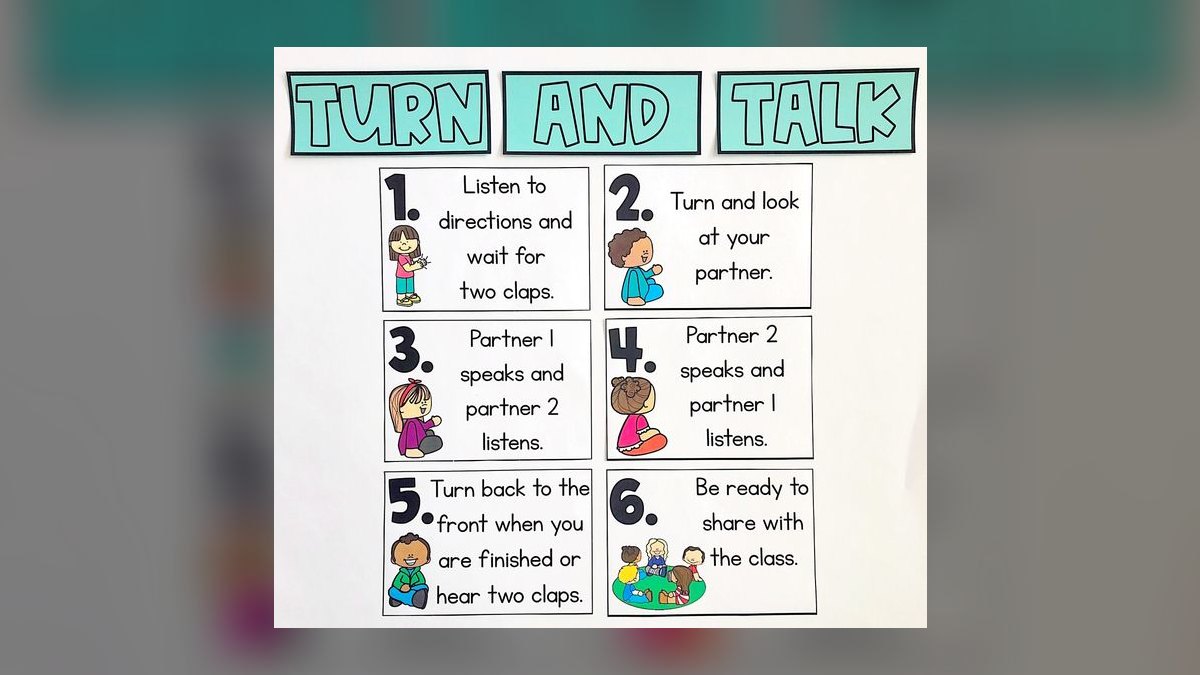
This is why structured partner talk is the single highest-yield technique for a chatty class, and why it feels counterintuitive to teachers who are already drowning in noise. The instinct is that adding talking will make the noise worse. In practice, planned talk displaces unplanned talk, because it satisfies the underlying drive and because it is bounded by a clear signal to stop.

The practical implementation has four parts. First, pre-assign partners so no time is lost to negotiation — a seating chart where every student has a designated A/B partner within arm's reach, refreshed every four to six weeks. Second, give a specific prompt with a specific product: not "discuss this with your partner" but "Partner A, explain to Partner B why the author chose the word 'brittle' — thirty seconds, then switch." Third, set a visible timer. Fourth, use a consistent, rehearsed stop signal and hold silence until the room is fully quiet before continuing.
Frequency matters more than duration. Thirty-second structured talk breaks every eight to ten minutes outperform a single five-minute discussion block, because the drive to talk rebuilds continuously and short frequent releases keep it below the threshold where students take it themselves.
The second mechanism is the nonverbal signal system, and it works through a different pathway: it removes the audience. When a teacher says "Marcus, stop talking" across the room, three things happen simultaneously. The instruction stops for everyone. Marcus receives a public status challenge in front of the peer group whose opinion governs his social standing, which makes compliance costly for him. And the other twenty-eight students receive a demonstration that talking is an effective way to get the teacher's attention.

A nonverbal redirect avoids all three. A hand placed briefly on a desk corner, a pointed look held for two seconds, a tap on the paper the student should be working on, a proximity move where you simply teach from a spot three feet away — each of these communicates the correction while the lesson continues, preserves the student's standing with peers, and gives the rest of the room nothing to watch.
Teach the signal vocabulary explicitly in the first week and re-teach it after every extended break. Students should know that two fingers means volume down, a flat palm means pause, and a tap on the desk means return to the task. Signals that have not been taught read as ambiguous and get ignored.
The third mechanism is the private redirect. When nonverbal fails and something verbal is required, the delivery format determines the outcome more than the words. Kneel or crouch to the student's eye level, keep your voice at a volume only they can hear, state the behavior and the expectation in under ten seconds, name the next step, and walk away immediately without waiting for a response. The walk-away matters: standing there waiting for acknowledgment converts a private redirect into a public standoff, and a thirteen-year-old with an audience will almost always choose the audience.
Real numbers, ranges, and benchmarks for a chatty period
Concrete targets make classroom management diagnosable rather than a matter of feel. These ranges come from widely replicated practitioner benchmarks and are worth measuring directly rather than estimating.

Teacher talk versus student talk. In a typical unmanaged middle school period, teacher talk consumes 70 to 80 percent of the airtime. A well-managed period targets 40 to 50 percent teacher talk, with the remainder split between structured student talk and independent work. Measure this by recording audio of one period and timing it — most teachers overestimate student talk time by a factor of two or more.
Instructional chunk length. Direct instruction blocks for middle school should run eight to twelve minutes before a processing break. Past roughly fifteen minutes, off-task talking rises sharply. A ninety-minute block should contain six to eight distinct activity segments, not two.
Transition time. A well-proceduralized transition between activities takes fifteen to thirty seconds. An unproceduralized one takes sixty to 120 seconds. With eight transitions per period, that difference is six to twelve minutes of instruction per period.
Wait time after the stop signal. Hold silence for three to five seconds after giving the attention signal before speaking. Teachers who begin talking at two seconds train students that the signal does not actually require full compliance, and the signal degrades within about two weeks.

Ratio of positive to corrective interactions. The widely cited practitioner target is four to five positive interactions for every corrective one. In chatty classes the observed ratio is often inverted, running one positive to three or four correctives. Tracking this for a week with tally marks on an index card is one of the highest-information, lowest-cost diagnostics available.
Nonverbal-first success rate. Expect roughly 70 to 80 percent of off-task talking to resolve with proximity or a nonverbal signal alone, once the signal system has been taught and consistently used for three to four weeks. If your rate is far below that, the signals were probably introduced but never rehearsed.
Time-to-quiet. Time how long it takes the room to reach silence after your signal, sampled five times across a week. Under five seconds is strong. Five to fifteen seconds is workable. Over fifteen seconds means the signal needs re-teaching, not louder enforcement.
Escalation frequency. In a functioning system, formal consequences — a logged referral, a parent contact for behavior, a removal — should be rare, on the order of one or two per week across all sections rather than several per period. High escalation frequency is a signal that the preventive layer is failing, not that the consequences are insufficient.

Re-teaching cadence. Expectations degrade predictably. Plan a full re-teach of procedures after every break longer than four days, and a brief refresh roughly every three weeks regardless. Teachers who teach procedures once in August and expect them to hold through April are consistently disappointed.
Seating chart refresh. Every four to six weeks. More often reads as arbitrary and generates resistance; less often lets talk clusters re-form and calcify.
Trade-offs among the available approaches
No single technique dominates. Each carries costs, and the right mix depends on the specific class, the teacher's own style, and how far the period has already deteriorated.
Silent-seatwork suppression — the approach of simply banning talk and enforcing it — produces fast, visible quiet. It is genuinely appealing when a class has gotten out of hand and the teacher needs stability this week. The cost is that it requires continuous enforcement energy, degrades student engagement and the relational climate, and tends to collapse the moment the teacher is absent or the energy runs out. It is a reasonable two-week stabilizer, a poor semester strategy.
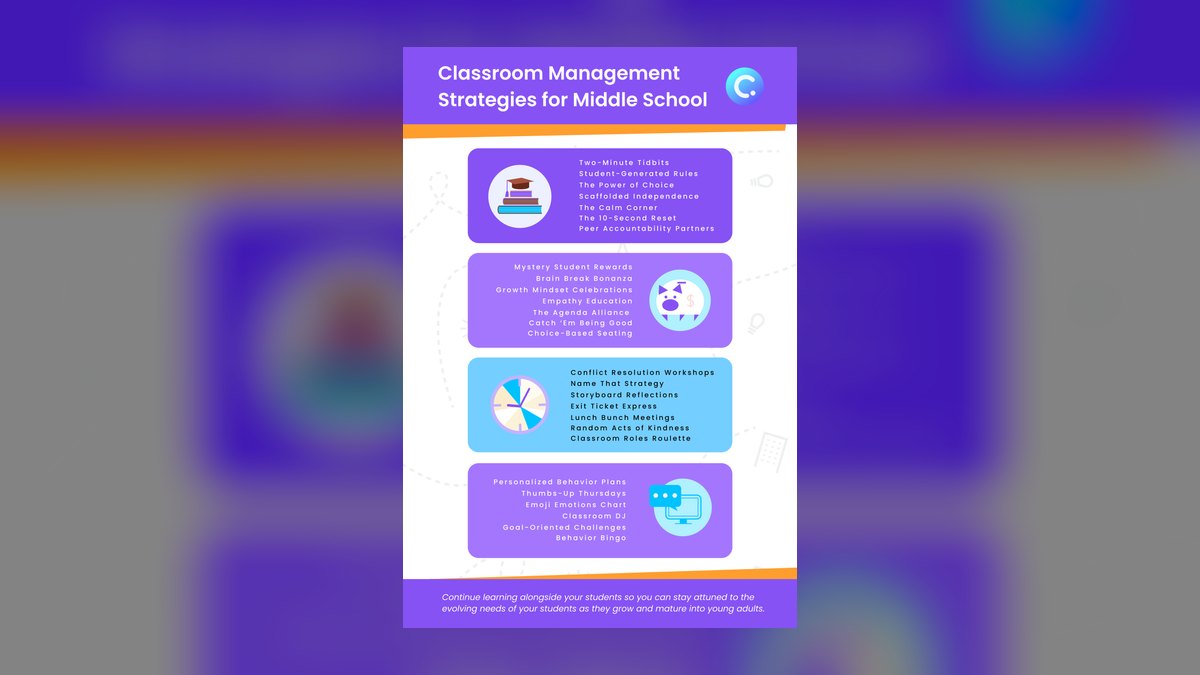
Structured talk substitution takes longer to establish — typically three to four weeks of consistent implementation before the payoff is clear — and the interim can feel noisier. Its advantage is durability: once students internalize that talk time arrives reliably, the illegitimate talk drops without ongoing enforcement pressure. It is the correct default for a class that will be together all year.
Individual point systems and behavior tracking give precise, individualized data and work particularly well for the two or three students driving disproportionate volume. The costs are administrative load, the risk of publicly ranking students in a way that damages standing among peers, and the well-documented tendency for external reward systems to lose potency over time and to undercut intrinsic motivation once withdrawn.
Whole-class group contingencies — the class earns something collectively — build peer accountability efficiently and are cheap to run. The failure mode is real: when one student repeatedly costs the group its reward, that student absorbs peer hostility, which in middle school can be severe and can make the underlying behavior worse.
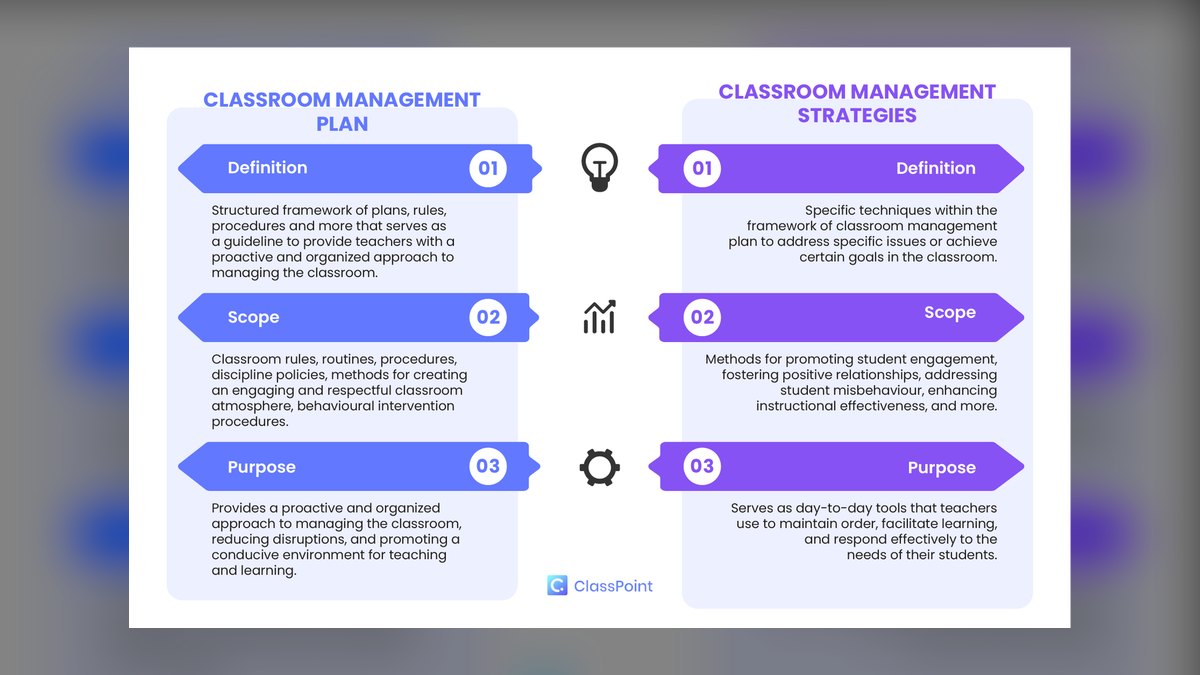
Seating architecture is nearly free, requires no ongoing enforcement, and is often underused. Breaking up talk clusters, placing high-talk students near the front and near the teacher's default path, and pairing chatty students with a focused partner rather than isolating them entirely, all reduce baseline noise. The limits: it does not address the underlying drive, students adapt within weeks, and full isolation of a talkative student typically backfires by removing the social investment that keeps them present.
Relationship investment — two-minute individual conversations, greeting at the door, knowing what students care about outside the room — has the largest long-run effect and the slowest onset. It cannot stabilize a room this week. It is what makes every other technique work by twenty percent more, because a redirect from an adult a student believes is on their side lands differently than the same words from an adult they read as an adversary.
Common pitfalls and how to avoid them
Talking over the noise. The most common error, and it teaches the room that your voice is background audio and that they do not need to stop talking for instruction to proceed. Instead, stop entirely. Give the signal, wait in silence, and resume only at full quiet. The first several times this will feel excruciating and cost thirty to sixty seconds. Within two weeks, time-to-quiet typically drops under five seconds, and you recover the investment many times over.
Escalating volume. A teacher who gets louder as the room gets louder sets the room's volume ceiling. Deliberately dropping your volume works better: students have to quiet down to hear, and it signals control rather than strain.

Inconsistent enforcement. Redirecting a behavior on Monday and ignoring it on Thursday converts your expectations into a gamble, and middle schoolers are excellent at calculating odds. Intermittent enforcement is worse than consistent leniency, because it makes testing rational. If you cannot enforce a rule every time, do not make it a rule.
Public confrontation. Correcting a student in front of peers forces a choice between compliance and social standing. The student is choosing standing. Move it private, brief, and low-volume every time.
Consequence inflation. When behavior does not improve, the instinct is a bigger consequence. Escalation almost never fixes chatter, because chatter is rarely a consequence-severity problem — it is a structure problem. If detentions are not working, more detentions will not work either. Go back to transitions, chunk length, and legitimate talk outlets.
Front-loading rules without rehearsal. Reading a list of expectations on day one is not teaching them. Procedures need modeling, practice, and correction, exactly like academic content. Practice the entry routine three times. Practice the attention signal until time-to-quiet is under five seconds. Practice the transition to group work.
Ignoring the two or three drivers. In most chatty classes, a small number of students set the baseline. Broad whole-class interventions applied to a problem concentrated in three students punish twenty-six students for something they are not doing, which corrodes goodwill. Address the drivers individually — private conversation, family contact framed as partnership rather than complaint, seating change, a specific role that channels their social energy productively.
Removing all talk as punishment. Cancelling group work because the class was loud removes the legitimate outlet and reliably increases illegitimate talk. It is the intervention most likely to make next period worse.
Neglecting the last ten minutes. Off-task talk concentrates at the end of the period, when work is finished and the bell is close. Plan a real closing task — an exit ticket, a partner summary, a preview of tomorrow — that occupies the final five to eight minutes. Dead time at the end undoes a well-run period.
Treating substitutes as someone else's problem. A class that behaves for you and not for a substitute has a system built on your presence rather than on procedures. Write the procedures down, leave them in the sub folder, and have students practice running them with you absent from the front of the room.
Related questions
How long does it take for new classroom management techniques to work?
Expect three to four weeks of consistent implementation before a durable change. Immediate improvements in the first few days are common but usually reflect novelty. The real test is whether the system holds after the novelty fades and through the first extended break.
Should I contact parents about a chatty student?
Yes, but frame it as partnership rather than complaint, and contact early rather than after weeks of accumulation. Lead with something specific and positive about the student, describe the pattern factually, and ask what works at home. First contacts framed as complaints tend to produce defensiveness.
Do seating charts actually reduce talking?
They meaningfully reduce baseline noise by breaking up talk clusters, but the effect decays as students adapt to new neighbors. Refresh every four to six weeks. Seating is a supporting technique, not a solution on its own — it changes opportunity, not the underlying drive.
What if only two or three students are the problem?
Address them individually rather than with whole-class interventions. Whole-class consequences for individual behavior punish the compliant majority and erode the goodwill your system depends on. Use private conversations, targeted seating, family contact, and roles that give their social energy a legitimate outlet.
FAQ
Is a chatty class always a discipline problem?
Usually not. Chatter is more often a structural signal than a defiance signal — it points to undefined downtime, unproceduralized transitions, task difficulty that is mismatched to the students, or an excess of teacher talk with no legitimate outlet for peer interaction. Diagnose the structure before escalating consequences, because escalation applied to a structural problem produces resentment without producing quiet.
What is the single fastest change for a loud period?
Tighten transitions. Most classes lose four to twelve minutes per period in the unstructured seconds between activities, and those seconds are where noise builds and becomes hard to recover from. Script each transition, state the time target, practice it three times, and time it. This is the change that produces visible improvement fastest and requires no new materials.
Does rewarding quiet behavior work in middle school?
Tangible rewards work in the short term and lose potency quickly, and withdrawal can leave motivation lower than it started. Specific behavioral praise — naming exactly what a student did, privately or to the group without singling anyone out for scrutiny — holds up better. Whole-class contingencies work reasonably well but carry the risk of directing peer hostility at whichever student costs the group its reward.
How do I handle a class that talks over me specifically?
Stop talking entirely and wait. Talking over noise trains the room to treat your voice as optional background. Give the attention signal, hold silence for three to five seconds, and resume only when the room is fully quiet. Pair this with dropping your volume rather than raising it. Time-to-quiet should fall under five seconds within about two weeks of consistent practice.
Do these techniques change with newer technology in the room?
The underlying developmental drivers do not change, so the core techniques hold. Devices add a specific complication: they create a silent form of off-task behavior that looks like compliance. Add explicit device-state procedures — screens down, lids at forty-five degrees, devices face-down on the corner of the desk — so the expected state is visible from the front of the room at a glance.
How do I recover a class that has already gotten out of control mid-year?
Reset explicitly rather than gradually. Name it directly: the current system is not working and here is the new one, starting Monday. Re-teach every procedure from scratch as if it were the first week, and expect the reset to be tested hard for about two weeks. Pair the reset with individual conversations with the two or three students setting the baseline, because a whole-class reset rarely holds without addressing them directly.
Sources
- https://ies.ed.gov/ncee/wwc/ — What Works Clearinghouse, U.S. Department of Education
- https://www.edutopia.org/classroom-management — Edutopia classroom management resources
- https://www.apa.org/education-career/k12/classroom-management — American Psychological Association, classroom management
- https://www.pbis.org/ — Center on Positive Behavioral Interventions and Supports
- https://www.ascd.org/ — ASCD, professional learning for educators
- https://www.amle.org/ — Association for Middle Level Education
- https://www.nea.org/professional-excellence/student-engagement/tools-tips — National Education Association classroom tools
- https://casel.org/ — CASEL, social and emotional learning framework
- https://www.readingrockets.org/classroom/classroom-management — Reading Rockets classroom management
Related on PULSE
- [What are the best methods for providing accommodations during a whole-class assessment in 2027](/knowledge/tr20)
- [How do you structure a math block to include direct instruction, guided practice, and independent work](/knowledge/tr19)
- [What are the best tools for tracking student behavior data without a complicated system in 2027](/knowledge/tr18)
- [How do you design a unit plan that naturally incorporates spiral review](/knowledge/tr17)
@Kory-White- · if Venmo asks, the last 4 of my number are 2012
 pulse-teacher-resourcesWhat are the top 10 concrete steps to create a parent-teacher communication calendar that stays on track in 2027
 pulse-teacher-resourcesWhat are the top 10 concrete steps to create a grading scale that is fair across all assignment types in 2027
 pulse-teacher-resourcesWhat are the top 10 ways to make your lesson plans more engaging for reluctant learners in 2027
 pulse-teacher-resourcesWhat are the top 10 ways to create a differentiated homework policy that respects all learners in 2027
 pulse-teacher-resourcesWhat are the top 10 ways to create a weekly parent communication log that is easy to maintain in 2027
 pulse-teacher-resourcesWhat are the top 10 ways to create a lesson plan that meets 504 plan requirements in 2027
 pulse-teacher-resourcesWhat are the top 10 ways to use formative assessment data to adjust your lesson plan mid-class in 2027
 pulse-teacher-resourcesWhat are the top 10 ways to create a classroom management plan that works for a new teacher in 2027
 pulse-teacher-resourcesWhat are the top 10 concrete steps to create a differentiated lesson plan for mixed-ability classrooms in 2027
 pulse-teacher-resourcesHow do you design a unit plan that naturally incorporates spiral review